
Free Shipping in the USA on nearly all items!
Limited phone hours during the Holidays! Call us: 888-611-9305
Free Shipping in the USA on nearly ALL items! Limited phone hours during the Holidays!

Succulents need different light levels because each species evolved under a distinct native light intensity and developed specific leaf, stem, and pigment adaptations that determine how much light it can use and tolerate. A desert Echeveria and a forest-floor Haworthia are not interchangeable at a south-facing window, and treating them the same is the most common reason succulents fail indoors.
The practical consequences of getting this wrong are immediate and visible:
University of Florida/IFAS recommends objective measurement over visual guessing because rooms that look bright to the human eye are often insufficient for sun-loving species. Photosynthetic measures like PAR (photosynthetically active radiation) and PPFD (photosynthetic photon flux density) give precise readings, but a simple shadow test or a free lux-meter app covers most growers’ needs. LedGrowLightsDepot offers supplemental LED fixtures for situations where natural light falls short.
Different succulents need different light levels because their native habitats shaped distinct physiological tolerances, and matching species to the right intensity prevents etiolation, sunburn, and poor color.
| Point | Details |
|---|---|
| Match species to light category | Low-light types (Haworthia, Gasteria) need bright indirect; high-light types (Echeveria, cacti) need 6+ hours of direct sun. |
| Use objective measurement | The shadow test and a lux app give reliable readings; human eyes consistently misjudge usable light levels. |
| Acclimate before moving plants | Increase exposure over 7–14 days to prevent sunburn when transitioning plants to stronger light. |
| Adjust seasonally | Winter sun is weaker and lower-angled; move plants closer to glass and add supplemental light on a 12–14 hour timer. |
| LedGrowLightsDepot fixtures | Full-spectrum LEDs from ThinkGrow and Grower’s Choice cover setups from single pots to large collections. |
The answer starts in geography. Desert species and shaded-habitat species evolved under radically different light intensities, and those differences are written into their tissue.
Desert and open-habitat origins produce plants built for intensity. Cacti and open-desert Echeveria species grow where the sun is direct, prolonged, and unfiltered. Their leaves are thick, waxy, and often covered in a powdery farina that reflects excess radiation. Many produce anthocyanins, the red and purple pigments that act as a biological sunscreen under high UV loads.
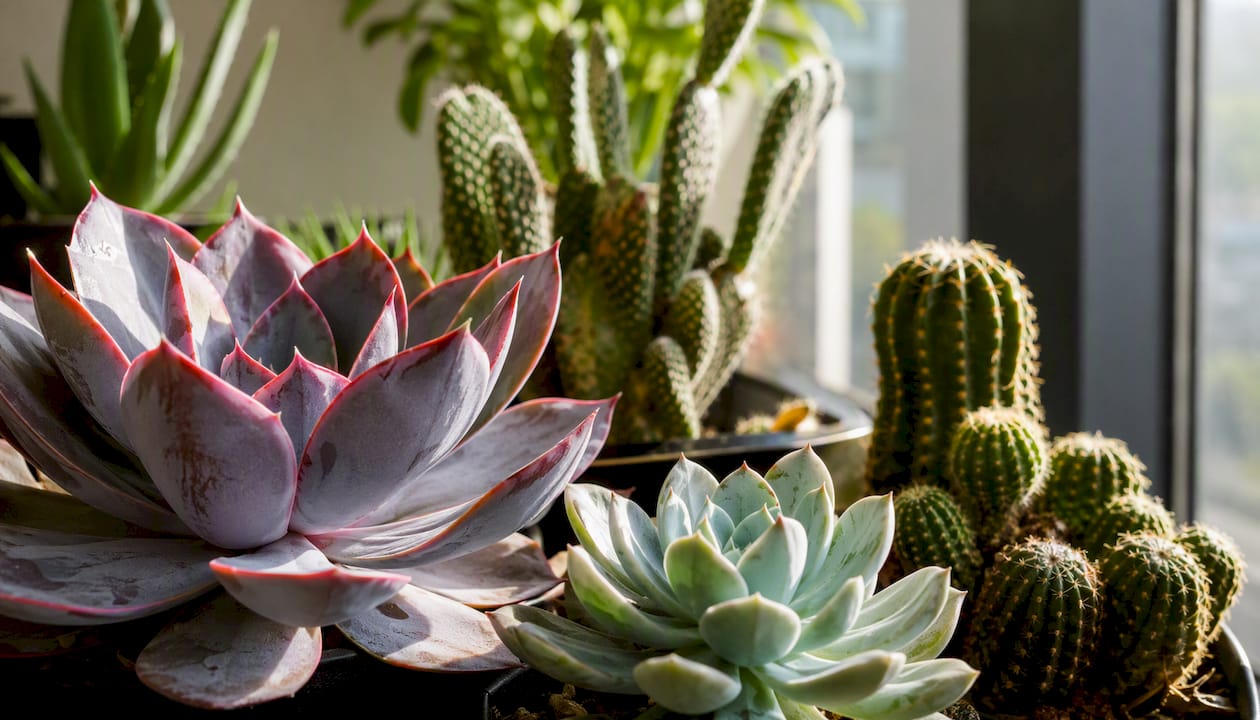
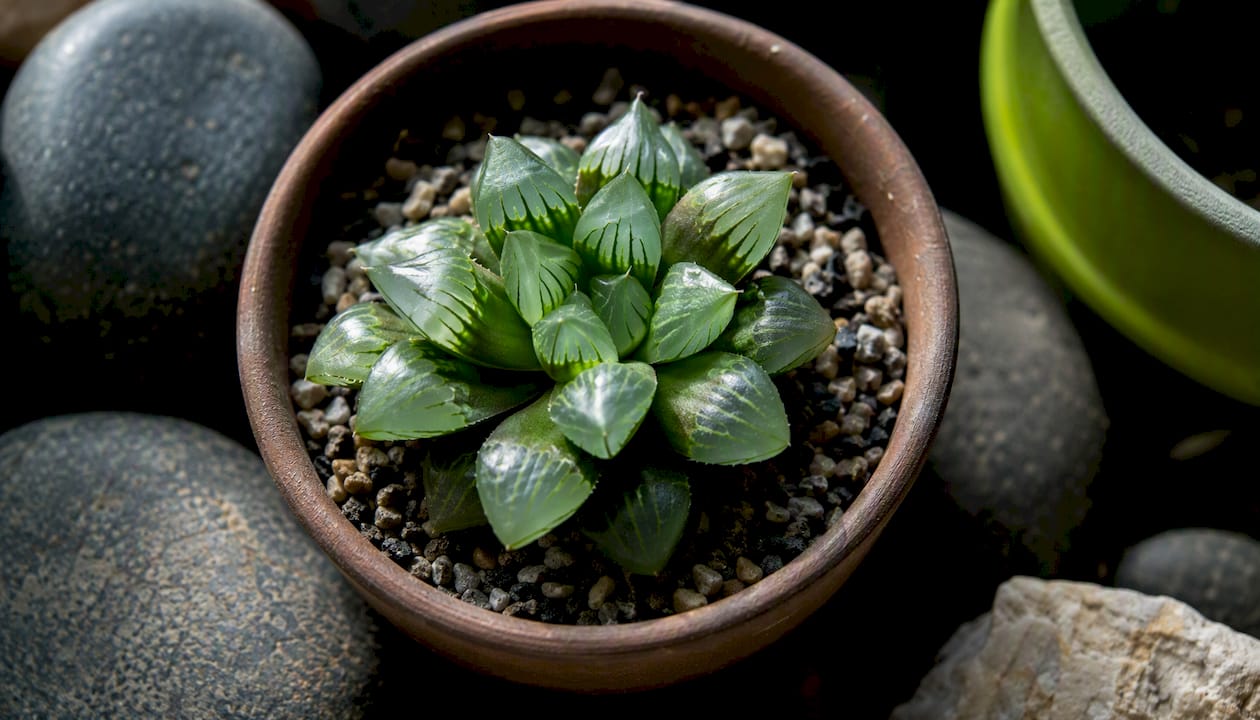
Crevice and alpine origins create a different profile. Haworthia species grow tucked under rocks or in the shade of taller plants in South Africa’s Eastern Cape. Their translucent leaf windows are an adaptation to filter and diffuse intense light rather than absorb it directly. These plants are physiologically limited in how much light they can process before damage occurs.
Forest-floor and epiphytic origins produce the most shade-tolerant succulents. Rhipsalis and similar jungle cacti grow in the canopy understory of tropical forests, where light arrives as dappled, indirect patches. Their flat, strap-like stems maximize surface area for low-intensity capture.
Three concrete examples:
Plant tags use light labels that can mean different things depending on context. For succulents specifically, here is what each label translates to in practice.
Full sun (6+ hours of direct sun): Unobstructed outdoor sun or a south- or west-facing window with no shade. This is the category for most cacti, Echeveria, Sedum, and Aeonium. Most succulents need at least 4–6 hours of bright light daily, and sun-lovers push that to 6 hours or more of direct exposure.
Partial sun/partial shade (3–6 hours of direct or filtered sun): An east-facing window or a spot that gets morning sun and afternoon shade. Suitable for Aloe, Gasteria, and many Crassula varieties.
Bright indirect (no direct sun, but high ambient light): A spot within 1–2 feet of a bright window, shielded from direct rays by a sheer curtain or a wall angle. Haworthia and Sansevieria do well here.
Low light (dim ambient): More than 2–3 feet from a window, or a north-facing room. Very few succulents genuinely thrive here; only the most tolerant Haworthia and Gasteria cope without supplemental lighting.
Morning vs. afternoon sun matters. Morning sun from an east-facing window is cooler and gentler. Afternoon sun from a west-facing window is hotter and more intense, which raises scorch risk for thin-leaved varieties. South-facing windows deliver the longest daily duration and the highest cumulative intensity indoors.
A few practical rules:
Observable symptoms give you a fast diagnosis. The corrective action depends on which direction the problem runs.
Signs of too little light:
Signs of too much light or sudden exposure:
Corrective sequence:
Acclimation warning: Never move a low-light plant directly into bright outdoor sun. Increase exposure over 7–14 days, starting with 1–2 hours of morning sun and adding an hour every 2–3 days.
Pro Tip: A plant that is both pale AND stretching is giving you a double signal: it is not just low on light, it is actively starving for it. That combination calls for an immediate move or a supplemental fixture, not a gradual adjustment.
Knowing a plant’s genus is the fastest shortcut to its light requirement. The lists below cover the most widely grown types.
Low light (bright indirect to dim ambient):
Moderate light (partial sun, 3–6 hours):
High light (full sun, 6+ hours direct):
One note on variegated varieties: a variegated Echeveria or Crassula has less chlorophyll per leaf than its solid-green counterpart and needs more light to compensate. Place variegated plants one step higher in the light category than the standard species recommendation.
For beginner-friendly pairings of plants and fixtures, the easy indoor plants and LED lights guide at LedGrowLightsDepot covers starter setups worth reviewing.
Human eyes are unreliable light meters. A room that looks bright to you may register well below what a sun-loving succulent needs. IFAS extension guidance recommends objective checks for exactly this reason.
Shadow test (no tools needed):
Lux meter or smartphone app:
Free apps like Lux Light Meter (iOS/Android) give a usable reading in seconds. Point the sensor toward the light source and take three readings at different times of day; use the average.
| Light Level | Approximate Lux Range | Foot-Candles | Typical Indoor Placement |
|---|---|---|---|
| Low | Low light | Low light | 3+ feet from window, north-facing room |
| Medium/bright indirect | Bright indirect | Bright indirect | 1–2 feet from a south or east window |
| High/direct sun | Full sun | Full sun | On the sill of a south-facing window, or outdoors |
Pro Tip: Take your lux reading at the same time of day you expect the plant to receive its peak light. A south window at noon in December reads very differently than the same window in July.
Getting the placement right once is not enough. Light levels shift with the seasons, and plants grow toward their source if you do not rotate them.
Acclimation plan for moving plants into stronger light (days 1–14):
Indoor adjustments checklist:
Outdoor adjustments:
Seasonal light changes are significant: winter sun is weaker and arrives at a lower angle, so growers should move plants closer to glass, clean windows to increase transmission, and add supplemental light on a timer when necessary.
Window light alone is often not enough, particularly in winter or in rooms without south-facing exposure. A well-chosen LED fixture closes that gap reliably.
Spectrum: Full-spectrum white LEDs in the 5000K–6500K range are the standard recommendation for succulents. They provide balanced wavelengths across the PAR range, support both vegetative growth and pigment development, and let you see true plant color. Older red/blue “blurple” arrays are less efficient for general succulent growth and make it harder to spot stress symptoms because they distort leaf color.
Photoperiod guidance:
A programmable timer removes the guesswork. Automated photoperiod control, as covered in LedGrowLightsDepot’s lighting controls guide, keeps schedules consistent without daily manual switching.
Distance and placement:
Fixture types:
Watching the same collection through a full calendar year makes one thing clear: the light problem is almost never the fixture or the window orientation. It is the assumption that nothing has changed since last time you checked.
A plant that looked fine in September can be etiolating by November because the sun angle dropped 20 degrees and the daily duration shortened by two hours. Most growers notice the stretch and blame the soil or the watering schedule. The real cause is a light deficit that built up over weeks.
The practical habit that prevents most of these failures is simple: rotate every pot a quarter turn weekly and run the shadow test or a lux app once a month. That combination catches a developing deficit before it becomes irreversible stretched tissue.
When window light falls short, a full-spectrum LED fixture is the most direct fix. LedGrowLightsDepot carries a range of fixtures sized for everything from a single windowsill pot to a large hobby collection.
For small shelves and tight spaces, the ThinkGrow LED Model-I Grow Light and the ThinkGrow LED Model-I Plus Grow Light deliver proximity-capable output with even canopy coverage. The Sunblaster Micro LED Grow Light Garden in white or black fits single-pot setups and narrow sills. For medium to large collections, the Grower’s Choice ROI-E420 covers a consistent 2x2 footprint, while the Grower’s Choice ROI-E720 and ROI-E900 handle larger setups and seasonal deficits. The Grower’s Choice ROI-FF 650W suits high-output commercial-style applications.
When selecting a fixture, check three things:
Browse the full selection at LedGrowLightsDepot to find the right fit for your setup.
0 of 3 items selected


Leave a comment