
Free Shipping in the USA on nearly all items!
Limited phone hours during the Holidays! Call us: 888-611-9305
Free Shipping in the USA on nearly ALL items! Limited phone hours during the Holidays!

Efficacy in LED fixtures measures how much visible light a fixture produces for every watt of electricity it consumes, expressed as lumens per watt (lm/W). The U.S. Department of Energy recognizes this as the standardized metric for comparing LED lighting performance across products and applications. A fixture rated with a certain lm/W value delivers that many lumens of visible light for every watt drawn from the wall. That single number tells you more about real-world energy use than almost any other spec on the label.
Efficiency and efficacy sound interchangeable, but they measure different things. Efficiency compares quantities with the same units, such as optical power output divided by electrical power input, expressed as a percentage. Efficacy mixes units: lumens out divided by watts in.
Think of it this way. A driver that converts 90% of input power to usable output has 90% efficiency. The fixture that driver powers might still only deliver 110 lm/W in efficacy, because lenses, heat, and other losses eat into the final light output.
The formula is straightforward:
Efficacy (lm/W) = Total luminous flux (lm) ÷ Total power input (W)

Luminous flux is the total amount of visible light the fixture emits, measured in lumens. Power input is the actual wattage the fixture draws from the circuit, including the driver.
Step-by-step example:
Real fixture efficacy is always lower than the LED chip’s rated efficacy. Thermal effects, driver losses, and optical inefficiencies can collectively reduce efficacy by more than 30% compared to the bare chip spec. The industry standard for measuring complete LED products is IESNA LM-79, which specifies absolute photometry at 25°C ambient temperature, controlled airflow, and stabilized electrical conditions.
Pro Tip: Always use the delivered lumens figure from LM-79 test data, not the LED chip’s rated lumens. Chip specs reflect a 25°C pulse test, not real operating conditions inside a fixture.
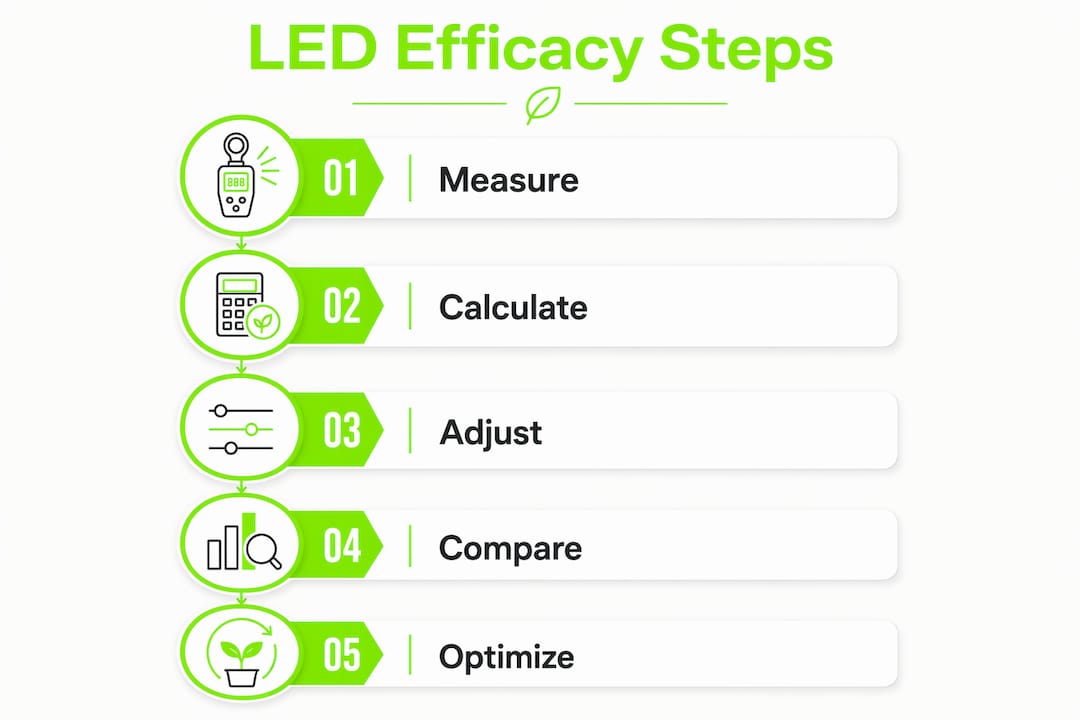
Higher efficacy means your fixture produces more light without drawing more power. For a commercial greenhouse running lights 16 hours a day, the difference between a 90 lm/W fixture and a 130 lm/W fixture adds up to real money on the electricity bill. The LED efficiency advantage over older technologies is not marginal.
Thermal management plays a direct role here. Efficacy decreases roughly 10% as junction temperature rises from 25°C to 85°C. A fixture with poor heat dissipation runs hotter, loses output, and degrades faster. Quality heat sinks or active cooling keep junction temperatures low, preserving both efficacy and fixture lifespan.
Most commercial LED fixtures land between 80 and 130 lm/W at the luminaire level. Architectural recessed fixtures tested to IESNA LM-79 standards, for example, reach 124–131 lm/W in current product lines. Older technologies fall well short of that range.

| Light source | Typical luminaire efficacy |
|---|---|
| Incandescent | 10 lm/W |
| Halogen | 20 lm/W |
| Compact fluorescent (CFL) | — |
| Linear fluorescent | — |
| High-intensity discharge (HID) | 80–130 lm/W |
| LED fixture (commercial) | 124–131 lm/W |
The U.S. Department of Energy has set a target of LED luminaire efficacy exceeding 200 lm/W at the system level. Lab LED packages can already approach or exceed that threshold, but real fixtures lose ground to driver inefficiency, heat, and optics. Protective covers required in humid grow environments, for instance, reduce fixture output by roughly 10% due to optical losses alone.
LED fixture efficacy, measured in lumens per watt, is the single most reliable metric for comparing energy efficiency across lighting technologies and making cost-effective choices.
| Point | Details |
|---|---|
| Efficacy formula | Divide total lumens output by total watts consumed to get lm/W. |
| Efficacy vs. efficiency | Efficacy mixes units (lm/W); efficiency compares same units as a percentage. |
| System losses matter | Thermal, driver, and optical losses can cut chip efficacy by more than 30% at the fixture level. |
| Current benchmarks | Most commercial LED fixtures deliver 124–131 lm/W; the DOE targets exceed 200 lm/W. |
| Thermal impact | Junction temperature rising from 25°C to 85°C reduces efficacy by roughly 10%. |
Growers who want to get the most from every watt should pair high-efficacy fixtures with precise environmental monitoring. The TrolMaster Hydro-X Full Spectrum Quantum Sensor from Ledgrowlightsdepot lets you measure actual photon output at canopy level, so you know exactly how much usable light your plants receive, not just what the spec sheet claims.
0 of 3 items selected


Leave a comment