
Free Shipping in the USA on nearly all items!
Limited phone hours during the Holidays! Call us: 888-611-9305
Free Shipping in the USA on nearly ALL items! Limited phone hours during the Holidays!

UV light can be used during veg, but only as a low-dose supplement added to your main grow light. UVA is the gentler band and the easier place to start. UVB is a powerful signal that can compact growth at small doses and damage leaves at high ones. A purpose-built UV supplemental bar lets you add a small, controlled amount of UV on top of your white or full-spectrum fixture. That is easier to manage than hoping your main light leaks the right amount.
Grow lights are rated on PAR, the photosynthetically active radiation between 400 and 700 nm. Plants use that light to build sugars. UV sits below it. The Project Blue horticultural lighting report splits it into three bands:
| Band | Wavelength | What it means for you |
|---|---|---|
| UVC | 100-280 nm | Not part of a plant-lighting plan |
| UVB | 280-315 nm | Strong signal, narrow safe dose |
| UVA | 315-400 nm | Gentler signal, more forgiving |
| PAR | 400-700 nm | Photosynthesis, what your main light provides |
The same report says UV sits entirely outside the photosynthetic band. A fixture can have an excellent PAR rating and deliver almost no UV.
Most horticultural lamps leave this band mostly empty. Erik Runkle’s 2018 review in Greenhouse Product News puts UV at roughly 1% of output for fluorescent lamps and 3% for metal halide. High-pressure sodium emits a negligible amount. White LEDs add little as well. If you want UV in a measured amount, you add it on purpose.
Veg is when the plant builds its frame: stems, branches and leaves. UV gives you a way to influence that frame without changing your main light.
Research points to these effects:
The UVR8 photoreceptor drives much of this. Project Blue reports it is sensitive to 280-330 nm, with its peak near 290 nm. The report also notes that small amounts of UVB produce large shape changes for very little energy. That is why the dose, not the presence of UV, is what you manage.
UVA is closer to visible light and carries less energy per photon. It is also the band with the clearest growth data in indoor setups.
A 2019 peer-reviewed lettuce study added 365 nm UVA to a base light of 237 μmol m⁻² s⁻¹ on a 16-hour photoperiod. Results by dose:
Leaf area rose 14-32% across the lower doses. Anthocyanin and ascorbic acid content rose too. Anthocyanin is a pigment and ascorbic acid is vitamin C.
The lesson is the shape of the curve, not the lettuce. More UVA was not better. The middle dose did best, and the highest dose gave back some of the gain. Lettuce is not cannabis or tomato, so treat those numbers as a picture of how dose behaves, not as a recipe.
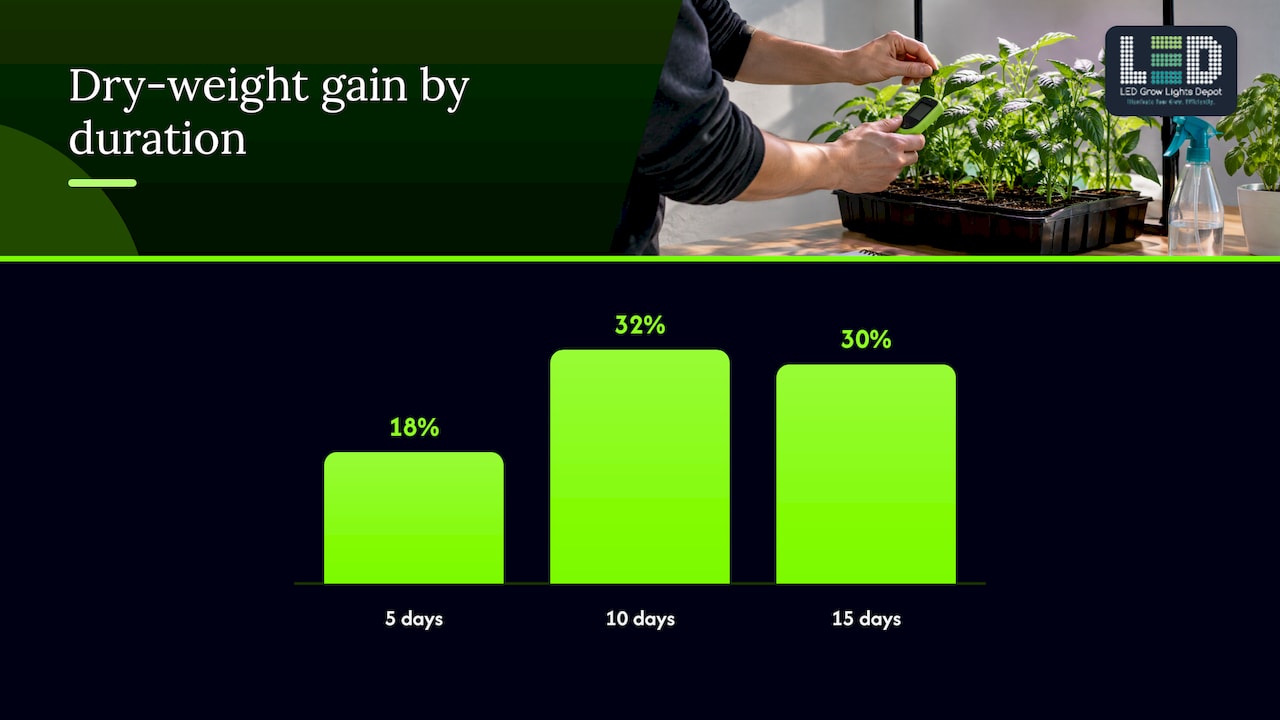
Timing mattered in the same study. A 10 μmol m⁻² s⁻¹ dose given for 5, 10 or 15 days before a day-15 harvest raised shoot dry weight by 18%, 32% and 30%. Ten days did about as well as fifteen. A short, steady exposure can capture most of the benefit.
UVB is the stronger signal, which is why growers ask about it. It also leaves less room for error.
A 2026 review in Agronomy describes a narrow operational window. At low doses, UVB acts as a regulatory signal through UVR8 and brings reduced elongation, altered branching and compact growth. At high intensity it is phytotoxic. The authors say UV must be finely calibrated and is generally limited to short applications in controlled conditions.
A 2023 lettuce study from Germany shows what consistency does. It used 10 or 20 mW m⁻² of UVB for 4 consecutive days, 10 hours a day, at 30 cm, alongside blue and red light. Flavonol glycosides and anthocyanins rose reproducibly, with changes up to tenfold compared with inconsistent greenhouse treatment. A fixed distance, a fixed schedule and a measured output are what make results repeatable.
Outdoors, plants never see the shortest UVB. The Frontiers cannabis UVB study reports that the solar UV cutoff is about 290 nm. It also reports the UVA to UVB ratio at the earth’s surface is roughly 40 to 1, within a range of 20 to 1 to 100 to 1. Sunlight is mostly UVA with a small slice of UVB.
That ratio is a useful target. A UV supplement that leans heavily on UVA, with UVB as the smaller share, looks more like the light plants evolved under.
Young plants are the most exposed to UV mistakes. The University of Queensland’s Plants in Action text on ultraviolet radiation reports that seedlings are especially vulnerable. So are plants moving from vegetative to reproductive growth.
A 2016 modeling study explains why timing matters. Plants hit with UV-B early in the season never recovered to their full biomass potential. Late-season events had proportionally smaller effects. Losing leaf area early compounds, because there is less leaf to make the next leaf.
In practice:
Species differ in tolerance. A 1983 review by Teramura found about 30% of tested species resistant to UV-B, 20% extremely sensitive and the rest in between. Your own cultivar may sit anywhere on that scale, which is another reason to start low.
UV adds a signal. It does not replace light. Get PAR intensity, spectrum and coverage right across the whole canopy before you add anything. Uneven white light is the bigger yield limiter in most rooms. Our supplemental lighting range covers lower-canopy and side coverage, and our adjustable spectrum LED grow lights let you tune the main light’s output.
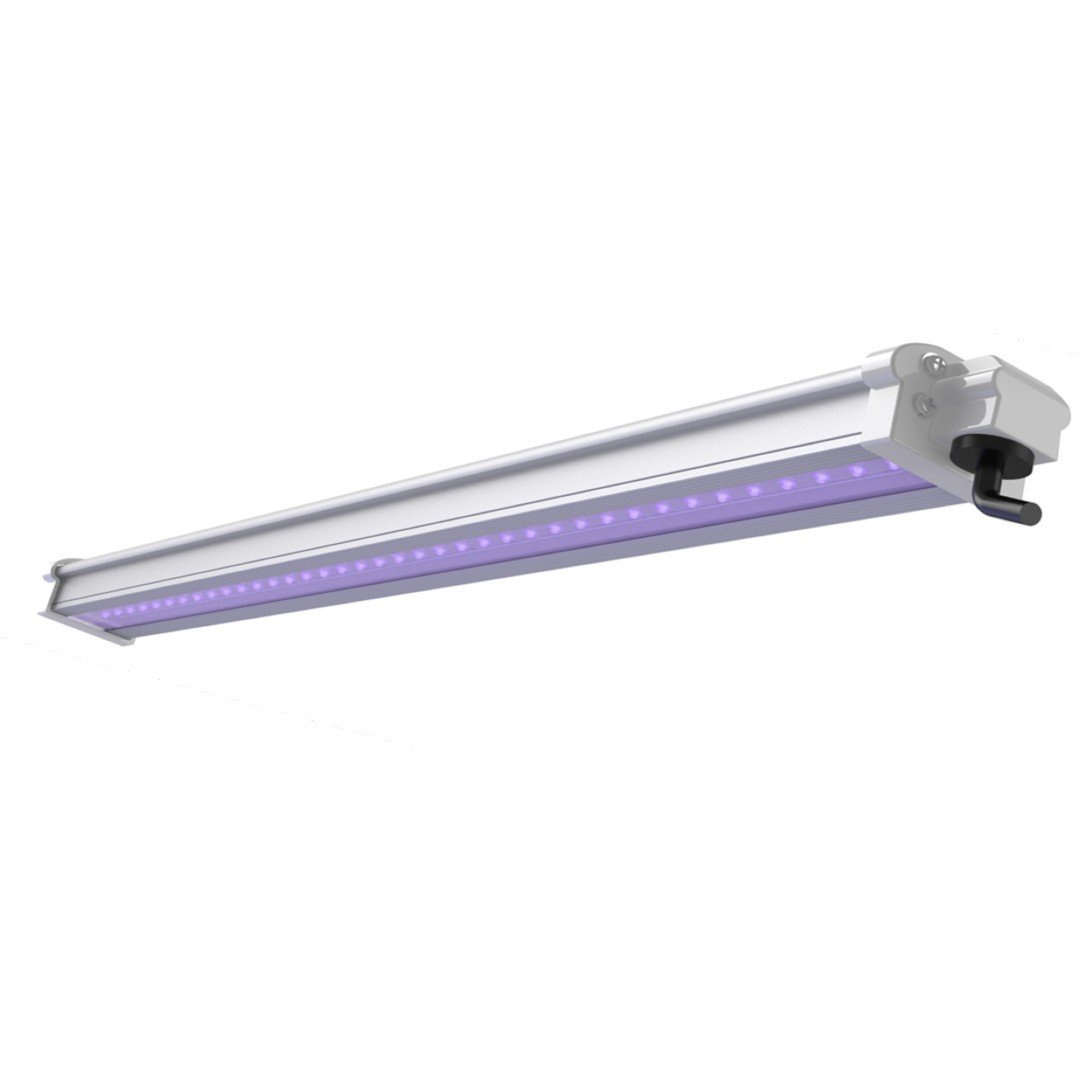
For most home growers and first-time users, a UVA bar is the starting point. Our TotalGrow UVA Bar is one example. If you want UVB too, the California Lightworks SolarSystem UVB is a UVB fixture. Growers who already run a Mammoth Lighting Mint White Series can use the UV Upgrade Kit with 2 UV bars and a 100w driver. You can compare all of them under LED grow lights with UV.
Look for:
Project Blue notes that UVB sources can be costly, and that UVB LEDs are much more expensive per unit of light than PAR sources. Plan the budget for the UV fixture separately from the main light.
Distance changes dose. A fixture at half the distance delivers far more than half the dose, so measure the gap from the bar to the canopy tips and keep it fixed. Raise the bar as the canopy grows. Begin with short daily sessions and a longer gap, then step up gradually.
The German lettuce study held its distance at 30 cm and ran a fixed schedule. That consistency is why its results repeated.
Note the distance, hours and start date for each tent or room. When a plant looks better or worse, you will know what changed.
The Queensland text notes plants moving into reproductive growth are more sensitive. If you extend UV into flower, treat it as a new plan with its own dose and do not carry over the veg settings.
The same kind of UV bar is also used in flower to target trichomes. Our guide to UV light for trichomes covers that stage. Our UVA vs. UVB dosing guide goes deeper on the doses.
This part is not optional. Project Blue warns that UVB damages DNA, proteins and RNA. It says artificial UVB in a grow room is a health hazard because it can cause sunburn and skin cancer.
The 2021 review in Horticulturae advises keeping worker exposure to a minimum with protection always worn. That means a hat for the face and neck, sunscreen, and eye protection matched to the light type and intensity.
The ICNIRP guidance on protecting workers from UV sets an exposure limit of 30 J m⁻² (spectrally weighted, 180-400 nm) over an 8-hour workday. It sets a separate UVA limit of 10,000 J m⁻² for 315-400 nm. The eye limits are ceiling values.
Safe habits:
Commercial teams should write the UV schedule and the protective equipment into their room procedures.
Urban growers with a 2x2 or 4x4 tent have the simplest case. One UV bar over a small canopy is easy to hold at a fixed distance. The coverage question is less about spread and more about keeping the bar level and at a steady height as plants grow.
Larger rooms raise the stakes. Hot spots near a bar and thin coverage at the edges lead to uneven plants. In multi-tier or commercial rooms, plan bar placement the same way you plan main fixtures, and buy in volume only after one trial room confirms your settings. For bulk orders, see our commercial lighting options.
UV works best when the rest of the light is already right. Most growers we talk to ask about UV before they have solved light penetration into the lower canopy. That is the first problem to fix.
Our proprietary proximity systems are built to improve under-canopy light distribution. Our own results show yield increases above 20% and better bud grading when the lower canopy gets proper light. UV then adds a signal on top of a canopy that is already working.
For veg, we suggest a simple order: set the main light, add under-canopy or supplemental light where the plants are shaded, then add a UVA bar at a low dose. Add UVB only after you have a record of how the plants respond. Keep notes on distance and hours, and keep people out of the room while UV is on.
Our team gives advice to beginners and to experienced growers who want high-efficiency fixtures. Tell us your tent size and your main light and we can point you to a matching UV option.
Scott
We stock UV bars, UV-enabled fixtures, top lighting and under-canopy grow lights, plus tents, environmental controls and accessories. That lets you plan the main light, the lower-canopy light and the UV add-on in one order. Our customers rate us 4.8 out of 5 across more than 5,800 reviews, and most US orders ship free.
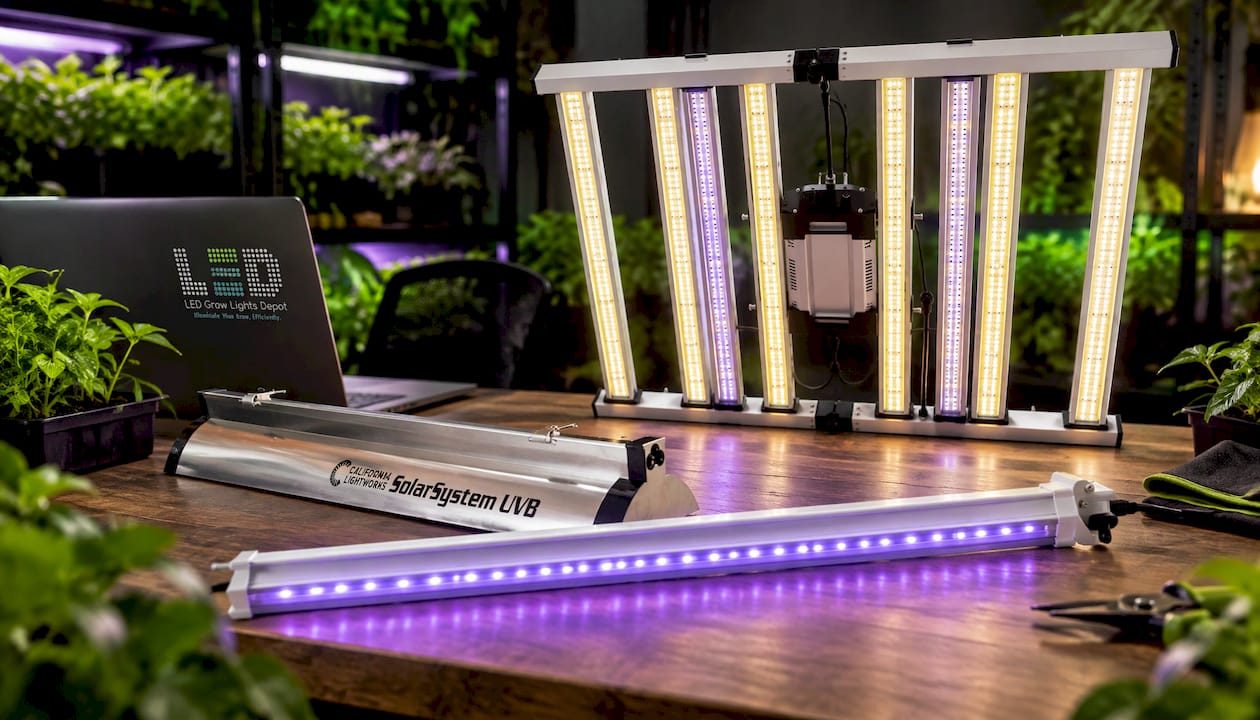
Start with UV supplemental lighting, or browse the UV, deep red and IR supplemental grow bars if you want to add more than one wavelength. On a tighter budget, our LED grow lights under $200 cover the main light.
No. Plants grow well in veg on PAR light alone. UV is an optional supplement that can shape plants and raise pigment content. If you try it, start with UVA at a low dose.
UVB can be used in veg at very low doses, but it has a narrow window. High doses stunt plants and burn leaves, and seedlings are the most vulnerable. For people, UVB is a skin and eye hazard, so wear protection and keep the room empty while it runs.
There is no single number for every plant and fixture. Research uses short, fixed schedules: the German lettuce study ran UVB 10 hours a day for 4 days at a fixed distance. Begin with a short session, keep the distance fixed and increase slowly only if the plants look healthy.
Only a little. Fluorescent lamps emit about 1% of their output as UV and metal halide about 3%, according to Runkle’s review. Many modern LEDs add almost none. A UV bar adds a measured amount.
No. UV sits outside the photosynthetic range and does not feed the plant. Your main light and under-canopy coverage still do the work that drives yield.
0 of 3 items selected

Leave a comment