
Free Shipping in the USA on nearly all items!
Limited phone hours during the Holidays! Call us: 888-611-9305
Free Shipping in the USA on nearly ALL items! Limited phone hours during the Holidays!

µmol/J (micromoles per joule) is the efficiency rating of a grow light. It tells you how many photons the fixture produces for every joule of electricity it draws. A higher number means more plant-usable light for the same power bill. It is the first number to check on a spec sheet, and the second one to check is how much of that light actually lands on your plants. We build our under-canopy lighting around that second question.
A micromole (µmol) is a count of photons: one millionth of a mole. Plants use light between 400 and 700 nm, called PAR (photosynthetically active radiation). A fixture’s total PAR output per second is its PPF, measured in µmol/s.
A joule is a unit of energy, and one watt equals one joule per second. So PPF divided by watts gives µmol/J. The research literature calls this photosynthetic photon efficacy (PPE): how well a fixture converts electrical energy into photons.
You will see these terms on spec sheets:
Virginia Tech Extension lays out these units and how they relate. Our own guide to what PPFD per watt actually measures covers the canopy side in more detail.
The math is one division.
Example: a fixture rated at 660 µmol/s that draws 240 W at the wall.
660 ÷ 240 = 2.75 µmol/J
Two details matter:
Lumens are weighted to human vision. Green light looks bright to us, and red looks dim, yet plants use both. Researchers state plainly that lumens per watt is a human-vision metric and does not apply to horticultural lighting. Virginia Tech puts it simply: lumens are for humans, while PAR, PPF and PPFD describe light for plants.
If a product lists only lumens, convert your thinking to PPF and watts. A shop bulb and a grow light can have the same lumens and very different plant output.
Here are published reference points for the best products in each lamp type, from the U.S. Department of Energy’s 2017 horticultural report:
| Lamp type | Best-in-class PPE (µmol/J) |
|---|---|
| T8 fluorescent | 0.84 |
| Induction | 0.95 |
| Mogul-base HPS | 1.02 |
| Ceramic metal halide | 1.46 |
| Double-ended HPS | 2.1 (2017) |
| LED | 2.5 (2017) |
LED has moved since then. A 2020 Horticulture Research paper found typical fixtures at 2.5 to 2.8 µmol/J for white-and-red designs and about 3 µmol/J for blue-and-red designs. The same paper calculated a ceiling of 3.4 µmol/J for white and red and 4.1 for blue and red with current LED technology.
A few practical benchmarks:
Michigan State’s 2024 update adds that DLC-qualified products are by design at least 35% more efficient than HPS, and that about 1,500 LED products were DLC-qualified for horticulture by early 2024, up from fewer than 100 in early 2020. It also notes that the highest-efficacy fixtures emit mostly red light, because red LEDs are the most efficient.
Fixture efficacy depends on drive current, junction temperature, driver efficiency and optical losses. In plain terms:
Spectrum is why you should not choose on µmol/J alone. A fixture with a slightly lower number but a spectrum suited to your crop can serve the plants better.
Efficacy converts directly into watts. To find the power a fixture needs for a target output, divide the PPF by the µmol/J.
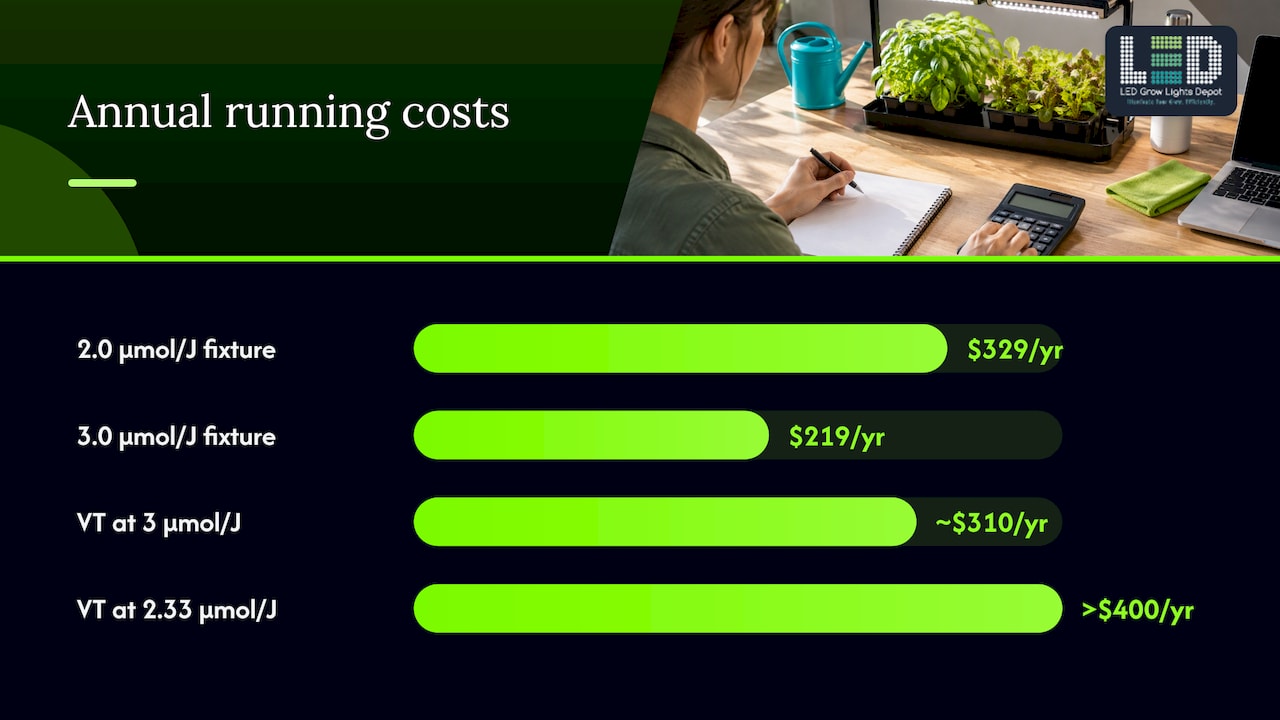
Worked example. You want 1,000 µmol/s of light, run 12 hours a day (4,380 hours a year), at an assumed $0.15 per kWh:
| Fixture efficacy | Power needed | Energy per year | Cost per year |
|---|---|---|---|
| 2.0 µmol/J | 500 W | 2,190 kWh | $329 |
| 3.0 µmol/J | 333 W | 1,460 kWh | $219 |
That is about $110 a year for the same photons. Virginia Tech’s own comparison shows the same pattern: a roughly 1,000 µmol/s fixture at about 3 µmol/J costs about $310 a year to run, against over $400 for one at 2.33 µmol/J. Your figure will differ with your local rate and light schedule.
Less wattage also means less heat in a tent. The University of Kentucky guide notes that LEDs at over 2.0 µmol/J use less than half the electricity of T8 fluorescents for a given intensity and emit less than half the waste heat. That helps in small rooms, closets and tents where cooling is a cost of its own.
For larger rooms, the case is economic. Runkle and Bugbee advise that lamp choice should rest on hours of operation, electricity cost, installation and rebates. They report that moving from old 400 W HPS to modern lighting can cut electric cost by more than 50%, with a payback of two to three years for lamps run over 2,000 hours a year at rates above $0.12/kWh.
DLC-qualified products are also often eligible for utility incentives. Check your utility’s horticultural lighting program before ordering. In California, the Title 24 draft report for 2025 reflects how fast the bar is rising: it lists current minimums of 1.9 µmol/J for indoor facilities and proposes 2.3.
µmol/J is measured at the fixture. It counts every photon that leaves the light. It does not say where those photons go.
Photons that miss the canopy, hit tent walls or fall on the floor still count in PPE. They do nothing for your plants. System efficacy is usable light on the grow area divided by power. It equals the fixture’s efficacy multiplied by the share of light that actually reaches the canopy.
This is the gap between a good spec sheet and a good harvest. Two fixtures at 2.8 µmol/J can give very different results in the same tent. Check:
Our guides explain how to measure PPFD in a real grow space and how to achieve uniform PPFD across your canopy.
Follow these steps for any tent or room.
By grower type:
Top-mounted fixtures light the top of the canopy well. Lower leaves and bud sites receive far less, which is the light penetration problem that limits standard setups. A high µmol/J on the top fixture does not change that.
Our proprietary proximity systems are designed to improve under-canopy light distribution, and we report yield increases of over 20% and better bud grading with them. Those lights sit close to the plants and add photons where the top light does not reach. You can browse them in our under-canopy grow lights collection. Options include the ThinkGrow Model One 4’ inner canopy LED bar and the ILUMINAR 160W under-canopy light.
The DOE and USDA-ARS also noted in a 2022 meeting that a new near-field measurement standard for lights deployed within 1 m of the canopy was nearly complete. Close-range lighting is a recognized category with its own measurement needs.
We hear the same question from home growers and commercial buyers: which light has the highest µmol/J? It is a fair place to start. Efficacy tells you what each watt buys.
But yield comes from photons that land on leaves. A top light with a strong efficacy rating still leaves the lower canopy short of light. That is why we sell under-canopy and proximity systems next to top lighting, and why we size lights to the tent instead of choosing by one spec.
Our advice: use µmol/J to compare fixtures, then judge the whole setup by PPFD at the canopy, uniformity and the lower leaves. We help beginners and experienced growers work through that, from a single tent to a commercial room.
Scott
We carry top lighting, under-canopy systems, complete grow tent kits, environmental controls and accessories. Our selection tools and expert advice help you match a fixture to your tent size and crop, and most US orders ship free. Commercial buyers can ask about bulk orders and financing. We have a 4.8 out of 5 customer rating from more than 5,800 reviews.
Start with LED grow lights for home grows, or browse the full range.
For LED fixtures, 2.5 µmol/J is the DLC Hort V4.0 minimum, and 3.0 or higher is what Virginia Tech Extension recommends. Typical white-and-red fixtures sit at 2.5 to 2.8. Compare the number alongside spectrum and coverage.
Yes. PPE (photosynthetic photon efficacy), efficacy and µmol/J all describe PPF divided by input power. System efficacy is a different figure that counts only light reaching the grow area.
You cannot convert from watts alone. You need the fixture’s PPF in µmol/s. Divide PPF by input watts. For example, 900 µmol/s from 300 W is 3.0 µmol/J.
Higher efficacy means less electricity per photon, which lowers cost and heat. For the best results, also look at spectrum, PPFD at your canopy height and uniformity across the whole tent.
0 of 3 items selected


Leave a comment