
Free Shipping in the USA on nearly all items!
Limited phone hours during the Holidays! Call us: 888-611-9305
Free Shipping in the USA on nearly ALL items! Limited phone hours during the Holidays!

Yes, switching from HPS to LED is almost always worth it, but only if you treat it as a system change, not a bulb swap. Before you buy anything, do three things: size fixtures by PPFD and DLI instead of watts, plan to raise your winter heating setpoint by about 2 to 4°F, and run a small pilot zone before converting the whole room. Some LED grow light fixtures fit into this plan at several points, and we’ll get specific about where.
TL;DR:
- Accurate fixture sizing relies on PPFD and DLI calculations, not wattage, to ensure uniform light distribution and crop health.
- LED fixtures should be selected based on their efficiency and PPFD output at the specific mounting height, with overlap to prevent low-light zones.
- Switching to LED requires adjusting HVAC setpoints upward by 2 to 4°F and recalibrating irrigation due to reduced radiant heat and lower transpiration rates.
- Energy savings typically range from 10 to 25 percent overall, once increased heating costs are included in the payback analysis.
- Running a pilot zone with proper instrumentation over a full growth cycle is critical for successful room-wide LED conversion.
A retrofit that skips planning usually ends in mismatched PPFD, a spike in the humidity controller’s runtime, or a canopy that stretches for no clear reason. Work through the sequence below before a single fixture comes off the ceiling.
Budget items to plan for:
Skipping the mapping step is the single most common mistake growers make. Without a wattage-and-coverage baseline, there’s no way to judge whether the new fixture layout is actually delivering more usable light or just less heat.
Watt-for-watt replacement is the wrong math for an HPS to LED conversion. A 1000W HPS fixture and a 600W LED fixture can deliver comparable PPFD at canopy level because LEDs convert more of their input electricity into usable photosynthetic light rather than heat and infrared waste. The metric that matters is Photosynthetic Photon Flux Density (PPFD), measured in micromoles per square meter per second, and its daily total, Daily Light Integral (DLI).
Here’s the practical sequence:
Take PPFD readings at multiple canopy heights and locations, not just center-of-room, and log every reading during your pilot. That gap is exactly what DLI-focused planning for indoor grows is meant to catch before it costs you a harvest.
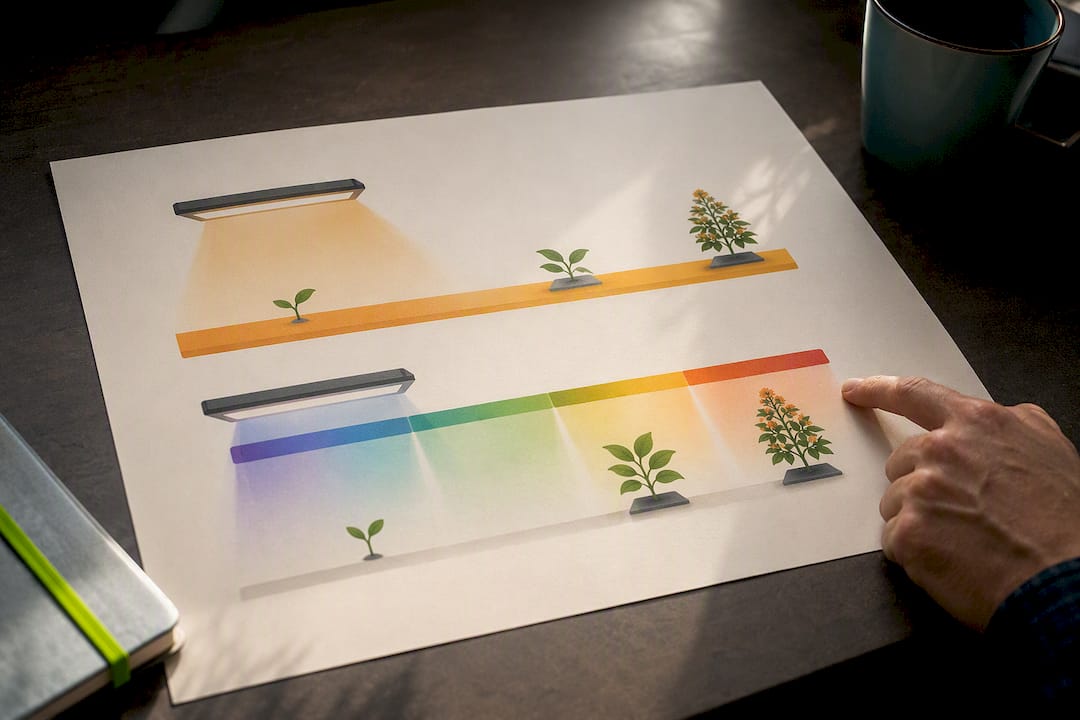
HPS light is fixed. It puts out a narrow, orange-heavy spectrum whether your plants are seedlings or three weeks from harvest. LEDs let you change that on purpose, and using that control well is one of the real advantages of switching, not just a side effect of saving energy.
Blue-heavy spectra during vegetative growth tend to produce more compact, sturdy plants with shorter internode spacing. Red and far-red light drive flowering response and can be used at the end of the day to influence stem elongation and canopy structure. Research on LED spectral control shows growers can tune spectrum and intensity by stage to influence morphology and secondary metabolite production in ways HPS simply cannot replicate.
A practical approach for the pilot phase:
Pro Tip: Don’t chase a perfect spectrum on day one. A stable, moderate full-spectrum setup that matches your old DLI is a better pilot baseline than an ambitious recipe you can’t yet compare against.
HPS ballasts throw off enormous radiant heat, and that heat has been quietly doing your HVAC system’s job for years. Pull that heat source out and your ambient heating load goes up, even though your electrical bill for lighting goes down.
Growers converting from HPS to LED should expect to raise their winter ambient heating setpoint by roughly 2 to 4°F to maintain consistent canopy temperature, compensating for the radiant heat LED fixtures no longer provide.
That heat shift has a second effect that catches growers off guard: transpiration drops. Less radiant heat on the leaf surface means lower leaf temperature and a lower vapor pressure deficit (VPD) at the same air temperature and humidity. Plants that were transpiring and drinking at a certain rate under HPS often slow down under LED, which means irrigation schedules calibrated to the old lighting can overwater the root zone.
Build these checks into your HVAC recommissioning:
Lighting electricity use typically drops the most dramatic amount after an LED conversion, but that number alone overstates your real savings. Facility-level modeling of greenhouse HPS-to-LED transitions puts net total energy savings in the 10 to 25% range, once the added heating demand from losing HPS radiant heat gets factored back in. Colder climates and rooms that previously ran lighting a large share of total energy use tend to land at the lower end of that range.
Lumen maintenance is the other half of the ROI math that gets skipped. HPS lamps degrade roughly a small percentage per 1,000 hours of operation (https://gpnmag.com/article/greenhouse-led-output-efficacy/), meaning a bulb you installed a year ago is already delivering noticeably less light than day one. DLC-qualified LEDs are built to lose no more than 10% of output over a full 50,000-hour lifespan, which is why long-term operating cost comparisons between LED and HID lighting tend to favor LED even before factoring in electricity rates.
| Payback input | What to measure |
|---|---|
| Installed wattage (old vs. new) | Nameplate watts times fixture count |
| Operating hours per day | Photoperiod schedule per crop stage |
| Local electricity rate | Cost per kWh from your utility bill |
| Heating cost delta | Estimated increase from setpoint adjustment |
| Maintenance and bulb replacement | HPS bulb swap frequency vs. LED driver lifespan |
Verify any conversion calculator’s output against your own PPFD readings and photometric files before locking in a fixture count. Datasheet lumens and wattage tell you almost nothing about delivered light at your specific mounting height.
Fixture selection comes down to a handful of technical criteria, not brand names. Look at µmol per joule (efficacy), PPFD delivered per watt at your actual mounting height, thermal design (can it run close to canopy without stress), dimming and control options, DLC qualification, and warranty terms backed by real lumen-maintenance data.
RJ11 ports and manual dimmers matter more than they sound. They let you fine-tune output during your pilot phase without swapping fixtures, and they give you a controlled way to phase in spectral or intensity changes instead of flipping a switch and hoping.
Pro Tip: Keep your old HPS ballasts wired but powered off for the first week of your pilot. If something goes wrong with the new fixtures, you want a fast fallback, not a scramble. Reviewing proper thermal management for high-power LED fixtures before install day prevents the most common early failures.
Pick a matched crop block, one you can compare directly against an HPS-lit control block growing the same genetics and stage. Change one variable at a time. Instrument the pilot with a PAR meter, a temperature and humidity datalogger, and a CO2 monitor if your room uses enrichment.
Track these metrics against acceptable variance thresholds:
Run the pilot for at least one full growth cycle, ideally two, before scaling. Consistent PPFD and DLI readings across that period, paired with stable VPD and no negative morphology signals, are your trigger to convert the remaining HPS fixtures.
This guide was written by Scott for LedGrowLightsDepot, drawing on greenhouse energy modeling, extension lighting guidance, and DLC efficacy standards cited throughout. LedGrowLightsDepot’s proprietary proximity systems are built around the same PPFD-first philosophy this article recommends, with a reported 20%+ increase in yield and improved bud grading from better under-canopy light distribution. The brand holds a 4.8 out of 5 customer satisfaction rating from more than 5,800 reviews.
For deeper technical grounding, see the DLI planning guide for indoor grows and the thermal management resource for high-power LEDs referenced earlier.
LEDs are the better long-term choice for most grow rooms, but the appeal of lower electricity bills tempts people into skipping the boring parts: HVAC recommissioning, VPD monitoring, pilot testing. Those boring parts are where conversions succeed or quietly underperform for a year. Run the pilot. Trust the PPFD meter over the datasheet. Scale only once the numbers hold steady, not once you’re excited to finish the project.
— Scott
Once your PPFD targets and pilot plan are set, the fixture choice comes down to room size and canopy density. For dense canopies or proximity lighting strategies, the Helios 840W Full Spectrum LED Grow Light gives you the output and manual dimming control to fine-tune during your pilot phase. If electricity savings matter most, the HortiBloom Mega Eco 720 LED Grow Light delivers high efficacy for long-run toplighting.
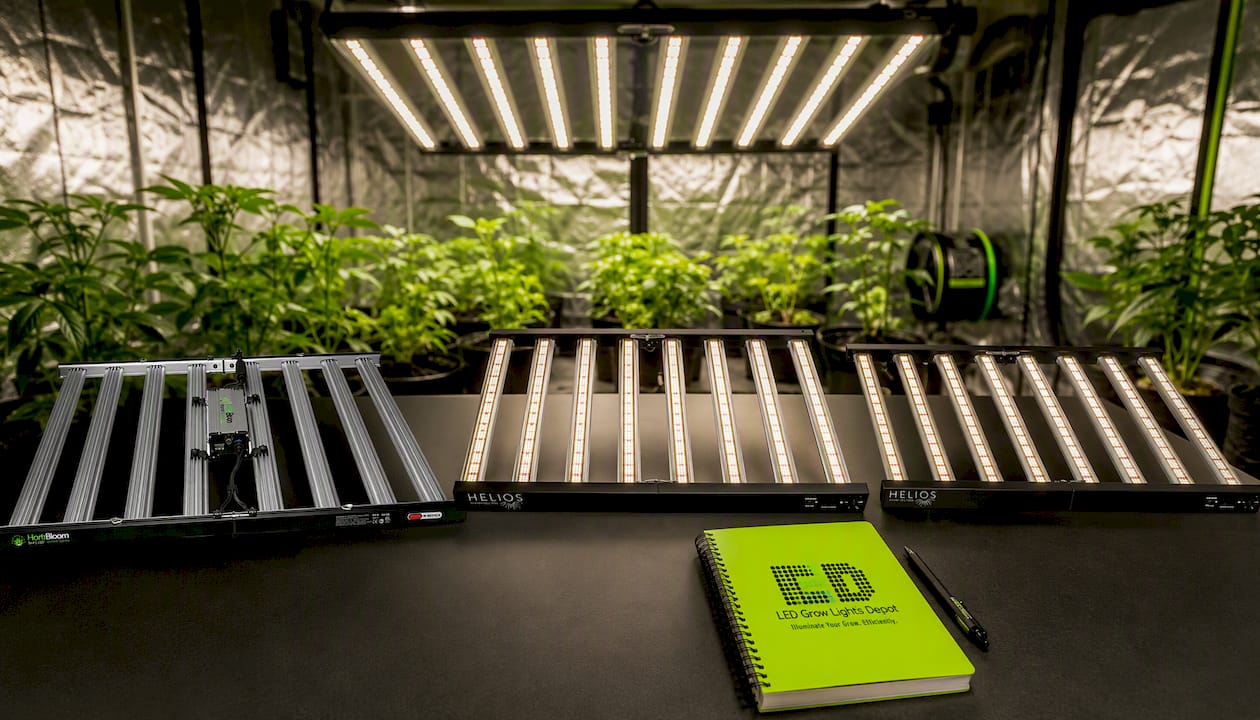
Running a pilot zone first? The Helios 640 Watt Full Spectrum LED Grow Light is sized right for a staged rollout without overcommitting before your data comes in. LedGrowLightsDepot offers bulk pricing and technical support for commercial-scale conversions, so reach out for a quote or browse the full catalog to match a fixture to your exact room dimensions and crop plan.
Not usually. Most HPS fixtures use ballasts incompatible with LED driver requirements, so a direct retrofit typically means replacing the fixture and driver, not just swapping the bulb.
There’s no fixed watt-for-watt answer. Match PPFD at your mounting height instead. A well-designed LED fixture can often match a higher-wattage HPS fixture’s canopy PPFD due to higher efficacy.
Most 1000W HPS fixtures get matched by lower-wattage LED fixtures, again based on PPFD delivered at canopy level rather than nameplate wattage. Fixtures like the Helios 840W can cover large, dense canopies at comparable or better PPFD than a 1000W HPS.
No, LED is generally the better long-term choice. LEDs offer spectral control HPS lacks, lower long-term lumen degradation, and lower total energy costs, though HPS remains cheaper upfront and simpler to operate without recalibrating HVAC.
0 of 3 items selected

Leave a comment