
Free Shipping in the USA on nearly all items!
Limited phone hours during the Holidays! Call us: 888-611-9305
Free Shipping in the USA on nearly ALL items! Limited phone hours during the Holidays!

Photoacclimation indoors is the process by which existing leaves adjust their photosynthetic machinery over several days to a new light regime, while leaves that develop afterward are built from scratch for that light level. Manage it by measuring PPFD and DLI rather than judging by eye, and by raising intensity in small steps while watching for stress signs. Skip the ramp and you risk bleached leaves and stalled growth instead of the yield gains you’re chasing.
TL;DR:
- Existing leaves typically take 7 to 14 days to substantially readjust to a new light level, with adjustment speed depending on species and genotype.
- Photosynthetic changes involve pigment ratio shifts within days, biochemical capacity adjustments over days, and photoprotection system activation within minutes to weeks, requiring gradual ramps.
- Proper measurement of PPFD and DLI using quantum meters is essential, with multiple canopy points and microclimate data to accurately guide and monitor the ramp process.
- Abrupt light jumps beyond a plant’s acclimation capacity cause stress signs such as bleaching and leaf drop, which can be mitigated with small, controlled increases and continuous monitoring.
- Different species have specific DLI targets; shade-tolerant plants often require lower light levels, and exceeding these can lead to morphological changes and stress rather than faster growth.
Plants adjust to light in two distinct ways, and confusing them is why so many indoor growers misjudge their timelines. Dynamic acclimation happens inside leaves that already exist. The chloroplasts inside those leaves retool their pigment ratios, enzyme activity, and protective systems to handle whatever light regime you’ve just introduced. Developmental acclimation is different: it only shows up in leaves that form after the light change, and those new leaves are built from the start to match the environment they’ll actually live in.
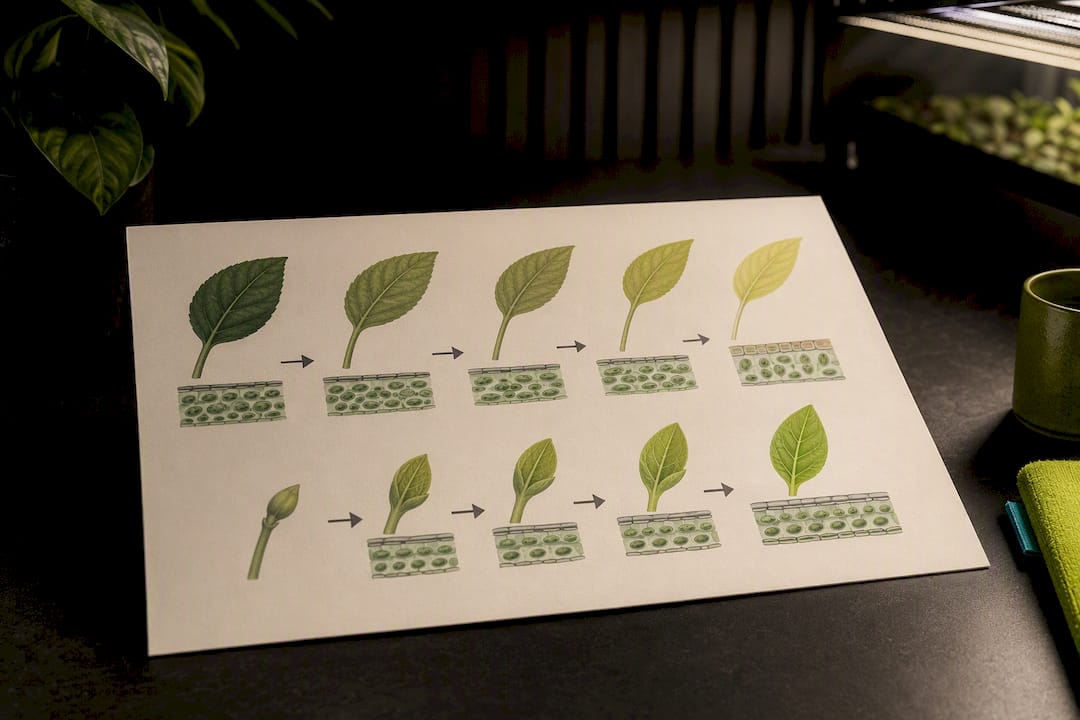
This distinction matters because it explains why a plant can look unhappy for a week or two after you increase your fixture’s output, then seem to “catch up” once fresh growth emerges. The old leaves are struggling through dynamic acclimation. The new leaves skip that struggle because they never had to adjust. Research on photosynthetic acclimation to changing environments confirms that dynamic acclimation in existing tissue involves real changes to chloroplast composition, photosynthetic proteins, and photoprotective systems, and that process takes time to complete.
How much time? It varies by species and genotype, but a common working window is 7 to 14 days for existing leaves to substantially readjust their photosynthetic capacity. Adjustment speed varies: some fast-cycling species show partial adjustment within a few days, while slow-growing houseplants with thick, leathery leaves may take several weeks before stabilization at the new light level.
A concept worth understanding here is entrainment. A leaf’s prior light history doesn’t just fade away the moment you change your fixture’s intensity. It shapes how quickly and how far that leaf can shift its maximum photosynthetic rate, often called Pmax, and its induction state (how fast photosynthesis ramps up when light first hits the leaf each day). Work on fluctuating light response in Arabidopsis found that acclimation and entrainment rates are genotype specific, meaning two plants of the same species grown from different genetic lines can acclimate at noticeably different speeds.
Practical implications for indoor growers:
Photoacclimation isn’t a single switch. It’s a coordinated overhaul of several separate systems, and they don’t all move at the same speed or for the same reason. Understanding which system is adjusting helps you interpret what you’re seeing on the leaf surface.
Pigment composition is usually the first visible layer. Chlorophyll a and chlorophyll b exist in a ratio that shifts depending on light intensity. Under lower light, leaves tend to invest more in chlorophyll b and larger light-harvesting antenna complexes, essentially building bigger nets to catch scarce photons. Under higher light, that antenna size shrinks and the a to b ratio rises, because catching every photon matters less than protecting the photosynthetic machinery from an oversupply of energy. Total chlorophyll content itself often drops under high light too, which is one reason leaves can look visibly paler, not damaged, after a successful intensity increase.
Biochemical capacity shifts underneath the visible pigment changes. Rubisco, the enzyme that fixes carbon dioxide into usable sugars, gets activated and expressed at higher levels when light supply increases, since more captured energy is worthless without the enzymatic capacity to use it. Electron transport chain components adjust in parallel. Respiration rates change too, often increasing somewhat under higher light to support the added metabolic demand of faster growth.
Photoprotection is the system most growers underestimate, and it’s the one most responsible for preventing visible damage. Three mechanisms do the heavy lifting:
Pro Tip: A leaf’s visible health can lag behind its functional acclimation status. A plant that looks stressed on the surface may already be running efficient photosynthesis underneath, according to research on genotype-specific photoacclimation and entrainment. Judge the ramp by growth trend over two weeks, not by a single day’s leaf appearance.
These systems operate on overlapping but not identical timelines. NPQ can activate within minutes of an intensity spike. Pigment ratio shifts take days. Biochemical capacity changes over a similar multi-day window. That’s part of why abrupt light increases are risky: NPQ and PSII repair have to absorb the entire shock immediately, while the slower systems that would normally share the load haven’t caught up yet.
You cannot manage what you don’t measure correctly, and lux is the wrong unit for this job. Lux and foot-candles are calibrated to human eye sensitivity, which peaks in green wavelengths, while chlorophyll absorbs most efficiently in the blue and red bands lux meters barely register. Wattage is even less useful, since it tells you how much electricity a fixture draws, not how many usable photons reach your canopy. The correct units are PPFD (Photosynthetic Photon Flux Density, measured in μmol·m⁻²·s⁻¹) and DLI (Daily Light Integral, measured in mol·m⁻²·d⁻¹).
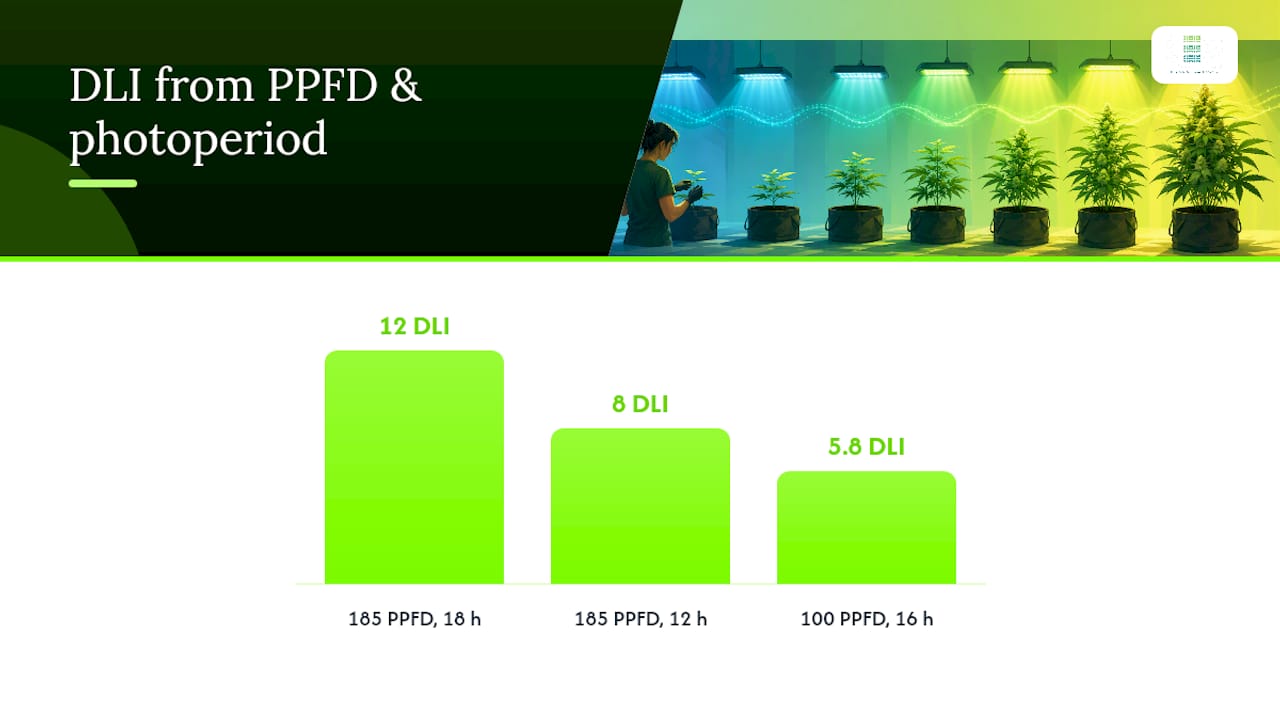
PPFD tells you the intensity of light hitting a specific point at a specific instant. DLI tells you the total photon load a leaf accumulates over an entire day, which is the number that actually correlates with growth and photosynthetic output over time. The conversion is straightforward:
DLI = PPFD × photoperiod (hours) × 0.0036
Here’s how that plays out with real numbers, based on guidance from Michigan State University Extension:
A canopy reading of 185 μmol·m⁻²·s⁻¹ run for an 18-hour day works out to roughly 12 mol·m⁻²·d⁻¹ of DLI (185 × 18 × 0.0036 ≈ 12). 2. That same 185 μmol·m⁻²·s⁻¹ reading run for only 12 hours drops DLI to about 8 mol·m⁻²·d⁻¹, showing how photoperiod alone can swing your daily total by a third. 3. A lower intensity of 100 μmol·m⁻²·s⁻¹ run for 16 hours lands close to 5.8 mol·m⁻²·d⁻¹, useful context for shade-tolerant houseplants that don’t need or want a high-intensity setup.
Measuring this correctly requires a quantum or PAR meter, not a photography light meter or a smartphone lux app. A single reading at canopy center also isn’t enough. Light intensity varies significantly across a growing area, and a canopy average can hide serious hotspots near the fixture’s center relative to its edges. Map several points, top canopy, mid-canopy, and edges, and log each one separately rather than relying on a single number to represent your whole setup.
For a deeper breakdown of how PPFD, PPF, and fixture efficacy interact, our guide on PAR, PPF, PPFD, and DLI walks through the full set of metrics worth tracking. And if you’re still relying on lux readings out of habit, the difference between PPFD and lux is worth understanding before you size any fixture for a real canopy.
The core principle behind any safe acclimation schedule comes straight from the entrainment research: start below your target PPFD, hold everything else constant, and increase intensity in small increments while watching how the plant responds. Two ramp speeds work for most indoor setups, and which one you pick depends on how much risk you’re willing to accept and how fast you need results.
This approach favors plant safety over speed and suits sensitive species, mature specimens that haven’t seen bright light in months, or any situation where you can’t monitor daily.
This approach moves faster and works well for resilient species, seedlings, or commercial setups where downtime has a real cost.
Both ramps share a monitoring checklist that matters more than the specific percentage you choose:
Pause or roll back the ramp immediately if you see leaf bleaching, sudden leaf drop, or a measured drop in chlorophyll fluorescence efficiency. These are signs the plant’s photoprotective systems are overwhelmed, not signs it needs more light to “push through.” Research on light stress and photoprotection is clear that abrupt jumps well beyond current capacity are what drives photoinhibition, and rolling back a step is far cheaper than losing a full growth cycle to leaf damage.
One more variable worth controlling: how the light changes, not just how much. Fluctuating light is biologically distinct from a stable average PPFD, and abrupt on/off transitions or dimming steps that jump rather than ramp can push leaves repeatedly outside their acclimation window. Smooth dimming transitions, where your controller supports them, reduce that repeated-excursion risk considerably compared to hard step changes.
For growers dialing in exact PPFD and DLI combinations at each ramp stage, our DLI targeting guide breaks down practical PPFD and photoperiod pairings for common indoor crops.
Not every plant wants, or can safely handle, the same DLI target, and treating all species like they need maximum intensity is a common and expensive mistake. A 2024 study on common indoor foliage species is a useful reality check here. When intensity was raised to 20.1 μmol·m⁻²·s⁻¹ at an 18 hour photoperiod, growth rate increased, but so did morphological change, according to the species-specific indoor lighting study.
That morphological shift matters as much as the growth rate number. Shade-tolerant species facing more light don’t just grow faster in a straight line. They often reallocate biomass toward stem and root development, shift leaf shape, and change internal leaf structure to handle the new energy load, sometimes in ways that change the plant’s appearance more than a grower expects or wants for an ornamental piece.
Setting a target DLI should start with your actual goal, not a generic “more light is always better” assumption:
Choosing the right target for your species avoids a wasted ramp entirely. Pushing a naturally shade-tolerant plant toward a DLI built for a high-light species risks the exact photostress the ramp protocol is designed to prevent.
Photostress shows up when light supply outpaces a plant’s ability to use the energy it’s absorbing, and catching it early is far cheaper than recovering from it. Watch for leaf bleaching or a washed-out yellow-white color, especially on upper leaves closest to the fixture. Leaf drop, particularly sudden drop rather than gradual lower-leaf aging, is another red flag. Slowed growth despite more light is counterintuitive but common: the plant is spending energy on repair and defense instead of expansion.
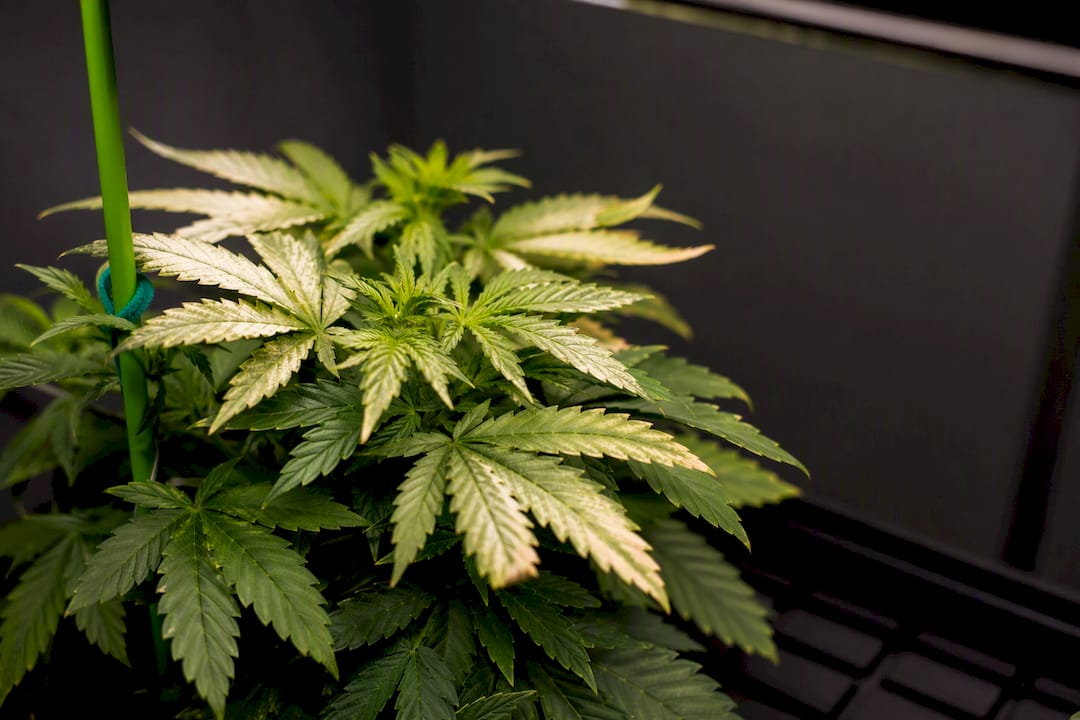
If you have access to a chlorophyll fluorometer, a measured drop in Fv/Fm confirms photoinhibition is underway rather than just cosmetic stress. Elevated leaf surface temperature, measured directly rather than assumed from ambient air readings, often confirms a fixture is too close or too intense for the current setup.
Common root causes behind these symptoms:
The fixes are usually straightforward once the cause is identified: cut PPFD back to the last stable level, shorten photoperiod if DLI has crept above target, improve airflow to manage leaf temperature, stagger your ramp steps further apart, and double check that nutrient supply and irrigation scheduling can support the increased photosynthetic demand. Also verify you haven’t changed more than one variable at once. Combined changes to intensity, spectrum, and photoperiod at the same time make it nearly impossible to identify which factor actually triggered a stress response, a caution echoed in the light stress and photoprotection literature.
A monitoring plan only works if it measures the right spots at the right frequency. Take PPFD readings at top canopy, mid canopy, and lower canopy, and check both center and edge positions at each height. A single top-of-canopy reading tells you almost nothing about what your lower leaves or edge plants are actually receiving, and that gap is exactly where under-canopy supplemental lighting earns its place in a serious setup.
During an active ramp, check PPFD weekly at minimum, and track your running DLI trend rather than isolated daily snapshots. Log leaf temperature at the same time, since it’s the fastest-moving warning sign of overlighting. Ambient temperature, relative humidity, and CO2 concentration round out the microclimate picture, because all three interact with how much light a plant can safely process.
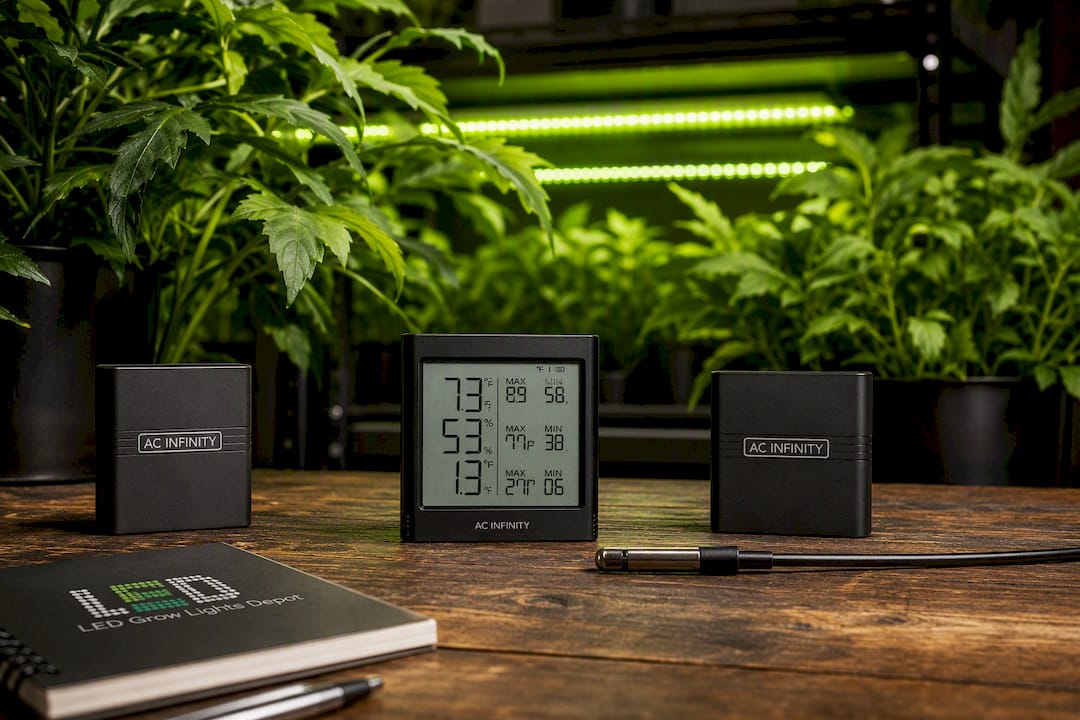
This is where continuous environmental logging earns its keep over spot checks with a handheld meter. The AC Infinity Mini Smart Thermo-Hygrometer A2, with its integrated sensor probe and companion data app, tracks temperature and humidity trends automatically and flags deviations in real time, which matters most during the first week after any intensity increase, when conditions can shift faster than a daily manual check catches. The AC Infinity Mini Smart Thermo-Hygrometer A1, which ships with a 12 foot remote probe, is built for exactly the lower-canopy or edge-of-tent placements that a single central sensor misses. The AC Infinity Smart Thermo-Hygrometer B2, also with an integrated probe and app logging, gives a second data point for larger tents or multi-zone setups running different ramp schedules at once.
| Metric | Where to measure | Suggested tool |
|---|---|---|
| PPFD | Top, mid, lower canopy; center and edges | Quantum/PAR meter |
| DLI trend | Calculated from PPFD × photoperiod | Manual log or grow app |
| Leaf/ambient temperature | Near fixture, canopy top, tent center | AC Infinity A2, A1, or B2 |
| Relative humidity | Canopy level, tent center | AC Infinity A2, A1, or B2 |
| CO2 | Tent center, near canopy | Dedicated CO2 monitor |
None of these devices measure PPFD directly, but pairing continuous temperature and humidity logging with your periodic PPFD mapping gives you the full picture a ramp decision actually needs: is the light increase working, and is the microclimate keeping pace with it?
Photoacclimation research answers the biology. Applying it indoors, at your specific canopy height and fixture distance, is where most growers actually get stuck. A resource library exists to translate the PPFD and DLI concepts covered here into fixture-specific sizing and placement guidance.
A few resources worth working through alongside your ramp plan:
Some product catalogs reflect the same under-canopy uniformity problem this article covers in the monitoring section: canopy averages hide lower-leaf shortfalls, and proximity lighting systems can close that gap rather than relying on top lighting alone.
The instinct to crank a new fixture to full output on day one is understandable and almost always wrong. Every mechanism covered here, pigment remodeling, enzyme activation, photoprotective buildup, runs on a timeline measured in days, not minutes. Skipping that timeline doesn’t make a plant photosynthesize faster. It just means the photoprotective systems absorb a shock they weren’t ready for.
The real trade-off isn’t between fast growth and slow growth. It’s between energy spent on adaptation versus energy spent on expansion. A plant mid-acclimation is diverting resources into NPQ, PSII repair, and antioxidant production, resources that would otherwise go into new leaves and root mass. A properly staged ramp lets a plant spend more of its energy budget on growth and less on defense, which is the entire point of measuring PPFD and DLI instead of eyeballing a fixture’s brightness dial.
I’d also push back on the idea that higher DLI is automatically the better target. The species research on shade-tolerant foliage plants makes clear that sustained low-light growth is a legitimate strategy, not a compromise, for the right species and the right goal. Before scaling any lighting change across a full room or commercial run, test it on a small cohort first, and read the extension and peer-reviewed literature for your specific crop rather than assuming a cannabis-oriented DLI target applies to a shade-tolerant houseplant.
— Scott
Running the ramp protocols in this guide without continuous microclimate data is like driving with your eyes closed between checkpoints. LedGrowLightsDepot carries the AC Infinity Mini Smart Thermo-Hygrometer A2, the A1 model with its 12 foot remote probe for lower-canopy placement, and the B2 with integrated sensing for a second monitoring zone, each logging temperature and humidity data straight to an app so you catch a stress signal before it shows up as bleached leaves.
If your fixture setup is the limiting factor rather than your monitoring, LedGrowLightsDepot’s top lighting collection covers overhead options built to hit specific DLI targets, and the under-canopy grow light collection addresses the lower-leaf PPFD gap that a canopy average always hides, part of the proximity lighting approach that has driven yield increases of over 20 percent for growers who add supplemental lighting where a single top fixture leaves shadows. Browse the full catalog to build a monitoring and lighting combination sized to your actual canopy, not a generic average.
Chlorophyll absorbs blue and red light most efficiently and reflects most of the green wavelength band, which is why leaves appear green. That reflected green light isn’t wasted for the plant entirely; it penetrates deeper into a dense canopy than blue or red and reaches lower leaves that surface wavelengths never do, according to horticultural lighting guidance.
Photosynthesis only requires usable light photons, water, carbon dioxide, and a suitable temperature range, not sunlight specifically. Well-tuned LED fixtures supply the blue and red wavelengths chlorophyll needs most, and broad-spectrum lighting research confirms indoor plants photosynthesize normally under artificial light that supplies an adequate PPFD and photoperiod.
Photorespiration happens when the enzyme Rubisco reacts with oxygen instead of carbon dioxide, usually under heat, drought, or low internal CO2 conditions, and it consumes energy while releasing previously fixed carbon back out of the plant. Environmental control indoors, keeping temperature moderate and CO2 adequate, reduces its cost but does not eliminate it in C3 plants, based on findings from photosynthetic acclimation research.
Photosynthesis runs through light absorption by chlorophyll, energy transfer through the electron transport chain, water splitting to release oxygen, generation of ATP and NADPH, and carbon fixation by Rubisco in the Calvin cycle to build sugars. Indoors, the practical version of this sequence depends on supplying sufficient PPFD and a stable photoperiod, since interruptions or insufficient intensity at any stage limit the whole chain’s output.
Existing leaves usually show measurable dynamic acclimation within 7 to 14 days of a light change, though the exact timeline varies by species and genotype. Full stabilization, including new leaves developed specifically for the new light level, can take several weeks, which is why genotype-specific entrainment research recommends judging a ramp by growth trend rather than a fixed calendar date.
Either works mathematically, but they aren’t interchangeable for plant health. Most plants need a dark period for normal metabolic function, and University of Maryland Extension advises capping total indoor illumination at no more than 16 hours, so raising PPFD in small steps while holding photoperiod within that range is generally the safer path to a higher DLI target.
0 of 3 items selected


Leave a comment