
Free Shipping in the USA on nearly all items!
Limited phone hours during the Holidays! Call us: 888-611-9305
Free Shipping in the USA on nearly ALL items! Limited phone hours during the Holidays!

Mixing grow lights pays off when it closes a real gap in canopy PPFD or spectral coverage that a single fixture can’t fill, and it wastes money when it just duplicates light your plants already get. The rule: measure before you add a second light class, not after. If your current fixture already hits your DLI target with even coverage, adding HPS or a second LED bar usually creates hot spots and higher power bills instead of bigger yields.
TL;DR:
- Mixing grow lights is only effective if it addresses a real PPFD or spectral coverage gap, not simply to add more light to an already saturated canopy.
- Modern full-spectrum LEDs often eliminate the need for HID supplementation by providing sufficient PPFD and penetration, especially in larger or denser canopies.
- Proper setup requires measuring existing PPFD maps, zoning dimmers, and verifying fixture specifications to avoid overlighting, heat overload, or electrical issues.
- Flowering stages benefit from increasing red and far-red light, with careful temperature monitoring when adding heat-intensive fixtures like HPS.
- Costly mismatches occur if fixture efficacy, electrical load, and dimming compatibility are not thoroughly checked before implementing a mixed-light setup.
Growers chase lumens and “watts equivalent” numbers because bulb boxes advertise them, but neither metric tells you what your plants can use. What matters is PAR (photosynthetically active radiation, the 400 to 700 nanometer band plants convert into growth), PPFD (photosynthetic photon flux density, measured in µmol/m²/s at canopy level), and DLI (daily light integral, the total photon dose your plants receive over 24 hours). A fixture rated with marketing wattage equivalence can deliver much less PPFD than a properly specified LED panel produces at the same height.
Spectrum roles differ by function, not just color:
Mixed spectra can improve secondary metabolite production, but only when temperature, humidity, and light levels stay tightly controlled during the comparison. Loosen any of those variables and the spectral benefit disappears into the noise. That’s why DLI planning should drive your fixture decisions long before you start comparing color temperatures on a spec sheet.
Pro Tip: If you’re deciding whether to add a second light source, check your current PPFD map first. A spectral tweak rarely fixes a PPFD shortfall, and a PPFD surplus makes any spectrum argument moot.
Not every combination makes sense, and some pairings just burn power for no measurable gain. Here’s how the main categories stack up:
Adding HPS to an LED-dominant room only makes sense when your LEDs can’t economically hit the PPFD or penetration depth your canopy needs. Modern full-spectrum LEDs have closed that gap enough that many commercial growers are replacing HID entirely rather than mixing. When you do shop for a second fixture, check published PPF, µmol per joule efficacy, an actual PPFD map at your mounting height, and dimmability before you buy anything.
Start with your crop’s DLI target, not your fixture’s wattage. Seedlings need roughly 100 to 250 µmol/m²/s PPFD, while high-light bloom crops want 700 to 950 µmol/m²/s, and you convert PPFD to DLI based on your photoperiod hours using a PPFD-to-DLI calculator. Once you know your target, sizing the fixtures becomes a math problem instead of a guess.
Mounting height differs by class: LEDs typically run 12 to 24 inches from foliage, while high-output T5s work best at 6 to 12 inches given their lower output density. Mixing heights without remapping is the fastest way to create a canopy with bright centers and starved edges.
Pro Tip: Zone your dimmers so the HPS or red-heavy source only contributes the marginal photons you’re missing during flower. Running it at full output alongside a fully powered LED panel almost always overshoots your DLI target and spikes your energy bill for no yield gain.
Your light mix should shift as the plant does. Seedlings and clones need low PPFD, gentle spectrum, and close-range fixtures like T5s or dimmed LED bars set 6 to 12 inches above foliage. Vegetative growth calls for a full-spectrum white LED as the workhorse, with a blue emphasis added only if you’re fighting stretchy, leggy growth.
The transition into flower is where most mixing decisions actually happen:
LedGrowLightsDepot builds its LED grow lighting systems around proprietary under-canopy proximity technology, which is engineered to correct the exact PPFD gaps that make growers consider mixing in the first place.
A practical example: in a 4x4 flowering tent, a main full-spectrum panel delivering roughly 700 µmol/m²/s at center and 500 µmol/m²/s average across canopy pairs well with under-canopy LED bars adding 50 to 100 µmol/m²/s of fill light to lower bud sites, provided exhaust capacity scales with the added heat load.
Before you commit to any mixed configuration, run this checklist:
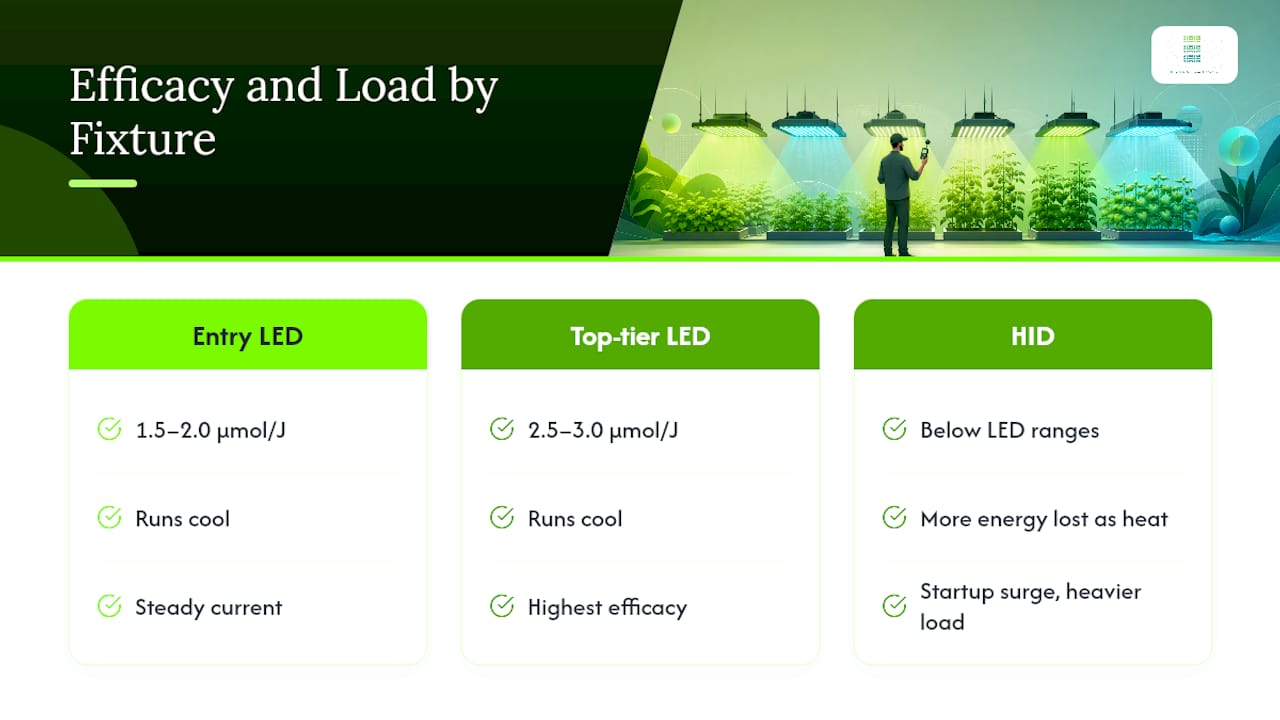
Mixing light classes multiplies your electrical planning work, not just your photon count. LED drivers pull relatively steady current and run cool, but HID ballasts draw a heavier startup surge and sustained load, and stacking that onto a circuit sized for LED alone risks tripped breakers or, worse, overheated wiring. Before adding any HID or fluorescent fixture to an LED room, check your circuit’s amperage rating against the combined draw of every fixture running on it, plus your ventilation fans and controllers.
Efficacy varies sharply by class. Entry-level LED fixtures deliver around 1.5 to 2.0 µmol per joule, while top-tier modern panels reach 2.5 to 3.0 µmol per joule. HID fixtures fall well below that range once you account for the energy lost as heat rather than usable light. That efficiency gap means every HID fixture you add to a mixed setup increases your power draw far faster than it increases usable PPFD, which is the actual math that should drive whether mixing makes financial sense for your grow.
Dedicated circuits matter more than most growers assume. Running your primary LED panel and a supplemental HID unit on the same circuit as your exhaust fan and controller creates a single point of failure. Split high-draw fixtures across separate circuits where your electrical panel allows it, and label each circuit clearly so troubleshooting a tripped breaker doesn’t turn into a guessing game during flower week.
Every added fixture is a recurring cost, not just an upfront one. HID bulbs need replacement on a schedule, typically annually with heavy use, while LED panels commonly run for years before output degrades enough to matter. Factor bulb replacement, higher electricity draw, and added cooling load into your cost comparison, not just the sticker price of the second fixture.
The return depends entirely on whether the added light closes a real PPFD or spectral gap. If your canopy already sits within that 10 to 15% tolerance of your target, the added fixture mostly returns higher power bills and more heat to manage, with little to show for it in the harvest weight.
Commercial growers scaling across multiple rooms should run this math per room, not once for the whole operation. A single-fixture LED setup that hits DLI with even coverage in Room A doesn’t mean Room B, with a taller canopy or denser plant spacing, will perform the same way with the identical fixture. Mixed lighting decisions made at scale need PPFD data specific to each room’s mounting height and canopy density, or you risk overspending on lights that some rooms never needed while others stay underlit.
Dimming compatibility is where a lot of mixed-light plans quietly fall apart. LED drivers commonly support 0 to 10V dimming or PWM (pulse width modulation) control, while HID ballasts often dim across a much narrower range, sometimes only 50 to 100% output, and some magnetic ballasts don’t dim at all. Before you wire a controller to both fixture types, confirm each one’s dimming protocol matches what your controller actually outputs.
Smart controllers and grow room automation systems increasingly support multiple protocols, but mixing brands and fixture generations on one controller still causes mismatched response curves. A 50% dimmer setting might mean 50% output on your LED panel and a completely different reduction on your HID ballast, throwing off the PPFD ratios you calculated during setup. Test each fixture’s actual output at every dimmer setting with a PAR meter rather than trusting the percentage on the controller display.
Zoning solves most of these headaches. Running your primary LED panel and any supplemental fixture on separate dimmer channels, even if they share one controller, lets you adjust each independently as you tune your mixed setup through veg and flower. If your controller can’t handle multiple fixture protocols cleanly, a simple mechanical timer or basic dimmer switch on the secondary fixture is often more reliable than forcing incompatible hardware to sync.
I only add a second light class to solve a measurable PPFD or spectral gap, never for novelty or because a room “looks underlit.” My checklist before any mixed setup: measure current PPFD, map the canopy, zone the dimmers, verify heat load against ventilation capacity, then run two weeks of observation before calling the setup finished.
— Scott
If your PPFD map shows a real gap rather than just an itch to add more gear, certain suppliers offer fixtures built for exactly that role. The Grower’s Choice ROI-FF 650W works as a main-panel fixture for a 4x4 flowering tent, delivering the canopy-wide PPFD most single-fixture setups need without a supplemental source at all.
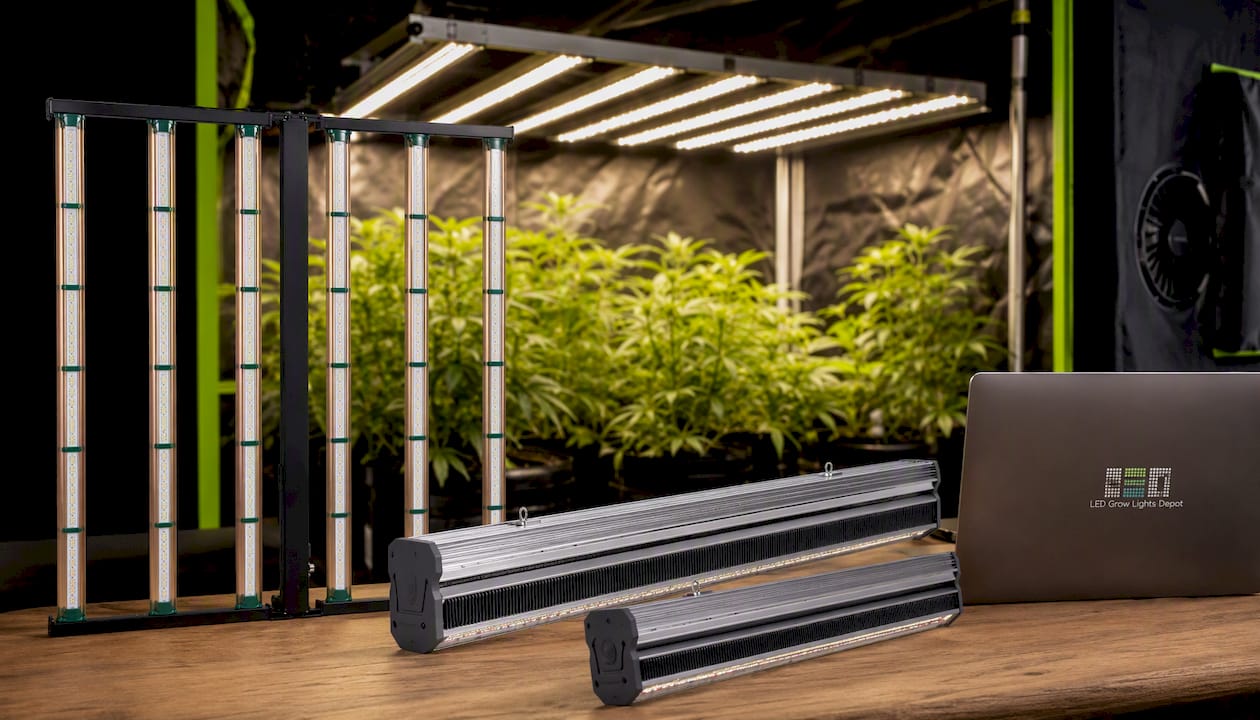
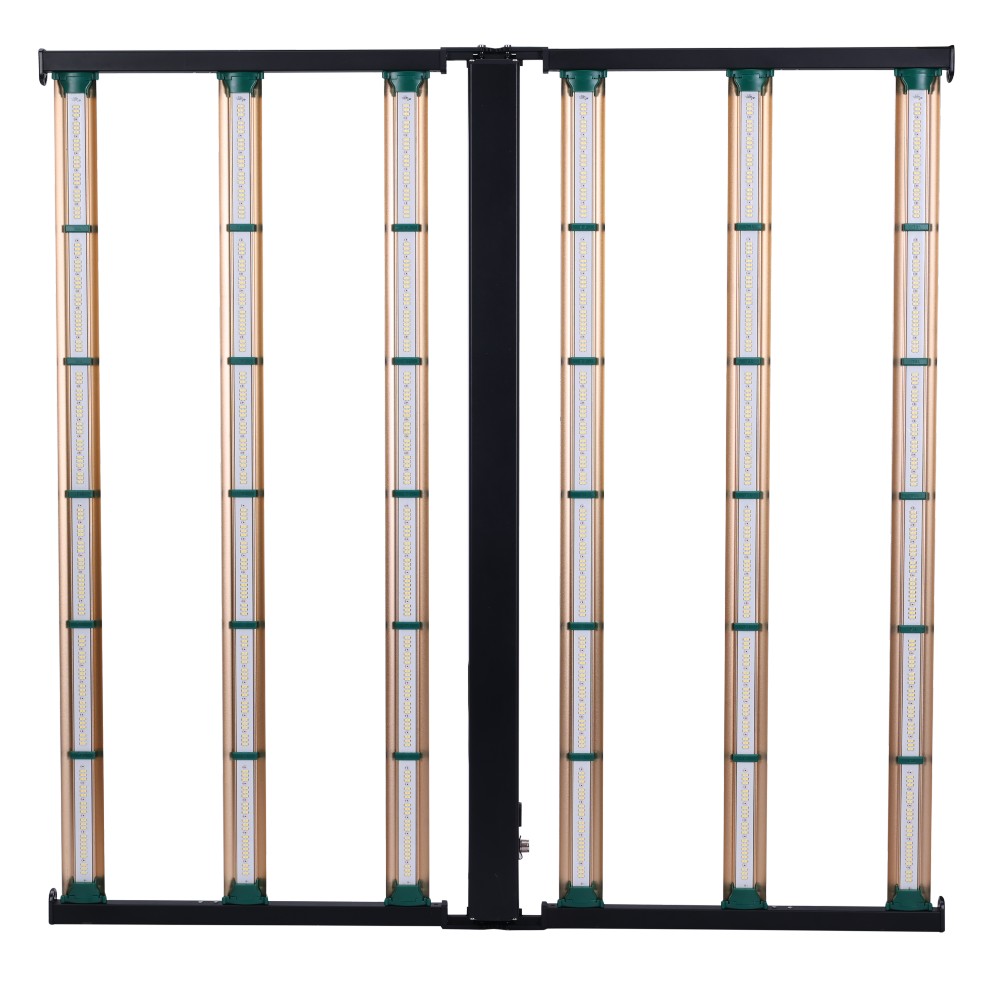
For growers who want a smaller primary panel or a paired fixture in a mixed configuration, the ThinkGrow LED Model-I delivers full-spectrum coverage suited to smaller benches or secondary zones. The ThinkGrow LED Model-I Plus adds extra dimmable channels for growers who want finer spectrum control when zoning a mixed rig between a main panel and under-canopy fill lighting.
Before buying anything, run through this checklist: confirm published efficacy in µmol per joule, request or check a PPFD map at your intended mounting height, verify how many dimming channels the fixture supports, and read the warranty and return policy so a mismatch doesn’t become a permanent cost. Compare LED and HPS trade-offs in more detail through this LED vs HPS breakdown before you decide whether your room needs one fixture or two. If you’re ready to size a rig for your specific tent dimensions, browse the full fixture lineup and start mapping your target PPFD against real specs.
For deeper reference, see the Iowa State extension guide on supplemental lighting, a PPFD and DLI calculator, and a reliable PAR meter to verify any plan before you commit.
0 of 3 items selected

Leave a comment