
Free Shipping in the USA on nearly all items!
Limited phone hours during the Holidays! Call us: 888-611-9305
Free Shipping in the USA on nearly ALL items! Limited phone hours during the Holidays!

The role of meandering light paths in a plant canopy is to create complex, diffused light patterns that push photosynthesis deeper into foliage through indirect and scattered illumination. This process is not random. It follows structured interactions between leaf angles, canopy porosity, and the geometry of incoming light. Metrics like Leaf Area Index (LAI) and Gap Fraction quantify how open or closed a canopy is, directly controlling how much light reaches lower leaves. Recent 2026 research on seabuckthorn plantations and birch-blueberry forests confirms that canopy architecture drives light distribution more than raw light intensity does. For indoor growers, understanding these dynamics is the first step toward building a lighting system that actually performs.
Canopy light distribution is governed by Gap Fraction, the proportion of open sky visible through the leaf layer. Gap Fraction explains 70% of the effect on photosynthetically active radiation (PAR) reaching lower plant zones. That single metric tells you more about light penetration than wattage alone ever will.
As LAI increases with plant age, the canopy closes. LAI rising from 1.2 to 4.3 reduces the gap rate from 35% down to 10%, cutting light in middle and lower foliage zones by over 85%. This is the core problem indoor growers face as plants mature and canopies thicken.
Leaf angles and canopy architecture cause light to scatter rather than travel in a straight line. This scattering creates penumbra zones, the soft-edged shadows where light intensity is reduced but not eliminated. Dappled shading from these penumbra zones is not a loss. It is a feature. It allows lower leaves to receive usable light without the stress of direct, concentrated exposure.
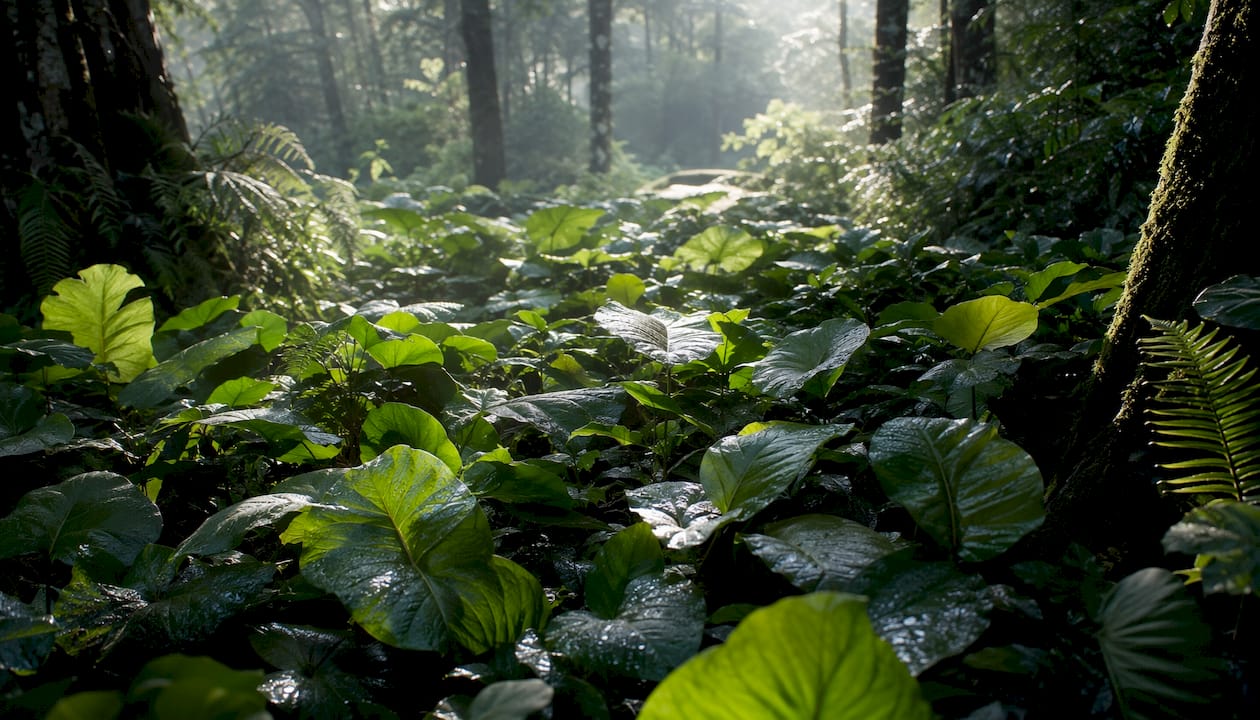
Species composition also matters. A 2026 birch-blueberry forest study found that light under birch canopy measures roughly 10,500 lux compared to 66,000 lux in open areas. Under dense spruce canopy, that figure drops to just 4,300 lux. The difference between birch and spruce represents a factor of 2.4x in light penetration. For indoor growers, this translates directly: canopy density and leaf architecture shape the light environment far more than most growers realize.
| Canopy type | Light intensity | Relative to open area |
|---|---|---|
| Open area | 66,000 lux | 100% |
| Birch canopy | 10,500 lux | ~16% |
| Spruce canopy | 4,300 lux | ~6.5% |
| Dense indoor canopy (closed LAI) | Estimated severe reduction | Over 85% loss at lower zones |
The table above shows why canopy management is not optional. Without active intervention, lower leaves operate in near-darkness regardless of how powerful your grow light is.
Diffused, meandering light reduces localized leaf stress. When light scatters through a porous canopy, no single leaf absorbs a concentrated dose for extended periods. This distributes the photosynthetic load across more leaf surface area, improving overall energy conversion efficiency.
Spectral quality matters as much as intensity. Narrow-spectrum blue-heavy LEDs cause mitochondrial decline in plants, reducing mitochondrial protein levels and triggering metabolic stress. Broader spectra covering 400–1500nm, including red and near-infrared wavelengths, are necessary to maintain plant metabolic health. Natural meandering light delivers this spectral breadth automatically. Indoor systems must engineer it deliberately.
The physiological benefits of diffused canopy light include:
A multispectral light approach that mimics natural sunlight cycles prevents mitochondrial dysfunction and improves crop vitality under indoor LED lighting. This is not a marginal gain. It is the difference between a plant that survives and one that thrives.
Pro Tip: If your plants show bleaching at the top and pale, underdeveloped growth at the bottom, your canopy is blocking light paths. Thinning the upper canopy by 20–30% often restores light access to lower zones without reducing total leaf area significantly.
Replicating natural canopy light diffusion indoors requires deliberate changes to both your lighting setup and your plant canopy structure. The goal is to create the same scattered, indirect light that a forest canopy produces naturally.
Increasing module-to-canopy distance reduces harsh shadows and hot spots by allowing light to smooth out before it hits the leaf surface. This simulates the penumbra effect that natural canopy geometry creates. Raising your fixture by even 6–12 inches can meaningfully change the light distribution pattern across your canopy.
Wavefront engineering offers a more advanced solution. Microlens array technology transmits 27% of light indirectly through obstacles, enabling illumination of shaded lower canopy layers via engineered light paths. This technology is now entering commercial grow light design and represents a direct application of forest light physics to indoor cultivation.
Follow these steps to build a more natural light environment in your grow space:
Pro Tip: Canopy light distribution improves significantly when you combine canopy thinning with raised fixtures. Neither change alone delivers the same result as both together.
Dynamic canopy light modeling shows that managing leaf angles, azimuth, and canopy porosity can increase early-season light intensity up to 100%, which accelerates early plant growth phases. The same principle applies indoors when you actively manage your canopy structure rather than letting it grow unchecked.
Quantifying light distribution requires specific metrics and tools. Without measurement, canopy management is guesswork. With it, you can predict how pruning, repositioning, or adding fixtures will change light levels at every layer of your plant.
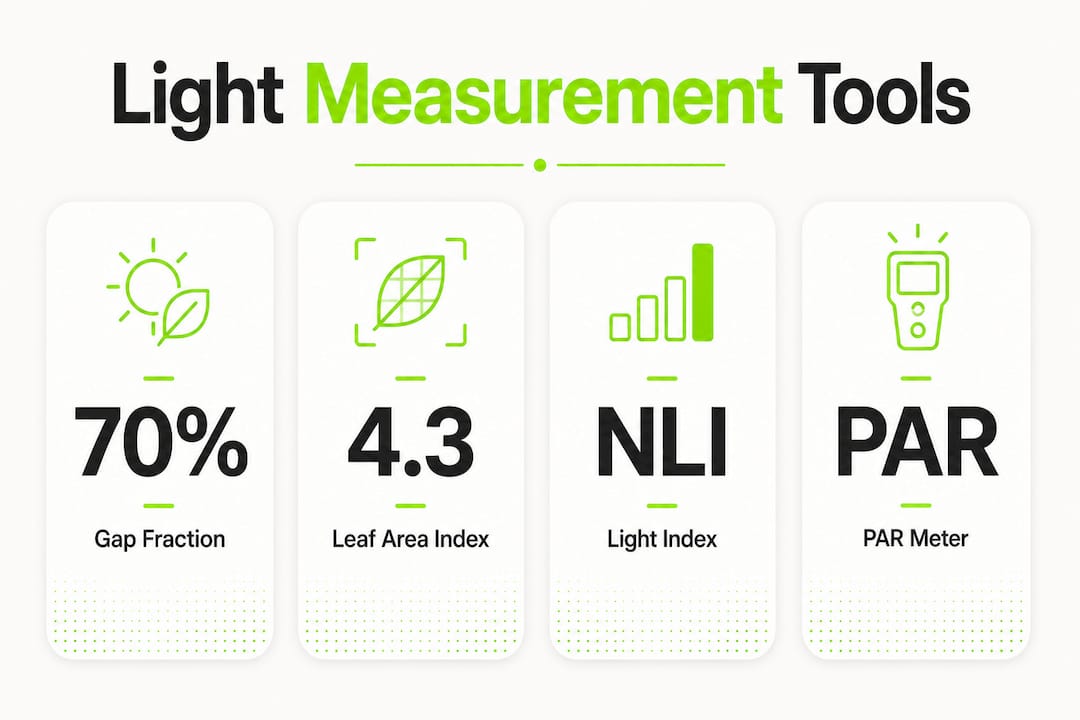
Leaf Area Index (LAI) measures total leaf surface area per unit of ground area. A higher LAI means a denser canopy and fewer light paths to lower zones. Gap Fraction measures the proportion of open sky visible through the canopy. Together, these two metrics define how light travels through your plant structure.
The Neighbourhood Light Index (NLI) takes this further. NLI derived from LiDAR data predicts understory light intensity with an RMSE of just 6.19% and an MAE of 4.57%. That level of accuracy means you can simulate the effect of canopy changes before you make them. Predictive modeling tools like NLI let growers simulate light conditions after pruning or thinning, avoiding yield drops from over-dense canopies.
Radiance-compatible Python frameworks now support multispectral, dynamic canopy modeling. These tools account for leaf movement, seasonal changes, and spectral shifts across the day. Canopy models that ignore porosity underestimate light penetration by roughly 26%, with peak seasonal gains up to 100% before canopy closure. Static models simply cannot capture this.
| Tool or metric | What it measures | Practical use |
|---|---|---|
| Leaf Area Index (LAI) | Total leaf area per ground area | Indicates canopy density and light blocking potential |
| Gap Fraction | Open sky proportion through canopy | Predicts PAR reaching lower zones |
| Neighbourhood Light Index (NLI) | Spatial understory light intensity | Simulates post-pruning light conditions |
| PAR meter | Photosynthetically active radiation | Direct measurement at any canopy depth |
| Multispectral modeling (Python/Radiance) | Dynamic spectral light distribution | Models seasonal and structural light changes |
For most indoor growers, a PAR meter combined with LAI estimation gives enough data to make informed decisions. Commercial growers with larger canopies benefit from NLI-based modeling to plan pruning schedules and fixture placement.
Meandering light paths are the primary mechanism by which canopy structure controls photosynthesis depth, spectral quality, and plant metabolic health across all foliage layers.
| Point | Details |
|---|---|
| Gap Fraction drives light penetration | Gap Fraction explains 70% of PAR distribution, making canopy openness the key variable to manage. |
| Dense canopies block over 85% of light | LAI rising from 1.2 to 4.3 cuts lower-zone light by more than 85%, starving lower leaves. |
| Broad spectrum prevents metabolic stress | Narrow-spectrum LEDs cause mitochondrial decline; spectra covering 400–1500nm are necessary for plant health. |
| Distance and diffusion reduce hot spots | Raising fixtures and adding diffusers replicates natural penumbra, reducing leaf stress and improving distribution. |
| NLI modeling predicts pruning outcomes | Neighbourhood Light Index tools predict post-pruning light levels with under 7% error, supporting informed decisions. |
Most growers I talk to focus almost entirely on wattage. They upgrade to a higher-output fixture and expect better results. What they miss is that the canopy itself is the primary filter controlling how much of that light actually reaches the plant.
I have seen setups where a 1,000-watt fixture delivers less usable light to lower buds than a 600-watt fixture with proper canopy management. The physics are straightforward. A dense canopy blocks over 85% of light before it reaches the lower third of the plant. Adding more watts at the top does not fix that. Thinning the canopy, raising the fixture, and adding under-canopy supplemental light does.
The spectral piece is equally underappreciated. Growers who switch to broad-spectrum LEDs covering red and near-infrared wavelengths consistently report better bud density and plant vitality. The research on mitochondrial health under narrow-spectrum LEDs is clear. Plants need the full range, not just blue and red peaks.
The future of indoor growing is dynamic light management. Sensor-based systems that adjust spectrum and intensity based on real-time canopy readings are already available. Growers who adopt this approach will outperform those still chasing wattage numbers. The shift from static lighting to diffuse, dynamic light strategies is not a trend. It is the direction the science points.
— Scott
Getting light to every layer of your canopy requires the right hardware, not just the right technique. Ledgrowlightsdepot carries fixtures and controllers built specifically for dynamic, multi-layer light distribution.

The TrolMaster Hydro-X Lighting Control Adapter lets you automate DLI-based lighting schedules, adjusting intensity throughout the day to mimic natural light cycles. The California Lightworks SolarSystem 1100 UVB delivers a broad-spectrum output designed for deep canopy penetration and full-plant health. Ledgrowlightsdepot’s proximity systems are rated 4.8 out of 5 across more than 5,800 customer reviews. Browse the full LED grow lights catalog to find the right setup for your canopy size and growth stage.
Meandering light paths are the indirect, scattered routes that light takes as it interacts with leaves, branches, and canopy gaps. They create diffused, penumbra-rich light patterns that reach lower foliage layers rather than concentrating at the canopy top.
A higher LAI means a denser canopy with fewer gaps. Research shows LAI rising from 1.2 to 4.3 reduces lower-zone light by over 85%, making canopy thinning necessary to restore light access.
Narrow-spectrum blue-heavy LEDs cause mitochondrial protein reduction and metabolic stress in plants. Spectra covering 400–1500nm, including red and near-infrared wavelengths, are required to maintain full plant metabolic health.
Gap Fraction is the proportion of open sky visible through a canopy. It explains 70% of the variation in PAR reaching lower plant zones, making it the most important single metric for light management decisions.
Yes. Raising fixture height, adding diffuser panels, thinning the upper canopy, and using multispectral LEDs all replicate the scattering effects of natural canopy light paths. Wavefront engineering with microlens arrays can transmit 27% of light indirectly to shaded lower layers.
0 of 3 items selected


Leave a comment