
Free Shipping in the USA on nearly all items!
Limited phone hours during the Holidays! Call us: 888-611-9305
Free Shipping in the USA on nearly ALL items! Limited phone hours during the Holidays!

The fastest leggy seedlings fix is three moves: bring your light closer, drop the temperature, and add gentle airflow. Do all three within the next hour and you will stop the stretching. Most seedlings show visible stem thickening within 3–7 days once conditions improve.
Act now — do these five things immediately:
Light is the primary driver. University of New Hampshire Extension confirms that light quantity (measured as PPFD or Daily Light Integral) and fixture distance are the main causes of stretch in indoor seedlings. A target of 200–300 µmol·m⁻²·s⁻¹ at the canopy over a 16-hour photoperiod gives most common seedlings what they need. LedGrowLightsDepot carries fixtures sized for exactly this range, from compact bars to full-spectrum panels.
Fixing leggy seedlings comes down to one core correction: deliver adequate light at the right distance, starting immediately, and pair it with cooler temperatures and airflow.
| Point | Details |
|---|---|
| Light is the primary fix | Position LEDs 2–6 inches above the canopy (bars) or 12–18 inches (panels); target 200–300 µmol·m⁻²·s⁻¹. |
| Photoperiod target | Run lights 16 hours on, 8 hours off using a timer, as recommended by University of Minnesota Extension. |
| Temperature matters | Remove heat mats after sprouting; keep daytime temps at 60–70°F to stop heat-driven elongation. |
| Bury stems selectively | Tomatoes, tomatillos, eggplant, and basil root from buried stems; do not bury lettuce, cucumbers, or peas. |
| LedGrowLightsDepot fixtures | Options range from the Sunblaster Micro LED for small trays to the Grower’s Choice ROI-E720 for larger setups. |
Leggy seedlings have one defining trait: too much stem, not enough substance. The plant has spent its energy reaching toward light rather than building structure.
Diagnostic checklist — your seedling is leggy if:
A healthy seedling is compact, with short internodes, a thick stem relative to its height, and leaves that are dark green and horizontal. If yours looks stretched and pale by comparison, you are dealing with legginess.
**
Legginess is not random. Each cause triggers a specific plant response, and knowing which one applies to your tray points you directly to the right fix.
Insufficient light or light positioned too far away. This is the most common cause. When photon levels drop below what a seedling needs, it activates shade-avoidance responses, elongating internodes to “reach” toward a brighter zone. Garden Betty’s research confirms that insufficient or inconsistent indoor light is the leading driver of weak, leggy seedlings. Even a south-facing windowsill in late winter rarely delivers enough light, which is why supplemental LED lighting is commonly required from day one.
Excessive heat after germination. Heat mats are useful for sprouting but harmful once seedlings emerge. Temperatures above 75°F after germination accelerate cell elongation, producing soft, stretched growth even under adequate light.
Overcrowding. When seedlings compete for light, each plant stretches upward to outcompete its neighbors. Crowded cells also restrict root development, which weakens stems further.
Poor air circulation. Still air allows seedlings to grow without mechanical resistance. Wind or airflow triggers thigmomorphogenesis, the process by which physical movement stimulates thicker, shorter stem growth. Without it, stems stay thin.
Overwatering or a weak seed-starting mix. Consistently wet soil encourages shallow roots and soft tissue. It also raises damping-off risk, a fungal condition that rots stems at the soil line. A sterile, well-draining seed-starting mix prevents both problems.
A note on timing: Starting seeds too early in the season compounds every one of these issues. Seeds started 8–10 weeks before last frost in low-light February conditions face the worst combination of weak natural light and cold windowsill temperatures. Matching your start date to your local last frost date reduces the window during which seedlings must survive on marginal light.
Most leggy seedlings can be rescued if caught early, but the answer depends on species and severity.
Species that recover well:
Species where restarting is often smarter:
Quick assessment — decide in two minutes:
Mild stretch with green leaves and firm roots: save it. Collapsed, yellowing, or rotting stems: restart.
Follow this sequence in order. Steps 1–3 are immediate; steps 4–6 happen over the next 24–72 hours and beyond.
Give bright, close light right now. Position low-power LED bars 2–6 inches above the canopy. For stronger full-spectrum fixtures, start at 12–18 inches and lower gradually. Set a timer for 16 hours on, 8 hours off. This single step stops new stretch within 24 hours.
Remove heat mats and lower temperature. Once seedlings have sprouted, heat mats drive elongation. Target 60–70°F during the day. Avoid temperatures above 75°F. Cooler nights (55–65°F) actually promote compact, sturdy growth.
Add gentle airflow. Set a small oscillating fan on its lowest setting so leaves move slightly but are not blown flat. Alternatively, brush your hand lightly across the tops of seedlings for 30–60 seconds twice a day. This mimics wind, strengthens stems, and reduces damping-off risk by limiting surface moisture.
Thin overcrowded trays. Cut (do not pull) extra seedlings at soil level, leaving the strongest one per cell. Pulling risks disturbing roots of the seedling you keep.
Repot and bury stems where appropriate. For tomatoes, tomatillos, eggplant, and basil, repot into a deeper container and bury the stem up to the lowest set of true leaves. Buried stem tissue produces adventitious roots, converting a liability into a stronger root system. Use a sterile seed-starting or potting mix. Do not bury lettuce, cucumbers, or peas.
Add temporary support and adjust watering. Use a toothpick or bamboo skewer as a stake for very floppy seedlings. Water only when the top inch of mix is dry. Hold off on fertilizer until new compact growth appears, typically 5–10 days after fixing light conditions.
What to expect:
Pro Tip: If you do not yet have a grow light, place seedlings under two or three standard cool-white shop light tubes (T5 or T8 fluorescents) positioned 2–3 inches above the canopy as a short-term bridge. This is not ideal long-term, but it stops the stretch while you source a proper full-spectrum LED. Check the seedling light schedule guide at LedGrowLightsDepot for photoperiod recommendations by crop.
Recovery callout: Wired Homestead’s stepwise rescue routine confirms that moving to full-spectrum LEDs close to plants, combined with airflow and cooler temperatures, produces visible improvement in days to weeks for most species.
Tomatoes: Bury the stem deeply at repotting. Lay the stem horizontally in a trench if it is very long, angling the top upward. New roots form along the buried section within 7–10 days. This is the most forgiving crop for legginess recovery.
Peppers: Increase light and add airflow first. Peppers do not root as readily from buried stems as tomatoes do, so deep burying is less reliable. Focus on compact new growth rather than trying to recover the stretched portion.
Brassicas (broccoli, cabbage, kale, cauliflower): Respond well to light correction. You can bury the stem slightly deeper at transplant, but avoid burying more than 1–2 inches. Kale and broccoli are particularly forgiving.
Lettuce and salad greens: Do not bury. Lettuce stems rot easily when covered. Stake floppy plants temporarily, correct the light immediately, and replace if the stretch is severe. Lettuce grows fast enough that restarting is rarely a setback.
Cucumbers, squash, and melons: Do not bury and avoid disturbing roots. These crops dislike transplant stress. If severely leggy, resow. They germinate in 5–7 days and catch up quickly.
Flowers (zinnias, marigolds, cosmos, impatiens): Most annual flowers respond well to light correction and gentle airflow. Zinnias and marigolds can be buried slightly deeper. Impatiens are more sensitive; replace if severely stretched. Cosmos are fast-growing and easy to resow.
Prevention costs far less time than rescue. Apply this checklist from the moment you sow.
Prevention checklist:
Seed-start timing reference:
| Crop | Weeks before last frost to start indoors | Transplant outdoors |
|---|---|---|
| Tomatoes | 6–8 weeks | After last frost, soil 60°F+ |
| Peppers | 8–10 weeks | After last frost, soil 65°F+ |
| Broccoli / Cabbage | 4–6 weeks | 2–4 weeks before last frost |
| Lettuce | 4–6 weeks | 4–6 weeks before last frost |
| Zinnias / Marigolds | 4–6 weeks | After last frost |
| Cucumbers | 2–3 weeks | After last frost, soil 70°F+ |
| Cause | Typical symptom | Do this right now | Prevention tip |
|---|---|---|---|
| Light too dim or too far | Tall, thin stems; long internodes; pale leaves | Lower light to 2–6 inches (bars) or 12–18 inches (panels); set 16-hour timer | Use full-spectrum LEDs from day one |
| Light too far away | Seedlings lean strongly toward one side | Reposition light directly above canopy; rotate trays daily | Center fixture over tray; use multiple bars for even coverage |
| Heat mat left on too long | Soft, fast-elongating stems despite adequate light | Remove heat mat immediately; target 60–70°F daytime | Remove mat once most seeds have sprouted |
| Overcrowding | Seedlings competing upward; thin, pale stems | Thin to one seedling per cell by cutting at soil level | Sow 1–2 seeds per cell; thin early |
| Poor air circulation | Floppy stems; damping-off at soil line | Add fan on lowest setting; brush stems gently twice daily | Run fan continuously at low speed |
| Overwatering | Mushy stem base; yellowing lower leaves; mold on soil | Let mix dry to 1 inch depth before watering; improve drainage | Water only when top inch is dry; use sterile seed-starting mix |
Two numbers matter most when setting up a seedling light: PPFD and DLI.
PPFD (Photosynthetic Photon Flux Density) measures how many light photons hit the canopy per second, expressed in µmol·m⁻²·s⁻¹. DLI (Daily Light Integral) is the total photon dose delivered over a full day. Think of PPFD as the flow rate and DLI as the total volume delivered.
For most common seedlings, a practical canopy target is 200–300 µmol·m⁻²·s⁻¹ over a 16-hour photoperiod. Extension services recommend thinking in DLI and PPFD rather than informal “hours at a window” when planning indoor seed starting, because window light varies too much by season and orientation to be reliable.
Distance and intensity:
Light intensity drops sharply as distance increases. Moving a fixture from 4 inches to 8 inches above the canopy does not halve the intensity — it reduces it to roughly one-quarter, following the inverse-square principle. In practical terms: keep low-power LED bars 2–6 inches above seedlings and raise them as plants grow. Stronger full-spectrum panels work well at 12–18 inches. Raise the fixture as plants grow to maintain consistent intensity rather than letting seedlings grow into the light zone.
Spectrum:
Blue-dominant light (400–500 nm range) promotes compact, short-internode growth. Full-spectrum white LEDs cover this range naturally and are the most reliable choice for beginners. Avoid warm-white-only bulbs, which are heavy in red wavelengths and can encourage stretch. For more detail on why seedlings need different light than adult plants, LedGrowLightsDepot’s resource library covers spectrum differences by growth stage.
Multiple bars vs. one large fixture:
For many home setups, two or three lower-intensity bars per shelf provide more even canopy coverage than a single high-output fixture. This reduces edge stretching, where seedlings at the tray perimeter receive less light and stretch toward the center.
Pro Tip: Without a PAR meter, use plant cues: compact new growth and dark green leaves mean intensity is adequate. Pale new leaves or continued stretch means the light is too far or too dim. Free phone apps (such as Photone) give a rough PPFD estimate using the phone camera — not lab-accurate, but useful for ballpark checks. Always use a timer; consistent photoperiods matter as much as intensity.
A leggy seedling that makes it to the garden is not starting from the same position as a compact one. The structural deficit carries forward.
Thin, elongated stems are mechanically weaker. They snap more easily in wind, require staking in the field, and are more vulnerable to pest and disease entry at damaged points. Root systems in leggy seedlings tend to be underdeveloped relative to the above-ground mass, which means the plant struggles to take up water and nutrients efficiently during the critical establishment phase after transplanting.
Yield is affected too. Tomatoes and peppers that were severely leggy as seedlings often show delayed flowering, reduced fruit set in the first flush, and lower total yield compared to compact transplants started under adequate light. The plant spends early weeks in the garden compensating for structural weakness rather than building the canopy and root mass that drive production.
For crops like lettuce and brassicas, legginess at transplant often means the plant bolts earlier under field stress, cutting the harvest window short. The compounding effect of a weak start rarely fully corrects itself outdoors, even with good soil and irrigation.
Not every stretched seedling deserves rescue effort. Knowing when to cut losses saves time and growing space.
Replace rather than rescue when you see any of these:
A practical rule: if fixing the light and temperature today would give the seedling fewer than 3–4 weeks of healthy growth before your transplant window, resow now and run the corrected setup from the start.
The single intervention that produces the most visible improvement, fastest, is moving the light closer. Not buying a new light, not changing the soil, not adjusting the schedule. Just physically lowering the fixture to the correct distance. Seedlings that have been under a light positioned 18 inches too high often show measurable stem thickening within 72 hours of correction, simply because the photon dose at the canopy jumps dramatically.
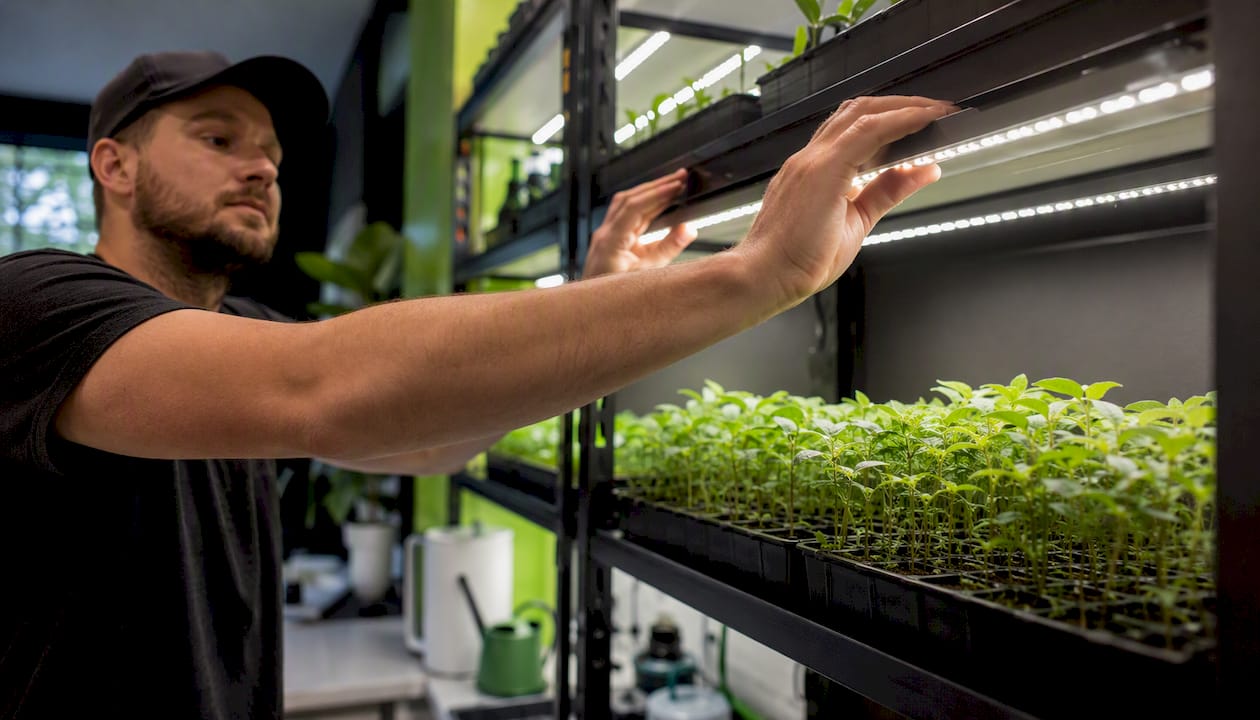
The second-fastest result comes from adding airflow. A fan running on low overnight produces noticeable stem stiffening within a few days. Most home growers skip this step entirely, which is why their seedlings stay floppy even after fixing the light.
Temperature is the most underrated variable. Growers focus on light and forget that a heat mat running under a tray at 75°F+ is actively driving elongation regardless of what the fixture is doing. Removing it is free and immediate.
The combination of close bright light, gentle airflow, and cooler temperatures stops legginess faster than any single fix alone. LedGrowLightsDepot’s guide to LED grow lights for seedlings covers fixture selection for home setups in more detail.
A dedicated seedling LED solves the core problem permanently: uniform intensity, adjustable hanging height, low heat output, and a full spectrum that discourages stretch from day one.
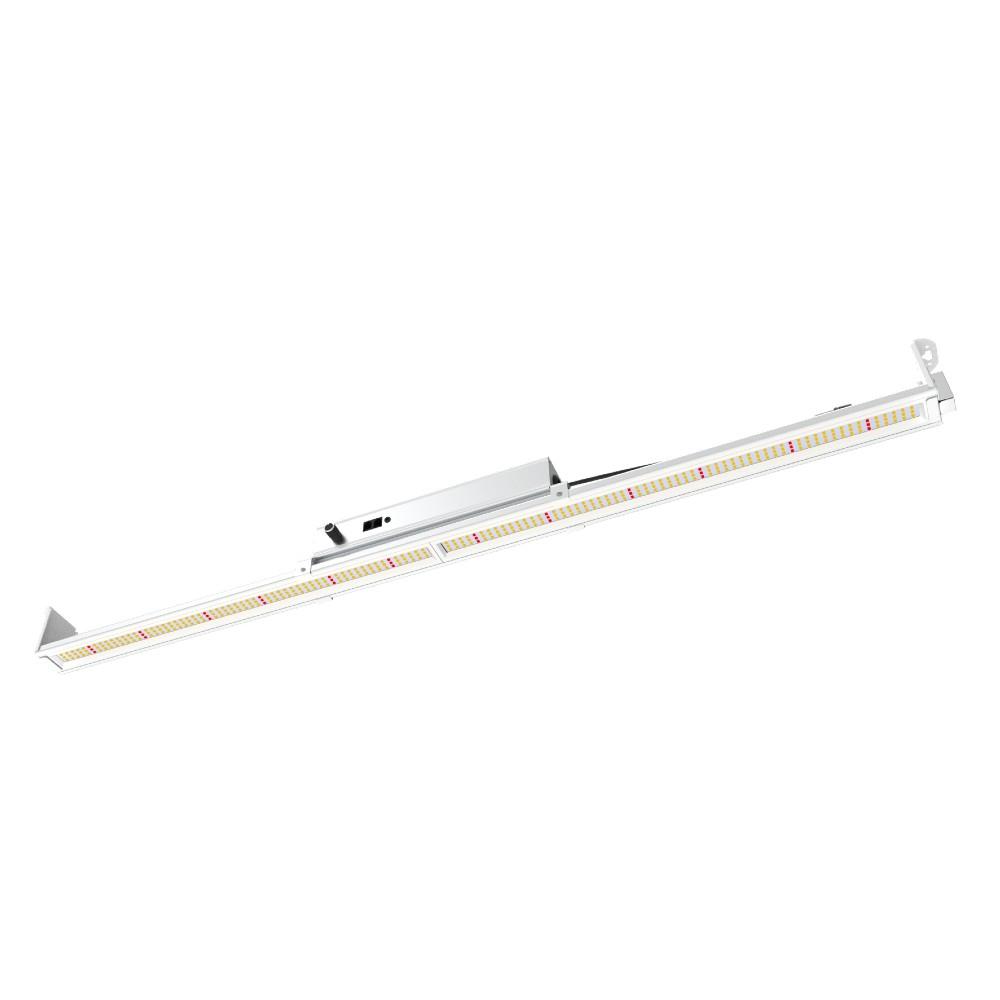
When selecting a fixture, check for dimmability (useful for hardening off), full-spectrum output with blue-range coverage, and a hanging system that lets you raise the light as plants grow. For small trays and single-shelf setups, the Sunblaster Micro LED Grow Light Garden is a practical, low-cost starting point. The ThinkGrow LED Model-I suits growers who want a compact, adjustable bar for a standard seed-starting shelf. For larger carts or growers planning to scale, the Grower’s Choice ROI-E420 delivers full-spectrum output across a wider footprint, and the Grower’s Choice ROI-E720 handles multi-shelf or commercial-scale seed starting. The ThinkGrow LED Model-I Plus offers a broader spectrum upgrade for more demanding setups, while the CeresLux QuadRay 1000W and the PROXIMITY Cube Lighting System address high-output and under-canopy supplemental needs. Browse the full range at LedGrowLightsDepot and use the product filters to match fixture size to your tray footprint and budget.
0 of 3 items selected


Leave a comment