
Free Shipping in the USA on nearly all items!
Limited phone hours during the Holidays! Call us: 888-611-9305
Free Shipping in the USA on nearly ALL items! Limited phone hours during the Holidays!

For most LED grows, aim for air temperatures in the low to mid 80s °F while lights are on, or warmer if you’re running supplemental CO₂. Drop nighttime temperatures by 6°F to 10°F depending on growth stage. These are ambient air targets, not gospel. Actual results depend on leaf surface temperature and VPD (vapor pressure deficit), which is why checking both a wall probe and a leaf-level reading matters more than chasing one number on a thermostat.
TL;DR:
- Grow room ambient temperatures under LEDs should be in the low to mid 80s Fahrenheit during lights-on, with leaf surface temperatures typically cooler than the air.
- Temperature and humidity targets vary by stage, with seedlings needing higher humidity and cooler leaf temperatures, while flowering stages benefit from gradually dropping temperatures and humidity.
- Accurate monitoring requires placing probes at canopy height and using infrared thermometers to track leaf surface temperature, not just wall-mounted thermostats.
- LED grow rooms often need warmer ambient temperatures than HPS setups because leaf temperatures are cooler than room air, which affects transpiration and CO2 uptake.
- Automation systems like the Medic Grow GLC-1 or Mars Hydro Controller 43 can help maintain stable temperatures and humidity by reacting faster than manual adjustments.
Plants don’t want the same climate on day one that they want during week seven of flower. Cannabis and most herb crops shift their tolerance for heat and humidity as roots, stems, and buds develop, and matching that shift is where most yield gets won or lost.
Here’s how the targets break down by stage:
VPD ties temperature and humidity together into one number that tells you how hard the air is pulling moisture from the leaf. Seedlings run best at lower VPD values, vegetative plants target moderate ranges, and flowering plants tolerate higher VPD as buds mature. If your VPD-based environmental targets don’t line up with your temperature and RH readings, adjust the RH first. It’s the faster lever to pull.
LEDs don’t heat a room the way HPS fixtures do, and that single fact rewrites most of the old temperature rules growers memorized a decade ago. HPS bulbs throw off enormous radiant and infrared heat directly onto the canopy. LEDs push far less radiant heat into the leaf surface itself, but the drivers and boards still dump real heat into the surrounding room air.
The practical result: leaf surface temperature under LED can run noticeably cooler than the room’s ambient air temperature. One independent benchmark of LED grow rooms recorded average daytime conditions near 79°F with nighttime dropping to about 72°F, alongside daytime RH near 40%, showing how much cooler LED canopies run compared to the warmer air growers often assume they need.
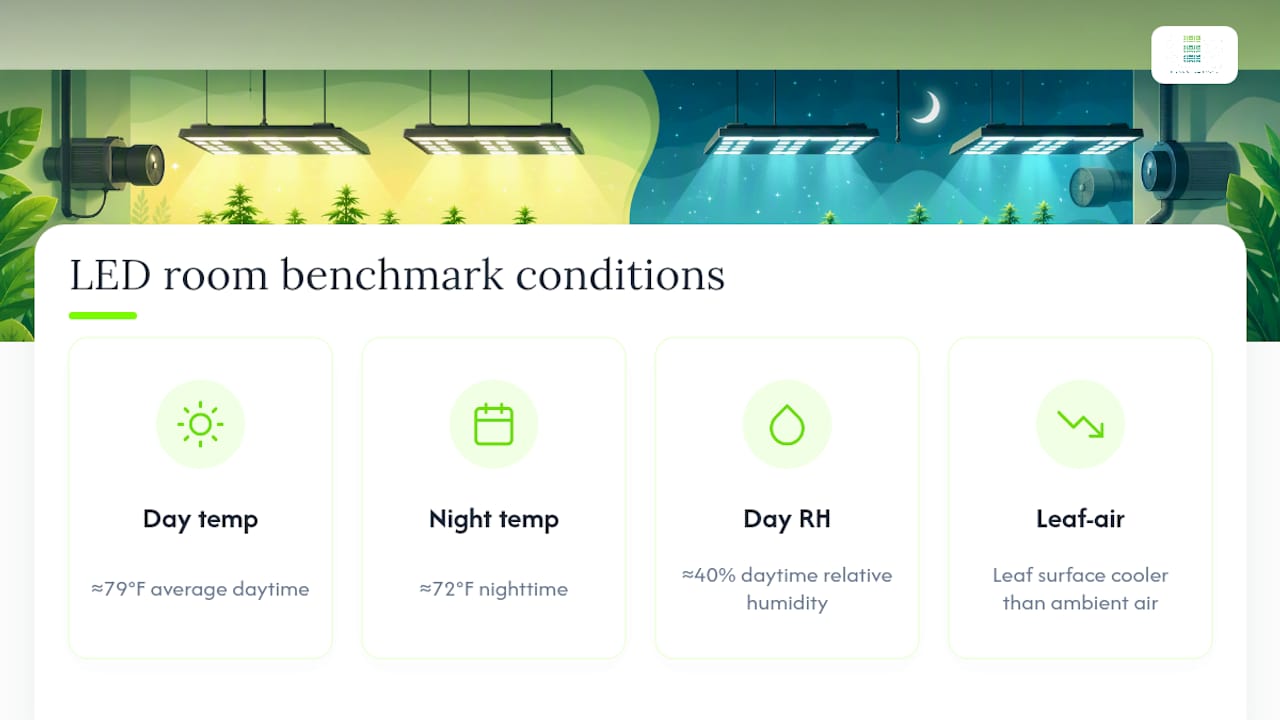
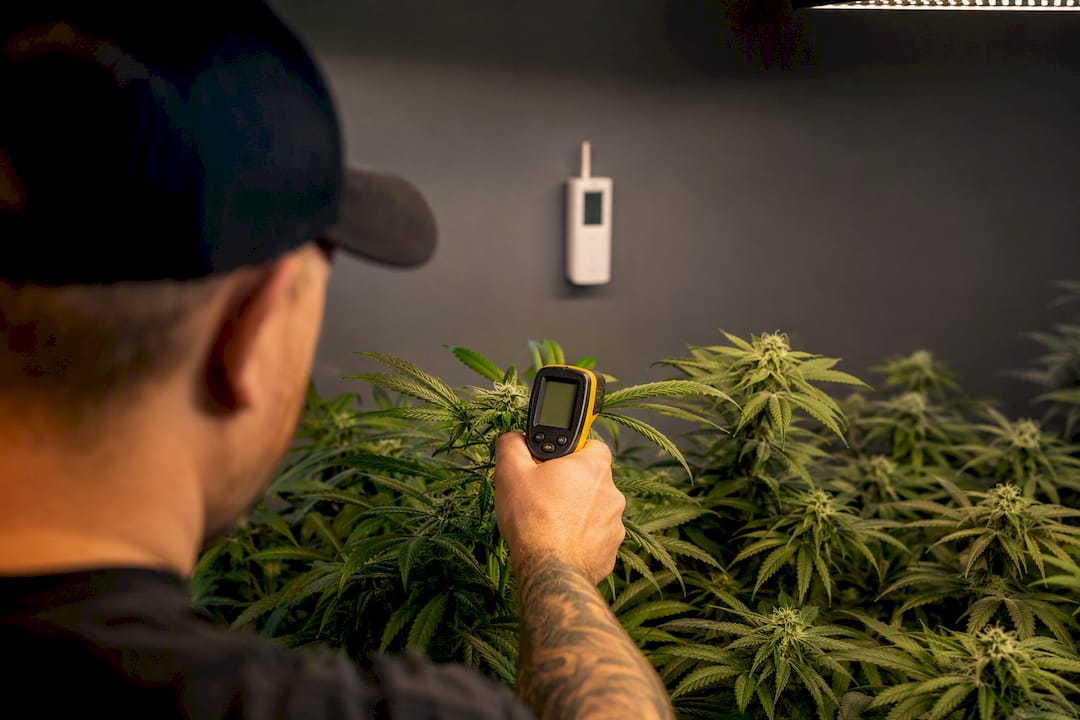
That gap between leaf and air temperature, sometimes called the leaf-to-air delta, directly affects stomatal function. Stomata are the pores that regulate transpiration and CO₂ uptake, and they respond to the moisture gradient at the leaf surface, not the number on your wall thermometer. Leaf surface temperature can diverge meaningfully from ambient air readings under LED lighting, which means a probe mounted on the wall and an infrared reading on a leaf can tell two different stories about the same room.
Fixture design compounds this. Different LED architectures shed heat in different patterns, so a board-and-driver combo with poor heat dissipation can warm a room faster than a more efficient design running the same wattage. That’s part of why comparing LED grow lights against HPS on temperature alone misses half the picture.
A single thermometer hanging near the door tells you almost nothing about what your plants actually experience. Accurate readings require the right tools placed in the right spots, checked on a schedule that catches the swings that matter.
Pro Tip: If a room suddenly reads hotter than expected, move the probe before you touch a single fan or dimmer. A surprising number of “heat problems” turn out to be a probe sitting too close to a light fixture or an exhaust duct.
Fixing a hot or cold room doesn’t always mean buying new equipment. Work through cheap fixes first, then escalate to active climate control only when passive changes can’t close the gap.
Start with the free adjustments:
If passive fixes don’t get you to target, move to active control:
For most growers running multiple lights or a commercial-scale room, manual adjustment eventually becomes a losing battle against outside temperature swings. This is where environmental controllers earn their keep. A system like the Medic Grow GLC-1 Lighting Controller ties your lighting schedule to environmental setpoints automatically, while a unit like the Mars Hydro Controller 43 monitors temperature, humidity, and CO₂ simultaneously and triggers connected fans or HVAC equipment the moment a reading drifts out of range. Automation doesn’t replace good sensor placement. It just reacts to it faster than you can.
Running supplemental CO₂ changes the math on heat. Elevated CO₂ concentration lets plants photosynthesize faster at higher temperatures than they’d otherwise tolerate, which is why growers using CO₂ commonly push lights-on targets to warmer temperatures than standard ambient air targets.
That higher ceiling comes with real limits:
Raising ambient temperature near 88°F can genuinely boost photosynthetic rate when VPD and airflow are controlled, but that benefit disappears fast if humidity or circulation falls out of balance.
Heat stress and cold stress show up differently, but both cost you yield if you don’t catch them early.
Getting LED grow room temperature right comes down to trusting the leaf over the wall thermometer. That’s the core lesson behind one leading indoor gardening retailer’s approach to environmental guidance.
A few practical habits make the biggest difference:
The Medic Grow GLC-1 Lighting Controller and Mars Hydro Controller 43 both map directly onto the automation tasks described above. The GLC-1 handles lighting schedules and dimming triggers tied to environmental setpoints. The Controller 43 adds continuous monitoring of temperature, humidity, and CO₂ across the room, triggering connected fans or HVAC equipment before a small drift becomes a real problem.
Most temperature advice floating around growing forums still assumes an HPS-era room, where blasting the AC to fight radiant bulb heat was the default move. That thinking doesn’t transfer cleanly to LED rooms, and it’s costing growers yield they don’t realize they’re losing.
The real insight buried in the research is this: LED rooms often need to run warmer, not cooler, than growers instinctively expect, because the leaf surface is running cooler than the air around it. Chasing a “safe” 75°F room with LEDs can leave your canopy sitting below its ideal leaf temperature, slowing transpiration and CO₂ uptake without any obvious symptoms to warn you.
If there’s one habit worth adopting over any single number in this guide, it’s checking leaf temperature with an infrared thermometer on a regular basis. A wall-mounted probe tells you about the room. It doesn’t tell you what the plant is feeling. Growers who prioritize leaf-level data over ambient air alone tend to catch problems weeks before symptoms show up in growth rate or bud structure.
— Scott
Manually checking probes and adjusting fans works until your room scales past a couple of lights, and then it becomes a full-time job. Automation hardware is available that closes that gap directly, without the guesswork of running separate thermostats, humidity controllers, and timers that don’t talk to each other.
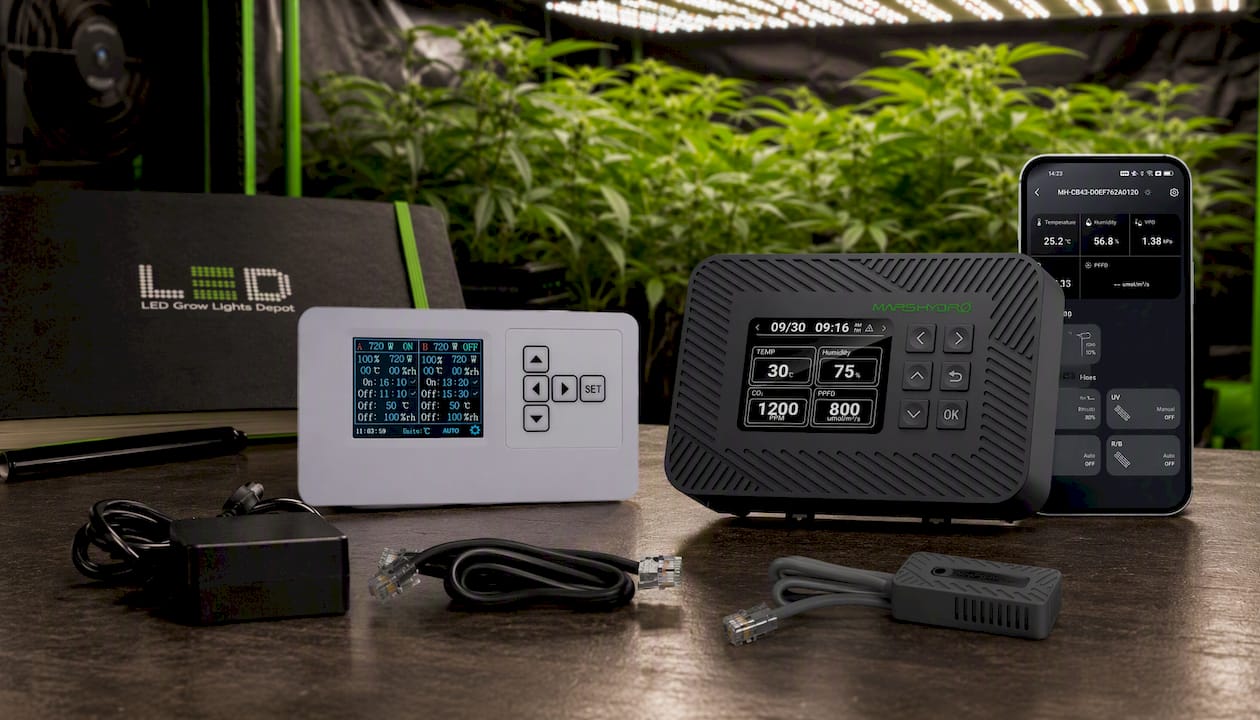
The Medic Grow GLC-1 Lighting Controller automates your lighting schedule alongside environmental setpoints, so dimming and heat management happen together instead of as separate manual steps. The Mars Hydro Controller 43 monitors temperature, humidity, and CO₂ in one system and triggers connected fans or HVAC equipment the moment a reading drifts from target. Both products are built for growers who want the stage-based targets covered in this guide to run automatically instead of requiring constant manual checks. Browse either controller page to compare specs and find the setup that matches your room size.
Nighttime temperatures below roughly 60°F stress most cannabis and herb plants, slowing metabolic activity and increasing the risk of purpling stems or stunted growth, especially during flower.
Yes, for most stages without CO₂ supplementation. Ninety degrees Fahrenheit ambient air pushes leaf surface temperature into a range that can cause curling and slowed nutrient uptake, though rooms running supplemental CO₂ can tolerate closer to 88°F safely with proper airflow.
No. Eighty degrees Fahrenheit sits comfortably within the standard daytime range of 75°F to 85°F for LED-lit tents across seedling, vegetative, and early flowering stages.
LED fixtures emit less direct radiant heat onto the canopy than HPS bulbs, but their drivers and boards still release real heat into the surrounding room air, which is why LED rooms often need warmer ambient targets than growers expect based on old HPS-era rules.
0 of 3 items selected

Leave a comment