
Free Shipping in the USA on nearly all items!
Limited phone hours during the Holidays! Call us: 888-611-9305
Free Shipping in the USA on nearly ALL items! Limited phone hours during the Holidays!

Instead of chasing raw humidity numbers, track vapor pressure deficit (VPD) at canopy height, since it accounts for both temperature and humidity at once. Watch for night-time RH spikes, and lean on ventilation, fans, and a humidifier or dehumidifier to hold those ranges steady.
TL;DR:
- Vapor pressure deficit tracking provides a more accurate climate control approach than raw humidity numbers, especially during flowering when microclimates are critical.
- Growers should adjust humidity levels throughout growth stages, with lower RH in late flowering to prevent mold and botrytis in dense buds.
- Ventilation sizing based on tent volume and the use of circulation fans are more effective for controlling humidity and preventing mold than adding equipment alone.
- Temperature and humidity targets vary by stage: seedlings need high humidity and warmth, vegetative stages require moderate conditions, and flowering needs progressively lower humidity levels.
- A low-heat LED lighting system simplifies climate management and can improve yield by reducing the heat load that conventional fixtures produce.
Grow tent climate control isn’t one setting you dial in once and forget. Plants need different temperature and humidity conditions at each stage of growth, and getting the ranges wrong at the wrong time is one of the most common reasons growers see stunted seedlings, stalled vegetative growth, or moldy buds right before harvest.
Seedlings and clones need warmth and moisture to push new root growth without a functioning root system to pull water on their own. Aim for warm temperatures and high humidity, ideally using a humidity dome for the first week to hold moisture around fragile leaf tissue. Airflow should be gentle here. A combined temperature/humidity controller placed near the tray gives a far more accurate reading than a wall-mounted sensor.
Vegetative growth shifts the priority toward active transpiration. Plants are building leaf mass fast and need airflow moving across the canopy to strengthen stems and prevent stagnant air pockets. Aim for moderate temperatures with a moderate humidity range suitable for vegetative growth, allowing a slight nighttime temperature drop. This is also where fixture heat starts to matter more; a hot HPS bulb pushes canopy temperature well above what your controller reads for the room, so fixture choice affects your entire climate strategy.
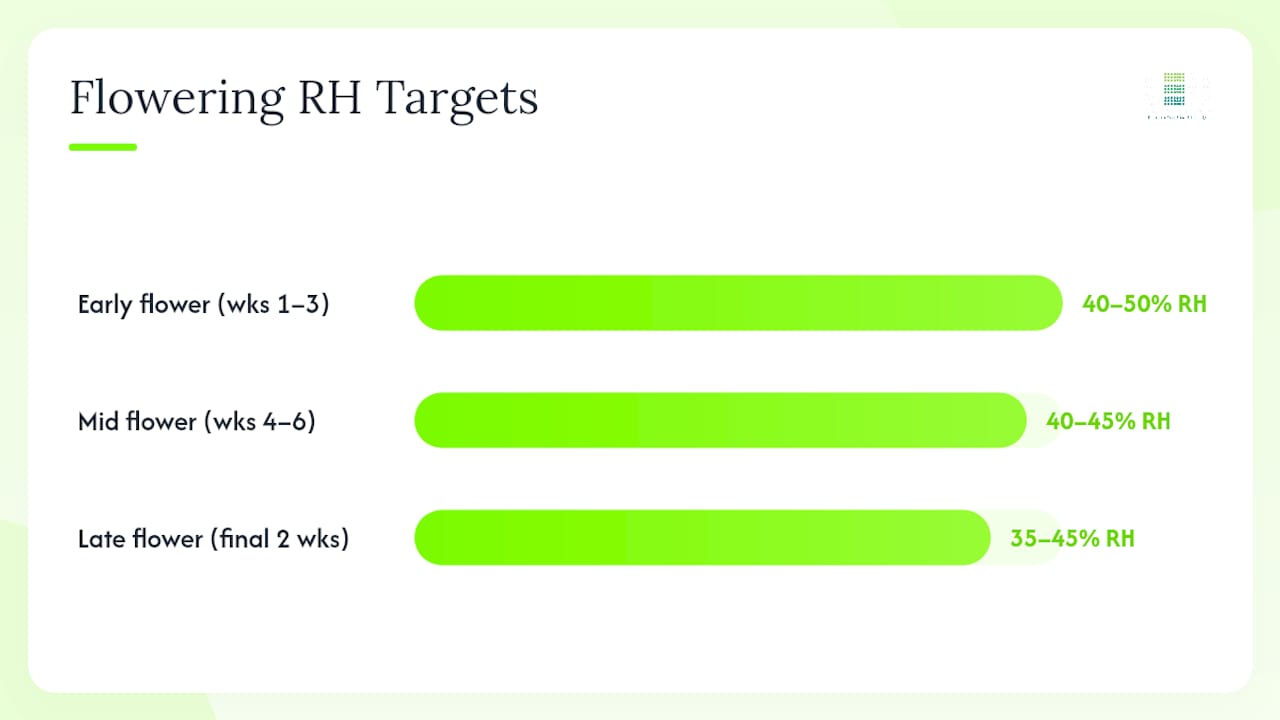
Flowering is where humidity control gets less forgiving. Buds trap moisture and airflow, creating dense microclimates where mold thrives if RH runs too high. Step humidity down as flowering progresses:
That final step down isn’t optional for dense-budding varieties. Lower RH in late flower protects buds from botrytis and powdery mildew, which spread fastest in tight, humid microclimates that never fully dry out between light cycles.
Vapor pressure deficit measures the gap between the moisture the air can hold and the moisture it’s actually holding, expressed in kilopascals (kPa). A plant transpires based on that pressure gap, not on the percentage your hygrometer displays.
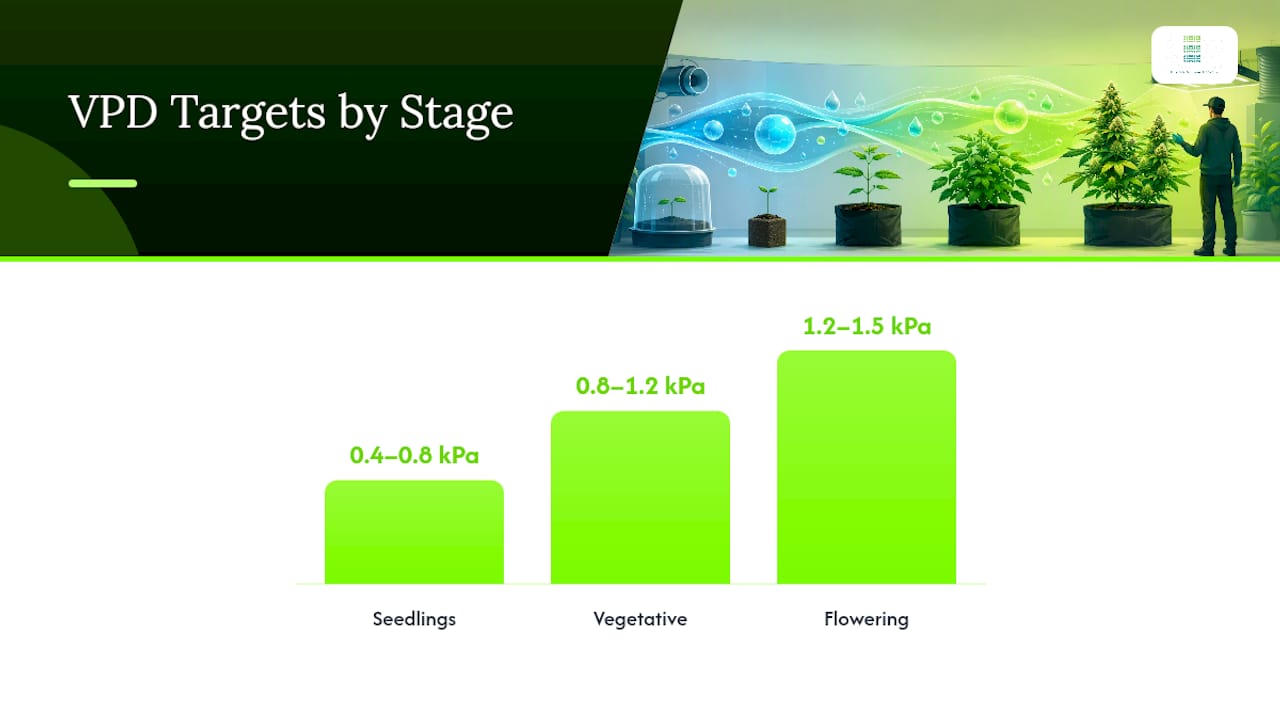
VPD stage targets run roughly 0.4 to 0.8 kPa for seedlings, 0.8 to 1.2 kPa for vegetative growth, and 1.2 to 1.5 kPa for flowering.
Pro Tip: Don’t calculate VPD from your room’s air temperature alone. Leaf surface temperature under LED lighting typically runs 1 to 2°C cooler than the surrounding air, so an IR thermometer aimed at the canopy gives you the number that actually matters for calculating true VPD.
Useful tools for staying on target include:
Ventilation comes first, before you buy a single humidifier or dehumidifier. Most growers who fight persistent humidity problems have an exhaust fan that’s undersized for their tent, not a moisture problem that needs more gear thrown at it.
Install a drip tray under any humidifier or dehumidifier, plug both into a GFCI outlet, and route condensate lines away from electrical connections. These aren’t optional steps in a sealed tent where standing water and electronics share tight quarters.
Mount your primary sensor at canopy height, not near the tent’s roof vent or floor, since both spots read differently from what your plants actually experience. Keep it shaded from direct light and out of the direct path of a circulation fan, which can produce falsely low humidity readings.
When something looks wrong fast: isolate the plant, increase ventilation immediately, and run a dehumidifier temporarily while you diagnose the root cause.
Every degree of heat your lighting adds to the tent is a degree your ventilation and cooling have to remove. LED fixtures generally run cooler than legacy HPS setups, which gives growers more room before temperature control becomes a fight.
For growers running a 3-tier setup, the fixture spacing and low radiant heat of a well-designed tight-space LED system means each tier can hold its own microclimate without one shelf overheating the tier below it.
Most grow tent advice treats humidity control as a shopping problem: buy a bigger dehumidifier, add another fan, install a second sensor. That’s backwards. The research consistently points to ventilation sizing and VPD tracking as the two levers that fix most climate problems, and both are nearly free compared to another piece of hardware.
The conventional wisdom of “keep RH at X” falls short because it ignores temperature entirely. Switch to VPD, correct for leaf temperature under LED lighting, and most of the “mystery” problems in a tent, curling leaves, slow flowering, surprise mold, resolve without buying anything new.
Where hardware does matter is fixture heat. A tent running hot HPS lighting fights an uphill battle no controller schedule can fully solve. For growers who want that variable removed from the equation before they even start troubleshooting, an integrated kit built around low-heat LED lighting and matched tent sizing is a genuinely practical shortcut, not a marketing add-on.
— Scott
Integrated tent kits remove the sizing guesswork that causes most temperature and humidity headaches in the first place: the tent, the LED fixture, and the airflow footprint are matched from the start, instead of you piecing together a light, a tent, and a fan from three different sources and hoping the CFM math works out.
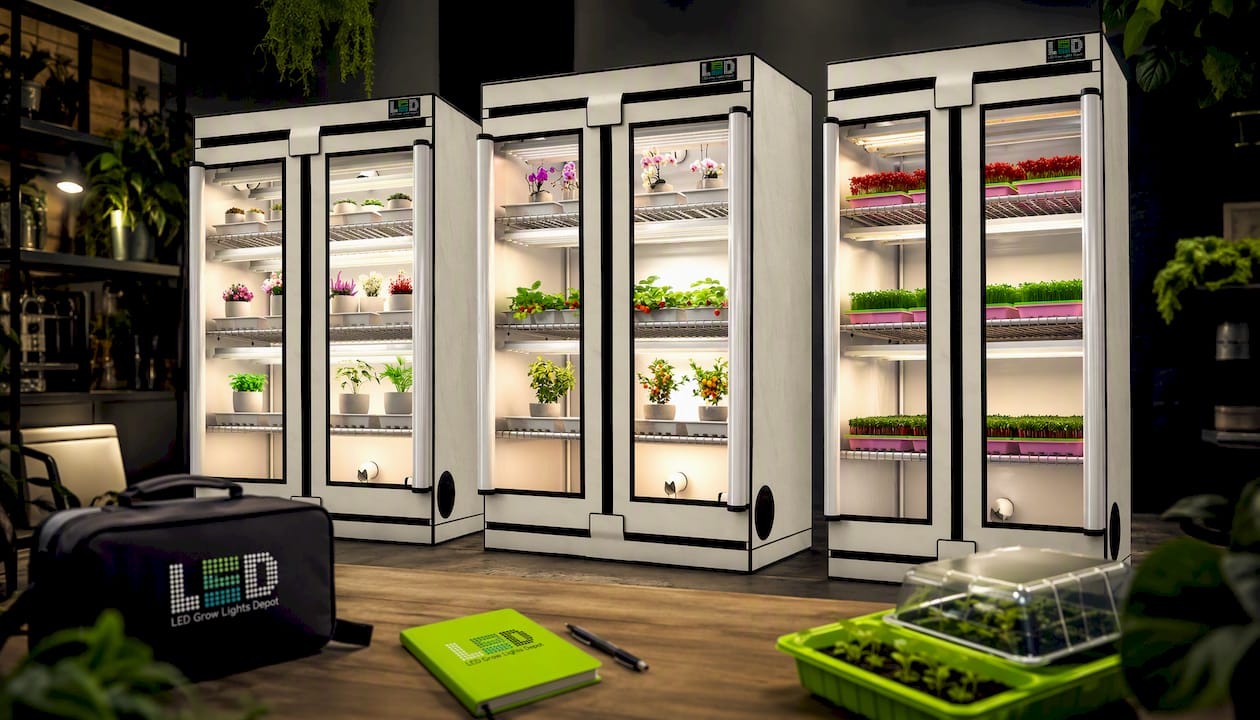
The Active Grow House Plants 3-Tier Walden White LED Grow Tent Kit suits growers maintaining general foliage across multiple shelves where moderate, stable humidity matters more than aggressive VPD targeting. The Active Grow Flowers & Fruits 3-Tier Walden White LED Grow Tent Kit fits growers managing the tighter RH step-down that flowering and fruiting crops demand through their final weeks. The Active Grow Microgreens & Herbs 3-Tier Walden White LED Grow Tent Kit is built for the warm, humid conditions microgreens and herbs need, without the trial-and-error most beginners go through matching a generic tent to those crops.
Browse the full range of grow tents and kits to find the tier count and footprint that matches your space, or check the under-canopy lighting options if you’re retrofitting an existing tent rather than starting fresh.
The stage targets and control methods above draw on VPD-based environmental guidelines for equipment sizing, step-by-step humidity control methods for ventilation math, and practical VPD tables for temperature and RH conversions.
Temperatures at the higher end of the seedling range can run slightly high for vegetative and flowering stages, especially if leaf temperature under your lights climbs above ambient air. Pair any warm readings with an IR thermometer check at canopy level before assuming it’s a problem.
Circulation fans alone don’t remove moisture from the air; they only move it around, which prevents the stagnant, saturated pockets that trigger mold. Actual RH reduction requires an exhaust fan pulling humid air out or a dedicated dehumidifier.
Yes, for mid to late flower. Early flower can tolerate up to 50% RH, but growers should step down toward 40 to 45% by mid flower and 35 to 45% in the final two weeks to protect dense buds from mold.
Yes, at nearly any stage.
0 of 3 items selected


Leave a comment