
Free Shipping in the USA on nearly all items!
Limited phone hours during the Holidays! Call us: 888-611-9305
Free Shipping in the USA on nearly ALL items! Limited phone hours during the Holidays!

For flowering, run a full-spectrum core fixture and add targeted red and far-red wavelengths through a dual-channel controller or a supplemental bar. Full-spectrum alone drives healthy growth; the bloom-tuned red and far-red push bud density, flower count, and terpene expression higher. Track your progress with PPFD and DLI readings rather than guessing, and adjust hanging height as you add channels.
TL;DR:
- Photoperiod manipulation with red and far-red wavelengths during bloom significantly enhances bud density, flower count, and terpene expression when carefully timed.
- Red light around 660 nm mainly drives flowering signals, while far-red near 730 nm influences shade response and plant stretching, requiring precise timing to avoid excessive stretch.
- Blue and green wavelengths support plant structure and lower canopy development, making a full-spectrum baseline vital even when tuning for flowering.
- Spectrum control via dual-channel fixtures allows for stage-specific adjustments, with best results achieved through gradual far-red increases and PPFD measurements.
- LED fixtures with integrated red and far-red diodes outperform HPS in spectrum flexibility, lifespan, and energy efficiency, provided growers measure and manage hanging height and timing properly.
Flowering spectrum LED lighting is not about a single magic wavelength. It is about how red, far-red, blue, and green work together across the plant’s canopy during bloom. PAR (photosynthetically active radiation) covers 400 to 700 nanometers, and it tells you how much usable light energy reaches a leaf. But PAR alone misses the point growers care about most: what a plant does with that light changes dramatically depending on the color mix, not just the total quantity.
Red light around 660 nm drives the strongest photosynthetic response and is the primary trigger behind flowering signals in most crops. Far-red near 730 nm sits just outside the traditional PAR range, yet it plays an outsized role in how a plant reads day length and canopy density. According to Oklahoma State University’s extension guidance, LEDs emitting red or far-red wavelengths are consistently the most effective choice for flowering ornamentals, and flowering lamps built around these wavelengths are used commercially to manipulate photoperiod and trigger bloom on schedule.
Blue light, typically in the 400 to 500 nm range, keeps internode spacing tight and supports the enzymatic processes tied to compact, sturdy growth. Cut blue too aggressively during flower and you risk leggy, weak stems that can’t hold bud weight later. Green light, often dismissed as filler, actually penetrates deeper into a dense canopy than red or blue. GPN Magazine’s research on green light shows it reaches lower leaves that would otherwise sit in shade, which matters once your canopy thickens up during bloom.
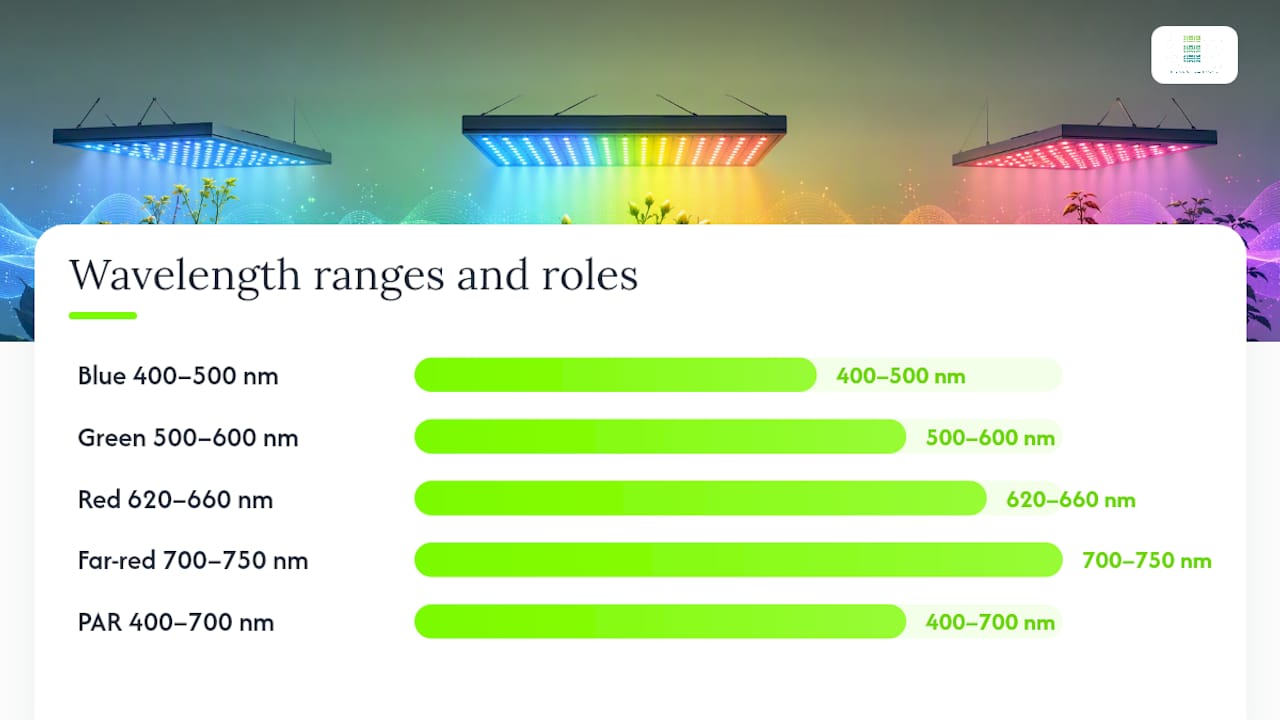
This is why a full-spectrum baseline still matters even when you are tuning for flower. A fixture that only pushes red and far-red without the supporting blue and green wavelengths tends to produce stretched, thin plants with underdeveloped lower bud sites. The full-spectrum foundation gives you the structural growth; the red/far-red tuning gives you the flowering push on top of it.
A few practical distinctions worth locking in before you touch a dial or buy a bar light:
Pro Tip: Don’t judge a fixture’s flowering potential by its wattage alone. Two lights can draw the same power and produce wildly different bloom results depending on how much of that output lands in the red and far-red bands versus green filler.
The Light Science Tech spectrum guide makes a point worth repeating: spectral balance, not simple color temperature, is what determines flowering performance across different crops and grow environments. A 3000K bulb and a “flowering spectrum” LED can look similar on a spec sheet but behave completely differently once buds start forming.
The Emerson effect explains why red and far-red work better together than either does alone. When red and far-red light hit a plant simultaneously, photosynthetic efficiency jumps beyond what you’d get from either wavelength in isolation. This synergy is the biological reason dual-channel bloom fixtures exist. It’s not a marketing gimmick; it’s a documented interaction between two photosystems that respond to slightly different light wavelengths but boost each other when paired.
Far-red carries a second job beyond feeding photosynthesis: it signals shade. In nature, canopy shade filters out red light faster than far-red, so a high far-red ratio tells a plant “there’s competition nearby, stretch toward the light.” Growers can use that signal deliberately. Michigan State University’s far-red radiation resource confirms far-red’s dual role: it contributes usable energy while also triggering shade-avoidance and flowering-related morphological changes.
Timing decides whether that signal helps or hurts you.
Watch for internode length as your feedback signal. If nodes start spacing out further than usual within a few days of adding far-red, you’ve overshot the dose. Pull back the far-red channel or shorten the supplemental window rather than removing it entirely; the goal is a nudge, not a flood.
Pro Tip: Add far-red supplementation gradually over the first week of any bloom transition instead of switching it on at full intensity immediately. Plants respond to the ratio change, and a sudden jump can trigger more stretch than a gradual increase to the same final dose.
Dual-channel fixtures split output into two independently controllable groups, typically a “full/veg” channel (blue-weighted, full-spectrum white) and a “bloom” channel (red and far-red weighted). This setup lets you shift the ratio without swapping hardware or adding extra lights. The Mammoth Nova Sun’s multi-channel design demonstrates how commercial fixtures now build in far-red and UV alongside full-spectrum white specifically so growers can dial in flower quality and terpene output without buying a second light.
Here’s a workable channel sequence broken into three bloom phases:
If your fixture doesn’t have dual channels, you can achieve a similar effect by layering a full-spectrum core with a separate red/far-red supplemental bar. The proximity supplemental lighting approach works especially well for under-canopy or side-lighting placement, since it targets bud sites that the main overhead fixture can’t reach efficiently once the canopy thickens.
A few placement rules that matter more than most growers expect are discussed in detail in How Lighting Shapes Indoor Plant Selection for Commercial Spaces, which highlights the importance of matching fixtures to environment and plant needs.
Some commercial fixtures now build 730 nm diodes directly into flowering-specific units, following the same logic. Enlite’s Flora Flowering series is one example of a fixture designed around 730 nm inclusion specifically to support bud development and potency, illustrating how mainstream this red/far-red pairing has become in dedicated bloom hardware.
Spectrum tuning without measurement is a guess. PPFD (photosynthetic photon flux density) tells you how much usable light lands on a specific point in your canopy, measured in micromoles per square meter per second. DLI (daily light integral) tells you the total light dose a plant receives over a full day, factoring in both intensity and photoperiod length.
For flowering-stage crops in a tent or small room, growers commonly target PPFD readings in a range suitable for canopy height, with DLI adjusted depending on the crop and fixture intensity. Oklahoma State’s extension fact sheet treats PPFD mapping and DLI tracking as the most reliable way to confirm whether a spectrum change actually improved plant performance, rather than relying on visual impressions alone.
Taking a real PPFD reading takes ten minutes and a $100 to $200 quantum meter, and it beats guessing every time.
Hanging height needs adjustment whenever you add a supplemental far-red or red channel, since you’re changing total output at canopy level, not just color ratio. Raising the fixture slightly (an inch or two) when adding supplemental bars helps avoid stacking too much heat and intensity into a small area. Watch two things closely after any height or spectrum change: leaf temperature (use the back-of-hand test or an infrared thermometer) and internode stretch over the following five to seven days. If leaves feel warmer than ambient room air or nodes start spacing out, raise the fixture another inch or reduce the supplemental channel’s runtime.
The PAR, PPF, PPFD, and DLI reference guide breaks down how these metrics interact if you want a deeper look at the math behind daily light dosing.
Three procurement paths get you to a flowering-tuned spectrum, and each fits a different grower profile.
| Approach | Best for | Spectrum control | Power/coverage | Duty cycle | Energy efficiency |
|---|---|---|---|---|---|
| Bloom-only fixture | Growers running a dedicated flower room separate from veg | Fixed red/far-red ratio, no adjustment | Moderate to high PPF, sized for flower-stage density | Runs full-time during flower cycle | Efficient for its single purpose, but inflexible if you also veg in the same space |
| Dual-channel tunable fixture | Growers who veg and flower in the same tent or room | Independent white/blue and red/FR channels | High PPF with adjustable ratio; scales to room size | Bloom channel activated at transition, increased through mid-bloom, tapered late | Slightly higher upfront cost, but eliminates the need for a second fixture |
| Full-spectrum core plus supplemental bar | Growers upgrading an existing setup incrementally | Base fixture fixed; supplemental bar adds targeted red/FR | Core handles bulk PPF; bar adds localized boost at bud sites | Bar typically timed to dusk window or specific bloom weeks | Most cost-efficient entry point; lets you test bloom tuning before committing to a full tunable system |
Home growers running a single tent through both veg and flower generally get the most value from a dual-channel tunable fixture, since it avoids buying and mounting separate hardware for each stage. Commercial cultivators running dedicated flower rooms often do better with a bloom-only fixture sized specifically for that room’s canopy density, since there’s no need to pay for veg-stage flexibility they won’t use. Growers testing whether red/far-red tuning is worth the investment before committing further should start with a supplemental bar added to their existing full-spectrum light. It’s the lowest-risk way to see the effect firsthand.
LedGrowLightsDepot builds its flowering recommendations around measurable outcomes, not marketing claims. The company’s proprietary proximity supplemental lighting system is designed specifically to solve the under-canopy light penetration problem that standard overhead-only setups struggle with, and it has been tied to yield increases of over 20% along with improved bud grading in customer setups.
Growers consistently underestimate how much bud density is lost simply because lower canopy sites never receive meaningful red or far-red exposure. Proximity supplemental lighting exists to close that specific gap, not to replace the main fixture.
That customer experience is backed by a 4.8 out of 5 rating across more than 5,800 reviews, a track record built on repeat purchases from home growers and commercial cultivators alike.
The catalog maps directly to the tuning strategies covered above:
Author credentials, in-house yield case studies, and internal trial data supporting these specific product-to-recommendation matches are maintained separately and available on request.
Not every flowering crop responds to red and far-red the same way. Long-day and short-day plants read far-red’s shade-avoidance signal differently, since photoperiod sensitivity is what far-red is manipulating in the first place. A short-day flowering crop pushed into bloom by shortened light cycles will respond more strongly to a dusk far-red pulse than a day-neutral crop that flowers regardless of photoperiod length.
Cultivar-level differences matter just as much as species-level ones. Denser, indica-leaning cultivars often tolerate higher far-red doses without excessive stretch, since their genetics already favor compact node spacing. Sativa-leaning or naturally leggy cultivars can overshoot into unwanted stretch faster under the same far-red dose, so a lighter touch and shorter supplemental window usually works better for those genetics.
Leafy ornamentals and fruiting crops grown for flower (rather than fruit set) tend to show the clearest response to red-dominant recipes, since their flowering signal is closely tied to red-driven photosynthetic activity rather than fruit development hormones. Growers working across multiple species or cultivars in the same room should treat far-red dosing as a per-crop variable, not a fixed room-wide setting, and adjust the supplemental channel’s timing based on how each crop responds over its first week of exposure.
High-pressure sodium (HPS) lighting has driven flowering crops for decades, and it earned that reputation honestly: HPS output sits heavily in the red-orange range, which happens to align well with flowering photosynthetic demand. Metal halide (MH), by contrast, skews blue-heavy and has traditionally been reserved for vegetative growth.
Modern flowering spectrum LED fixtures close the gap that older LED generations struggled with. Early LED grow lights often lacked sufficient red output and ran spectrum-heavy toward blue, which shortchanged flowering performance compared to HPS. Today’s flowering-tuned LEDs, particularly dual-channel and far-red-inclusive designs, match or exceed HPS’s flowering-relevant red output while adding controllable far-red that HPS simply can’t provide since its spectrum is fixed by the bulb’s chemistry.
The practical differences that matter most to growers:
For growers weighing a switch, the flowering performance case for LED no longer hinges on efficiency alone. It hinges on spectrum control that HPS and MH structurally cannot offer.
Flowering spectrum LEDs use electrical energy more efficiently than HPS or MH per unit of usable light delivered to the canopy, largely because LEDs convert a higher share of input energy into usable PAR rather than losing it as heat. That efficiency advantage compounds over a flowering cycle, since less energy also means less demand placed on cooling and ventilation systems trying to offset fixture heat.
Upfront cost remains the honest tradeoff. A quality dual-channel or far-red-inclusive LED fixture typically costs more than an equivalent-output HPS setup at purchase. That gap narrows over the fixture’s lifespan, since LED diodes last considerably longer than HPS bulbs, which need periodic replacement as their output degrades.
Supplemental red/far-red bars add a smaller, incremental cost rather than requiring a full fixture replacement, which makes them the more budget-conscious entry point for growers wanting to test bloom-spectrum tuning before committing to a full dual-channel system. Running supplemental channels only during specific windows, like the one to two hour dusk pulse recommended earlier, also keeps the added energy draw modest compared to running a second full-output fixture around the clock.
For commercial cultivators, the calculation shifts toward total cost per pound of finished product, where reduced cooling load, longer fixture lifespan, and improved bud grading from proper spectrum tuning tend to offset the higher initial LED investment within one to two grow cycles.
The most frequent mistake growers make is running far-red continuously instead of in a targeted window. Continuous high-dose far-red keeps the shade-avoidance signal active all day, producing exactly the leggy stretch growers are trying to avoid rather than the tighter, denser flowers they want.
A second common error: assuming “full spectrum” and “flowering spectrum” mean the same thing. A generic full-spectrum fixture without meaningful red or far-red weighting won’t drive flowering the way a properly tuned bloom channel will, even if the marketing language suggests otherwise. Read the actual spectrum chart, not just the label.
Hanging height mistakes compound spectrum problems. Adding a supplemental red/far-red bar without adjusting fixture height or checking leaf temperature can stack too much intensity into a small canopy area, leading to heat stress that mimics light-related problems and confuses diagnosis.
Finally, growers frequently skip measurement entirely, adjusting spectrum based on visual impressions rather than PPFD or DLI tracking. Without a baseline reading before a change and a follow-up reading after, there’s no reliable way to know whether a spectrum adjustment actually helped or simply coincided with normal plant development. The fix for all four issues is the same discipline: time your far-red exposure, read your spectrum chart carefully, monitor leaf temperature after any hardware change, and measure before and after every adjustment.
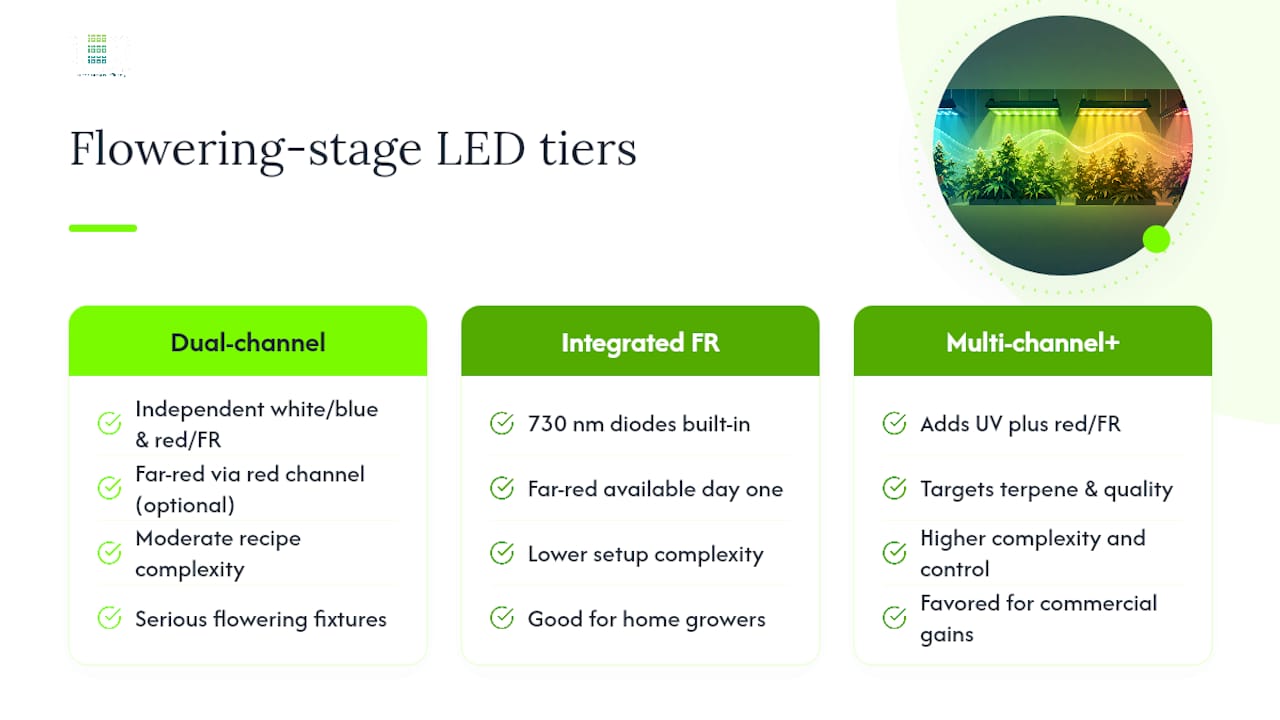
Dual-channel control has become the technology standard among growers who want precision without running multiple fixtures. This design, which lets a grower independently adjust a white/blue channel and a red/far-red channel, is what separates a serious flowering-spectrum LED from a fixture that merely claims “full spectrum” on the box.
Fixtures that integrate 730 nm far-red diodes directly into the flowering channel represent the next tier of specialization, since built-in far-red removes the need for a separate supplemental bar for growers who want that signal available from day one of bloom. Commercial multi-channel designs that pair red/far-red with UV diodes take this further, targeting not just bud density but flower quality and terpene expression, which matters more to cultivators chasing bud grading than to casual home growers.
For most home growers, a high-quality full-spectrum fixture with integrated red/far-red diodes remains the simpler, more reliable choice, since it reduces recipe complexity while still supporting flowering demands without requiring the grower to manage separate channels manually. Experienced growers chasing incremental gains in late-stage bud density tend to favor adding supplemental red/far-red bars to an existing full-spectrum core instead of replacing the whole fixture, since this preserves the blue/light balance already dialed in while giving a targeted bloom boost exactly where it’s needed.
The industry’s broader shift reflects this same logic: marketing language has moved away from simply advertising “full spectrum” toward advertising targeted PAR distribution for the flowering phase specifically, whether through supplemental diodes or dual-channel controllers.
Most flowering spectrum advice online treats spectrum choice as a shopping decision: buy the fixture with the best-sounding spectrum claim and expect results. That advice skips the part that actually determines outcomes, which is measurement. A fixture’s spec sheet tells you what it’s capable of producing. It doesn’t tell you what’s actually landing on your canopy after accounting for hanging height, reflectivity, and canopy density.
The conventional wisdom around far-red also deserves pushback. Plenty of growers still treat far-red as a blanket “more is better” additive, when the research points toward a narrow, well-timed window being far more effective than constant high-dose exposure. Overuse doesn’t just waste energy; it actively works against the tight, dense flowering structure most growers are chasing.
If there’s one priority worth adopting immediately, it’s this: buy a quantum meter before you buy another light. Spectrum tuning without a PPFD baseline is just guessing with extra steps, and growers who measure before and after every change consistently outperform those relying on visual impressions alone.
— Scott
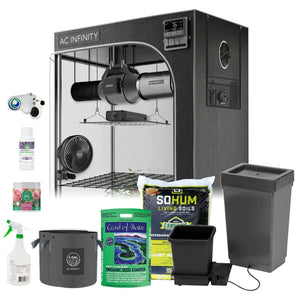
Choosing the right hardware comes down to matching your setup, not chasing the flashiest spec sheet. The ThinkGrow LED Model-I works well as a full-spectrum core for growers building a dual-channel style bloom recipe, giving you the structural baseline this guide covers before layering in red/far-red supplementation.
For dedicated flower rooms wanting higher output without managing separate channels, the Grower’s Choice ROI-FF 650W is built specifically around flowering-stage PPF requirements for 4x4 spaces. And if you’re testing whether targeted red/far-red supplementation actually improves your bud density before committing to a full tunable system, the PROXIMITY Cube Lighting System delivers exactly the under-canopy supplementation this guide recommends adding during transition and mid-bloom, without requiring you to replace your existing fixture.
Browse the full flowering lineup, compare PPF and coverage specs against your room size, and pick the combination that matches the tuning approach covered here at LedGrowLightsDepot.
0 of 3 items selected


Leave a comment