
Free Shipping in the USA on nearly all items!
Limited phone hours during the Holidays! Call us: 888-611-9305
Free Shipping in the USA on nearly ALL items! Limited phone hours during the Holidays!

CO2 enrichment works with LED grow lights, but only after canopy PPFD consistently clears roughly 600 µmol/m²/s in a sealed or semi-sealed space. Below that threshold, added CO2 does little because light, not carbon, is the limiting factor. Above it, growers following extension guidance and controlled-environment research can see real gains in biomass and finish time.
TL;DR:
- CO2 enrichment only works effectively if the canopy PPFD exceeds approximately 600 µmol/m²/s, as lower light levels do not limit growth.
- A sealed or semi-sealed environment is essential for maintaining consistent CO2 levels, with proper ventilation and airflow management to prevent rapid gas loss.
- CO2 should be targeted between 1,000 and 1,200 ppm during peak flowering, with levels above 1,500 ppm offering minimal additional gains.
- Proper CO2 system setup requires sizing the tank and regulator, placing diffusers above the canopy, and synchronizing injection with the light cycle to avoid waste.
- Monitoring with an accurate NDIR sensor and setting safety cutoffs below 2,000 ppm are critical to prevent plant damage and ensure human safety.
The question isn’t whether CO2 helps plants. It’s whether your grow room can actually use it. Carbon dioxide raises the point at which additional light stops producing additional growth, according to Oklahoma State University Extension. If your canopy isn’t already receiving enough light to hit that ceiling, feeding it more CO2 is like adding a second engine to a car with no gas.
Pro Tip: Measure PPFD at the canopy with a quantum meter, not by trusting the wattage printed on your fixture. Two lights rated the same can deliver very different photon counts once you factor in distance, spectrum, and coverage overlap.
Here’s what actually determines readiness:
If any of those boxes are unchecked, fix them first. A PPFD upgrade or better VPD control usually returns more yield per dollar than a CO2 system bolted onto an underlit room.
By the numbers: research on lettuce found that raising CO2 concentration significantly increased biomass when paired with higher illumination intensity. Low light and high CO2 together barely moved the needle.
Once the prerequisites check out, installation is mostly plumbing, placement, and a controller doing the thinking for you.
A lighting controller that already manages your fixtures makes this integration far less error-prone than running CO2 on a separate, disconnected timer.
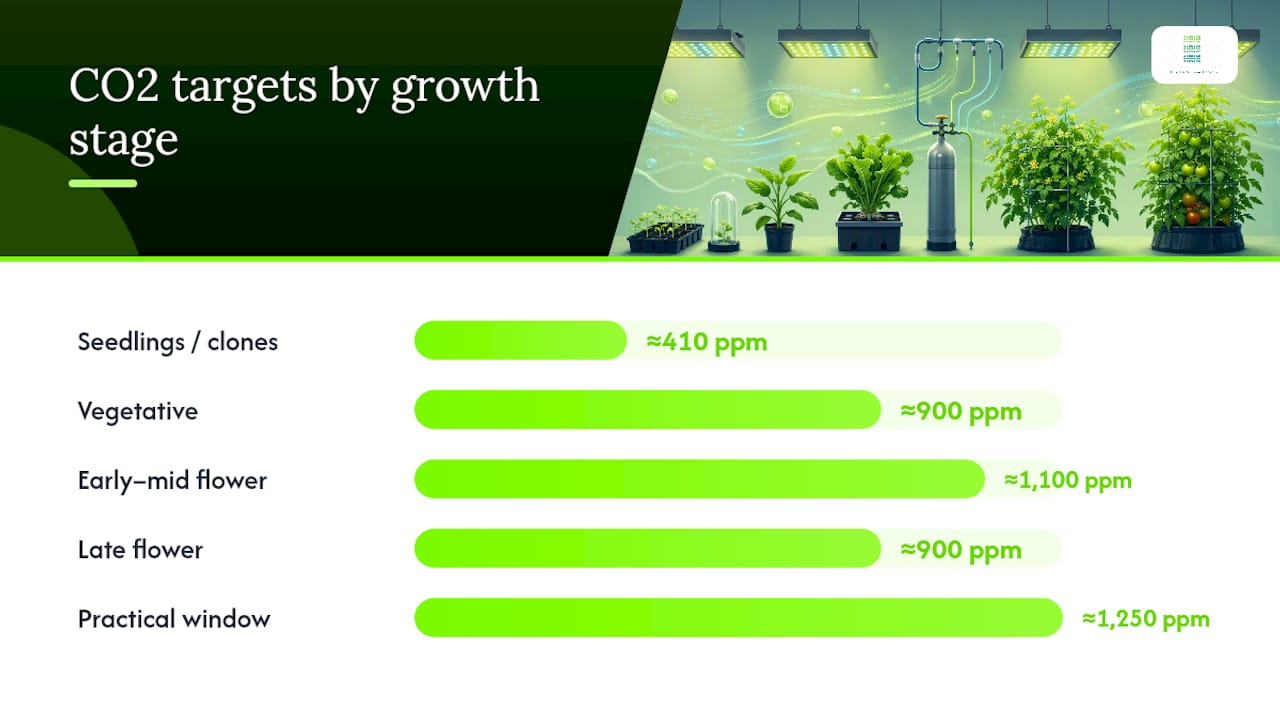
Concentration targets shift as plants move through their cycle, and pushing numbers too high too early wastes gas without adding growth.
A practical target window most indoor growers land on is 1,000 to 1,500 ppm, according to practitioner guides for indoor CO2 use, with returns flattening out past roughly 1,500 ppm for most setups. Some controlled studies on leafy crops even found gains leveling off closer to 1,200 ppm depending on the light spectrum used, so more is not automatically better once you’re past the sweet spot.
Timing matters as much as concentration. Delay injection 15 to 60 minutes after lights-on so plants aren’t hit with peak CO2 before photosynthesis ramps up, then stop 30 to 60 minutes before lights-off, per the same Hydrobuilder guidance. If your canopy PPFD drops, say a fixture ages or you rearrange plants, dial the CO2 setpoint down to match. Feeding 1,500 ppm to a canopy that just lost light intensity just burns gas for nothing.
Carbon dioxide is not automatically safe just because plants use it. Concentrations above 2,000 ppm start to harm plant tissue, while levels near 5,000 ppm create real human safety risk, according to Conviron’s guidance on plant growth chambers. Those numbers should anchor every controller setpoint and alarm you install.
None of this is optional gear. A tank, a regulator, and no monitoring is how growers hurt themselves.
The biggest mistake I see is growers buying a CO2 kit before they’ve confirmed their canopy PPFD justifies it. Enrichment on an underlit setup just burns gas. The second mistake is skipping the controller and running CO2 on a cheap timer disconnected from the light schedule, which wastes gas overnight and risks overshoot during the day.
Scott has watched enough home and commercial setups to know the pattern repeats: growers chase CO2 as a fix before they’ve solved lighting or VPD. LedGrowLightsDepot’s under-canopy proximity systems are built around the opposite priority, closing light gaps at the canopy level first, which the brand states can lift yield by over 20% before CO2 ever enters the conversation. Paired with a 4.8 out of 5 rating from more than 5,800 reviews, that light-first approach is what most CO2 upgrades are missing.
The research supports a blunt conclusion: CO2 is a multiplier, not a fix. It amplifies a grow that already has adequate PPFD, stable VPD, and healthy roots. It does nothing for a grow that’s underlit or stressed, and in a poorly sealed room it just leaks out the door.
Conventional advice treats CO2 like a universal yield booster you can add at any stage. That’s backwards. The interaction between light intensity and CO2 is well documented, and it cuts both ways: more light without more CO2 eventually plateaus, but more CO2 without adequate light does almost nothing.
My advice for anyone weighing this investment: audit your canopy PPFD and sealing before you spend a dollar on tanks or controllers. If the light isn’t there yet, that upgrade pays for itself faster and with less risk than a CO2 system bolted onto a room that can’t use it. Get the environment right first, then let CO2 do what it’s actually good at.
— Scott
LedGrowLightsDepot’s advantage for growers considering CO2 is simple: you get the high-PPFD lighting and environmental controls that make enrichment worth running, backed by proprietary under-canopy proximity systems the brand states can lift yield over 20% by fixing light penetration that standard setups miss entirely.
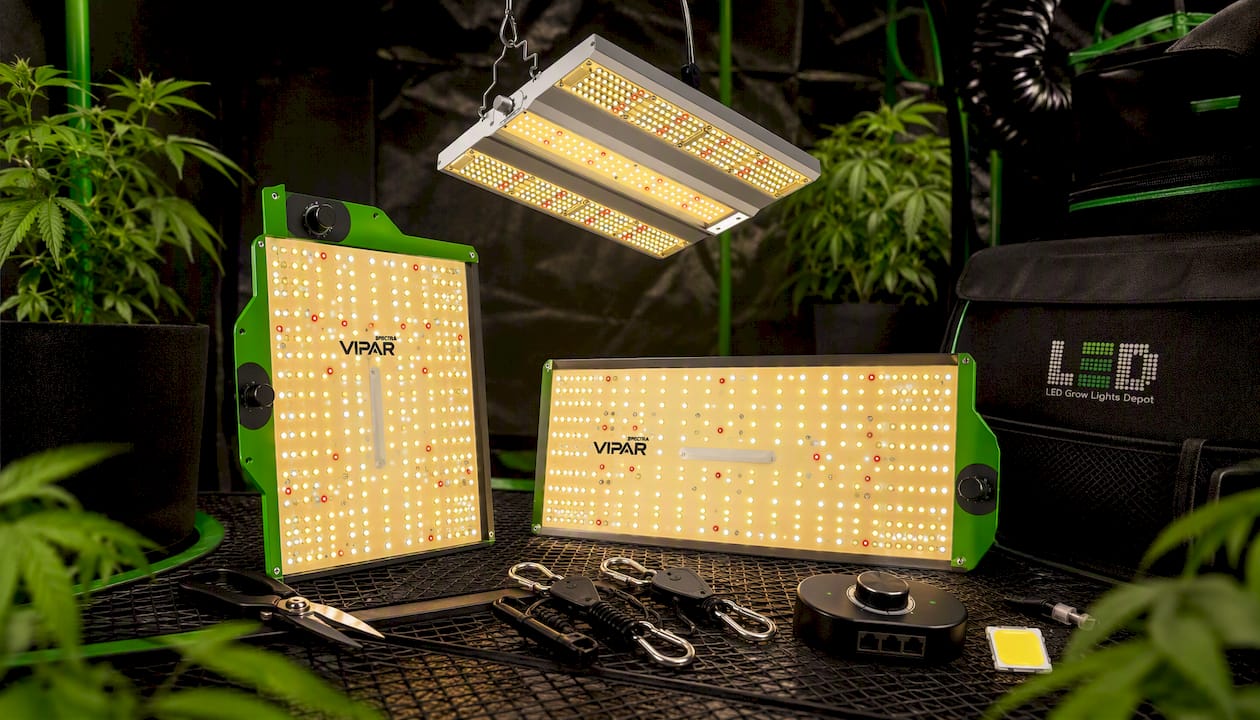
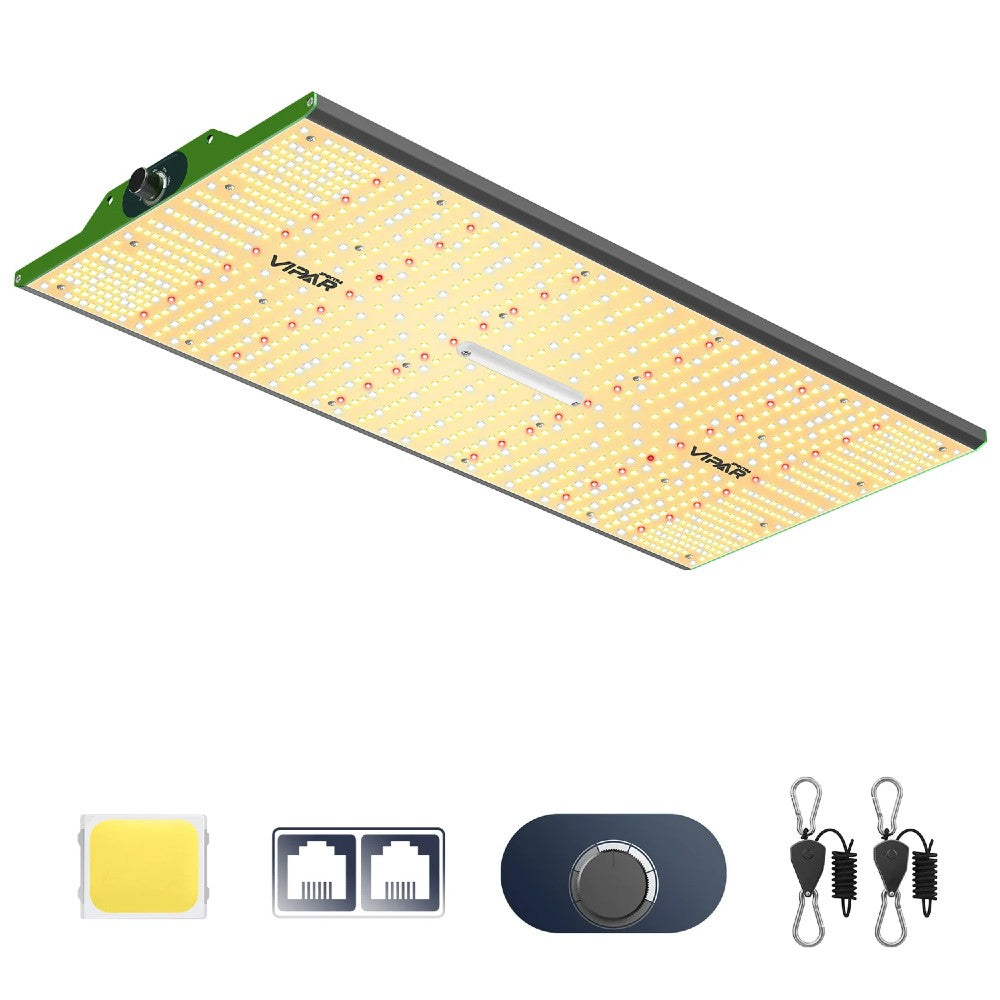
Before you buy a single CO2 tank, confirm your canopy is actually pulling enough photons to justify it. High-output fixtures like the Viparspectra Pro Series P1000 and the larger Viparspectra Pro Series P2000 are built for exactly the PPFD range where CO2 starts paying off, while the compact Viparspectra XS1500 Pro 150W works well for growers filling gaps in smaller tents. Pair either with a controller from the top lighting or under-canopy lighting collections to close light gaps before you add gas to the mix.
Measure your PPFD, browse the fixture that matches your canopy size, and check the full product lineup to build the light foundation CO2 enrichment actually needs.
No. CO2 raises the ceiling on how much light a plant can use productively, so without sufficient canopy PPFD there’s little for the extra carbon to fuel. Growers should confirm PPFD above roughly 600 µmol/m²/s before investing in CO2 equipment.
Plant tissue can suffer above 2,000 ppm, and human safety becomes a serious concern near 5,000 ppm, according to Conviron’s chamber guidance. Every setup should include an NDIR sensor and a controller with a hard cutoff well below those thresholds.
It can be, if the tent is sealed and canopy PPFD already justifies it. Smaller spaces are actually easier to enrich efficiently since less volume means less gas needed, as covered in this small tent CO2 breakdown.
Delay injection 15 to 60 minutes after lights turn on, then stop 30 to 60 minutes before lights-off, following practical guidance from indoor CO2 setup guides. Running CO2 during dark hours wastes gas since plants aren’t photosynthesizing.
Most growers target 1,000 to 1,200 ppm in early to mid flower, tapering back toward 800 to 1,000 ppm in late flower as growth slows. Gains generally flatten past 1,500 ppm for most indoor setups, per practitioner dosing guidance.
0 of 3 items selected


Leave a comment