
Free Shipping in the USA on nearly all items!
Limited phone hours during the Holidays! Call us: 888-611-9305
Free Shipping in the USA on nearly ALL items! Limited phone hours during the Holidays!

Getting the most out of your indoor garden comes down to a handful of variables you can actually control: light intensity, spectral quality, canopy management, and environmental conditions. The growers who consistently pull heavy harvests aren’t doing anything mystical. They’re hitting the right PPFD targets at each growth stage, keeping their daily light integral (DLI) in range, and pairing that with trained, open canopies that let every bud site drink in photons.
Two metrics matter more than wattage. PPFD (photosynthetic photon flux density) tells you how many usable photons are hitting your canopy per second, measured in µmol/m²/s. DLI is the cumulative total across a full photoperiod. Together, they determine whether your plants are starving, thriving, or getting burned. Spectrum matters too: blue wavelengths drive vegetative compactness, red drives flowering, and far-red accelerates cell elongation and biomass accumulation in ways that “full spectrum” marketing rarely explains clearly.
Key principles for boosting indoor yields with LED grow lights:
Ledgrowlightsdepot’s PhotonTek SQ300W PRO, X 465W PRO, and X 600W PRO are built around these principles, with verified PPFD maps and spectral tuning designed for high-yield cannabis cultivation.
Pro Tip: Invest in a PAR meter or use the Photone app with a paper diffuser over your smartphone camera sensor. Measure PPFD at multiple canopy points weekly, not just at the center. Hotspots and dead zones are the silent yield killers most growers never catch.
The flowering stage gets all the attention, but your harvest weight is largely decided before a single bud forms. Genetic selection, plant count, container choice, growing medium, and early training all set the ceiling your lights can reach.
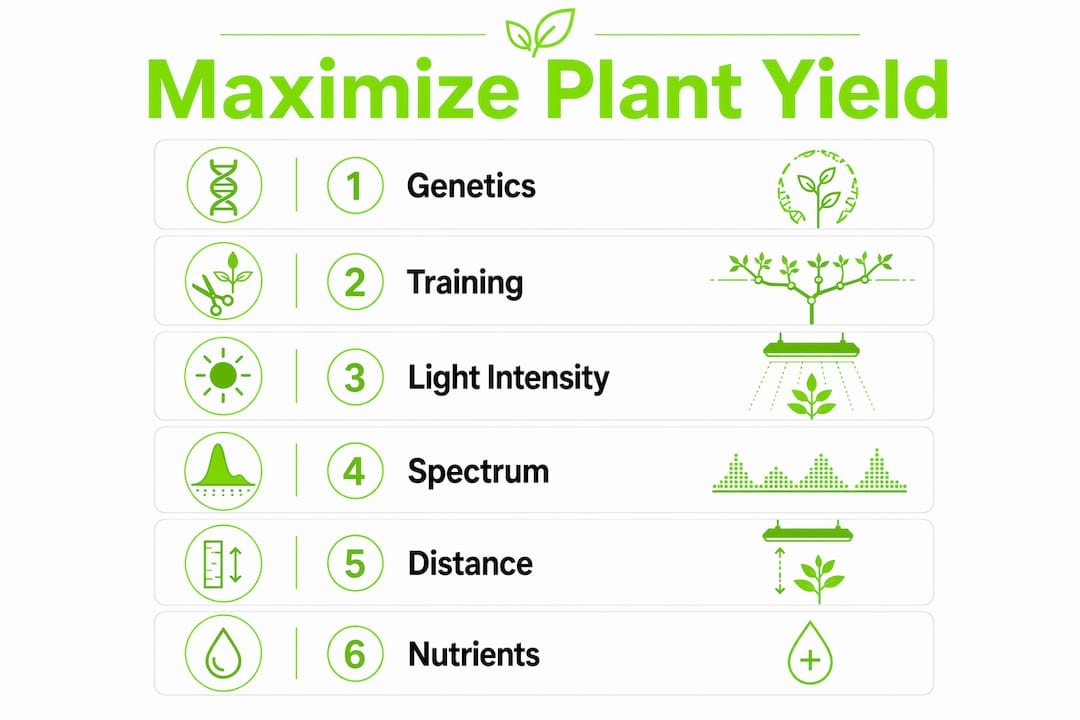
Genetics first. Not all strains respond equally to high-intensity LED lighting. Look for cultivars with documented performance under LED, particularly those bred for dense bud structure and high photosynthetic efficiency. Photoperiod strains generally allow more control over canopy development than autoflowers, though modern autos have closed the gap considerably.
Plant count and spacing. More plants don’t automatically mean more yield. In a 4×4 tent, four to six plants trained with LST typically outperform nine untrained plants crammed together. Overcrowding adversely affects airflow, increases humidity, and causes shading of lower bud sites. Match your plant count to your fixture’s actual coverage footprint, not its marketing claim.
Container selection:
Growing medium comparison:
Early training makes or breaks canopy uniformity. Low-stress training (LST) involves bending and tying stems outward during veg to create a flat, wide canopy. Topping removes the apical meristem, forcing two dominant colas instead of one. SCROG and LST training methods can increase yield by 50–80% with SCROG and 30–50% with LST, by maximizing the number of bud sites sitting at the same height directly under your fixture.
During vegetative growth, run an 18/6 light schedule and keep temperatures between 70–85°F with relative humidity at 50–70%. Get your ventilation sorted before flowering: a properly sized inline fan with carbon filter, oscillating fans for canopy movement, and a consistent fresh air exchange rate. Plants that enter flowering stressed, cramped, or poorly trained rarely recover.
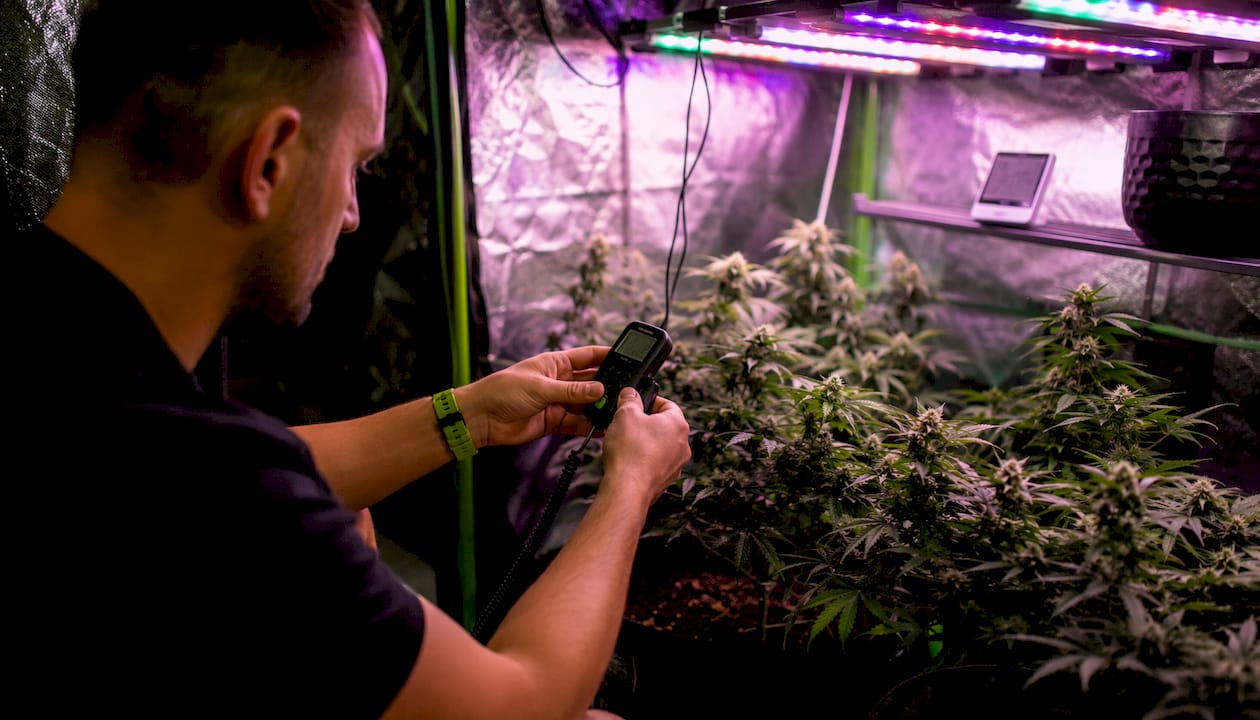
Flowering is where your LED choices pay off or cost you. The parameters that matter most are PPFD intensity, spectral composition, and fixture height. Get these wrong and you’ll either starve your buds of light or bleach the tops while the lowers go dark.
| Growth Stage | PPFD Target (µmol/m²/s) | Recommended DLI (mol/m²/day) | Typical Light Distance |
|---|---|---|---|
| Seedling | 100–200 | 6 | 18 inches |
| Early Veg | 250–350 | 14–20 | 18 inches |
| Late Veg | 400–600 | — | — |
| Early Flower | 600–700 | 30–40 | 14–20 inches |
| Peak Flower | — | 40–50 | 12 inches |
| CO2-supplemented Flower | — | 50–55 | 10 inches |
Without CO2, exceeding a DLI above 55 mol/m²/day causes light bleaching: upper leaves yellow, pigment-protein complexes break down, and yield drops. If you see white or pale yellow patches on your top colas, raise the fixture 3–6 inches immediately.
Red wavelengths (640–680 nm) drive photosynthesis and bud swelling. Far-red (700–750 nm) accelerates the Emerson enhancement effect, where combining far-red with red light produces more photosynthesis than either alone. Far-red light enhances productivity and modulates plant growth in ways that go well beyond what a standard white LED delivers. Green wavelengths (500–560 nm) penetrate deeper into the canopy than red or blue, sustaining photosynthesis in lower leaves that would otherwise be shaded.
The PhotonTek X 600W PRO and X 465W PRO are engineered with this spectral balance in mind, not just peak red and blue. Their output maps include far-red supplementation that most budget fixtures skip entirely.
PPFD uniformity ratios below 0.7 cause uneven plant development across the canopy. A fixture hung too high spreads light too thin; too low creates a hot center with dim edges. Use your PAR meter to map at least nine points across your canopy (corners, edges, center) and adjust height until the ratio between the lowest and highest reading stays above 0.7.
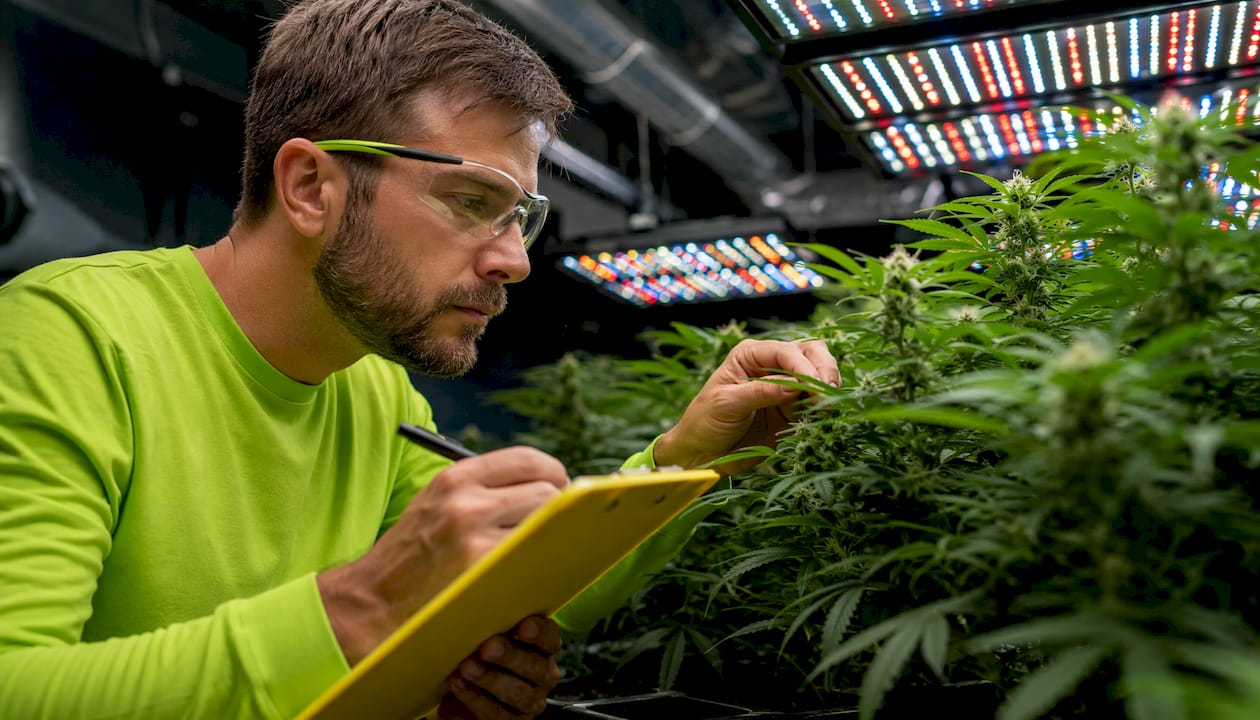
Dimmable fixtures give you a real advantage here. During early flower, run at 75–80% power and lower the fixture gradually as buds develop. This lets you increase intensity without spiking heat stress.
Pro Tip: The Photone app with a paper diffuser taped over your smartphone’s front camera gives surprisingly accurate PPFD readings at leaf level. It won’t replace a professional quantum sensor, but it’s accurate enough to catch major distance problems and costs nothing.
Lighting is the engine, but nutrition and maintenance are the transmission. Even a perfectly dialed LED setup underperforms when plants are overfed, underfed, or left to grow into each other.
Nutrient strategy for high-light grows. Cannabis under intense LED lighting metabolizes faster and demands more precise feeding. During flowering, prioritize phosphorus and potassium while tapering nitrogen after week two. Products like General Hydroponics Flora Series, Athena Pro, or Canna Coco A+B are widely used by commercial cultivators for their consistency and measurable EC targets. Keep your runoff pH between 6.0–6.5 in soil, 5.8–6.2 in coco, and 5.5–6.0 in hydro.
Plant size and canopy height. Taller plants are not better plants. A flat, even canopy where every bud site sits within 6–8 inches of the same height is the goal. Plants that stretch unevenly force you to compromise: either the tops get too much light or the lowers get too little. Aggressive LST and topping during veg keeps everything in the same plane.
Defoliation schedule:
Maintenance best practices:
Most grow light marketing stops at “full spectrum” and calls it a day. The growers pulling exceptional yields are thinking past that.
Spectral bandwidth, not just peak wavelength, is what shapes canopy architecture and chlorophyll retention. A fixture that emits a narrow red spike at 660 nm behaves differently from one that spreads energy across 620–680 nm, even at identical total photon output. The broader band supports more even chlorophyll absorption across leaf layers, which matters in a dense flowering canopy where lower leaves are working hard.
Far-red light supplementation (700–750 nm) activates the Emerson enhancement effect, increasing the rate of photosynthesis beyond what red or far-red alone can achieve. Research confirms that far-red enhances productivity and modulates plant growth, influencing growth hormones and biomass accumulation in ways that standard white LEDs simply don’t replicate. Growers who add even a modest far-red channel to their flowering spectrum consistently report improved internode elongation, larger leaf area, and denser bud development.
What to look for beyond wattage:
Ledgrowlightsdepot’s proprietary proximity systems address one of the most persistent problems in indoor cultivation: insufficient light reaching the lower canopy. Their under-canopy light distribution technology is engineered to push photons past the top colas and into the mid and lower bud sites, which is where most standard fixtures lose yield. The result, per their product data, is over 20% yield improvement and measurably better bud grading compared to conventional setups.
The full spectrum light benefits go beyond chlorophyll absorption peaks. Green wavelengths (520–560 nm) penetrate deeper into dense canopies than red or blue, sustaining photosynthesis in shaded leaf layers. Fixtures that include green in their output support more even whole-canopy productivity, particularly in SCROG setups where lower bud sites are always competing for light.
A 600W LED versus a 1,000W HPS setup illustrates the efficiency argument clearly. The LED consumes less power, generates far less heat (reducing cooling costs), and eliminates bulb replacement cycles. Over a full year, the electricity savings from LED can exceed $400 compared to HPS, with ROI typically achieved within one to two growing seasons.
Spectral optimization checklist:
Ledgrowlightsdepot carries a 4.8 out of 5 satisfaction rating across more than 5,800 customer reviews, which reflects consistent performance across both home growers and commercial operations. That kind of feedback doesn’t accumulate from fixtures that merely look good on spec sheets.
If you’ve read this far, you’re not looking for a generic grow light. You want a fixture with verified PPFD maps, real spectral engineering, and the efficiency rating to justify the investment. That’s exactly what Ledgrowlightsdepot is built around.
The PhotonTek SQ300W PRO is the go-to for compact grows and tent setups where space is tight but yield expectations aren’t. It delivers high PPE in a form factor that fits a 2×4 or 3×3 footprint without overheating the space. For growers running a 4×4 or larger, the PhotonTek X 600W PRO provides the photon density and spectral balance that peak-flower cannabis demands, with far-red integration and full dimmability built in. The PhotonTek X 465W PRO sits between the two, ideal for growers who want serious output without jumping to the 600W power draw. All three ship with verified PPFD maps and are backed by Ledgrowlightsdepot’s expert support team. Browse the full lineup at ledgrowlightsdepot.com and find the fixture that matches your canopy size and yield goals.
Maximizing indoor plant yield with LED grow lights requires hitting stage-specific PPFD targets, managing DLI below 55 mol/m²/day without CO2, and pairing spectral-quality fixtures with trained canopies and precise nutrition.
| Point | Details |
|---|---|
| PPFD and DLI are the core metrics | Peak flower targets are 800–900 µmol/m²/s without CO2 supplementation; keep DLI under 55 mol/m²/day without CO2 to prevent bleaching. |
| Spectrum beyond “full spectrum” matters | Far-red (700–750 nm) and green wavelengths drive yield gains that standard white LEDs don’t deliver. |
| Training multiplies light efficiency | SCROG increases yield by 50–80% and LST by 30–50% by creating uniform canopies where every bud site gets direct light. |
| Nutrition and environment support lighting | Match irrigation frequency to light intensity, defoliate at weeks 1 and 3 of flower, and hold humidity at 40–50% in late flower. |
| Ledgrowlightsdepot fixtures for serious growers | The PhotonTek SQ300W PRO, X 465W PRO, and X 600W PRO deliver verified PPFD maps, far-red integration, and over 20% yield improvement via proprietary under-canopy light distribution. |
0 of 3 items selected

Leave a comment