
Free Shipping in the USA on nearly all items!
Limited phone hours during the Holidays! Call us: 888-611-9305
Free Shipping in the USA on nearly ALL items! Limited phone hours during the Holidays!

The best closet grow lighting is a low-heat, full-spectrum LED panel sized to your footprint, mounted at the right distance and dimmed to match each growth stage. LED beats HPS and fluorescent for closets because it produces far less heat per watt of usable light, which matters enormously in a sealed, unventilated box.
Here are the numbers you actually need before you buy anything:
For a standard 2x2 or 2x4 closet, a single compact panel like LedGrowLightsDepot’s ThinkGrow LED Model-I Grow Light or a low-profile under-shelf strip can hit these targets without cooking the space.
Closet grow lighting succeeds when PPFD targets, hanging distance, ventilation, and dimming controls are matched to the plant’s current growth stage, not fixed at setup.
| Point | Details |
|---|---|
| Match PPFD to stage | Target 100–300 for seedlings, 300–600 for veg, and 600–900 for flowering. |
| Use real wattage, not equivalents | Size fixtures at 25–40 true watts per square foot, checking actual draw at the wall. |
| Hang lights by stage | Keep LEDs 24–26 inches up for seedlings and 18–22 inches for veg and flower. |
| Ventilation is non-negotiable | Run an inline exhaust fan since even LEDs raise heat fast in a sealed closet. |
| LedGrowLightsDepot fits closet footprints | The ThinkGrow Model-I and Sunblaster Micro lines cover 2x2 to 2x4 spaces with dimming built in. |
PPFD (Photosynthetic Photon Flux Density) measures how many usable light particles land on your canopy every second. It’s the number that matters, not the “3000 watt equivalent” language printed on cheap panel boxes, which almost always overstates real output. A fixture pulling 150 actual watts can outperform one labeled “2000W” if its diodes and optics are better matched to your canopy.
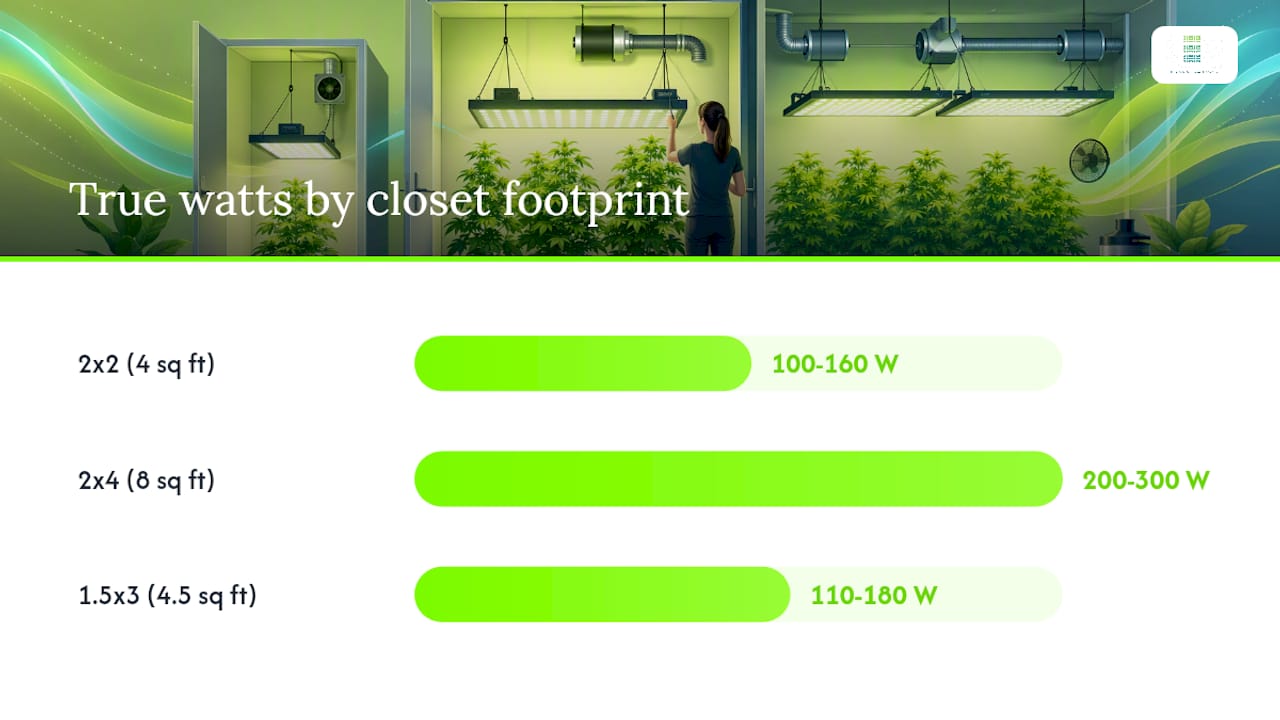
Watt-per-square-foot guidance gets you in the right ballpark fast, and it lines up with what growers report from real closet builds: panels in the 100 to 200 watt true-draw range work well for a 2x2 footprint, while 200 to 300 watts suits a 2x4, according to closet hydroponics setup guidance.
Run the math on three common closets:
Always check the spec sheet for actual power draw at the wall, not the “equivalent” wattage. A 100 watt LED marketed as “600W equivalent” draws 100 watts. That’s the number your electrical circuit and your utility bill both care about, and it’s the number our tiny-space wattage guide breaks down stage by stage.
Full-spectrum LED wins for closet grows, and it’s not close once you factor in heat.
Shop lights and under-cabinet LED bars can be a legitimately good budget move here. Wirecutter’s testing found some $20 shop lights deliver the right brightness and color temperature for starting seeds, which makes them a fine stopgap before you invest in a dedicated flowering panel.
Pro Tip: Never run an HID bulb in a closet without external venting. The heat load can push canopy temps past 90°F in under an hour, and that’s before you factor in fire risk from a hot bulb near hanging fabric or shelving.
Hanging distance changes as your plants grow, and getting it wrong causes most of the visible problems closet growers run into.
These ranges come from practical closet grow setup data and assume a standard LED panel or bar, not a high-intensity HID.
Narrow closets create uneven light more often than wide ones because the walls concentrate heat and shadow the edges of your canopy. Two smaller bar fixtures spaced apart usually beat one large panel centered overhead. Line the interior walls with flat white paint or Mylar sheeting to bounce stray light back onto the plants instead of losing it to the drywall. A bar-versus-panel comparison is worth reading if your closet is taller than it is wide, since verticality changes which form factor makes sense.
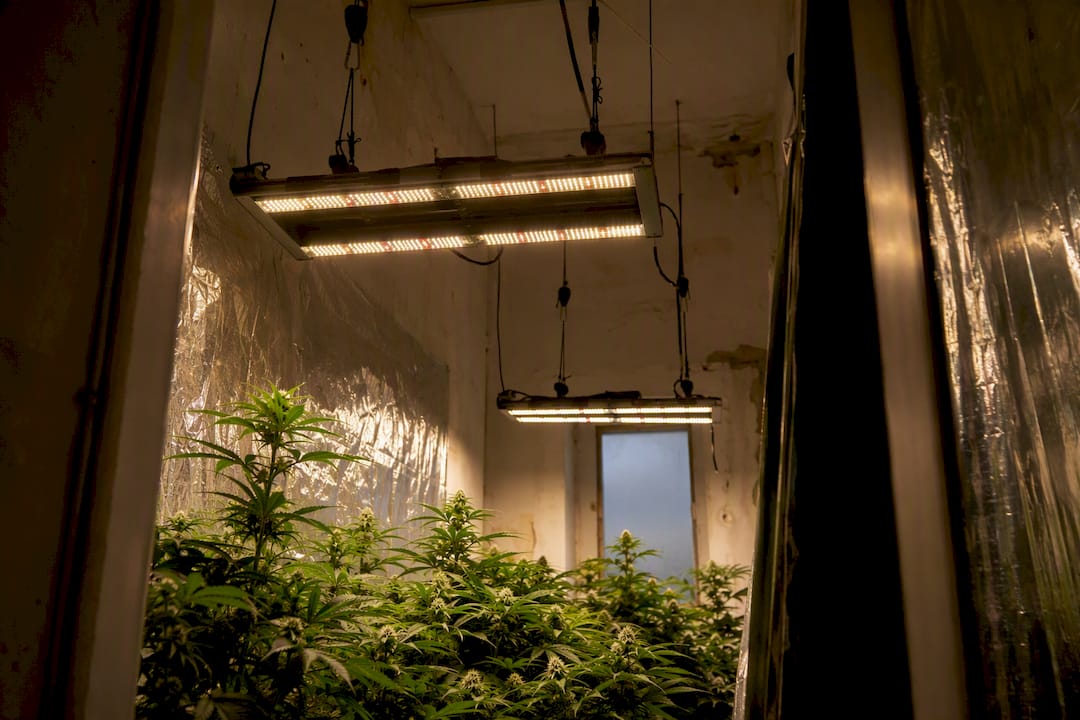
Mounting hardware matters more than most first-time growers expect. Use rated ratchet hangers rated for at least twice your fixture’s weight, clip carabiners through closed loops rather than open hooks, and tug-test every anchor point before you walk away.
Pro Tip: Staggering two low-profile bars at slightly different heights evens out canopy PPFD far better than one oversized fixture centered in a tight space.
Enclosed closets trap heat fast, and even efficient LEDs raise ambient temperature enough to stress plants without active airflow. An inline exhaust fan venting to an adjoining room or outside the structure is typically necessary, according to closet grow setup guidance, and a carbon filter helps if odor control matters for your situation.
Temperature and humidity swings inside a closet happen quickly because there’s so little air volume to buffer changes. A cheap combo sensor catches problems before they become plant damage.
Pro Tip: Set a sensor alarm for anything above 85°F or below 40% relative humidity during lights-on hours. Catching a spike in the first ten minutes beats discovering it after your plants have stretched overnight.
Keep nutrient buckets, EC meters, and any wiring elevated off the closet floor. Splashes and condensation are common in enclosed grows, and water near an outlet is the single fastest way to turn a hobby project into a real hazard.
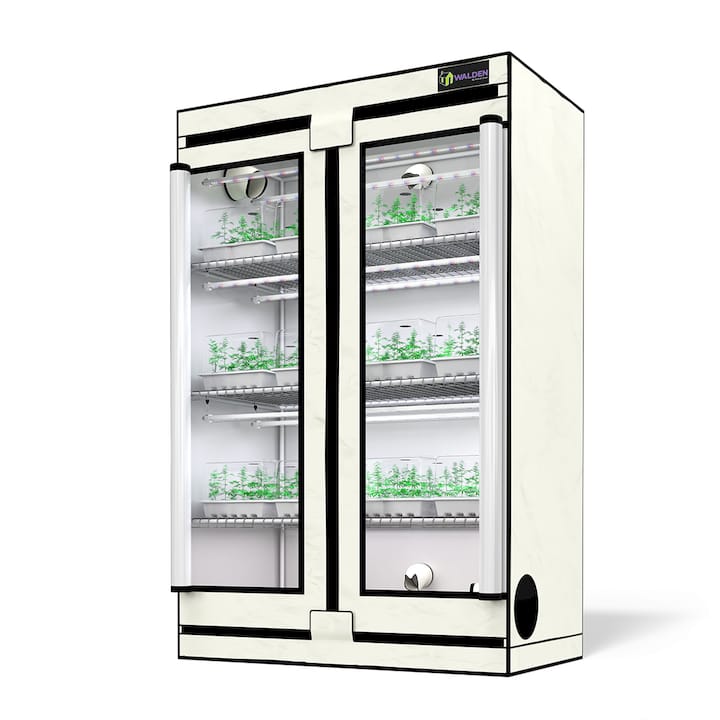
Compact panels and low-profile bars are the two form factors that consistently work in tight closets. Under-cabinet LED strips spread light evenly across shelves without eating vertical space, which matters when your closet ceiling gives you 6 feet or less to work with.
LedGrowLightsDepot’s lineup covers most closet scenarios:
Adjustable spectrum and dimming matter more in a closet than in a dedicated grow room because one fixture usually has to carry a plant from seedling through flower without a swap. That flexibility is what separates a fixture you’ll outgrow in six weeks from one that works for a full cycle.
Before buying, verify four things: actual watt draw at the wall, a published PPFD map (not just a lux estimate), dimming range, and warranty length. LedGrowLightsDepot’s product line carries a high customer satisfaction rating, reflecting good performance under real closet conditions rather than just marketing claims.
Before flipping the switch, confirm: hangers hold weight, fan runs quietly and pulls air correctly, reflective surfaces are in place, and your measured hanging distance matches your growth stage. Watch temps closely for the first two days. That window catches most wiring or airflow mistakes before they become plant damage.
Pro Tip: A handheld PAR meter gives you real PPFD numbers, but a calibrated phone app like Photone gets you close enough to catch major placement errors if you don’t own one.
Before you assume hardware is broken, try adjusting the light schedule or dimmer setting. Half the “my light isn’t working” problems growers report are really intensity or distance issues, not equipment failures.
We ran 24 grow lights through hands-on testing in small, enclosed footprints to see which fixtures actually hold usable PPFD at canopy level rather than just on a spec sheet.
Versatile fixtures with adjustable mounts and dimming controls performed best across mixed-use closet setups, according to hands-on testing of 24 grow lights, a pattern that held whether the closet was 2x2 or 2x4.
Among the compact panels tested, dimmable full-spectrum models showed a meaningfully more even PPFD spread across the canopy edges compared to fixed-intensity units, though results varied by closet size and reflectivity setup.
A dimmer turns one fixture into three, functionally speaking. Instead of buying separate lights for seedlings, veg, and flower, you dial intensity up as the plant matures and back down if you spot stress signs.
Seedlings need roughly 30 to 40% of a fixture’s max output. Push a full-power panel on a two-week-old seedling and you’ll bleach it within days. Vegetative growth wants somewhere around 60 to 80%, and flowering typically runs the fixture at 90 to 100% to hit the higher PPFD targets flowering plants need.
Dimmers also solve a real closet-specific problem: heat load. That’s a meaningful advantage in a space where every degree of extra heat has nowhere to escape.
Look for fixtures with either an onboard dimmer knob or a wired remote controller, since reaching into a hung fixture to adjust settings gets old fast. Some panels also support external control integration, letting you tie dimming into a broader environmental control setup rather than adjusting manually every week. Lighting automation controls cover this in more depth if you’re planning a setup that adjusts on a schedule rather than by hand.
I lean toward a single dimmable full-spectrum panel over multiple fixed lights in a closet, mostly because swapping hardware between growth stages wastes time and introduces more points of failure. Pair it with a cheap temp/humidity sensor set to alarm, and you’ll catch problems before they show up on the leaves.
One tip that surprised me: running lights overnight instead of during the day can actually help if your house runs warmer in daytime hours, since it keeps the closet cooler during the lights-on period without changing your total daily light hours.
LedGrowLightsDepot built its lineup around a specific problem closet growers run into constantly: standard grow lights are sized for tents and rooms, not four-square-foot enclosed spaces with limited airflow. Every fixture below is sized, priced, and speced for tight footprints rather than scaled down from a bigger product line.
ThinkGrow LED Model-I Grow Light: Compact panel with dimming, ideal first fixture for a 2x2 to 2x4 closet.
Grower’s Choice ROI-E720: Higher-output option for growers pushing toward denser flowering yields in the same footprint.
Sunblaster Micro LED Grow Light Garden: Low-profile, under-shelf design for shallow closets or discreet installs.
If you’re unsure which wattage or form factor fits your specific closet dimensions, LedGrowLightsDepot’s support team can walk through fixture fit before you buy, rather than leaving you to guess from a spec sheet alone. When you’re placing an order, consider adding a dimmer controller, a rated ratchet hanger set, and a small inline fan kit. These three add-ons solve most of the mounting and heat problems closet growers hit in their first month. Browse the full closet-ready fixture selection to compare options against your exact footprint and get started this week.
What is the best closet grow lighting for a beginner? A single dimmable full-spectrum LED panel sized to your footprint. It handles seedlings through flower without needing separate fixtures for each stage.
How many watts do I need for a small closet grow? Plan on 25 to 40 true watts per square foot for LEDs, adjusted by growth stage: less for seedlings, more for flowering.
Do LED grow lights get hot enough to be a fire risk in a closet? LEDs run far cooler than HPS or HID, but any enclosed space still needs an exhaust fan since heat has nowhere to dissipate on its own.
Can I use regular shop lights for a closet grow? Shop lights work well for seedlings and early growth on a budget, but they generally lack the PPFD output needed for dense flowering.
How do I know if my closet light is too close or too far? Watch the plant. Stretching means the light’s too far or too weak; bleached or yellowing tips mean it’s too close or too intense.
0 of 3 items selected

Leave a comment