
Free Shipping in the USA on nearly all items!
Limited phone hours during the Holidays! Call us: 888-611-9305
Free Shipping in the USA on nearly ALL items! Limited phone hours during the Holidays!

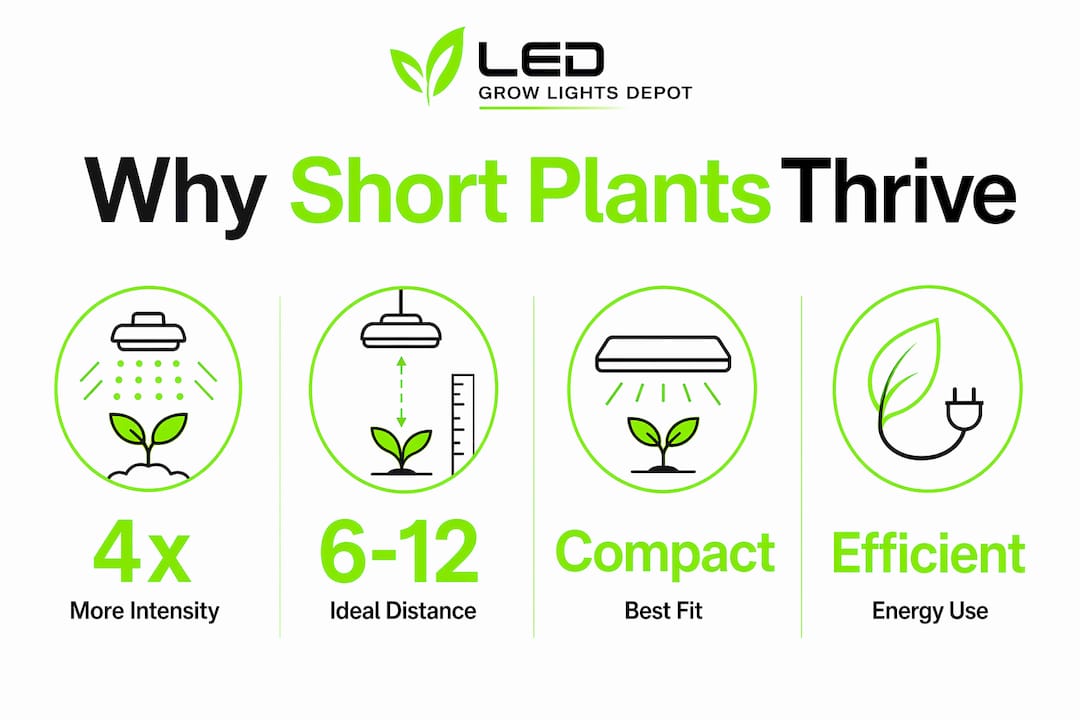
Short plants are the ideal match for small grow lights because their compact height allows growers to place fixtures just inches from the canopy, delivering maximum light intensity without heat damage. The Inverse Square Law governs this relationship: halving the distance between a light and a plant quadruples the light intensity reaching the leaves. That physics principle is why short plants suit small grow lights so well. Compact species like herbs, microgreens, and dwarf tomatoes sit naturally within the 6–12 inch sweet spot where small LED fixtures perform best. Ledgrowlightsdepot builds fixtures specifically engineered for this close-range advantage, helping indoor gardeners get more from every square foot.
Light intensity does not decrease gradually as distance increases. The Inverse Square Law states that intensity drops by the square of the distance, so moving a light from 6 inches to 12 inches does not halve the intensity. It reduces it to one quarter. That is a dramatic loss for any plant trying to photosynthesize.
Photosynthetic Photon Flux Density, or PPFD, measures the actual light energy reaching a leaf surface. Short plants benefit most from close placement because their canopy sits within the zone where PPFD is highest. A taller plant forces the grower to raise the light, which pushes the fixture out of that high-intensity zone and drops PPFD across the entire canopy.
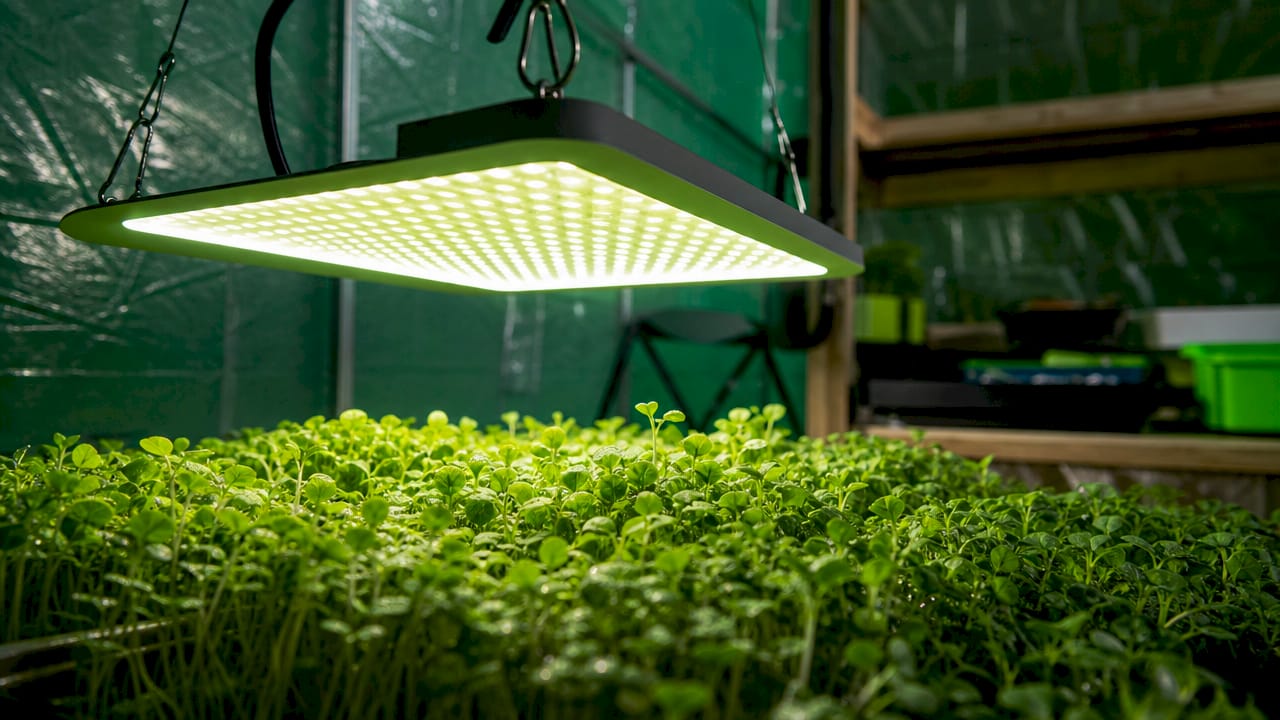
Small grow lights are engineered to work at close range. High-wattage LED bars require a 12–24 inch throw distance just to blend their light beams into a usable spread. That minimum distance alone eliminates the intensity advantage of close placement. A compact fixture does not carry that constraint.
| Light distance | Relative PPFD | Practical effect |
|---|---|---|
| 6 inches | Very high | Ideal for microgreens, seedlings |
| 12 inches | High | Good for herbs, compact lettuce |
| 24 inches | Moderate | Suitable for taller crops only |
| 36 inches | Low | Insufficient for most edibles |
Pro Tip: Use a PPFD meter or a free smartphone app calibrated for grow lights to measure actual intensity at canopy level before committing to a fixture height. Numbers matter more than guesswork here.
Small LED fixtures solve a problem that large, high-wattage bars create: heat concentration. A single high-wattage bar focuses thermal output in one zone, which burns foliage when placed too close. LED tube designs spread heat across a larger surface area, improving convection and protecting plants placed just inches below.
The engineering benefits of compact LED fixtures for short plants include:
Ledgrowlightsdepot’s lineup of compact LED grow lights reflects these engineering priorities, with fixtures designed to perform at the close distances short plants require.
Pro Tip: If you run multiple shelves, stagger your light timers by 30 minutes per tier. This prevents simultaneous peak heat output from all fixtures at once, keeping temperatures stable throughout your grow space.
Short plants do not just tolerate close, intense light. They respond to it with better structure and higher yields. The biological reasons are straightforward.
Compact internodes. When light intensity is high and consistent, plants do not stretch to find more. Lights placed 6–12 inches from short plants produce stocky stems with tight node spacing, which supports heavier foliage and fruit without collapsing.
No wasted stem growth. Stretching, also called etiolation, happens when a plant senses insufficient light and grows taller to reach more. Short plants under properly placed small grow lights skip this energy drain entirely and redirect resources into leaves, roots, and yield.
Faster canopy development. Herbs like basil and compact lettuce varieties fill their allotted space quickly under close, intense light. 14 hours of daily lighting under a well-placed grow light improves growth rates and yield compared to window light alone.
Repeat harvesting. Species like microgreens, cilantro, and dwarf tomatoes are compact, productive choices that regenerate quickly after cutting. Close, consistent light accelerates that regeneration cycle.
Better resource allocation. A short plant under intense light puts energy into dense, productive tissue rather than structural height. That efficiency is the core reason why small plants for grow lights outperform taller species in limited indoor spaces.
The LED spectrum you choose also shapes plant biology. Blue wavelengths suppress stretching and encourage compact, leafy growth. Red wavelengths drive flowering and fruiting. Full-spectrum fixtures deliver both, which is why they suit the widest range of short, productive species.
Placement is where most indoor gardeners lose yield without realizing it. The right distance depends on the plant species and the fixture’s output, but the principles apply broadly.
Pairing the right easy indoor plants with a properly sized fixture removes most of the guesswork from placement. Choosing compact, productive species is the single biggest success factor in small-space indoor growing.
Short plants and small grow lights form the most efficient pairing in indoor gardening because the Inverse Square Law, LED engineering, and plant biology all favor close, intense light delivery over short canopies.
| Point | Details |
|---|---|
| Inverse Square Law advantage | Halving light distance quadruples intensity, making close placement critical for short plants. |
| Safe close placement range | Small LEDs work effectively at 6–12 inches without heat damage or spectral issues. |
| Biology favors compact growth | Tight internodes, no stretching, and faster harvests result from consistent, intense light. |
| Best species for small lights | Herbs, microgreens, and dwarf tomatoes maximize yield under compact LED fixtures. |
| Vertical space efficiency | Modular LED arrays on each shelf maximize cubic foot utilization in limited indoor spaces. |
Scott here. I have spent years watching indoor gardeners make the same mistake: buying a large, high-wattage fixture because they assume bigger means better. In a small grow space with short plants, that logic works against you. A large bar hung 24 inches up to avoid heat damage is delivering a fraction of the PPFD a compact fixture provides at 8 inches.
The counter-intuitive truth is that a lower-wattage, well-engineered small fixture often outperforms a larger one for herbs and microgreens. The physics are not negotiable. Intensity at the canopy is what drives growth, and distance destroys intensity faster than most growers expect.
The other thing I have noticed is how quickly short plants respond to correct placement. Basil under a properly positioned compact LED looks visibly different within a week. The leaves are darker green, the stems are thicker, and new growth appears faster. That visual feedback is the best calibration tool you have.
My advice: start with a species like basil or lettuce, place your light at 10 inches, and observe for 7 days before adjusting. The plant will tell you everything you need to know. Experiment within the 6–12 inch range, and do not be afraid to go closer than feels intuitive. The results usually surprise first-time growers.
— Scott
Ledgrowlightsdepot carries fixtures built specifically for the close-range, high-intensity growing that short plants need.
The NextLight 150h is a strong choice for growers working with herbs, microgreens, or compact fruiting varieties in tight spaces. Its thermal management and full-spectrum output make it effective at the 6–12 inch distances where short plants thrive. For growers who prefer a modular shelf setup, the Toggled 2 ft. LED Grow Shop Light Fixture delivers flexible, close-range coverage across multiple tiers. Ledgrowlightsdepot holds a 4.8 out of 5 rating from more than 5,800 customer reviews, with product support tailored to both home growers and commercial cultivators.
Short plants sit within the 6–12 inch range where small LED fixtures deliver peak PPFD. That close placement maximizes light intensity at the canopy, producing compact, productive growth without stretching.
The recommended starting distance is 6–12 inches for most compact species. Start at 12 inches and move closer if the plant shows no signs of stress like leaf curl or bleaching.
Herbs like basil and cilantro, microgreens, and dwarf tomato varieties are the top choices. These species are compact, repeat-harvesting, and respond well to the intense, close light that small LED fixtures provide.
Properly engineered small LED fixtures avoid heat damage at 6–12 inches because their distributed diode design spreads thermal output across a larger surface area. High-wattage bars concentrate heat and require greater distances, making them unsuitable for short crops.
Most herbs and leafy greens perform well on a 16-hour light, 8-hour dark cycle. Dwarf fruiting varieties typically need 12 hours of light per day to trigger and sustain production.
0 of 3 items selected

Leave a comment