
Free Shipping in the USA on nearly all items!
Limited phone hours during the Holidays! Call us: 888-611-9305
Free Shipping in the USA on nearly ALL items! Limited phone hours during the Holidays!

Seedlings require fundamentally different light conditions than adult plants because their tissues, photoreceptors, and energy demands are not yet mature. A tomato seedling and a flowering tomato plant are biologically distinct organisms in terms of how they process light. Give a seedling the same intensity you use for a fruiting plant and you will bleach its leaves within days. Understanding why seedlings need different light than adults is the single most important thing a home gardener can do before turning on any grow light. The core differences come down to three factors: light intensity measured in PPFD, the spectrum of light delivered, and how many hours of light the plant receives each day.
PPFD stands for photosynthetic photon flux density. It measures how many light particles actually reach a plant’s surface per second. Seedlings and adult plants need very different PPFD levels, and the gap is larger than most beginners expect.
Seedling PPFD targets follow a clear ramp from germination through transplant readiness:
| Growth stage | Target PPFD (µmol/m²/s) |
|---|---|
| Germination | 100–200 |
| Cotyledon stage | 200–300 |
| First true leaves | 300–400 |
| Transplant-ready | 400–500 |
Adult plants typically need 600–1,000+ µmol/m²/s to reach full photosynthetic capacity. That means a mature plant may need five to ten times more light than a seedling just out of germination. The reason is simple: seedling leaf tissue is thin, undeveloped, and highly sensitive to photo-inhibition.
Too much light causes bleaching and leaf curl. Too little causes etiolation, the technical term for the stretched, pale, weak-stemmed growth you see when seedlings strain toward a distant light source. Both outcomes set the plant back weeks. Seedlings cannot handle the same light stress that adult plants manage daily.
Pro Tip: Use a dimmable LED and start it at 30–50% output for the first two weeks. Raise intensity gradually as the seedling adds true leaves. This single habit prevents most seedling light damage.
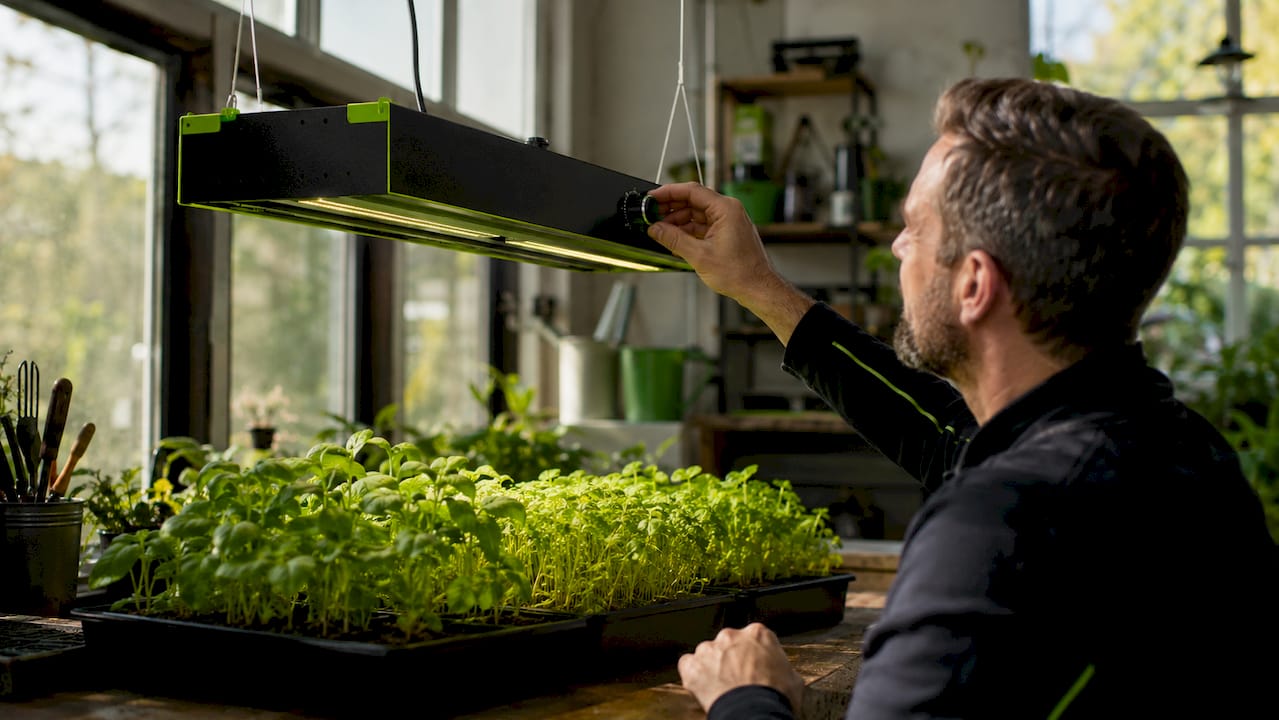
Blue light, the wavelengths between 400 and 500 nm, controls a process called photomorphogenesis. This is the biological mechanism that determines whether a seedling grows compact and stocky or tall and spindly. Blue light signals act like a chemical trigger, switching seedlings from an energy-conserving elongated state into a compact, photosynthetically active form.
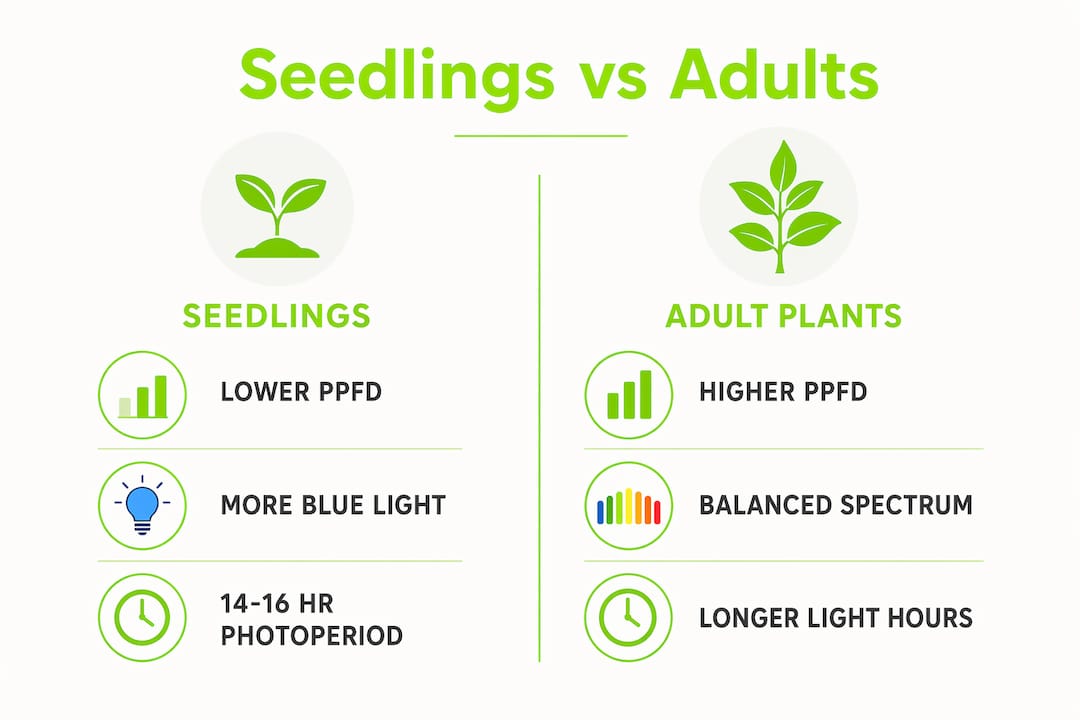
The target blue light fraction for seedlings is approximately 15–30% of total PPFD. Below that range, stems stretch. Above it, growth can slow unnecessarily. Adult plants shift their spectral preference toward red light as they focus on biomass and flowering, which is why the light spectrum for seedlings and mature plants diverges so clearly.
Key differences in spectral needs between seedlings and adults:
Full-spectrum white LEDs with 3,000–6,000K diodes plus added blue outperform red-blue-only lights for seedlings. Red-blue LEDs create stretched growth and mask leaf color changes that signal problems. For home gardeners checking trays daily, that visibility matters.
Pro Tip: If your seedlings are stretching toward the light despite correct height placement, check your spectrum first. A light heavy in red or far-red is often the cause, not the distance.
Photoperiod is the number of hours of light a plant receives per day. DLI, or daily light integral, is the total amount of light delivered over that period. Both metrics matter for seedlings, and both differ from what adult plants need.
The recommended approach for seedlings follows a clear progression:
Never run lights for 24 hours straight on seedlings. Continuous lighting disrupts the hormone cycles that strengthen stems during dark periods. Seedlings grown under 24-hour light often look lush but collapse at transplant because their stems never hardened. The 8–10 hours of darkness each night is not wasted time. It is when the plant consolidates the day’s growth.
Low DLI below 10 mol/m²/day produces weak roots, stretched shoots, and delayed transplant readiness. That outcome costs you weeks of growing time. A simple outlet timer set to 16 hours on and 8 hours off solves the problem completely.
Most seedling failures trace back to a handful of lighting errors. Recognizing them early saves the entire batch.
The most common single mistake is treating seedlings as small versions of adult plants. They are not. Their light requirements, sensitivity, and spectral needs are genuinely different, not just scaled down.
Getting seedling lighting right does not require expensive equipment. It requires the right choices made in the right order.
Choose a dimmable full-spectrum LED. Full-spectrum white LEDs with supplemental blue output give you control over both intensity and spectrum. A light you cannot dim forces you to manage intensity only through height adjustments, which is less precise. The types of LED spectrums available today range from narrow red-blue to broad white-spectrum designs, and the difference in seedling outcomes is significant.
Measure your PPFD. Smartphone apps like Photone give a reasonable PPFD estimate for free. Dedicated meters like the Apogee MQ-500 give lab-grade accuracy. Either tool tells you whether your seedlings are getting 150 µmol/m²/s or 600 µmol/m²/s, a difference you cannot judge by eye alone.
Set light height based on your target PPFD, not a fixed rule. Most LED manufacturers publish light intensity maps showing PPFD at various heights. Use those maps to position your light so the canopy receives 100–200 µmol/m²/s at germination. Lower the light or raise intensity as the seedlings grow.
Use a timer from day one. A 16-hours-on, 8-hours-off schedule covers the needs of nearly every seedling species. Plug-in mechanical timers cost under $15 and remove all guesswork. A detailed seedling light schedule can help you map out the full progression from germination to transplant.
Raise intensity in stages. Move from 100–200 µmol/m²/s at germination to 400–500 µmol/m²/s by transplant time. Do this over two to four weeks, not overnight. Each stage gives the seedling time to adapt its leaf tissue to higher light loads.
Pro Tip: Keep a simple log of your light height, dimmer setting, and PPFD reading each week. When a batch of seedlings looks off, that log tells you exactly what changed. It takes 30 seconds per week and saves hours of troubleshooting.
Seedlings need lower PPFD, more blue light, and a strict 14–16 hour photoperiod compared to adult plants, and skipping any one of these three factors produces weak, leggy transplants that never fully recover.
| Point | Details |
|---|---|
| PPFD ramps with growth | Start at 100–200 µmol/m²/s at germination and increase to 400–500 µmol/m²/s by transplant. |
| Blue light prevents legginess | Target 15–30% blue light fraction to trigger compact, stocky seedling structure. |
| Dark periods are non-negotiable | Run lights 14–16 hours and protect 8–10 hours of darkness for hormone-driven stem strengthening. |
| Full-spectrum LEDs outperform red-blue | White-spectrum LEDs with added blue produce better seedlings and make deficiencies visible. |
| Intensity ramp-up prevents damage | Jumping to full power causes bleaching within 72 hours; increase PPFD gradually over weeks. |
The first time I ran a high-powered flowering light over a seed tray at full intensity, I lost an entire flat of tomatoes in three days. The leaves curled, bleached at the tips, and the stems went rigid before the first true leaf even opened. I thought I was giving them the best possible start. I was doing the opposite.
What changed everything for me was understanding that seedlings are not just small plants. They are a completely different physiological state. Once I started treating the first two weeks as a low-light, blue-enriched phase and only ramping intensity after the second set of true leaves appeared, my transplant quality improved dramatically. Stems were thicker. Root balls were denser. Plants moved into their final containers without the two-week recovery lag I used to accept as normal.
The blue light piece surprised me most. Switching from a red-heavy budget light to a full-spectrum LED with strong blue output produced visibly stockier seedlings within one generation. The difference was not subtle. If you are still using an old red-blue panel for seed starting, that is the first thing I would change.
My honest recommendation: start with a dimmable full-spectrum light, set a timer, and measure your PPFD at least once per stage. You do not need to spend a lot. You need to spend it on the right things.
— Scott
Ledgrowlightsdepot carries a full range of dimmable full-spectrum LED grow lights built for every stage of plant development, from germination through harvest. Their team holds a 4.8 out of 5 rating from more than 5,800 growers who needed exactly what you need now: reliable light that works at seedling intensity without burning young plants.

Whether you are starting your first seed tray or dialing in a dedicated propagation setup, you can find the right LED grow light for your space and budget at Ledgrowlightsdepot. The ThinkGrow Model-I is one option worth considering for seed starting, with dimmable output and a full-spectrum design suited to early seedling stages. Pair it with a timer and a PPFD reading and you have everything you need to grow strong transplants from day one.
Seedlings need 100–200 µmol/m²/s at germination, ramping to 400–500 µmol/m²/s at transplant. Adult plants typically require 600–1,000+ µmol/m²/s for full growth.
Blue light in the 400–500 nm range activates photomorphogenesis, the process that keeps seedlings compact and prevents leggy stem growth. A target of 15–30% blue light fraction produces the strongest seedling structure.
You can, but only at significantly reduced intensity. Running a high-powered flowering light at full output causes bleaching and leaf curl in seedlings within 48–72 hours. Dim it to 30–50% and raise the fixture height.
Seedlings need 14–16 hours of light followed by 8–10 hours of darkness. The dark period supports hormone cycles that strengthen stems. Continuous 24-hour lighting produces weak, structurally compromised plants.
Seedlings grown below roughly 10 mol/m²/day develop weak roots, stretched shoots, and delayed transplant readiness. Raising DLI progressively from germination to transplant produces thicker stems and faster, healthier growth.
0 of 3 items selected


Leave a comment