
Free Shipping in the USA on nearly all items!
Limited phone hours during the Holidays! Call us: 888-611-9305
Free Shipping in the USA on nearly ALL items! Limited phone hours during the Holidays!

Full-spectrum lighting is defined as a light source that emits a balanced range of wavelengths across the visible spectrum, closely replicating the sunlight plants evolved under. Indoor gardens need full spectrum coverage because no single wavelength can carry a plant through every growth stage on its own. Blue light builds structure, red light triggers flowering, and far-red accelerates canopy penetration. Without that complete “light diet,” plants compensate in ways that hurt yield and health. Understanding why indoor gardens need full spectrum is the first step toward choosing the right LED grow light for your setup.
Plants do not treat all light equally. Each wavelength sends a specific biological signal, and missing even one disrupts the chain.
Blue light (400–500nm) controls compact vegetative growth and the internal spacing between leaf nodes. It signals to the plant that conditions are open and exposed, which promotes sturdy, dense growth. Without enough blue, plants interpret the deficit as shade and respond by stretching upward to find light. That survival response produces leggy, weak stems that struggle to support heavy flowers later. Growers often blame overwatering or poor nutrition for this problem, but the real cause is a blue-light gap in the spectrum.
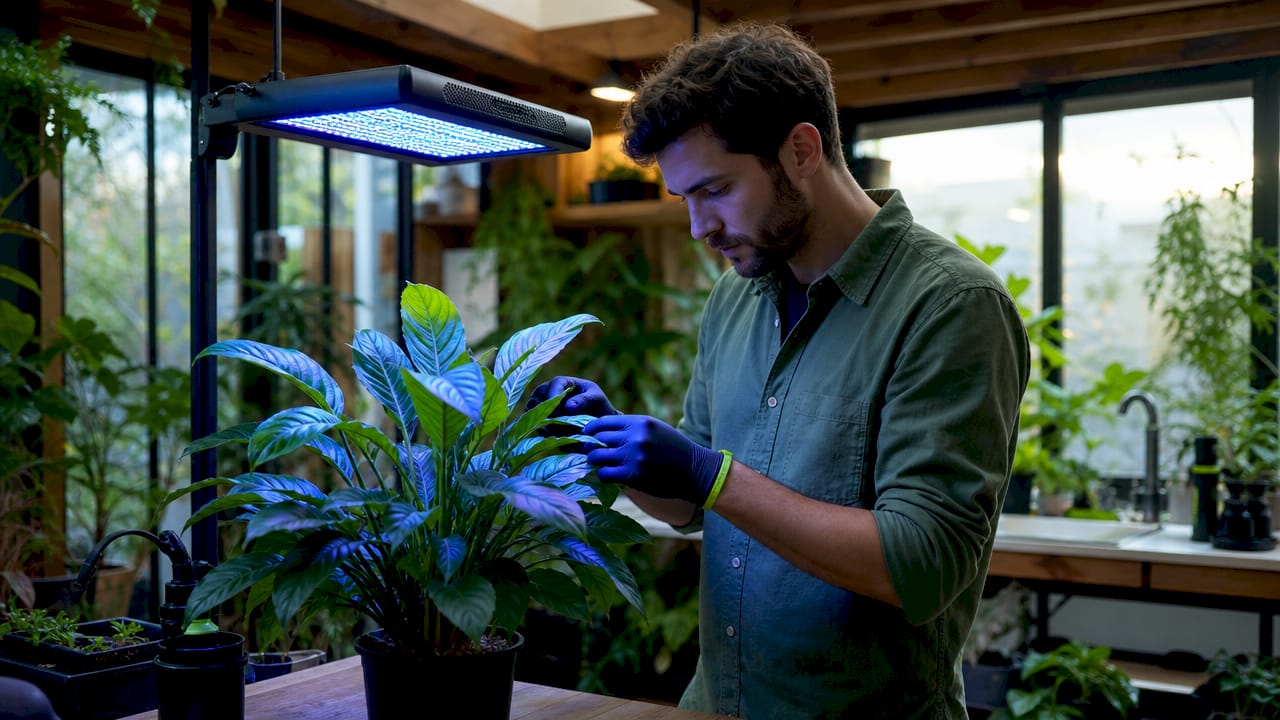
Red light wavelengths (600–700nm) are the primary signal plants use to initiate flowering and fruiting. They regulate the plant’s internal clock without requiring complex light cycle management from the grower. A spectrum deficient in red will produce plants that stay in a permanent vegetative state or flower poorly. This is why early grow lights that leaned heavily on blue diodes often frustrated growers who could not get their plants to bloom on schedule.
Far-red light (700–800nm) accelerates flowering and improves how light penetrates the lower canopy. Small amounts reduce the number of days to flowering in many crops, which matters when you are managing multiple grow cycles per year. UV wavelengths, while used in smaller quantities, stimulate the production of protective compounds in plants, including terpenes and flavonoids. A full-spectrum source covers all of these ranges without requiring separate supplemental fixtures.
Pro Tip: If your plants look healthy but refuse to flower, check your light’s red-to-blue ratio before adjusting nutrients or watering schedules. A spectrum gap is often the hidden culprit.
Photosynthetically active radiation, or PAR, is the industry standard measure for the light range plants actually use, covering 400–700nm. Full-spectrum grow lights are designed to deliver strong PAR output while also including the far-red and UV ranges that sit just outside that window. Matching your light’s PAR output to your plant’s needs at each growth stage is the core skill in indoor gardening.
The red-blue grow light, sometimes called a “blurple” light for its purple glow, dominated indoor growing for years. It has real limitations that full-spectrum white LEDs solve directly.
| Feature | Red-blue grow lights | Full-spectrum white LEDs |
|---|---|---|
| Plant color rendering | Distorted purple/pink tones | Natural, true-to-life color |
| Pest and deficiency detection | Very difficult | Clear and accurate |
| Spectrum coverage | Narrow, two-band | Broad, continuous PAR range |
| Energy efficiency | Moderate | High, with less heat output |
| Grower comfort | Eye strain under purple light | Comfortable for long work sessions |
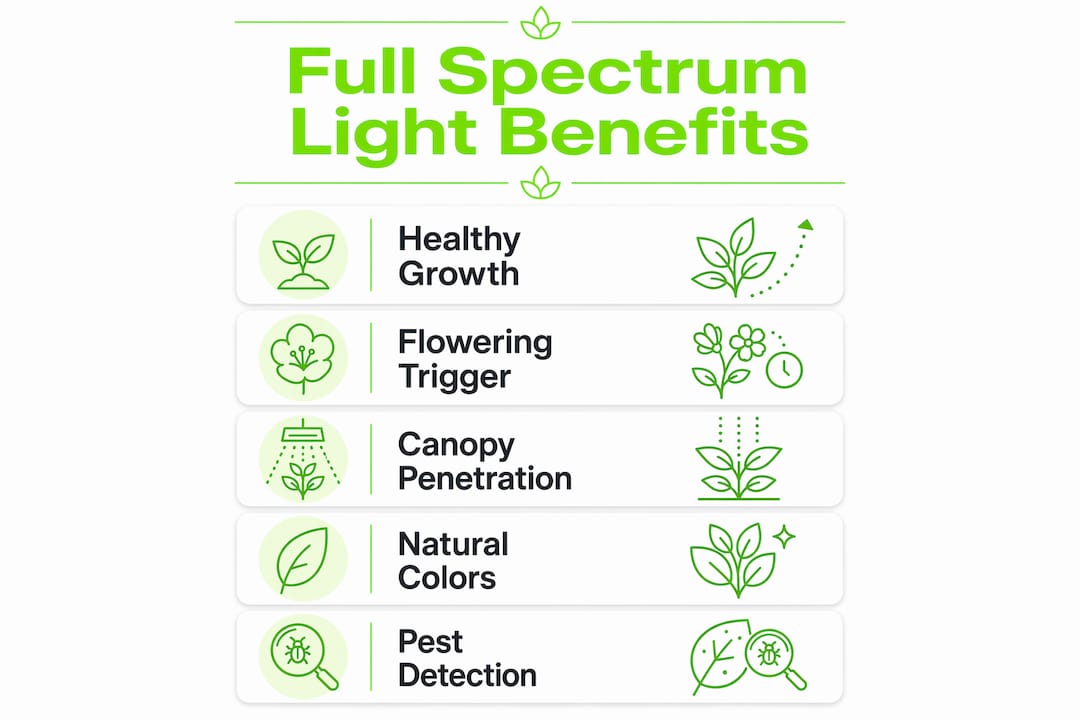
White balanced full-spectrum lighting enables accurate inspection for pests and nutrient deficiencies, which is nearly impossible under distorted red-blue lighting. When you cannot see true leaf color, you miss early signs of iron deficiency, spider mites, or powdery mildew until the problem is severe. That diagnostic advantage alone justifies the switch for most home growers.
Full-spectrum white LEDs are the current standard because phosphor-coated diodes deliver the full PAR range with natural color balance. They also run cooler than older red-blue fixtures, which reduces the risk of heat stress and lowers your electricity bill over time. For a deeper look at how spectrum types compare, the grow light spectrum guide at Ledgrowlightsdepot breaks down the options clearly.
Pro Tip: Work under your grow light for 10 minutes and check if you can read the color of your leaves accurately. If everything looks purple or pink, your light is making plant health monitoring harder than it needs to be.
The term “full spectrum” appears on a wide range of grow lights, and not all of them deliver the same thing. Knowing what to look for protects you from misleading marketing claims.
A genuine full-spectrum grow light covers the continuous visible range from roughly 380nm to 780nm, with meaningful output across blue, green, red, and far-red bands. Here is what separates real full-spectrum lights from narrow-band impostors:
Specialized multi-channel spectrum tuning is generally unnecessary for most home and hydroponic crops. Quality full-spectrum white LEDs cover nearly all applications without the added complexity and cost. Chasing the last 5% of light performance with specialized equipment makes sense for commercial operations optimizing rare crops, but it adds real complexity for home growers who just want healthy plants.
Plants under full-spectrum light express their natural vibrant coloring and texture better than under narrow-band lights. That visual match to evolutionary light conditions is not just aesthetic. It confirms the plant is receiving the signals it was designed to respond to.
Selecting the right light is only half the job. How you use it determines your results.
Match PPFD to your plant type. Leafy greens and herbs thrive at 200–400 μmol/m²/s. Fruiting plants like tomatoes and cannabis need 600–900 μmol/m²/s during peak growth. Check your light’s PPFD map at your intended hanging height before buying.
Calculate your daily light integral (DLI). DLI measures total light delivered per day in moles per square meter. Most vegetables need a DLI of 20–30 mol/m²/day. A DLI lighting controller like the TrolMaster Hydro-X LMA-15 automates this calculation so you never under-light or over-light your plants.
Set light duration by growth stage. Seedlings and clones do well with 18 hours of light per day. Vegetative plants need 16–18 hours. Most flowering plants require a 12/12 light-to-dark cycle to trigger and sustain blooming.
Use dimming controls for precision. Many quality full-spectrum LEDs include dimming functions. Start seedlings at 50–60% intensity and increase as plants mature. Sudden exposure to full intensity can cause light stress, especially in young plants.
Watch your plants, not just your timer. Leaf cupping, bleaching near the canopy, or slow growth despite adequate watering all signal a lighting problem. Adjust height or intensity before changing nutrients.
Pro Tip: Hang a quantum PAR meter at canopy level for one week after setting up a new light. The readings will tell you more about your actual growing conditions than any manufacturer specification sheet.
The benefits of full-spectrum grow lights extend beyond raw growth rates. Growers consistently report better plant structure, more uniform flowering, and fewer pest and disease problems when they switch from narrow-band to full-spectrum sources. LED efficiency also plays a direct role in long-term cost, and Ledgrowlightsdepot covers that topic in detail for growers who want to understand the full picture of LED efficiency for home grows.
Full-spectrum lighting is the single most important variable in indoor plant health because it delivers every wavelength plants need to grow, flower, and thrive without compromise.
| Point | Details |
|---|---|
| Blue light drives structure | Insufficient blue causes leggy, weak plants regardless of total light intensity. |
| Red light triggers flowering | Plants need 600–700nm wavelengths to initiate and sustain blooming cycles. |
| Full-spectrum beats red-blue | White LEDs allow accurate pest and deficiency detection that red-blue lights make nearly impossible. |
| “Full spectrum” labels vary | Verify spectral charts, CRI above 80, and PPFD specs before purchasing any grow light. |
| Match intensity to plant type | PPFD and DLI requirements differ by crop; calibrate your light placement and duration accordingly. |
Most home growers I talk to focus almost entirely on wattage when they shop for a grow light. Wattage tells you how much electricity a fixture consumes. It tells you almost nothing about whether your plants will thrive under it.
The shift that changes everything is moving from “how powerful is this light?” to “does this light cover the full spectrum my plants actually need?” A 200-watt full-spectrum white LED will outperform a 400-watt red-blue fixture for most crops, because the spectrum is doing work the wattage cannot compensate for. I have seen growers run expensive setups with premium nutrients and perfect humidity, then wonder why their plants look pale and stretched. Nine times out of ten, the light spectrum is the missing piece.
The other mistake I see constantly is treating full-spectrum lighting as a set-and-forget solution. Even a great light needs to be positioned correctly, run at the right intensity for each growth stage, and adjusted as plants develop. A seedling 12 inches below a full-power fixture is not getting the benefit of full spectrum. It is getting light stress. The spectrum matters, and so does how you use it.
My honest recommendation for most home growers: buy a quality full-spectrum white LED from a reputable source, learn to read a PPFD map, and spend more time observing your plants than adjusting your equipment. The science is on your side when the spectrum is right.
— Scott
Ledgrowlightsdepot carries a wide selection of full-spectrum LED grow lights built for home growers who want real results without unnecessary complexity.

The NextLight 150h delivers a balanced full-spectrum output designed for consistent performance across vegetative and flowering stages. For larger spaces, the ION 720W provides broad canopy coverage with customizable spectrum options. Ledgrowlightsdepot holds a 4.8 out of 5 customer satisfaction rating from more than 5,800 reviews, and their team is available to match you with the right fixture for your specific crop and grow space. Every product ships with expert support so you get the spectrum right from day one.
Full spectrum in grow lights means the fixture emits a continuous range of wavelengths from roughly 380nm to 780nm, covering blue, green, red, and far-red bands. This range replicates natural sunlight and supports all plant growth stages from seedling to flower.
Standard household LED bulbs lack the PAR output and spectral balance plants need for healthy growth. Dedicated full-spectrum grow lights deliver the correct wavelength ratios and intensity that regular LEDs do not provide.
Leggy growth is a direct response to insufficient blue light in the 400–500nm range. Plants interpret the blue-light deficit as shade and stretch upward, producing weak stems and wide node spacing.
Most vegetative plants need 16–18 hours of light per day, while flowering plants typically require a 12-hour light cycle. Seedlings do well at 18 hours, but intensity should be reduced to avoid stress during early development.
Full-spectrum white LEDs outperform red-blue lights for most crops because they support accurate plant inspection, deliver a broader wavelength range, and produce less heat at comparable output levels.
0 of 3 items selected


Leave a comment