
Free Shipping in the USA on nearly all items!
Limited phone hours during the Holidays! Call us: 888-611-9305
Free Shipping in the USA on nearly ALL items! Limited phone hours during the Holidays!

LED lifespan is defined as the period during which an LED maintains useful light output, measured by the L70 standard, the point at which output drops to 70% of its original level. For growers buying in bulk, this metric is the single most important number on any spec sheet. The U.S. Department of Energy confirms that high-quality LEDs last 30,000–50,000 hours, which is 3–5 times longer than compact fluorescent lamps. That gap in durability translates directly into fewer replacements, lower labor costs, and more consistent light delivery across your canopy. Understanding why LED lifespan matters in bulk purchasing decisions is the difference between a lighting investment that pays off and one that quietly drains your operating budget.
The L70 metric is the industry standard for measuring LED lifespan, and it tells you something more useful than a simple on/off failure point. L70 indicates that the LED still delivers 70% of its original lumen output, which is the practical threshold below which plant growth begins to suffer. For growers, this matters because light intensity drives photosynthesis. A fixture that dims gradually without burning out can silently reduce your yields long before you notice a problem.
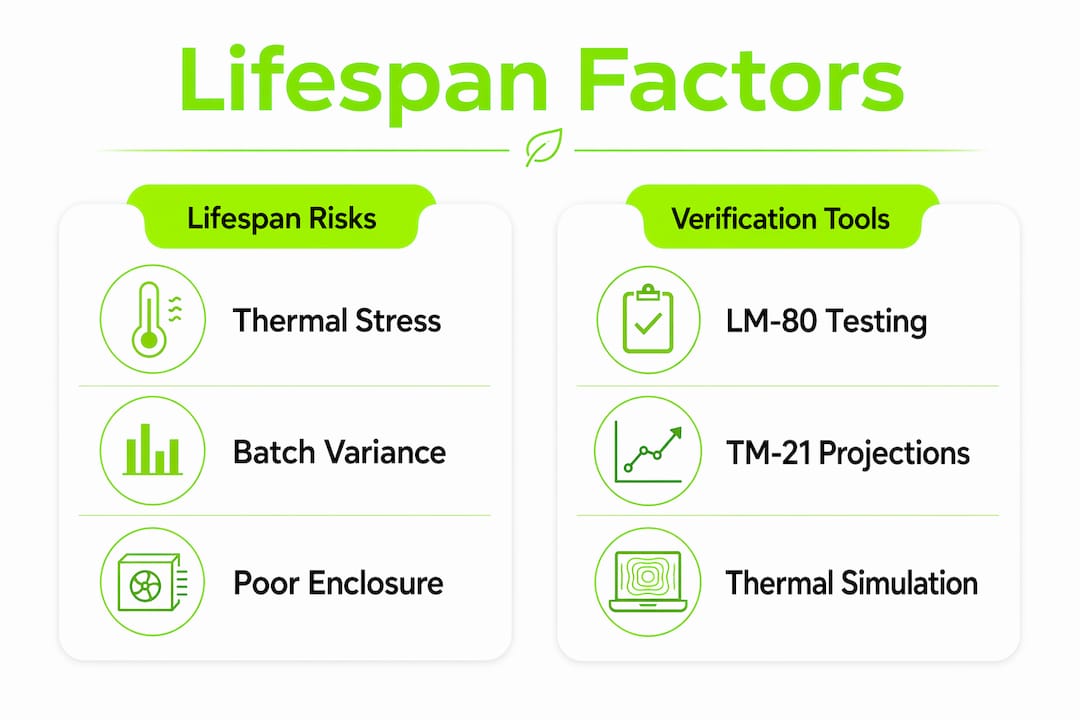
Two testing standards govern how manufacturers calculate and report lifespan claims:
Without documented LM-80 testing and TM-21 projections, lifespan claims lack credibility and increase your replacement risk significantly. When you are buying 50 or 500 fixtures, that risk multiplies at the same rate as your order size.
Pro Tip: Always ask your supplier for the actual LM-80 test report, not just the projected hour rating. If they cannot provide it, treat the lifespan claim as unverified.
Thermal management is the single biggest threat to LED longevity in indoor growing environments. Poor thermal management can reduce a 50,000-hour LED lifespan to less than 24 months. Grow rooms are warm by design, and that heat compounds the thermal load already generated by the fixtures themselves. The result is accelerated lumen depreciation that no datasheet accounts for unless you specifically model your operating conditions.
Here are the four most common factors that shorten real-world LED lifespan in grow rooms:
Thermal resistance, LM-80 testing, color bin control, and batch consistency are the four verification factors you must confirm before placing a bulk order. Skipping any one of them is a gamble that gets more expensive as your order grows.
Pro Tip: Request thermal simulation data and batch analysis reports from your supplier before committing to a large order. Reputable suppliers provide these without hesitation.
Total cost of ownership (TCO) is the correct framework for evaluating bulk LED purchases. Unit price is just the entry fee. Bulk buyers should use a TCO model rather than unit price comparison, accounting for installation, replacement, and energy costs over the fixture’s full life. A fixture that costs 20% less upfront but fails 40% sooner is not a bargain. It is a liability.

Switching to high-quality LED lighting reduces maintenance and operational costs by 60–80% compared to traditional systems, with ROI typically achieved in 2–5 years. That figure assumes the LEDs actually last as long as specified. Early failures collapse that ROI timeline and add costs that most growers do not budget for.
Replacement costs include labor, equipment, downtime, and lost crop, so early failures significantly increase total costs beyond the unit replacement price. In a commercial grow, a single week of suboptimal light during flowering can reduce yield quality enough to affect your entire harvest grade.
| Cost factor | Short-lifespan LEDs | Long-lifespan LEDs |
|---|---|---|
| Unit purchase price | Lower upfront | Higher upfront |
| Replacement frequency | High (every 1–2 years) | Low (every 5–7 years) |
| Labor and downtime costs | Frequent and compounding | Minimal and predictable |
| Energy consumption | Often higher per lumen | Lower per lumen over time |
| Crop consistency risk | High due to light variability | Low with stable output |
| 5-year TCO | Higher overall | Lower overall |
Bulk procurement should also model a 3–7% field failure rate in the first year due to thermal stress or manufacturing variation unless specific MTBF data is provided. On an order of 200 fixtures, that means budgeting for 6–14 early failures. Ignoring this figure leaves you scrambling for replacements mid-grow cycle.
Pro Tip: Build a simple 5-year TCO spreadsheet before finalizing any bulk order. Include unit cost, projected failure rate, labor for replacement, and energy cost per fixture. The cheapest unit almost never wins on a 5-year horizon.
A sound bulk purchasing strategy treats lifespan data as a procurement requirement, not a nice-to-have. These steps protect your investment before the first fixture ships:
The wholesale LED grow light procurement process rewards growers who treat lifespan as a financial variable, not a technical footnote. Every hour of documented lifespan translates directly into a lower cost per harvest cycle.
LED lifespan is a financial variable, not a technical footnote: growers who model L70 ratings, TCO, and realistic failure rates before bulk ordering consistently achieve lower costs and more stable yields.
| Point | Details |
|---|---|
| L70 is the real lifespan metric | Use L70 ratings, not nominal hours, to set realistic expectations for light output over time. |
| Thermal management drives longevity | Poor heat dissipation can cut a 50,000-hour LED lifespan to under 24 months in grow rooms. |
| TCO beats unit price every time | Factor in labor, downtime, and crop loss to see the true cost of cheap fixtures over 5 years. |
| Verify LM-80 and TM-21 data | Lifespan claims without these test standards are unverified and increase your replacement risk. |
| Model a 3–7% first-year failure rate | Budget for early failures in bulk orders to avoid scrambling for replacements mid-grow cycle. |
Scott here. After years of watching growers make bulk LED purchases, the pattern I see most often is this: a grower finds a fixture with an impressive hour rating, buys 100 units, and then spends the next two years replacing 15 of them while wondering what went wrong.
The problem is almost never the LED chip itself. It is the system around it. Thermal management, enclosure design, and airflow account for the majority of real-world lifespan variation. A fixture that performs beautifully in an open warehouse will age twice as fast in a sealed grow tent running at 85°F. The datasheet does not tell you that.
The other thing I have learned is that batch consistency matters more than most growers realize. When you buy 200 fixtures from two different production runs, you can end up with measurable differences in color output across your canopy. That creates uneven plant development, and it is nearly impossible to diagnose without a spectroradiometer. Ask your supplier for SDCM data and batch traceability before you commit.
Upfront unit cost is the least important number in a bulk LED decision. Documented lifespan, supplier accountability, and thermal performance data are what actually protect your investment. Growers who learn this early spend less money and grow better crops.
— Scott
Growers who need documented lifespan performance and reliable output across large installations will find what they need at LED Grow Lights Depot. The product lineup includes fixtures built for commercial and home grow environments, with verified light output and the kind of thermal design that holds up over multi-year grow cycles.
The PhotonTek X 600W PRO is built for commercial-scale operations where consistent output across hundreds of fixtures is non-negotiable. For mid-size operations, the PhotonTek X 465W PRO delivers the same lifespan-focused engineering at a lower wattage. LED Grow Lights Depot carries a 4.8 out of 5 rating from more than 5,800 customer reviews, and their team supports both home growers and commercial cultivators with product guidance tailored to real grow room conditions.
L70 is the point at which an LED delivers 70% of its original lumen output. For growers, this is the practical lifespan threshold because light intensity below this level measurably reduces plant growth and yield quality.
High-quality LED grow lights last 30,000–50,000 hours according to U.S. Department of Energy guidance. That translates to roughly 6–11 years of daily use in a standard 12-hour photoperiod grow cycle.
Poor thermal management can reduce a 50,000-hour LED lifespan to under 24 months. In bulk orders, this risk multiplies across every fixture, making heat dissipation design one of the most important factors to verify before purchasing.
Budget for a 3–7% first-year failure rate in bulk LED deployments unless your supplier provides specific MTBF data. On an order of 200 fixtures, that means planning for 6–14 replacements in year one.
Request LM-80 test reports, TM-21 lifespan projections, and SDCM color bin data. Without these three documents, any lifespan claim from a supplier is unverified and carries meaningful financial risk for your grow operation.
0 of 3 items selected

Leave a comment