
Free Shipping in the USA on nearly all items!
Limited phone hours during the Holidays! Call us: 888-611-9305
Free Shipping in the USA on nearly ALL items! Limited phone hours during the Holidays!

A mini grow tent is a compact, tent-style enclosure with reflective interior walls and ventilation ports, designed to create a controlled micro-environment for indoor plants in tight spaces. Think apartments, closets, spare corners of a basement. These structures solve a real problem: most indoor spaces offer zero environmental control, and plants suffer for it. A mini indoor growing tent changes that equation without demanding a dedicated grow room or a large budget.
A mini grow tent is defined by its combination of reflective walls and enclosure openings that allow precise environmental control in small indoor areas. The reflective interior, typically made from mylar rated at 90% or higher reflectivity, bounces light back onto plant canopies instead of letting it absorb into walls. The rigid frame holds the structure upright, while zippered access panels and ducting ports let you run cables, fans, and filters without breaking the sealed environment.
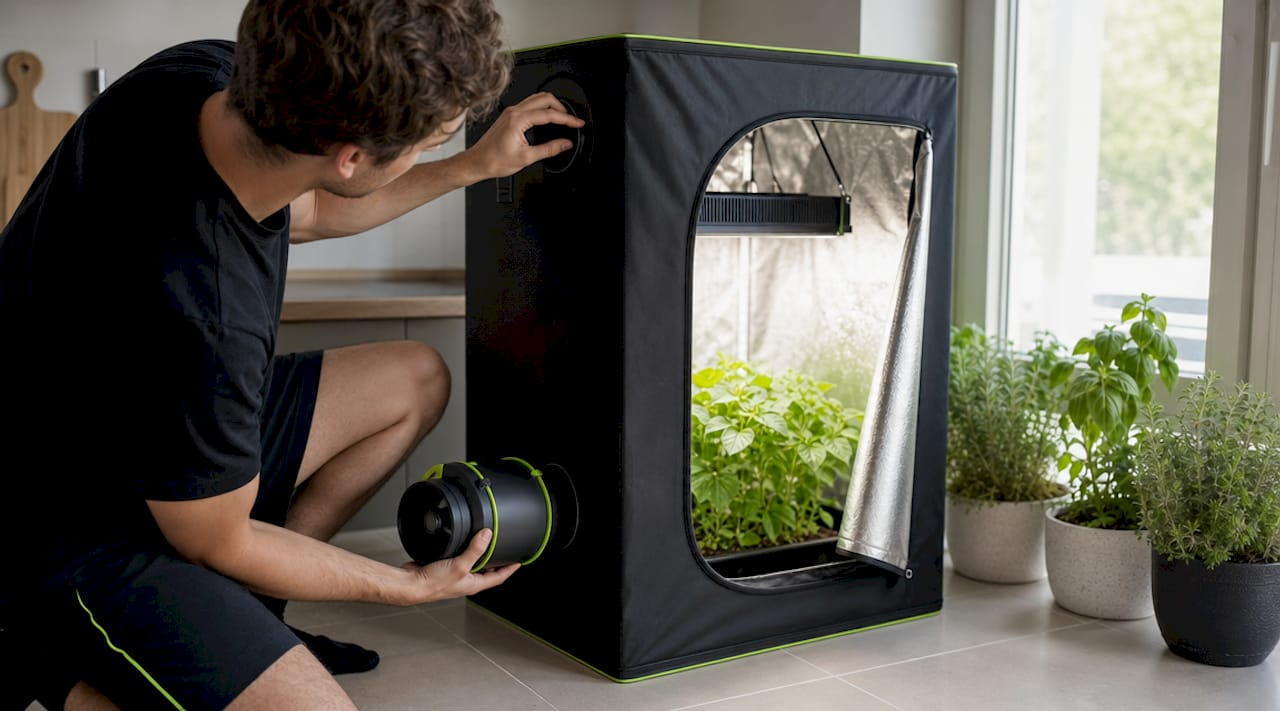
The term “mini grow tent” is an informal descriptor. The recognized industry term is simply “grow tent,” with “mini” or “compact” used to distinguish smaller footprint models from standard sizes. Both terms are accurate, and you will see them used interchangeably by manufacturers like Spider Farmer and Gorilla Grow Tent.
What separates a mini tent from a storage closet or a cardboard box setup is the intentional engineering. Every surface reflects light. Every port is sized for standard ducting. The fabric, usually 600D to 1680D canvas, blocks external light completely. That light-tight seal is what makes photoperiod-sensitive plants respond correctly to your lighting schedule.
Mini grow tents require fewer lights and ventilation components than larger setups, which directly reduces energy usage and upfront cost. That is not a minor advantage. A 2x2 tent running a 100-watt LED and a small inline fan costs a fraction of what a 4x4 or 5x5 setup demands in electricity and equipment. For a first-time grower or someone growing herbs and greens for personal use, that difference matters.
The core advantages of mini grow tents include:
Pro Tip: Buy a tent with at least two ducting ports on opposite sides of the structure. This lets you run fresh air in from one side and exhaust from the other, creating a proper negative pressure environment without improvising.
Mini grow tents also suit beginner growers because the manageable scale makes it easier to learn climate control without being overwhelmed by a large, complex system. Mistakes in a 2x2 tent are cheap to fix. Mistakes in a 5x5 tent can cost you an entire harvest.
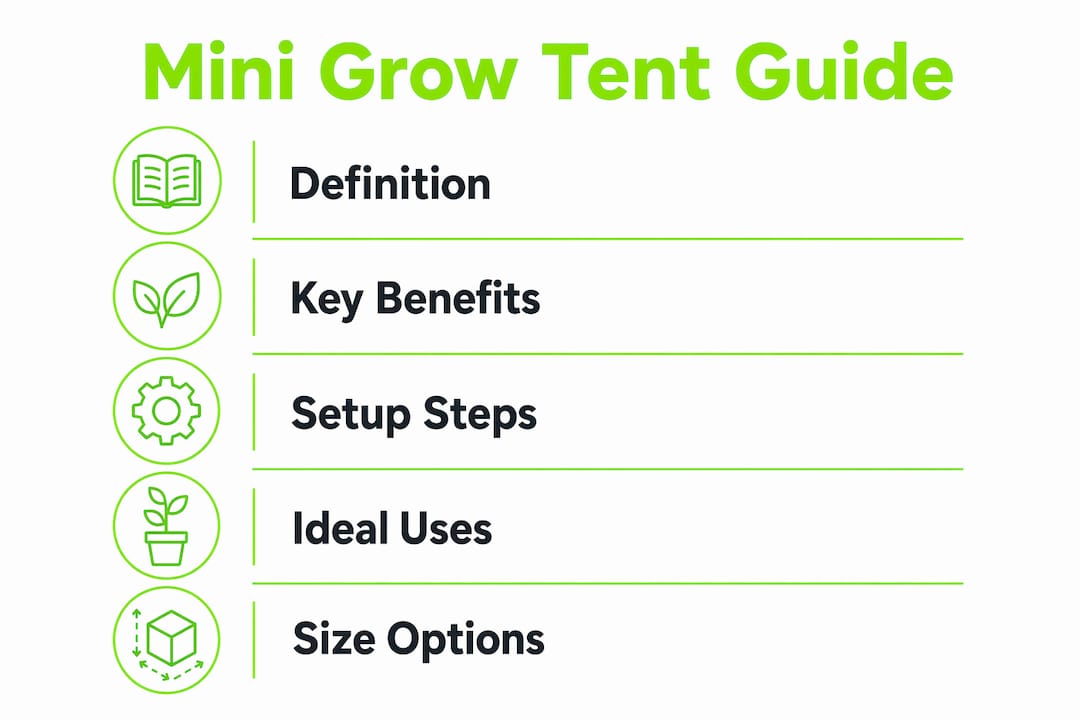
A successful mini grow tent setup follows a logical sequence. Skipping steps, especially in ventilation and lighting placement, creates problems that compound over the grow cycle. Here is the setup process that works:
Pro Tip: In a mini grow tent, matching light height to canopy size is critical. The smaller enclosure means light intensity changes dramatically with just a few inches of adjustment. Check and adjust lighting schedules and environmental parameters aggressively during the first week until conditions stabilize.
Mini grow tents typically measure from 2x2 feet to 3x3 feet, while standard tents start around 4x4 feet and scale up to 10x10 and beyond. That size gap translates directly into plant capacity, equipment requirements, and energy costs. The Spider Farmer 2.3’ x 2.3’ x 5.2’ tent is a representative example of the mini category, featuring 1680D canvas, 98% reflective mylar lining, multiple ducting ports, and metal corner connectors built for repeated assembly and disassembly.
| Tent size | Grow space | Recommended plants | Ideal use case |
|---|---|---|---|
| 2x2 ft | 4 sq ft | 1 large plant or 2 to 4 small plants | Seedlings, clones, single-plant grows |
| 2x4 ft | 8 sq ft | 2 to 4 plants | Herbs, greens, small flowering plants |
| 3x3 ft | 9 sq ft | 3 to 4 medium plants | Propagation, vegetative stage, compact flowering |
| 4x4 ft | 16 sq ft | 4 to 9 plants | Standard home grow, full cycle |
| 5x5 ft | 25 sq ft | 6 to 12 plants | Larger home grow or small commercial |
A 2x2 grow tent provides roughly 4 square feet of growing space, which is sufficient for one large photoperiod plant or several smaller autoflowers. That scale keeps electricity bills low and makes climate mastery achievable for new growers. Height extensions, available on premium models from brands like Gorilla Grow Tent, add 12 to 24 inches of vertical clearance for taller plants without requiring a new tent purchase.
The feature that most growers overlook when comparing sizes is ducting port placement. Mini tents with ports on multiple sides give you more flexibility in how you route ventilation, which matters when the tent is tucked into a closet with limited access.
Herbs, leafy greens, seedlings, clones, and low-height plants are the natural fit for mini grow tents. Basil, cilantro, mint, spinach, and lettuce thrive in 2x2 and 2x4 footprints. These plants have shallow root systems, short stature, and fast harvest cycles, which means you can run multiple crops per year in the same small space.
Mini tents also serve specific cultivation goals that go beyond plant species:
The main limitation is plant count and canopy size. Tall or wide-spreading plants like indeterminate tomatoes or large cannabis plants in full vegetative growth will outgrow a 2x2 tent quickly. Training techniques like low-stress training (LST) and topping keep plants compact and spread the canopy horizontally, which maximizes light exposure within the tent’s limited footprint. Growers using LST in a 2x2 tent consistently report better light penetration and more even bud development than untrained plants in the same space.
A mini grow tent is the most practical entry point into controlled indoor cultivation because it combines environmental precision with low cost and minimal space requirements.
| Point | Details |
|---|---|
| Core definition | A mini grow tent is a sealed, reflective enclosure with ventilation ports for controlled indoor plant growth. |
| Size range | Mini tents run from 2x2 to 3x3 feet, compared to standard tents starting at 4x4 feet. |
| Energy and cost advantage | Smaller footprint means fewer lights and less ventilation equipment, reducing both upfront and ongoing costs. |
| Best plant types | Herbs, leafy greens, seedlings, and clones perform best in mini tent dimensions. |
| Setup priority | Ventilation, canopy-matched lighting, and consistent monitoring are the three factors that determine success. |
Scott here. After years of watching growers start with oversized setups and struggle, my honest observation is this: a 2x2 or 3x3 tent teaches you more in one grow cycle than a 5x5 tent teaches you in three. The smaller space forces you to pay attention. Temperature swings are immediate and visible. Humidity problems show up fast. That feedback loop is exactly what new growers need.
The mistake I see most often is under-investing in lighting and ventilation while over-spending on the tent itself. A premium tent with a weak light produces mediocre results. A modest tent with a quality LED, like the options Ledgrowlightsdepot carries, consistently outperforms the reverse. LED efficiency matters more in a mini tent than in a large one because the light-to-space ratio is tighter. Every watt either contributes to plant growth or becomes heat you have to manage.
I also think the odor control question gets oversimplified. Grow tents alone are not smell-proof. Odor containment depends on the combined system of a sealed tent, an inline fan, and a quality carbon filter working together. Skipping the carbon filter because the tent is small is the most common and most avoidable mistake in mini tent setups.
My practical advice: start with a 2x2, run one full grow cycle from seed to harvest, and take notes on every environmental reading. By the end of that cycle, you will know exactly what you need to scale up or optimize. No amount of reading replaces that direct experience.
— Scott
The right lighting makes or breaks a mini grow tent setup. Ledgrowlightsdepot carries compact, high-efficiency options built specifically for small indoor spaces. The NextLight 150h delivers full-spectrum output in a form factor sized for 2x2 and 3x3 tents, with the kind of canopy penetration that translates directly into yield. For growers who want a proven shop-light style option, the Toggled 2 ft. LED Grow Shop Light fits tight spaces without sacrificing output. With a 4.8 out of 5 rating from more than 5,800 customer reviews, Ledgrowlightsdepot backs every recommendation with real grower results.
A mini grow tent is used to create a controlled indoor growing environment for plants in small spaces like closets, apartments, or basements. Common uses include growing herbs, leafy greens, seedlings, and clones year-round.
Mini grow tents typically range from 2x2 feet to 3x3 feet, providing 4 to 9 square feet of growing space. Standard grow tents start at 4x4 feet and scale up significantly from there.
A tent alone does not fully contain odors. Effective odor control requires a sealed tent combined with an inline exhaust fan and a carbon filter working as a complete system.
A 2x2 tent holds one large plant or two to four smaller plants, depending on species and training method. A 3x3 tent accommodates three to four medium-sized plants comfortably.
Mini grow tents are well-suited for beginners because the smaller scale makes environmental control more manageable and mistakes less costly. The compact space also accelerates the learning curve by making temperature and humidity changes immediately visible.
0 of 3 items selected


Leave a comment