
Free Shipping in the USA on nearly all items!
Limited phone hours during the Holidays! Call us: 888-611-9305
Free Shipping in the USA on nearly ALL items! Limited phone hours during the Holidays!

For most small indoor gardens and seed trays, a compact full-spectrum LED bar or an adjustable multi-head lamp is typically the right choice, but optimal fixture type can vary depending on whether you’re starting seedlings, growing herbs, or caring for houseplants — see the detailed recommendations below by use case and crop type. The ThinkGrow LED Model-I Grow Light is the top pick for single-shelf herb trays and seedling setups: small footprint, daisy-chain compatible, and purpose-built for tight spaces. If you need more coverage or want room to scale, the ThinkGrow LED Model-I Plus adds dimming and broader reach without a major price jump.
Quick picks by use case:
A 24-light test by The Spruce confirmed that full-spectrum LED fixtures with adjustable stands consistently outperform single-spectrum options for seedling and small-space use. Coverage area matters as much as raw wattage: a light that saturates the center of your tray but fades at the edges will produce uneven seedlings.
Pro Tip: Measure your shelf or tray before you buy. Most compact LED bars cover a 1–2 ft² footprint at the recommended hanging height. Buying a light rated for a 4×4 ft space and running it over a 10-inch tray wastes electricity and can cause heat stress.
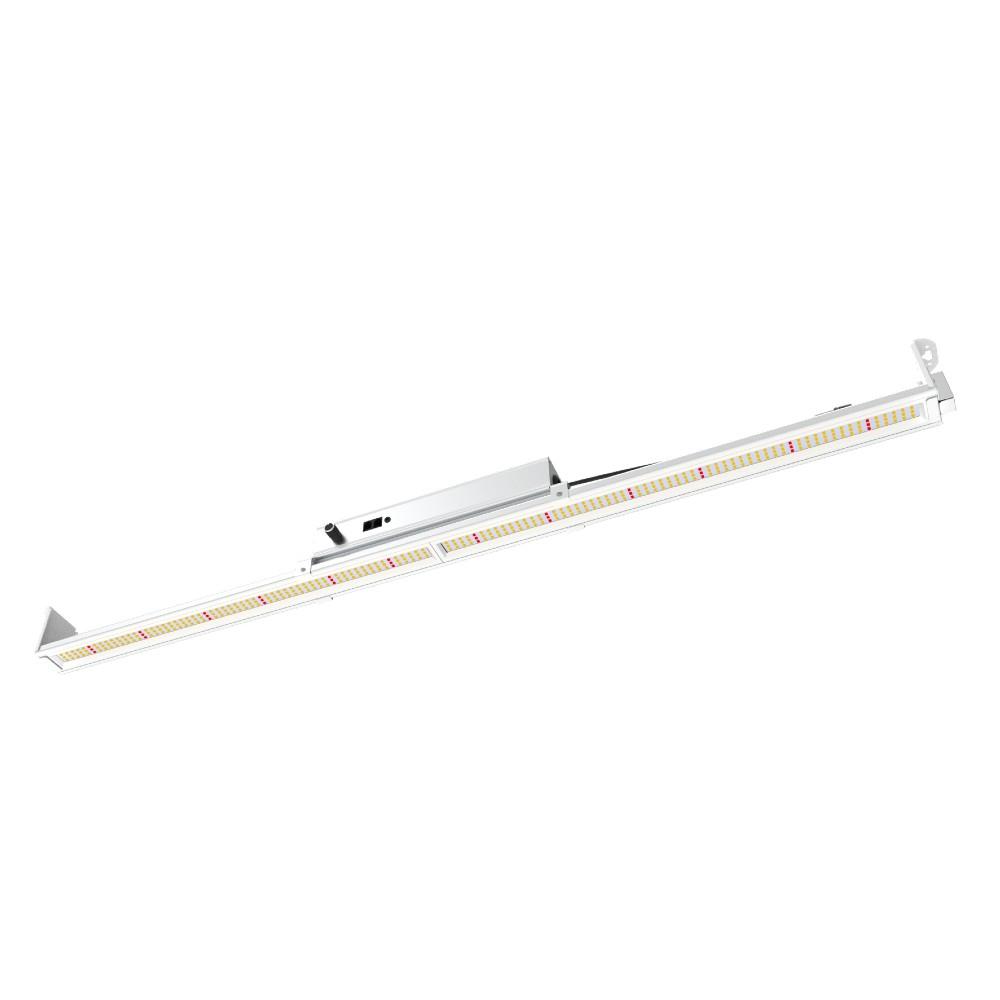
Full-spectrum LED bars matched to your actual tray or shelf size are the most effective and energy-efficient choice for small indoor gardens and seed starting.
| Point | Details |
|---|---|
| Match coverage to your tray | Measure your shelf or tray first; most compact LED bars cover 1–2 ft² at the recommended height. |
| PPFD targets by crop | Seedlings need 100–300 μmol/m²/s; herbs 200–400; fruiting crops 400–600+ μmol/m²/s. |
| Daily light hours matter | Run microgreens about half a day, leafy herbs a bit longer, and fruiting seedlings for an extended daylight period. |
| Dimmer controls improve results | Starting seedlings at 50–60% intensity and ramping up reduces stretch without requiring a second fixture. |
| LedGrowLightsDepot for small spaces | The ThinkGrow Model-I, PROXIMITY Cube, and Sunblaster Micro kits are purpose-built for compact shelf and countertop setups. |
The table below covers all eight featured fixtures across the dimensions that matter most for small-space growers. Price bands reflect typical retail positioning: budget (under $50), mid ($50–$200), and premium (over $200).
Notes on PPFD and coverage: Exact PPFD figures vary by mounting height and are not uniformly published for every model. Where manufacturer spec sheets list PPFD maps, check the product page directly. As a general rule, seedlings need roughly 100–300 μmol/m²/s, leafy herbs 200–400 μmol/m²/s, and fruiting crops 400–600+ μmol/m²/s at canopy level.
Pro Tip: If a listing omits PPFD data entirely and only quotes “equivalent wattage,” treat that as a red flag. Reputable fixtures publish either a PPFD map or a PPF (μmol/s) value you can use to estimate coverage.
The Model-I is the most practical starting point for a single shelf or herb tray. Its slim bar profile fits standard wire shelving without overhang, and the daisy-chain port lets you add a second unit to an adjacent shelf without running a new power cable. The full-spectrum output covers seedling and vegetative stages well. The main limitation is coverage: at roughly 1–2 ft², it suits a 10×20-inch propagation tray but not a wider setup.
The Model-I Plus adds a dimmer and broader coverage compared to the base Model-I, which makes it the better choice if you plan to move from seedlings to established herbs or want to run the same fixture across multiple growth stages. The dimming function is genuinely useful: starting seedlings at 50–60% intensity and ramping up as they develop reduces stretch without requiring a second fixture.
The ROI-E420 sits at the mid-range of the ROI lineup and covers roughly a 2×4 ft footprint, making it a strong fit for a single small tent or a two-shelf rack. It draws moderate power and includes a dimmer, so you can dial back intensity for seedlings and push it for vegetative growth. Build quality on the ROI series is well-regarded, and the passive cooling design keeps noise at zero.
The ROI-E720 delivers higher output and covers a full 4×4 ft footprint at full power, but its dimmer lets you run it at reduced intensity over a smaller area. That flexibility makes it useful for growers who start with a small tent and expect to expand. At full output, heat management and adequate airflow in an enclosed space become real considerations.
The ROI-FF 650W is included here as a “graduate” option for growers who have outgrown compact setups and are moving into a dedicated 4×4 tent for full flowering cycles. At 650W true draw, it produces substantial heat and requires active ventilation. It is not the right choice for a kitchen shelf or a small apartment rack, but it is the logical next step for anyone scaling up from the ROI-E420 or E720.
The PROXIMITY Cube Lighting System is designed specifically for dense propagation racks and microgreen trays where standard overhead bars leave gaps between tiers. The close-proximity design delivers even coverage across each tray surface without the intensity falloff you get from mounting a panel 12–18 inches above. It stacks and modularizes, so you can match it to the exact number of tiers in your rack.
Both Sunblaster Micro kits are countertop-ready seed-starting solutions with an integrated tray and dome option. The white version suits bright kitchen or utility room setups; the black version fits darker decor. Practical guides including Savvy Gardening recommend SunBlaster micro kits for countertop seed starting and microgreens, citing the convenience of matched trays and domes. The light output is calibrated for propagation, not fruiting, so expect strong germination and early seedling results rather than full-cycle performance.
Start with coverage and PPFD for your crop type, then match form factor and heat output to your space. A light that fits the shelf but underdelivers on intensity produces leggy, weak seedlings. A light that overdelivers in a sealed cabinet creates heat stress.
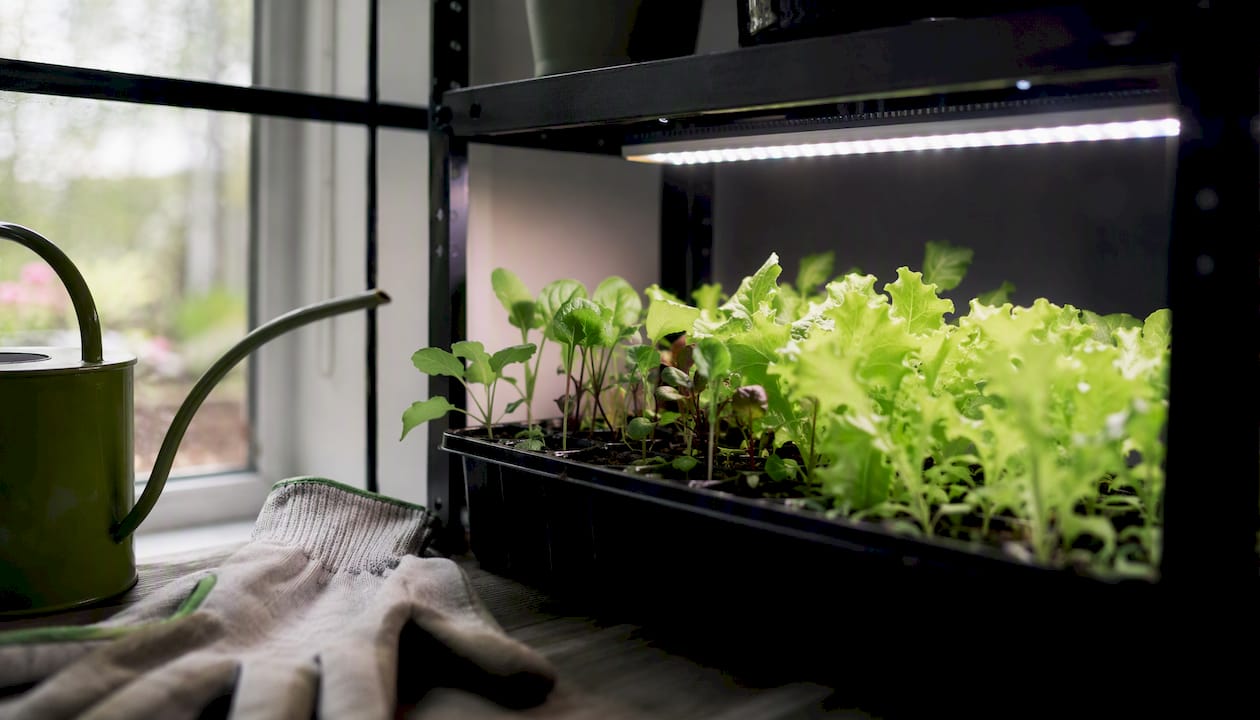
UrbanMicrotips recommends 20–30W true draw for herbs and seedlings in compact setups, scaling to 50–100W for mixed fruiting setups. PPFD targets by crop class:
For a practical wattage guide tailored to compact spaces, LedGrowLightsDepot’s sizing guide walks through the math by shelf footprint.
Full-spectrum LED bars and slim panels are the most practical form factor for shelf installs. Clip-on arm lamps work for single pots. Hanging panels suit tents and open racks with vertical clearance.
Red flags: No PPFD or coverage spec listed. “Equivalent wattage” only (not true draw). No warranty information. Excessive heat claims for a sealed-cabinet fixture.
Pro Tip: UrbanGreenSpace advises that coverage uniformity matters as much as peak brightness. A light that hits 600 μmol/m²/s at center but drops to 150 at the edges will produce uneven plants. Look for fixtures with a published PPFD map, not just a center-point reading.
Understanding the main fixture families helps you match the right form factor to your shelf, windowsill, or countertop.
| Light Type | Efficiency | Heat | Footprint | Cost | Best For |
|---|---|---|---|---|---|
| Full-spectrum LED bar | High | Low | Slim, shelf-ready | Mid | Seedlings, herbs, leafy greens |
| LED panel (mid-output) | High | Low-moderate | Compact, hanging | Mid–Premium | Small tents, mixed crops |
| LED panel (high-output) | High | Moderate | Larger, hanging | Premium | Fruiting crops, scale-up |
| Clip-on / arm lamp | Moderate | Low | Very small | Budget | Single pots, windowsill |
| Fluorescent T5/T8 | Moderate | Low-moderate | Long tubes | Budget–Mid | Seedlings, propagation |
| Countertop kit (integrated) | Moderate | Very low | Micro | Budget | Seed starting, microgreens |
Full-spectrum LED bars are the most practical first purchase for apartment growers. They mount under shelves or hang from wire racks, draw low wattage, and produce minimal heat. BHG’s tested roundup confirms compact full-spectrum LEDs as the top recommendation for seedlings and small houseplants, with adjustable mounts and dimmers listed as key differentiating features.
LED panels (mid-output, like the ROI-E420) suit growers who want more coverage or are running a small tent. They cost more upfront but deliver better PPFD uniformity across a wider footprint.
Fluorescent T5/T8 tubes remain a viable budget option for propagation. They run cooler than older HID lights and are widely available. Their efficiency trails modern LEDs, and bulb replacement adds to long-term cost.
Clip-on arm lamps work for a single pot on a desk or windowsill. They are not practical for trays or multi-plant setups.
Pro Tip: For a detailed breakdown of compact LED form factors and mounting options, LedGrowLightsDepot’s guide covers shelf bars, panels, and cube systems side by side.
Follow these steps for a typical shelf or countertop setup.
| Crop Type | Daily Light Hours |
|---|---|
| Microgreens | 12 hours |
| Leafy greens and herbs | 14 hours |
| Fruiting seedlings | 16 hours |
A 30W LED bar running 14 hours per day draws approximately 0.42 kWh per day, based on typical power use. At the U.S. average residential electricity rate of roughly $0.16 per kWh, that is about $0.07 per day or approximately $2.10 per month per fixture. A 100W panel running 16 hours costs roughly $0.26 per day, or about $7.80 per month. LED fixtures typically carry an L90 rated life of around 50,000 hours, indicating long operational lifespan before significant dimming is expected. Commercial specs from Hort Americas document L90 lifespans of 54,000 hours on comparable LED fixtures, which gives a useful benchmark for evaluating manufacturer longevity claims.
Pro Tip: Pair your grow light with a smart plug and an indoor air quality monitor to track temperature and humidity automatically. Small enclosed spaces can accumulate heat and excess moisture faster than open shelves, and catching a spike early prevents crop loss.
The picks in this article reflect a combination of hands-on comparisons, published spec sheet analysis, and real-use seedling trials. Evaluation criteria included:
Testing references used in this article include a 24-light roundup by A 2026 tested roundup by The Spruce and Better Homes & Gardens evaluated multiple grow lights. Both prioritized full-spectrum LED fixtures with adjustable stands for small-space and seedling use cases.
Key spec metrics to verify on any product page: PPF (μmol/s) tells you total photon output. PPFD (μmol/m²/s) tells you intensity at a specific distance and area. Efficacy (μmol/J) tells you how efficiently the fixture converts electricity to usable light. L90 rated life tells you how long before output drops to 90% of original. If a listing omits all four, ask the manufacturer directly before purchasing.
LedGrowLightsDepot carries a customer satisfaction rating of 4.8 out of 5 from more than 5,800 reviews, reflecting consistent performance across home grower and commercial cultivator purchases. All products featured in this article are available through LedGrowLightsDepot with manufacturer warranty support and customer service for sizing questions.
Match your purchase to your actual use case.
When to spend more: If you plan to run the same fixture for two or more years across multiple crop cycles, the ROI-E420 or Model-I Plus pays back its higher upfront cost through better coverage uniformity and longer rated life. A budget bar light is fine for a single season of seed starting.
Always verify the coverage area and warranty terms on the product page before purchasing. Manufacturer specs can vary between production runs, and a current spec sheet is more reliable than a third-party summary.
For easy plant and light pairings that work well in compact setups, LedGrowLightsDepot’s plant guide offers ready-made combinations for beginners.
The most common mistake small-space growers make is buying a light sized for a 4×4 tent and hanging it over a 10-inch tray. The center PPFD looks great on paper, but the edges of the tray get a fraction of that intensity, and the excess heat in a small cabinet stresses plants that should be thriving. Start with a fixture matched to your actual tray size, not your aspirational grow space.
One tip that consistently improves seedling results: run your light on a dimmer at 50–60% for the first two weeks after germination, then ramp to full output. Seedlings started under gentler light develop stronger root systems before the canopy has to support full photosynthetic demand. Adjustable stands and dimmers materially improve seedling outcomes precisely because they let you adapt the light to the plant’s stage rather than the other way around.
For deeper reading on why full-spectrum output matters across all growth stages, the full-spectrum grow light guide at LedGrowLightsDepot covers the science in plain language.
Small-space growers need fixtures that fit the shelf, not the other way around. LedGrowLightsDepot stocks the full range covered in this article, from the ThinkGrow LED Model-I for single-shelf seed trays to the PROXIMITY Cube Lighting System for dense microgreen racks. Every fixture ships with manufacturer warranty coverage, and the LedGrowLightsDepot team is available to help you match a light to your exact tray size, crop type, and budget. The Sunblaster Micro LED Grow Light Garden is a practical countertop starting point for new growers. Returns and warranty support are handled directly. Contact customer support with your shelf dimensions and target crops for a specific sizing recommendation before you order.
0 of 3 items selected

Leave a comment