
Free Shipping in the USA on nearly all items!
Limited phone hours during the Holidays! Call us: 888-611-9305
Free Shipping in the USA on nearly ALL items! Limited phone hours during the Holidays!

For reliable fruiting, run peppers at 400 to 600 µmol/m²/s PPFD for 14 to 16 hours a day to hit a DLI around 22 to 30 mol/m²/day. Seedlings need less: 100 to 200 µmol/m²/s. Vegetative plants want 200 to 400 µmol/m²/s.
The practical fixture pick: a dimmable, full-spectrum LED panel as your main light, paired with a supplemental strip for seed starting or under-canopy support.
One warning worth repeating before you buy anything: watch canopy temperature closely, and plan on hand-pollinating flowers, since indoor air rarely moves enough pollen on its own.
Reliable pepper fruiting depends on hitting 400 to 600 PPFD and 22 to 30 mol/m²/day DLI for 14 to 16 hours daily, paired with daily hand-pollination and canopy temperatures under 90°F.
| Point | Details |
|---|---|
| Fruiting light target | Run 400 to 600 PPFD for 14 to 16 hours to reach a DLI of 22 to 30 mol/m²/day. |
| Stage-specific distances | Hang panels 24 to 30 inches for seedlings, 18 to 24 inches vegetative, 12 to 18 inches fruiting. |
| Watch canopy heat | Keep air below 90°F (32°C) near the canopy to protect pollen viability and prevent blossom drop. |
| Pollinate daily by hand | Shake flower clusters or brush them gently once a day from first bloom through fruit set. |
| Match fixture to plant count | LedGrowLightsDepot’s ThinkGrow Model-I, ROI-E720, and AC Infinity tent kit cover single-plant to two-plant fruiting setups with dimmable, full-spectrum output. |
PPFD (Photosynthetic Photon Flux Density) measures how many light particles hit a square meter of your plant’s canopy every second. DLI (Daily Light Integral) totals that light over a full day. The formula connecting them is simple: DLI = PPFD × hours of light × 0.0036. Run 500 PPFD for 16 hours and you land at roughly 29 mol/m²/day, comfortably inside the fruiting range.
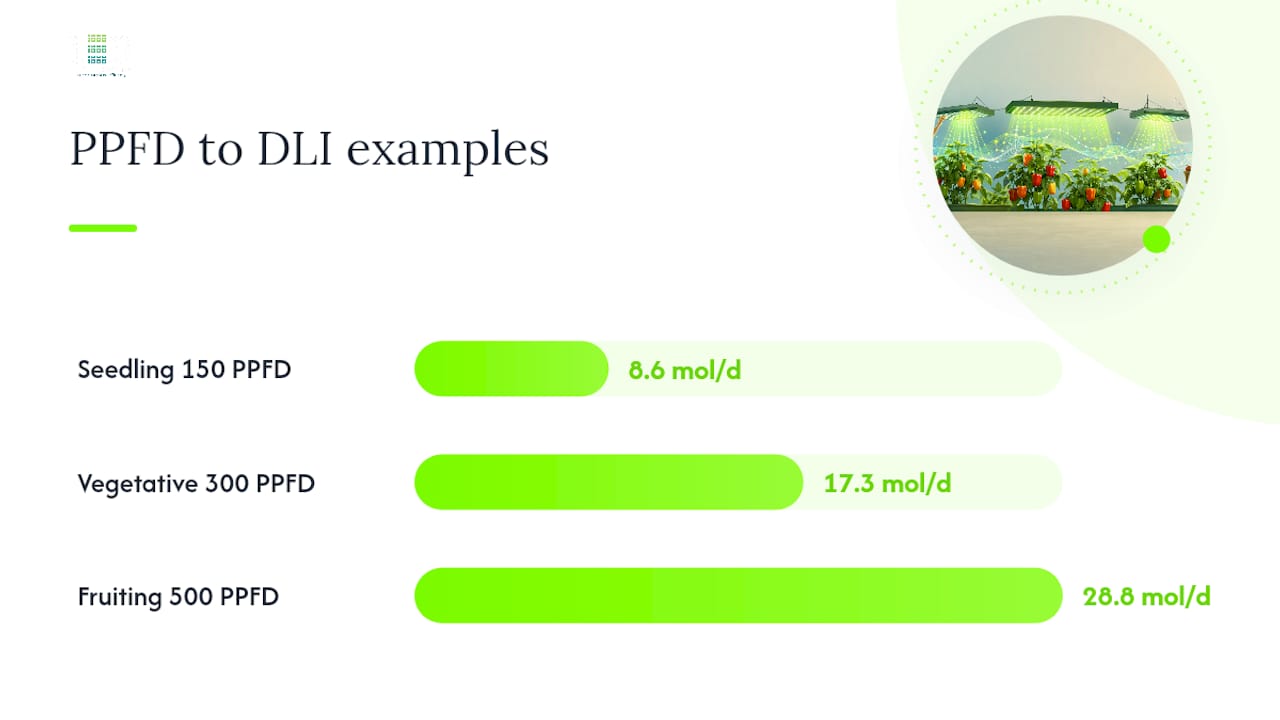
Peppers move through three light phases, each with its own numeric target:
These stage-by-stage figures come from extension-style growing guides, and they track closely with what commercial hydroponic pepper growers report for hitting a 22 to 30 mol/m²/day DLI during fruit set.
Spectrum matters as much as intensity. Blue wavelengths keep growth compact and encourage sturdy stems during the vegetative phase. Red wavelengths push flowering and fruit development. Full-spectrum white LEDs, rather than narrow-band red/blue “blurple” fixtures, tend to produce better fruit weight and quality while also making it easier to spot pests or discoloration during inspection.
Peppers also need genuine darkness. A plant running lights 24 hours a day doesn’t grow faster. It just burns energy without the recovery period photosynthesis depends on, which is why 14 to 16 hours on and 8 to 10 hours off is the standard window for fruiting plants.
Fixture choice comes down to coverage area, efficacy, and how much control you want over intensity. A quality 100W full-spectrum LED panel typically covers about a 2 foot by 2 foot area, enough for two to four plants, while many growers step up to 150 to 200 watts for denser fruiting setups.
Efficacy, measured in PPE (µmol/J), tells you how much usable light a fixture produces per watt of electricity. A higher PPE means less wasted energy turning into heat, which matters a lot in a closet or tent where airflow is limited. Two panels drawing the same wattage can produce very different PPFD if their PPE differs.
Dimming ability is worth paying for. A single dimmable panel can run at 40% output for seedlings, ramp to 70% for vegetative growth, and hit full output for fruiting, which simplifies wiring and cuts the number of fixtures you need compared to swapping lights between stages.
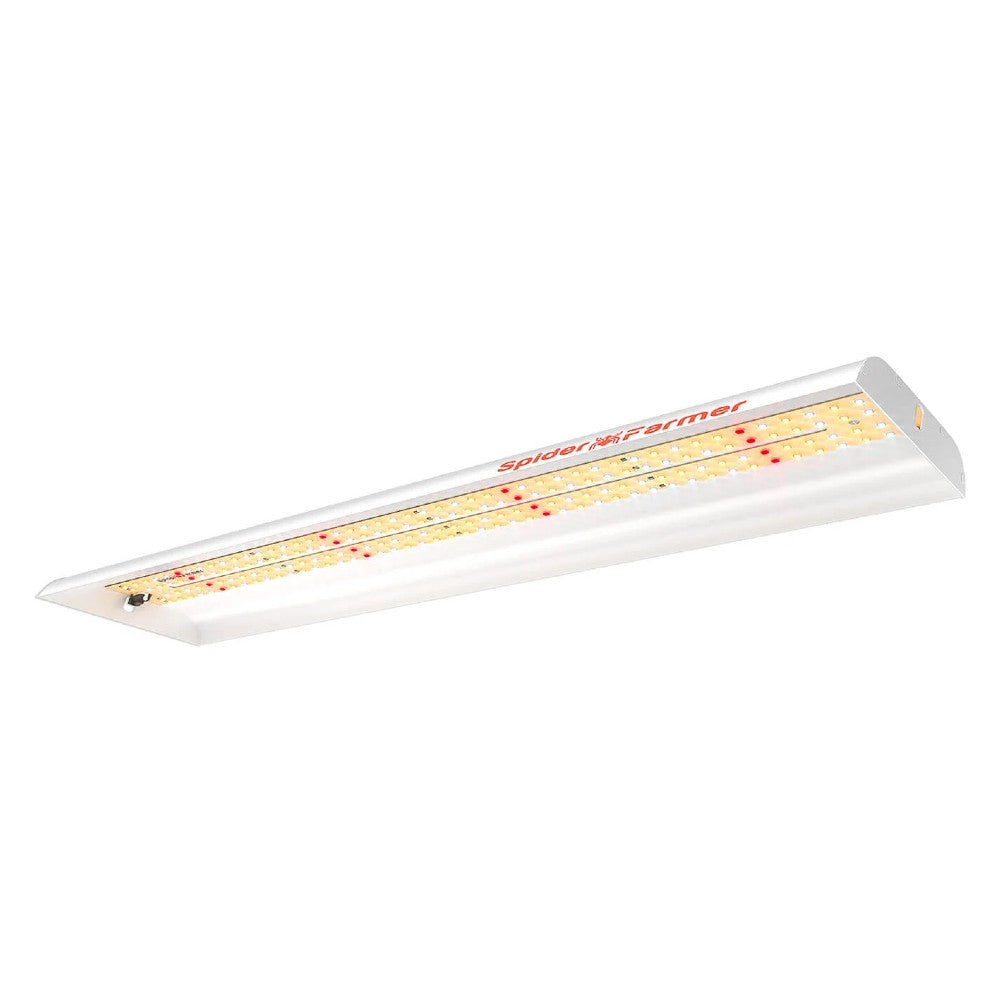
Pro Tip: If you’re only growing one or two pepper plants, buy one dimmable full-spectrum panel sized for your fruiting stage, then dial it down for earlier stages instead of buying separate lights for each phase.
Distance and intensity move together. Start with these ranges for panel-style fixtures, adjusting based on your specific model’s PPFD map:
Manufacturer PPFD maps, usually charted at several heights and grid points, are the most reliable way to know actual output at your canopy. A handheld PPFD meter gives you an exact reading; lacking one, smartphone light meter apps offer a rough estimate, though they read in lux rather than PPFD and need a conversion factor for accuracy.
Set your timer to match the stage table above: 16 hours during vegetative growth, then step down to 14 to 16 hours once flowers appear. Add a small clip fan near the canopy, both to strengthen stems and to keep warm air from pooling under the fixture.
Canopy air temperature deserves its own line item. Keep it below 90°F (32°C). Heat above that threshold reduces pollen viability and triggers flower drop, even when your PPFD numbers look perfect on paper.
Most light-related pepper problems trace back to one of three causes, and each has a specific fix.
Indoor air rarely carries enough pollen movement on its own, so hand-pollination or gentle mechanical agitation is close to mandatory for reliable fruit set. Once the first flowers open, shake each cluster gently or brush across it with a small artist’s brush, once a day, and keep it up until you see the first fruit forming.
Pro Tip: If you’ve corrected light and pollination and blossom drop continues, check root zone temperature and nutrient calcium levels before touching the light setup again. Not every fruiting problem is a light problem.
The University of Minnesota Extension frames light as something you adjust continuously, not something you set once. Increase intensity and shorten distance as plants move from vegetative to fruiting, and judge success by how the canopy actually responds rather than by hours on a timer alone. That mindset separates growers who get consistent fruit from growers who set a light and forget it.
LedGrowLightsDepot’s proprietary under-canopy proximity systems apply this same logic to the lower half of the plant, where a single overhead fixture often leaves leaves shaded and underperforming.
Under-canopy supplemental lighting raises usable PPFD at the lower canopy, improving fruit set on multi-branch plants where shading otherwise cuts off photosynthesis to interior leaves.
That approach is part of why LedGrowLightsDepot customers report meaningful gains in yield on compact, multi-stem pepper plants where a single top-down light leaves the lower third in shadow.
For readers building out a full setup, these guides go deeper on the mechanics:
Most advice on lighting peppers spends too much time on wattage and not enough on distance and duration, and that’s backward. A 200 watt panel hung too high delivers less usable PPFD than a 100 watt panel hung correctly, yet buyers keep chasing bigger numbers on the box instead of measuring what actually reaches the leaf surface.
The bigger blind spot is pollination. Growers nail the PPFD and DLI targets, then wonder why flowers keep dropping, without realizing that indoor air simply doesn’t move pollen the way wind or bees do outdoors. Daily hand-pollination isn’t an advanced technique. It’s baseline maintenance for anyone growing peppers under lights, and skipping it undoes weeks of careful light management.
If you take one thing from stage-by-stage targets, take this: treat PPFD as something you check and adjust weekly, not something you set once at installation. Plants that stall out under a “good enough” light almost always needed a few inches of adjustment, not a whole new fixture.
Matching your fixture to your actual plant count and growth stage beats buying the biggest panel available. Here’s how the setups in this guide map to real products.
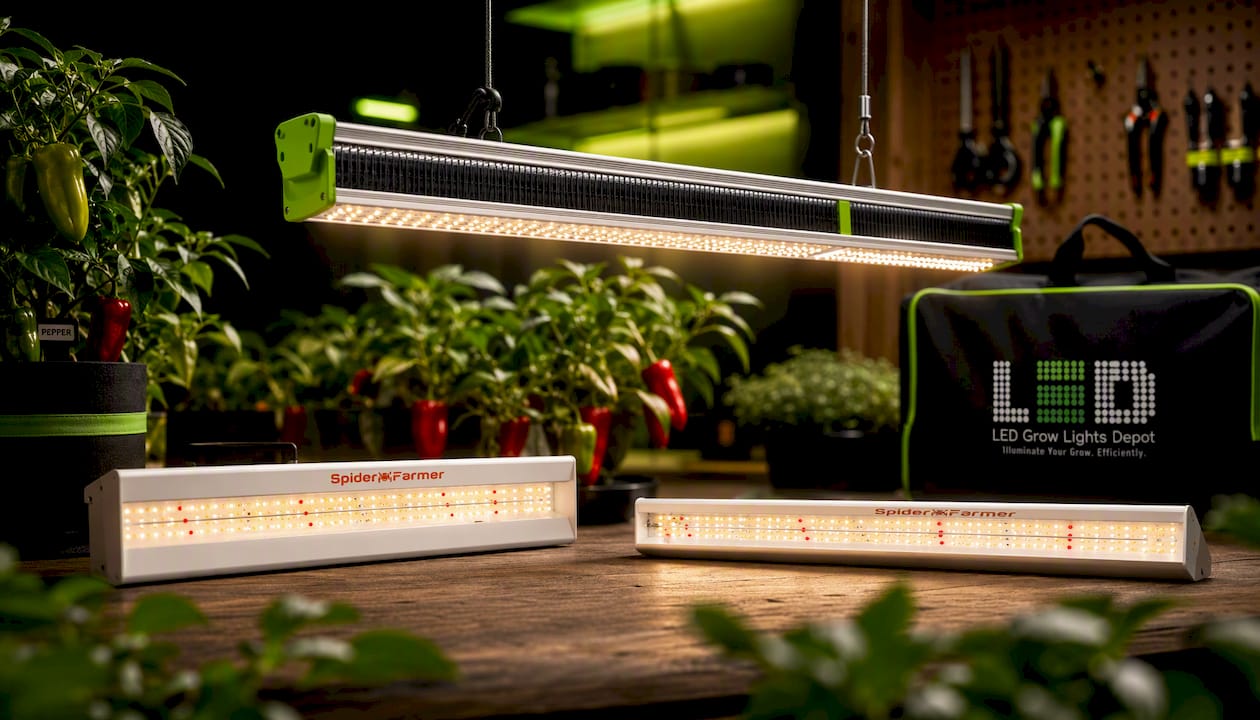
If you’re starting seeds or need under-canopy support for lower leaves, the Active Grow Integrated Strip T5 delivers gentle, even coverage at seedling-appropriate intensity, and the Sunblaster Micro LED Grow Light Garden works well for compact trays on a windowsill or shelf.
Growing one or two plants through fruiting? The ThinkGrow LED Model-I hits the 400 to 600 PPFD fruiting range with room to dim down for earlier stages, and the ThinkGrow LED Model-I Plus or the higher-output Grower’s Choice ROI-E720 scale up coverage for two to four plants in denser fruiting setups.
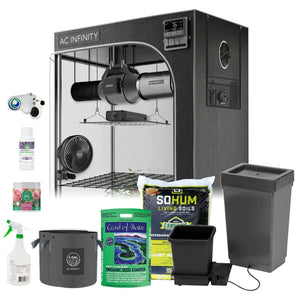
Want lights, ventilation, and environmental control in one package instead of assembling pieces separately? The AC Infinity Complete 2’ x 4’ Cultivator Kit bundles full-spectrum lighting with WiFi-integrated airflow control for a two-plant tent setup, no separate parts list required. Readers sizing a fixture to their available space might also find this overview of how lighting shapes plant selection useful for planning layout before you buy.
Check current stock and specs on any of these fixtures directly on LedGrowLightsDepot, and pick the one that matches the plant count and stage you’re actually growing for right now.
0 of 3 items selected

Leave a comment