
Free Shipping in the USA on nearly all items!
Limited phone hours during the Holidays! Call us: 888-611-9305
Free Shipping in the USA on nearly ALL items! Limited phone hours during the Holidays!

For productive indoor tomatoes, aim for a daily light integral (DLI) of 20 to 30 mol/m²/day, according to Virginia Tech Extension. That translates to roughly 400 to 900 µmol/m²/s of PPFD depending on growth stage and how many hours the light runs.
Here’s the fast version, before we get into the why:
Hang lights higher for seedlings and lower them as plants mature into fruiting. Seedlings sit 18 to 24 inches below the fixture; fruiting plants tolerate 12 to 16 inches. One caution: cranking PPFD to the top of these ranges without matching CO2 and temperature control can trigger photoinhibition, where leaves actually lose photosynthetic capacity instead of gaining it.
Tomatoes need a DLI of 20 to 30 mol/m²/day, achieved through stage-specific PPFD and photoperiod combinations rather than any single fixed light setting.
| Point | Details |
|---|---|
| Target DLI, not watts | Aim for 20–30 mol/m²/day and use PPFD × hours × 0.0036 to check your setup. |
| Match PPFD to stage | Run 200–300 µmol/m²/s for seedlings, 400–600 for vegetative, 600–900 for fruiting. |
| Keep a dark period | Give tomatoes at least 8 hours of darkness even during fruiting; skip 24 hour lighting. |
| Adjust hang height as plants grow | Start at 18–24 inches for seedlings and lower to 12–16 inches at fruiting. |
| Choose fixtures by PPE and footprint | LedGrowLightsDepot’s ROI-E720, 820W 6-Bar, and ThinkGrow Model-I map to multi-plant, vertical, and tabletop tomato setups respectively. |
Watts and lumens tell you almost nothing about what a tomato plant actually receives. DLI does the real work because it accounts for both intensity and duration, the two variables that determine total photons delivered to the canopy over 24 hours. Think of it as a bucket: PPFD is how fast water pours in, and photoperiod is how long the tap stays open. Fill the bucket to the same level either way, and the plant responds about the same.
Virginia Tech Extension classifies tomatoes as high-light fruiting crops, placing their productive DLI range at 20 to 30 mol/m²/day, a band well above what leafy greens or herbs need. This gives growers real flexibility. A grower running a lower-output fixture can compensate with longer photoperiods. A grower with a high-PPFD fixture can hit the same DLI target in fewer hours and save on electricity. Neither approach is wrong; the DLI number is the actual finish line, not the path you take to reach it.
Home growers who plan around lumens often end up either underlighting fruiting plants or overspending on fixtures they run inefficiently. Planning around DLI avoids both mistakes.
Each tomato growth stage has a distinct light appetite, and matching it precisely avoids leggy seedlings, stalled vegetative growth, or fruit drop.
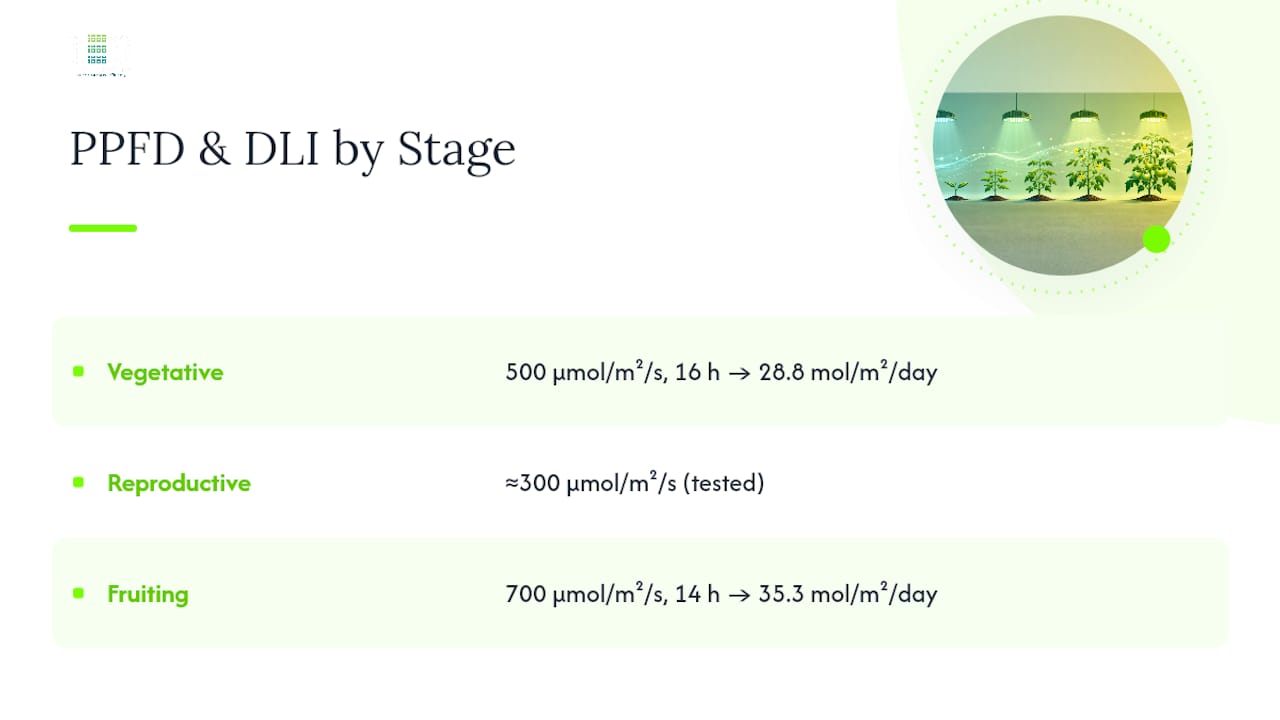
These figures come from practical stage guidance compiled by BloomingExpert alongside controlled-environment data on dwarf tomato cultivars, where researchers tested PPFD levels near 300 µmol/m²/s during vegetative and reproductive stages.
Converting PPFD and photoperiod into DLI takes one formula:
DLI = PPFD × hours × 0.0036
Two examples make it concrete. A vegetative tomato under 500 µmol/m²/s for 16 hours: 500 × 16 × 0.0036 = 28.8 mol/m²/day, comfortably inside the target band. A fruiting plant under 700 µmol/m²/s for 14 hours: 700 × 14 × 0.0036 = 35.3 mol/m²/day, which pushes above 30 and starts entering diminishing-returns territory.
Pro Tip: Run the math before you buy a fixture. If your planned PPFD and photoperiod produce a DLI above 35, you’re likely paying for light your tomatoes can’t fully use.
Conservative targets near the low end of each range keep electricity bills in check and suit growers without CO2 supplementation. Aggressive targets near the top end work best when temperature, humidity, and airflow are all dialed in.
Photoperiod scheduling changes as tomatoes move through their life cycle, and getting it wrong at any stage shows up fast in leggy stems or delayed fruit set.
Tomatoes are not a 24-hour-light crop. Research on seedling lighting shows continuous light can actually injure young plants, since the dark period allows metabolic processes tied to sugar transport and leaf development to complete. Skipping darkness doesn’t add growth; it just adds stress.
If you want to mimic outdoor conditions more closely, ramp your lights up over 15 to 30 minutes at the start of the cycle and back down at the end, rather than switching from full intensity to total darkness instantly. Most programmable timers and app-controlled drivers handle this automatically.
A simple analog timer works fine for a single tent, but a smart timer that logs your schedule per stage saves you from the classic mistake of forgetting to adjust hours when plants move from vegetative to flowering. Write your schedule down. Two weeks into fruiting, you will not remember exactly when you changed it.
Distance between the fixture and canopy determines how much of your fixture’s rated output actually reaches the leaves, and tomatoes are unforgiving about getting this wrong in either direction.
Light intensity falls off fast with distance, roughly following the inverse-square relationship: double the distance from the source and you receive about a quarter of the PPFD, not half. That’s why a few inches of hang-height error matters more than growers expect, and why center placement over the canopy counts more than growers realize, since PPFD drops sharply toward the edges of most fixture footprints.
The most reliable way to check your setup is a handheld quantum meter, spot-checking a grid of points across the canopy rather than trusting a single center reading. Manufacturer PPFD maps, when available, save you the equipment cost by showing expected output at multiple hang heights and positions. Smartphone light-meter apps exist, but treat their readings as rough approximations only. They’re not calibrated for PAR wavelengths and can be off by wide margins.
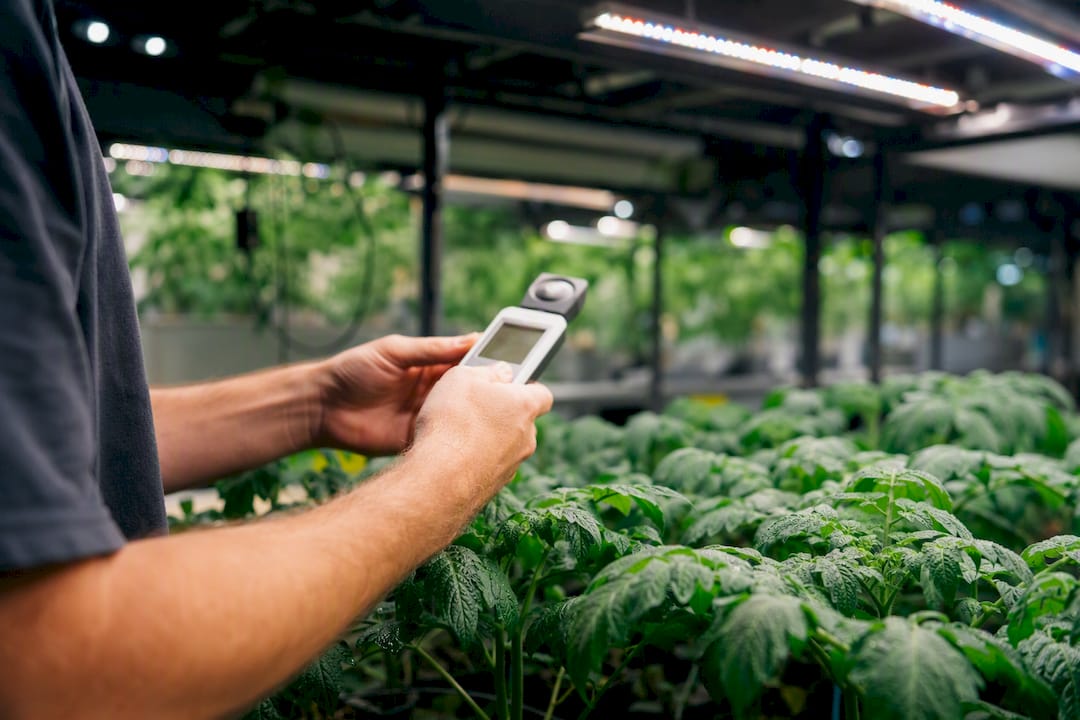
Pro Tip: Check PPFD at the top of the canopy AND at a lower fruit cluster. If the difference is dramatic, your plant’s lower trusses are likely under-lit even though your top growth looks great.
Wattage and lumens are marketing numbers borrowed from human lighting standards; neither measures what a tomato plant uses. Three specs actually matter:
Two fixtures rated at 200 watts can produce very different usable PPFD at the same hang height. A learn more about PAR, PPF, PPFD, and DLI resource breaks down how these terms interact if you want the full picture before buying.
For coverage planning, use these rough rules of thumb at fruiting-stage PPFD:
Full-spectrum white LEDs with supplemental red and blue diodes, plus a small amount of green and far-red, tend to outperform narrow-spectrum red/blue-only fixtures for tomatoes specifically. Green light penetrates deeper into dense canopies than red or blue alone, and far-red can influence stem elongation and flowering response. Look for fixtures rated above 2.5 µmol/J PPE; anything lower usually signals older diode technology drawing more power for less usable light.
More light isn’t always better light, and tomatoes prove this clearly. A 2023 study in Frontiers in Plant Science found that radiation-use efficiency in dwarf tomatoes peaked around moderate PPFD, near 300 µmol/m²/s, during the reproductive stage. Pushing PPFD higher kept increasing total biomass, but each additional unit of light produced less fruit per unit of radiation received. You’re paying more for less proportional return.
Diminishing returns in practice: the Frontiers study found higher PPFD raised biomass numbers but lowered radiation-use efficiency, meaning growers running at the top of the flowering range are trading electricity for a shrinking output gain.
Running costs are simple to estimate. Higher wattage fixtures running long hours consume significant electricity. Increasing PPFD beyond moderate levels can raise costs disproportionately relative to yield increases.
Three practical levers cut costs without sacrificing yield: choose a fixture with higher PPE rather than simply higher wattage, dim output during vegetative growth when plants don’t need fruiting-level intensity, and supplement with a bright window or sunroom when natural light is available. A breakdown of LED efficiency for home grows covers the math in more depth.
Correct lighting gets you to flowering, but tomatoes still need help finishing the job indoors, since there’s no wind or bees doing the pollination work for you.
Picking a fixture gets easier once you know your target footprint and stage. The Grower’s Choice ROI-E720 delivers the PPFD needed for multi-plant fruiting setups in larger tents, making it a fit for growers running several tomato plants at once. The 820W 6-Bar Full Spectrum LED Grow Light suits vertical or multi-layer production where under-canopy proximity lighting improves fruiting in the lower trusses without overdriving the top canopy. For a single tabletop plant or a small 2×2 tent, the ThinkGrow LED Model-I Grow Light hits fruiting-stage PPFD without oversized wattage. LedGrowLightsDepot backs these fixtures with a 4.8 out of 5 rating across more than 5,800 reviews.
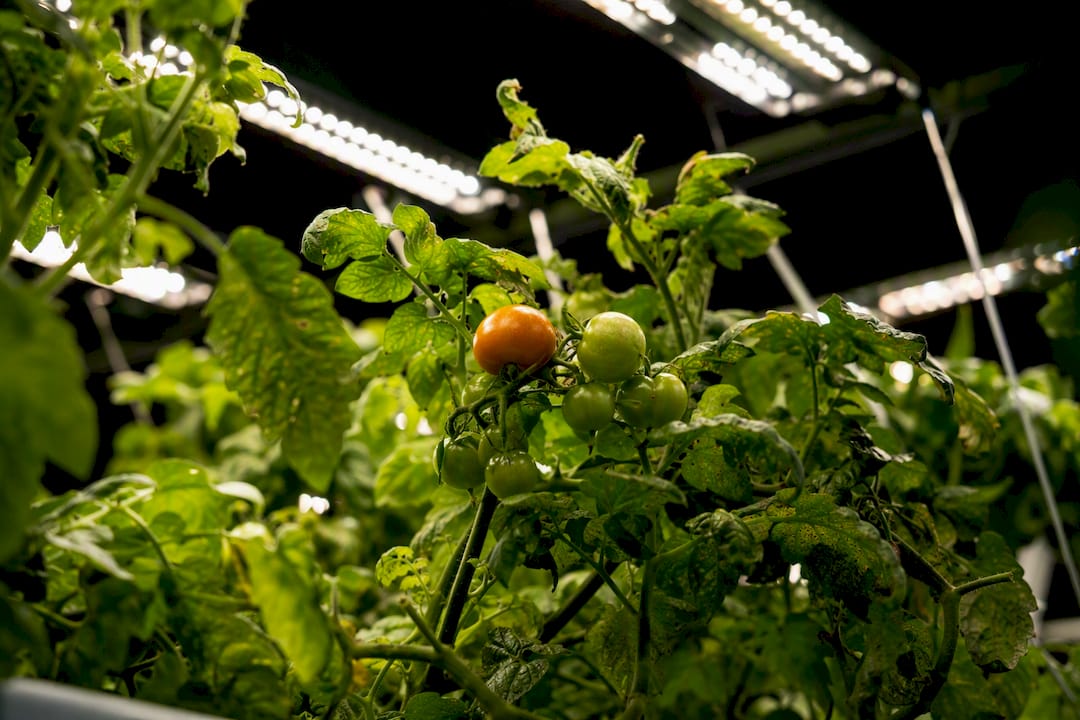
Most grow light advice online treats PPFD like a dial you turn up until you run out of budget. The research doesn’t support that. The Frontiers study on radiation-use efficiency is the most underrated finding in this entire topic: it shows tomatoes hit a point where more light stops paying for itself. Growers chasing 900 µmol/m²/s across every stage aren’t optimizing, they’re overspending.
The conventional wisdom also undersells photoperiod as a lever. Most guides fixate on intensity because it’s the flashier number to advertise on a fixture’s box. But DLI treats PPFD and hours as interchangeable, and for a home grower with a lower-output fixture, adding an hour or two of run time is often cheaper and simpler than buying a more powerful light.
If you take one thing from this guide, prioritize hang height accuracy over fixture wattage. A well-positioned mid-range fixture consistently beats an oversized one hung too high or too low.
LedGrowLightsDepot solves the exact problem most tomato growers run into with generic lighting: uneven PPFD across the canopy that leaves lower fruit clusters underlit even when the top growth looks lush.
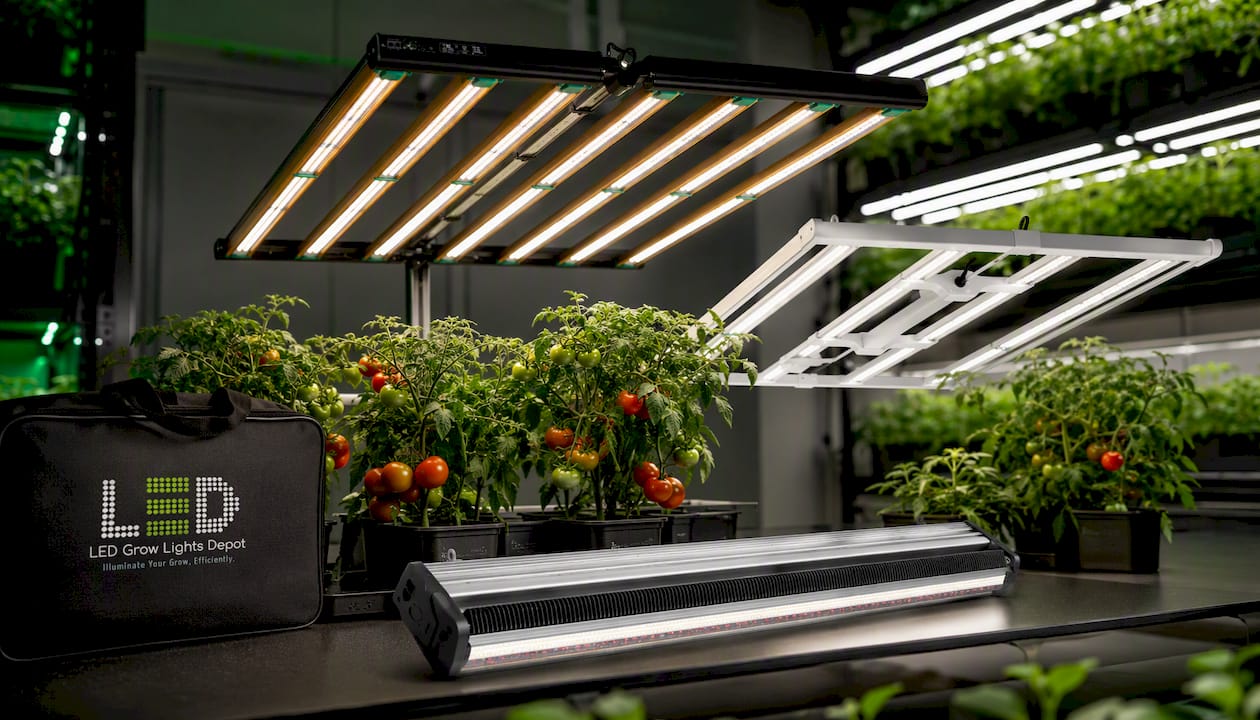
Whether you’re running a single tomato plant on a tabletop or a multi-tier vertical setup, our catalog maps directly to the PPFD targets covered in this guide. Start with the ThinkGrow LED Model-I Grow Light for a compact tent, or step up to the Grower’s Choice ROI-E720 for multi-plant fruiting production. Browse our full fixture lineup and use our product guidance to match a fixture to your exact footprint and stage before you buy.
What PPFD do tomatoes need to fruit indoors? Fruiting tomatoes need roughly 600 to 900 µmol/m²/s of PPFD, run for 14 to 16 hours daily to reach a DLI of 20 to 30 mol/m²/day.
Can too much light hurt tomato plants? Yes. Pushing PPFD too high without matching CO2 and temperature control can cause photoinhibition, and research shows radiation-use efficiency actually declines at very high PPFD levels.
Do tomatoes need a dark period under grow lights? Yes, at least 8 hours daily. Continuous 24-hour lighting has been shown to injure tomato seedlings rather than accelerate growth.
How far should a grow light be from tomato plants? Distance depends on stage: 18 to 24 inches for seedlings, 14 to 18 inches for vegetative growth, and 12 to 16 inches during fruiting, adjusted to your fixture’s specific PPFD chart.
What light spectrum is best for tomatoes? Full-spectrum white LEDs with added red and blue, plus some green and far-red, tend to outperform narrow red/blue-only spectrums, since green penetrates deeper into dense canopies.
For deeper reading, consult Virginia Tech Extension’s DLI guide, the Frontiers in Plant Science study on PPFD and radiation-use efficiency, and the dwarf tomato PPFD experiments published in Plants. LedGrowLightsDepot’s DLI guide for high-light crops and product pages round out the practical side of planning your setup.
0 of 3 items selected

Leave a comment