
Free Shipping in the USA on nearly all items!
Limited phone hours during the Holidays! Call us: 888-611-9305
Free Shipping in the USA on nearly ALL items! Limited phone hours during the Holidays!

Ozone removes some odors by oxidizing the molecules that cause them. It does this only at concentrations that are unsafe for people, pets and plants. At levels within public-health limits, U.S. agencies say it is largely ineffective. For a grow room, that means ozone is a poor fit while plants are growing. Source control, ventilation and carbon filtration are the proven way to manage smell.
This guide explains how ozone works, what it can and cannot remove, what the exposure limits are, and what to use in a grow tent or grow room.
An ozone molecule has three oxygen atoms. The third atom can detach and attach to other molecules, which changes their chemical makeup. That is the “oxidizing” that product pages describe. The EPA explains this mechanism and notes that reactions with some indoor chemicals can produce harmful or irritating by-products.
Because ozone is a gas, it spreads into corners, fabric and gaps that a cleaning tool cannot reach. That is the main argument made for it. The catch is how much ozone is needed and what else it reacts with on the way.
Most consumer and commercial generators use corona discharge. The electrical discharge splits O2 into single atoms that form O3. Research on these devices shows that when ordinary air is the feed gas, they can also form nitrogen oxides and N2O5. With water vapor present, N2O5 can form nitric acid. A humid grow room is exactly that kind of environment.

Pages that sell ozone machines say it works on smoke, pet odors, mold and mildew smells. The independent evidence is narrower.
The California Air Resources Board (CARB) adds that ozone below health standards does not effectively remove many odor-causing chemicals, dust or pollen. It can also react with indoor chemicals to form pollutants such as formaldehyde and ultrafine particles.
A University of Colorado CIRES guide on fire recovery makes a similar point. High ozone reacts with VOCs on walls and surfaces and can make them more volatile. It can also form formaldehyde, other carbonyls, acetone and ultrafine particles. CIRES does not recommend ozone generators for smoke-damaged homes, because evidence of effectiveness is limited.
Ozone is a toxic gas. The numbers below are the ones that apply in the United States.
| Measure | Value | Source |
|---|---|---|
| OSHA permissible exposure limit, 8-hour average | 0.1 ppm (0.2 mg/m³) | OSHA |
| NIOSH recommended exposure limit, ceiling | 0.1 ppm | NIOSH |
| NIOSH immediately dangerous to life or health | 5 ppm | NIOSH |
| FDA maximum for devices used as air cleaners in occupied enclosed spaces | 0.05 ppm | 21 CFR 801.415 |
The same federal regulation describes ozone as a toxic gas. It states that inhaling it can cause pulmonary irritation and edema. It also says that olfactory fatigue makes odor an unreliable indicator of how much ozone is in the air.
That last point matters in practice. CARB warns that ozone can deaden the sense of smell. It can disguise odors and reduce your ability to notice high ozone levels. CARB strongly advises against using ozone generators in spaces occupied by people or animals.
How high can real-world levels go? Lawrence Berkeley National Laboratory cites studies where indoor ozone rose, usually above 100 ppb and as high as 650 ppb, during generator operation. That is well above the health-based benchmarks in the table.
If you or someone nearby has breathed ozone and has coughing, chest tightness or shortness of breath, go to fresh air at once. See a doctor if symptoms continue. People with asthma or other lung conditions should stay out of any treated space until it has been aired out.
The short answer is that ozone and living plants do not mix.
The practical rule: do not treat a grow room while plants, seedlings or clones are inside. Plant response is genotype-specific, so you cannot assume your cultivar tolerates it.
The EPA ranks the approaches in this order: source control first, then ventilation, then air cleaning. It recommends these over ozone. Here is how that translates to a tent or room.
Ventilation lowers airborne contaminants by dilution. A case study on ventilation and odor treatment also notes that ventilation does not reliably remove VOCs adsorbed on porous surfaces. That is why exhaust should be paired with filtration, not used alone.
A peer-reviewed study of indoor air cleaners found that sorption filtration was the most effective off-the-shelf technology tested for general VOC removal in the initial period. Performance varied with the VOC, the filter design, the surface area and the contact with the sorbent.
The lesson for a grow tent is to route all exhaust air through the filter. Match the filter size to the duct and fan. Allow enough contact time and replace it on the manufacturer’s schedule.
We stock carbon filters for grow tents and rooms. One example is the 6-inch carbon filter for inline ducting. Check the filter’s rated airflow against your fan before you order.
A different approach to the air itself is a HEPA plus photocatalytic oxidation unit. See the Mammoth Lighting Capture & Kill Air and Surface Sanitizer for specifications.

Some growers use ozone only as a shock treatment between crops, in an empty room. If you do, treat it as a hazardous-gas task, not a routine one. The steps below follow the guidance in the sources above.
Before treatment
During treatment
After treatment
A note on running ozone through a duct: that does not make it risk-free. Ozone leaving the exhaust adds to the outdoor air and can reach neighbors, and a duct leak puts it into the room. Check local rules and keep exposure at or below the OSHA limit for anyone who works in the building.
We sell grow equipment, and we see the same odor question every season. Growers want the smell gone without hurting the crop.
Our view is simple. Odor is best handled where it starts and where air leaves the space. A properly sized carbon filter on the exhaust, steady airflow and clean practice cover most grow tents and rooms. None of that needs a toxic gas in the room.
Odor control also fits inside a well-planned setup. Light distribution, airflow and tent size should be planned together. Our under-canopy lighting systems are designed to improve light distribution through the canopy. Our customers choose them for yield and bud grading. Our advisors can help you build the rest of the environment around that.
Scott
If you are planning a new space, choose the tent, lights, exhaust and filter together. We carry LED grow lights, tents and kits, environmental controls and accessories. Free shipping applies on most U.S. orders.
Start with LED Grow Lights Depot to browse categories. Our team can help match a filter to your fan and tent.

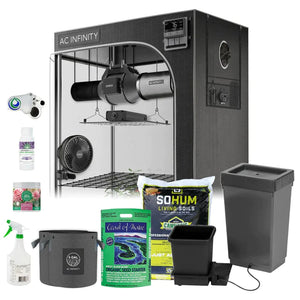
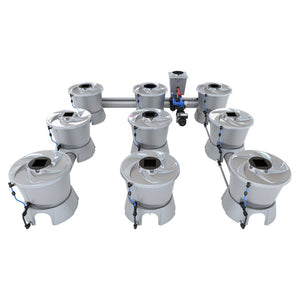
Package options for larger spaces:
It can oxidize some odor compounds, but the evidence for broad claims is limited. The EPA says ozone generators have little potential to remove indoor contaminants at concentrations within public-health standards. Reactions with many common indoor chemicals can take months or years.
Not while plants or people are in the space. High ozone can damage plants, and CARB advises against generators in spaces occupied by people or animals. Treat only an empty, plant-free room, then air it out fully before re-entry.
CIRES advises airing the space with open windows and doors for three hours before anyone re-enters. Smell is not a reliable guide, because ozone can dull your sense of smell. Follow the device maker’s instructions as well.
Use source control, ventilation and a carbon filter on the exhaust. That order follows the EPA’s ranking of approaches. Size the filter to your duct and fan, and replace it on schedule.
0 of 3 items selected


Leave a comment