
Free Shipping in the USA on nearly all items!
Limited phone hours during the Holidays! Call us: 888-611-9305
Free Shipping in the USA on nearly ALL items! Limited phone hours during the Holidays!

Micro grow tent light selection means choosing full-spectrum LED grow lights with the right wattage, spectrum, and dimming capabilities to match your plant type and tent size. The wrong light wastes electricity, stresses plants, and kills yields before harvest. The right light, sized correctly for a 2x2 or 3x3 foot tent, can push plants through every growth stage without heat damage or light deficiency. This guide covers wattage math, spectrum science, dimming requirements, and form factor comparisons so you can buy with confidence.
Wattage is the most misunderstood number in grow light shopping. Manufacturers often list a “rated” wattage based on maximum diode capacity, but the true wall-draw wattage is what your plants actually receive. Always check the actual power consumption listed in the spec sheet, not the marketing headline.
For a 2x2 foot tent, 100–150 watts of true wall-draw LED power is the target range. Below 100 watts, flowering plants will stretch and underperform. Above 150 watts without added cooling, heat stress becomes a real problem in that confined space.
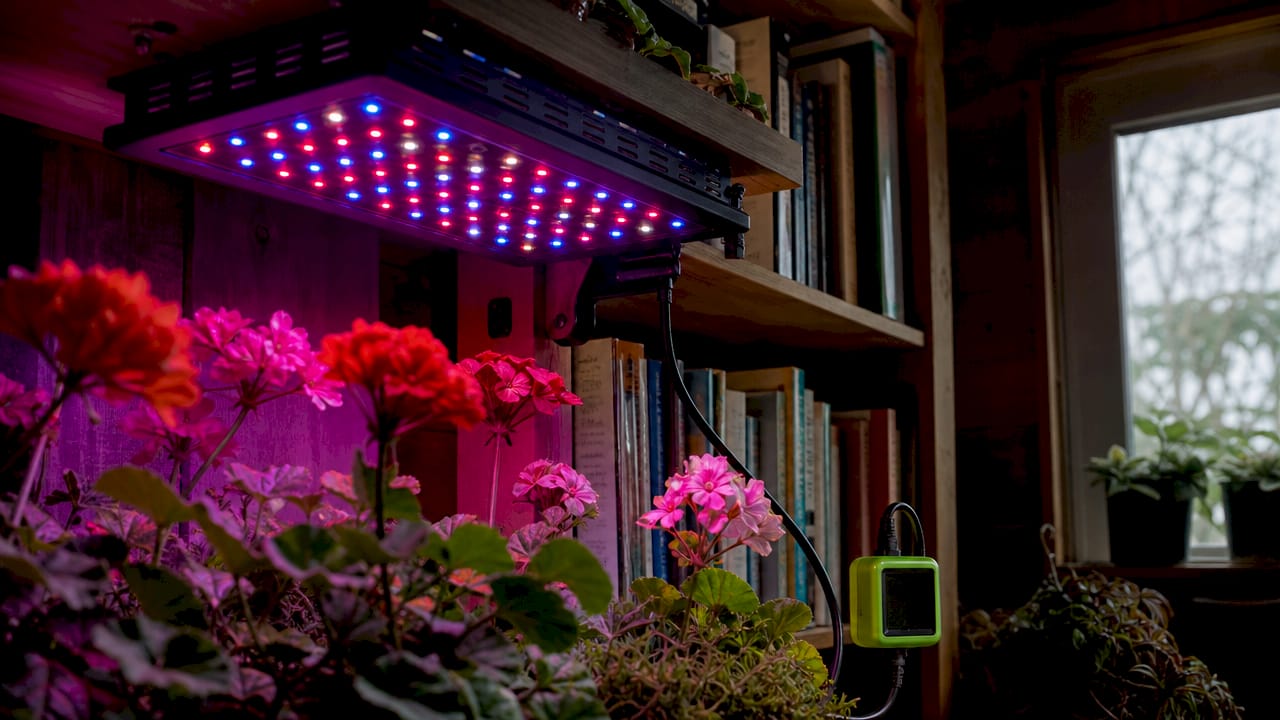
A reliable rule of thumb is 30–50 watts per square foot of quality LED. A 2x2 tent covers 4 square feet, so 120–200 watts covers the range depending on your plant species and growth stage. Flowering plants need the high end; seedlings and clones need the low end.
PPFD (photosynthetic photon flux density) is the metric that actually measures light reaching your canopy. Target ranges by growth stage:
Pro Tip: Never buy a grow light based on wattage alone. Always request or look up the PPFD distribution map for your specific tent footprint. A light with a sharp center hotspot and dark edges will underperform a lower-wattage fixture with even spread.
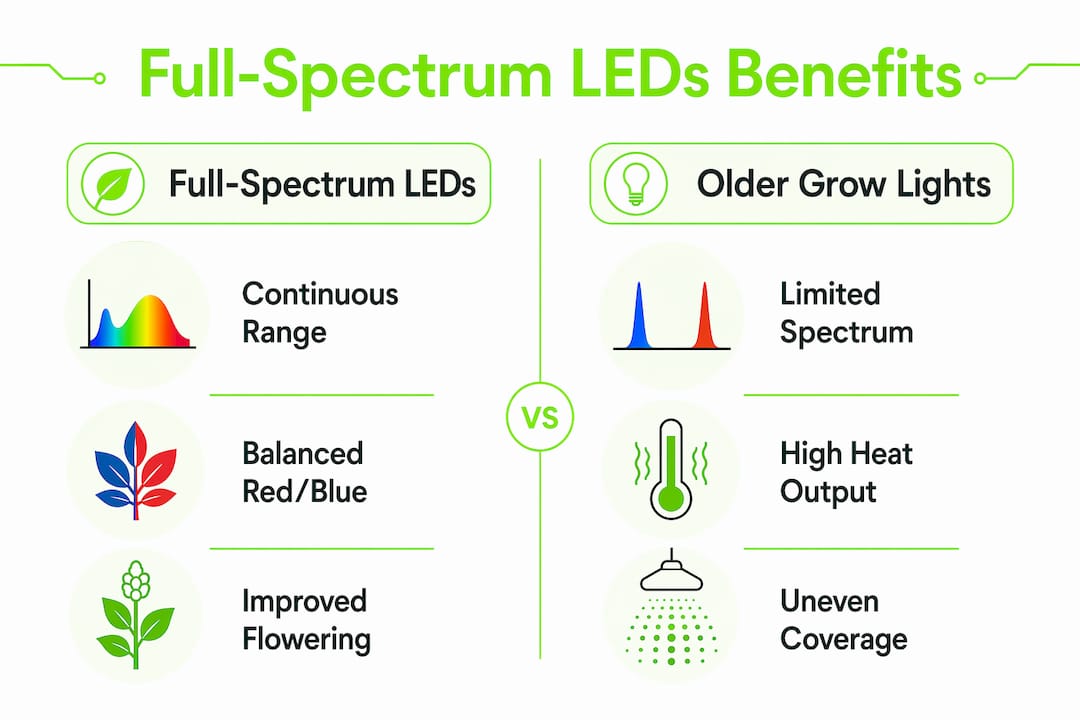
Full-spectrum LED grow lights are defined as fixtures that emit a continuous range of wavelengths covering both the blue and red bands plants need for photosynthesis. Older “blurple” lights emit only narrow red and blue peaks, which looks purple and misses the broader wavelength range that drives healthy plant development.
Full-spectrum LEDs balance red wavelengths at 630–680 nm for flowering and blue wavelengths at 430–460 nm for vegetative growth. This balance supports photosynthesis across every stage rather than forcing growers to swap fixtures between phases. The result is stronger stems, denser buds, and more consistent canopy development.
Quality LED fixtures should achieve an efficacy rating (PPE) of at least 2.5 µmol/J. Fixtures rated at 3.0 µmol/J or higher are considered excellent. High PPE means more usable light per watt of electricity consumed, which directly cuts your power bill.
Key spectrum benefits for micro grow tent growers:
For a deeper look at how wavelength choices affect plant development, Ledgrowlightsdepot’s spectrum selection guide breaks down each band and its role in the growth cycle.
Dimmable LED grow lights are not optional for micro grow tents in 2026. They are the single feature that lets one fixture serve seedlings, vegetative plants, and flowering plants without stressing any of them. A fixed-output light that works for flowering will burn seedlings. A light sized for seedlings will starve flowering plants.
Dimming from 0–100% output lets you deliver 200–300 µmol/m²/s to new seedlings and ramp up to 600–900 µmol/m²/s at peak flowering. That range is impossible to cover with a fixed-output fixture in a small space. Dimming also lets you respond to plant stress signals like leaf bleaching or leaf “taco-ing” (edges curling upward) without raising the light.
Heat management is the second reason dimming matters in confined spaces. Small tents trap heat fast. Running a light at 70% output instead of 100% during early vegetative growth reduces heat load without sacrificing plant development. LED fixtures with external drivers reduce internal tent temperature by 5–10°F by relocating the heat-generating driver outside the grow space.
Practical heat and dimming checklist:
Pro Tip: Adjust your light height by 1–2 inches every few days based on how plants respond, rather than locking in a fixed hang height from day one. Dynamic height adjustment based on plant signals consistently outperforms static factory recommendations.
The shape and design of a grow light affects coverage uniformity, heat spread, and how well it fits inside a small tent. Four main form factors dominate the market for compact grow spaces.
| Form factor | Best tent shape | Light uniformity | Heat output | Vertical space used |
|---|---|---|---|---|
| Quantum board | Square (2x2, 3x3) | Excellent | Low to moderate | Moderate |
| Bar-style LED | Rectangular tents | Excellent | Low | Low |
| COB array | Square tents | Moderate | Moderate to high | Low |
| Compact panel | Any small tent | Fair | Moderate | Low |
Quantum boards deliver the most even canopy coverage in square tents. Their wide, flat design spreads photons across the full footprint rather than concentrating them in a center hotspot. PPFD uniformity across the canopy matters more than peak PPFD because uneven light creates underperforming plants at tent edges.
Bar-style LEDs work best in rectangular tents where multiple bars can be spaced evenly across the width. They run cooler than COB arrays because heat dissipates across a larger surface area. COB (chip-on-board) arrays pack high intensity into a small footprint, which suits growers who need concentrated light but must manage heat carefully.
Compact panels are the entry-level option. They cost less but often produce uneven light distribution with a bright center and dim edges. For a serious micro grow, a quantum board or bar-style LED is the better long-term investment. Ledgrowlightsdepot’s guide to compact LED grow lights covers these form factors with specific product examples.
A good grow tent light setup starts with three measurements: tent footprint in square feet, target PPFD for your current growth stage, and ceiling height available after accounting for plant height at harvest. Write these down before you shop.
Follow this selection and setup sequence:
| Setup step | Key metric | Target value |
|---|---|---|
| Wattage calculation | Watts per sq ft | 30–50W |
| Seedling PPFD | µmol/m²/s | 200–300 |
| Vegetative PPFD | µmol/m²/s | 400–600 |
| Flowering PPFD | µmol/m²/s | 600–900 |
| Efficacy rating | PPE (µmol/J) | 2.5 minimum |
Pro Tip: Before you scale up light intensity at any stage, run the new setting for 48 hours and check for stress signals. Bleaching, tacoing leaves, or sudden wilting all mean back off. Plants tell you when the light is too much.
The best micro grow tent lighting strategy pairs a full-spectrum, dimmable LED with a PPE rating above 2.5 µmol/J, sized at 30–50 watts per square foot of canopy.
| Point | Details |
|---|---|
| Match wattage to tent size | Target 100–150W true draw for a 2x2 tent; scale by 30–50W per square foot. |
| Prioritize PPE over wattage | Choose fixtures rated above 2.5 µmol/J to maximize light output per watt consumed. |
| Dimming is non-negotiable | A 0–100% dimmable fixture covers every growth stage from seedling to flower in one unit. |
| Full-spectrum beats blurple | Balanced red (630–680 nm) and blue (430–460 nm) wavelengths outperform narrow-band blurple lights. |
| External drivers reduce heat | Fixtures with drivers outside the tent lower internal temperatures by 5–10°F. |
The most common mistake I see is growers buying the highest-wattage light they can afford and running it at full power from day one. They assume more light equals more yield. It does not. It equals bleached seedlings, heat stress, and stunted plants that never recover their early growth deficit.
The shift from HID to modern full-spectrum LED changed everything about micro tent growing. HID lights in a 2x2 tent were a heat management nightmare. Modern LEDs with external drivers and quantum board designs made it possible to run a serious grow in a closet without a dedicated cooling system. That technology shift is real, and growers who haven’t updated their mental model from the HID era are still fighting problems that no longer need to exist.
What I advocate now is treating light height as a daily variable, not a set-and-forget number. Adjusting fixture height in response to what plants actually show you produces better results than any fixed formula. Plants communicate stress clearly if you know what to look for. Tacoing leaves mean too much intensity or heat. Stretching means too little. Neither requires a new light. Both require an adjustment.
The growers who get the best results from micro tents are the ones who test at low intensity first, watch the canopy response for 48 hours, and increase gradually. Patience in the first two weeks of each stage pays off in the final two weeks before harvest.
— Scott
Ledgrowlightsdepot carries a curated selection of full-spectrum, dimmable LED grow lights built specifically for compact grow spaces. Every model in their micro tent lineup is rated for PPE performance, includes dimming control, and ships with PPFD distribution data so you can verify coverage before you hang the fixture.
Their catalog includes the NextLight 150h, a dimmable full-spectrum fixture well-suited for 2x2 and 3x3 tents, alongside a full range of LED grow lights for every grow size and budget. Ledgrowlightsdepot’s proprietary proximity systems enhance under-canopy light distribution, with growers reporting over 20% yield increases compared to standard setups. With a 4.8 out of 5 rating from more than 5,800 reviews, their team can help you match the right fixture to your tent size, plant species, and growth goals.
A 2x2 tent needs 100–150 watts of true wall-draw LED power. Below 100 watts is insufficient for flowering; above 150 watts risks heat stress without added cooling.
PPE (photosynthetic photon efficacy) measures how efficiently a fixture converts electricity into usable plant light, expressed in µmol/J. Target a minimum of 2.5 µmol/J; ratings above 3.0 µmol/J are considered high efficiency.
Full-spectrum LEDs outperform narrow-band blurple lights by delivering the complete wavelength range plants need across every growth stage. Blurple lights miss key wavelengths that drive healthy stem structure and dense flowering.
A fixture with even PPFD across the full canopy produces consistent growth at every plant position. A light with a bright center hotspot and dim edges leaves edge plants underpowered and creates uneven harvests.
Check plant response every 24–48 hours and adjust height daily if you see stress signals like bleaching or stretching. Dynamic adjustment outperforms any fixed hanging height recommendation.
0 of 3 items selected


Leave a comment