
Free Shipping in the USA on nearly all items!
Limited phone hours during the Holidays! Call us: 888-611-9305
Free Shipping in the USA on nearly ALL items! Limited phone hours during the Holidays!

Herb gardens grow under LEDs by receiving controlled light intensity, spectrum, and duration that replicate or exceed what a sunny windowsill provides. Understanding how herb gardens grow under LEDs means knowing three numbers: photoperiod (12–16 hours daily), fixture distance (about 12 inches above the canopy), and daily light integral (DLI). Get those three right and herbs like basil, cilantro, thyme, and mint grow faster, stay compact, and produce richer flavor than most outdoor plants. Miss any one of them and you get the leggy, pale stems that frustrate every indoor grower.
Light duration is the first dial to set. Most culinary herbs need 12–16 hours of daily light under LEDs to compensate for the lower intensity of artificial sources compared to direct sunlight. Running lights for fewer than 12 hours produces slow, stretched growth. Running them beyond 16 hours stresses most herbs and disrupts their rest cycle.
Distance matters just as much as duration. Positioning your LED fixture about 12 inches above the herb canopy delivers enough photon density for compact, healthy growth without bleaching leaf tips. Move the light too far away and intensity drops sharply. Move it too close and you risk heat stress even with low-heat LED panels.
The metric that ties duration and intensity together is the Daily Light Integral. DLI for culinary herbs like basil typically falls in the 14–25 mol·m⁻²·day⁻¹ range. DLI is calculated by multiplying photosynthetic photon flux density (PPFD, measured in micromoles per square meter per second) by the number of light hours per day. A fixture running at 200 PPFD for 14 hours delivers a DLI of roughly 10, which is below the basil target. Knowing your fixture’s PPFD output lets you dial in the right photoperiod instead of guessing.
Pro Tip: Set your LED timer to run during daylight hours rather than overnight. Herbs grown on a light schedule that mirrors natural day patterns tend to show more consistent growth than those lit at random hours.
Full-spectrum white LEDs and targeted blue or red monochromatic LEDs produce different results in herbs. Full-spectrum LEDs mimic sunlight across the 400–700 nm photosynthetically active range and support balanced vegetative growth. Blue-dominant LEDs (400–500 nm) drive compact leaf structure and trigger secondary metabolite production. Red LEDs (600–700 nm) accelerate stem elongation and overall biomass. Most home growers benefit most from full-spectrum LED lighting because it handles all growth stages without swapping fixtures.
The flavor and nutrition angle is where LED science gets genuinely surprising. Research shows that higher LED light intensity increases rosmarinic acid-derived phenolics in basil by up to 2.1–2.2 times, significantly boosting antioxidant properties. That means the same basil plant grown under a stronger LED dose produces measurably more of the compounds responsible for its aroma and health benefits.
“Targeting LED light dose can improve not just herb size but flavor and antioxidant compounds, shifting indoor herb growing toward quality optimization.” — research on controlled-environment blue LED lighting in hydroponic basil
The mechanism behind this is a signaling pathway involving cryptochrome and HY5 proteins that activate under blue light stress. This pathway triggers phenylpropanoid metabolism, the biochemical route that produces rosmarinic acid, chlorogenic acid, and other flavor compounds. For home growers, the practical takeaway is straightforward: a quality full-spectrum LED run at the right intensity does not just grow more herb. It grows better herb.
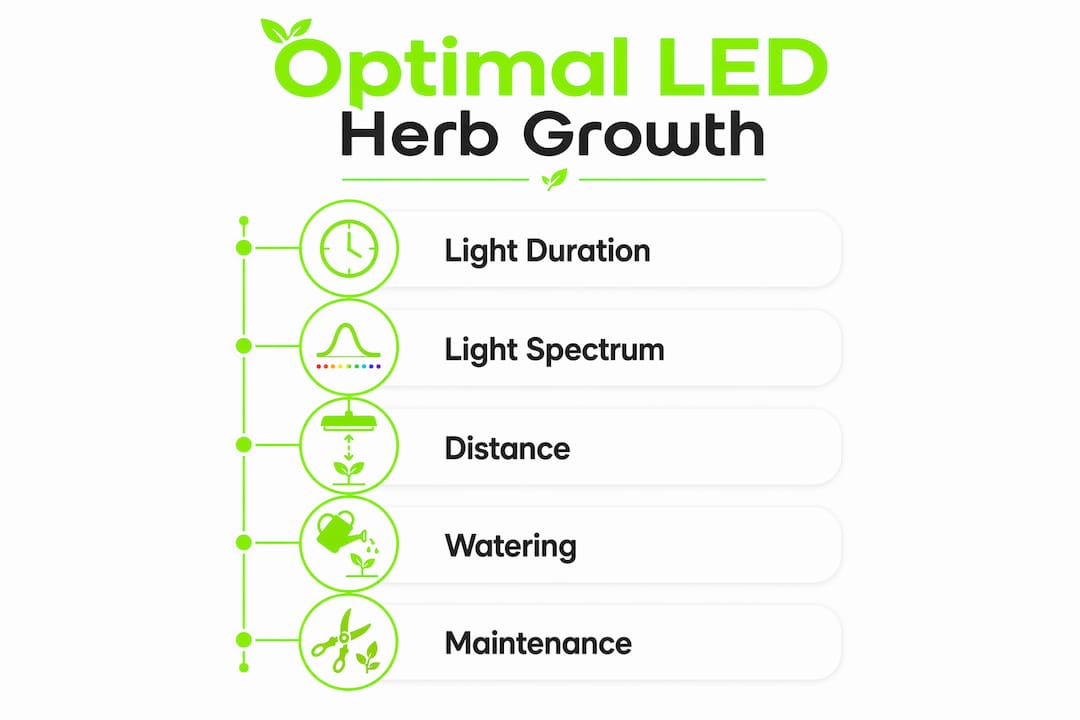
Container size directly shapes root health and growth rate. Typical indoor herb pots run 2–4 inches for small herbs like basil and cilantro, while woody herbs like rosemary and thyme need larger containers to prevent root crowding. A pot that is too small restricts root expansion and causes the plant to stall even under perfect light. A pot that is too large holds excess moisture and invites root rot.
Watering rhythm under LEDs differs from growing near a window. LEDs drive faster transpiration, which means herbs dry out more quickly than you expect. The right approach depends on the herb type:
Watering requirements differ significantly between soft-stemmed and woody herbs under LED-driven growth rates. Fertilize lightly every two to three weeks with a balanced liquid fertilizer at half the recommended dose. LEDs accelerate growth, and herbs in small pots exhaust nutrients faster than outdoor plants.
Pro Tip: Place a saucer under each pot and check it 30 minutes after watering. If water still sits in the saucer, your drainage is poor. Empty it immediately to prevent root rot.
Even light distribution across the canopy is the difference between a uniform harvest and a patchy one. Uniform canopy coverage using multiple LEDs close to plants produces consistent herb morphology and harvest quality. A single strong light source creates a bright center and dim edges. Multiple smaller panels or a wide-beam fixture eliminate that problem.
A grow cabinet setup adds reflective walls that bounce light back onto lower leaves, effectively increasing usable light without adding wattage. This matters for herbs with dense canopies like basil, where lower leaves can become shaded quickly.
| Setup type | Best fixture configuration | Ideal for |
|---|---|---|
| Kitchen countertop | Single wide-beam LED panel, 12 inches high | 4–8 small herb pots |
| Shelf or rack | Two narrow LED bars per shelf level | Vertical herb stacks |
| Grow cabinet | Full-spectrum panel with reflective walls | Year-round production |
| Windowsill supplement | Small clip-on LED grow light | 1–3 pots near natural light |
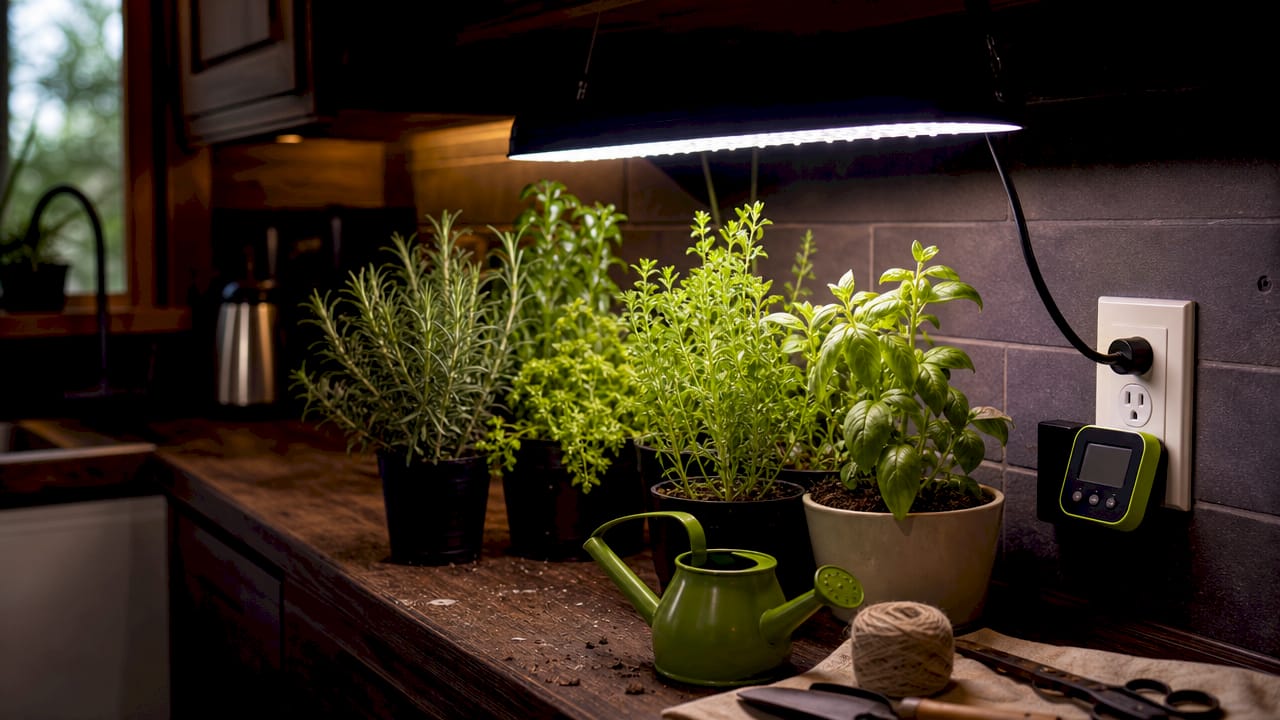
A complete indoor herb setup typically uses a 100–200W full-spectrum LED running 12–16 hours per day, paired with small pots and quality potting mix. That wattage range covers a standard kitchen counter or small shelf without excessive energy cost.
Six culinary herbs consistently perform well under LED grow lights indoors. Each has light and care traits that make it a reliable choice for home growers.
Bright household light rarely meets herbs’ light needs indoors, making LEDs necessary even near sunny windows. Grouping herbs by similar light and water requirements simplifies management. Basil and mint share one zone. Thyme, oregano, and rosemary share another. That separation prevents overwatering woody herbs while keeping moisture-loving herbs healthy.
For growers new to easy indoor plants with LEDs, starting with thyme and parsley builds confidence before moving to faster-growing, more demanding herbs like basil.
Herb gardens grow best under LEDs when photoperiod, fixture distance, spectrum, and watering are matched to each herb’s specific needs.
| Point | Details |
|---|---|
| Set the right photoperiod | Run LEDs 12–16 hours daily; use a timer for consistency across all herb types. |
| Control fixture distance | Keep LEDs about 12 inches above the canopy to prevent leggy growth and leaf bleaching. |
| Use full-spectrum LEDs | Full-spectrum fixtures support all growth stages and boost flavor compounds in herbs like basil. |
| Match watering to herb type | Water soft-stemmed herbs more frequently; let woody herbs dry out between waterings. |
| Group herbs by light needs | Pair basil and mint together; keep thyme, oregano, and rosemary in a separate lower-water zone. |
Most home growers underestimate how much the light dose affects flavor, not just size. They buy a decent LED, set it to 12 hours, and call it done. The herbs grow. But they taste flat compared to what the same plant can produce under a dialed-in setup.
The biggest mistake I see is using standard household LED bulbs as a substitute for grow lights. Even bright household light falls short of what herbs need indoors. A household bulb lacks the PPFD output and spectral balance that a purpose-built grow light delivers. The plant survives, but it does not thrive.
The second mistake is ignoring DLI entirely. Growers focus on hours of light but never check their fixture’s PPFD. A dim LED running 16 hours still delivers a DLI too low for basil. Measuring PPFD with an inexpensive meter and calculating DLI takes ten minutes and eliminates most guesswork permanently.
The finding that genuinely changed how I think about indoor herb growing is the research showing LED intensity increases rosmarinic acid in basil by up to 2.1–2.2 times. That is not a marginal difference. It means the herb you harvest from a properly lit indoor setup can be nutritionally and aromatically superior to supermarket basil grown in full sun. That shifts the goal from “keeping herbs alive indoors” to “producing herbs worth growing.”
Invest in a quality full-spectrum LED fixture, set it at the right height, and run it on a timer. Those three steps alone put you ahead of most indoor herb growers.
— Scott
Ledgrowlightsdepot carries a full range of LED grow lights built for exactly this kind of setup, from compact countertop fixtures to high-output panels for serious indoor gardens. Their products are backed by a 4.8 out of 5 customer satisfaction rating from more than 5,800 reviews, which reflects real results from home growers and commercial cultivators alike.
For a kitchen countertop herb garden, the NextLight 150h delivers full-spectrum output in a compact form that fits standard shelf setups. Growers who want a shelf-mounted option can check the Toggled 2 ft. LED fixture, which is built for countertop and rack herb gardens. Browse the full selection at Ledgrowlightsdepot to find the right fixture for your space and budget.
Most culinary herbs need 12–16 hours of daily LED light to grow compactly indoors. Woody herbs like thyme and oregano do well at the lower end; fast-growing herbs like basil benefit from closer to 16 hours.
Full-spectrum LEDs that cover 400–700 nm work best for most culinary herbs. Blue wavelengths (400–500 nm) specifically trigger the production of flavor and antioxidant compounds like rosmarinic acid in basil.
Position LED fixtures about 12 inches above the herb canopy. This distance delivers sufficient light intensity for compact growth without causing heat stress or leaf bleaching.
Standard household LED bulbs lack the PPFD output and spectral balance that herbs need. Even near a sunny window, household light rarely meets the minimum light requirements for healthy indoor herb growth.
Basil, parsley, cilantro, thyme, mint, and oregano all perform well under LED grow lights indoors. Basil and mint need the most light and moisture; thyme and oregano thrive with less of both.
0 of 3 items selected


Leave a comment