
Free Shipping in the USA on nearly all items!
Limited phone hours during the Holidays! Call us: 888-611-9305
Free Shipping in the USA on nearly ALL items! Limited phone hours during the Holidays!

Your LED spectrum, photoperiod, and fixture layout directly change how pests orient, settle, and reproduce in your grow room. Lighting is a usable behavioral IPM tool, not a standalone exterminator. High-intensity blue spotlights at approximately 186 μmol/m²/s deterred nearly 50% of whiteflies from plants in greenhouse trials. That result, consistently observed in greenhouse experiments, should inform your fixture placement.
Three things to act on immediately:
Pro Tip: Label your trial sections and log trap counts every 7 days. Without a written baseline, you cannot tell whether a lighting change actually moved the needle.
Insects do not see color the way you do. Whiteflies, aphids, and thrips rely on green/blue color opponency to find host plants, and their peak behavioral responses fall in predictable wavelength bands. Greenhouse whitefly (Trialeurodes vaporariorum) shows peak attraction near 525 nm (green), which is why green LEDs paired with yellow sticky cards consistently outperform yellow cards alone in capture rate tests. Blue light, by contrast, acts as a deterrent: narrow-band blue LED arrays arranged around plants produced strong reductions in host-plant settlement for the same species.
UV sits in a different functional category. It drives migratory flight more than settling decisions, so UV-enhanced traps show mixed results depending on whether you are trying to intercept migrants or redirect settled adults.
Key figure: Blue spotlights deterred nearly 50% of whiteflies and increased recapture on paired green LED traps in scaled greenhouse trials.
The practical tactic is push-pull: blue as the “push” that makes your plants less attractive, green as the “pull” that draws displaced insects onto sticky traps. Spectral tactics redirect and concentrate pests — they do not kill them on contact. Pair every push-pull setup with a collection method (sticky traps, vacuum, predators) or you are just moving the problem around the room.
| Spectrum | Behavioral effect | Recommended use |
|---|---|---|
| Blue (narrow blue wavelength band) | Deters settling; repels whiteflies | Spotlights near plant canopy |
| Green (near 525 nm) | Attracts whiteflies and aphids | LED-enhanced sticky traps |
| UV (below blue wavelengths) | Stimulates migratory flight | Entry-point traps; mixed results |
| Far-red (approximately 730 nm) | Alters plant defenses indirectly | Nighttime supplementation for mite management |
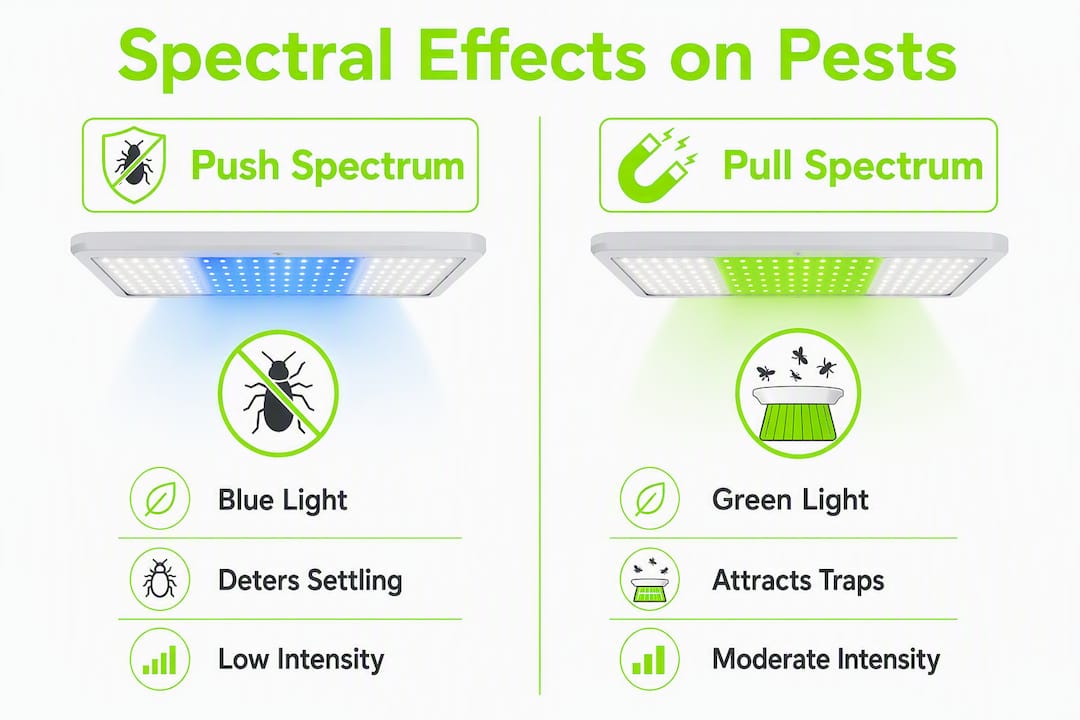
Intensity matters more for some tactics than others. Blue light’s repellent effect is intensity-dependent: low blue output is routinely overwhelmed by ambient grow-room light, making it ineffective at commercial scale. You need high-intensity blue spotlights at sufficient levels to produce a measurable deterrent cue. For predators, the calculus flips. Research on Orius insidiosus found that spectral composition altered locomotion and attack probability, but overall intensity had negligible impact on predation rates. You can often retain biocontrol efficacy while adjusting spectrum for pest management.
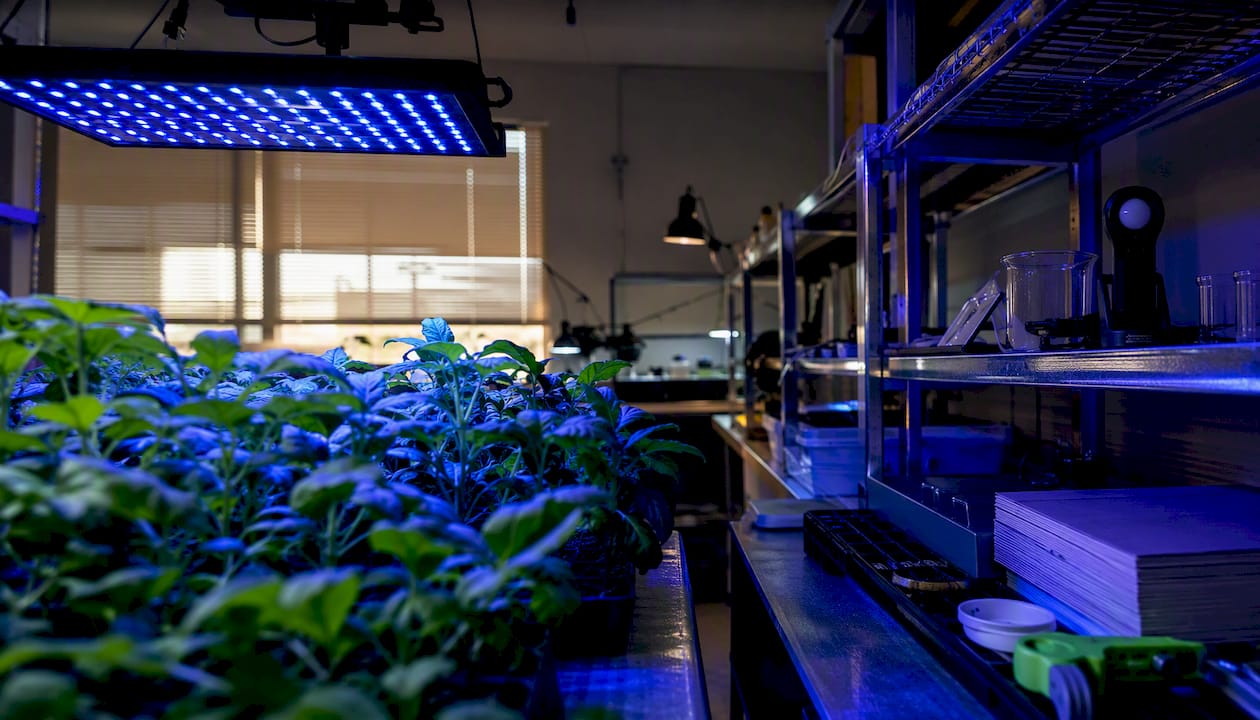
Photoperiod effects are subtler but real. Longer dark periods can trigger diapause in some pest species, slowing reproduction. Altered night spectra, particularly far-red supplementation applied at night, can change plant chemical defenses including trichome density, which indirectly reduces certain mite populations. Daytime far-red supplementation showed weaker effects in the same research.
Key intensity and schedule considerations:
Statistic: Orius insidiosus attacked prey across all tested lighting conditions, confirming that spectrum adjustments for pest management rarely compromise this predator’s effectiveness.
Shadows are pest habitat. Low-light pockets under a dense canopy stay cooler and more humid than the rest of your room, and that microclimate is exactly where fungus gnats, spider mites, and thrips populations persist between spray cycles. Uneven DLI distribution does not just hurt yield uniformity — it creates refuges your IPM program cannot reach.
Reflective ground mulches with high blue reflectance reduced whitefly settlement in lettuce experiments, suggesting that what bounces off your floor matters as much as what comes from your fixtures. Foil-backed reflective surfaces under plants push blue-shifted light back up into the lower canopy, disrupting the visual cues pests use to identify sheltered settling sites.
Practical layout fixes:
Pro Tip: Map your canopy with a PAR meter at 12-inch intervals before buying additional fixtures. Most growers find 2–3 specific dark zones driving the majority of their pest pressure — fix those spots first.
A lighting change without a monitoring plan is just an experiment with no data. Run it like a trial.
Always pair behavioral lighting with a collection method. Traps, predators, or both — lighting alone redirects pests, it does not remove them. Check that your chosen predators tolerate your new spectrum before deploying them at scale. Programmable lighting controls make running repeatable spectral schedules and A/B trials practical without manual intervention.
Pro Tip: Log temperature and humidity alongside lighting changes. Spectrum adjustments sometimes shift microclimate enough to confound your pest data — you need to rule that out.
These are starting points for trials, not guaranteed outcomes. Species, crop, and room conditions all affect results.
| Pest | Spectral tactic | Intensity / schedule note | Expected outcome |
|---|---|---|---|
| Whiteflies | Blue spotlights (push) + green LED sticky traps (pull) | 186 μmol/m²/s blue; traps at canopy edge | Nearly 50% deterrence from plants; higher trap capture |
| Thrips | Retain broad-spectrum for Orius; avoid UV-heavy night spectra | Spectrum over intensity; standard photoperiod | Predator activity preserved; reduced settling |
| Fungus gnats | Eliminate under-canopy dark zones; reduce constant low UV | Increase floor reflectance; sticky traps at soil level | Fewer adult settling sites near growing medium |
| Spider mites | Nighttime far-red supplementation | Applied during dark period only | Plant-mediated trichome increase; monitor for crop sensitivity |
For thrips specifically, LED spectra affect Orius insidiosus locomotion and attack behavior, so preserving a spectrum your predators tolerate is the primary lever. Adjusting schedule to reduce overlap with peak thrips activity (often early morning) is a lower-risk first step than spectral changes.
Pro Tip: For spider mites, start nighttime far-red at a low dose and monitor both mite counts and trichome condition over two full mite generations before increasing duration. Some cultivars respond strongly; others show minimal change.
Lighting changes can backfire. The most common problems:
Troubleshooting steps: isolate variables by running a short A/B test, check your environmental logs for temperature and humidity shifts, and observe predator activity directly rather than relying only on trap counts. Revert a lighting change if yield indicators drop, predator counts fall below your pre-trial baseline, or pest counts increase after two full pest generations.
Pro Tip: Track both pest and beneficial insect counts on separate trap types. A sticky trap total that looks flat can hide a scenario where pests are rising and predators are falling simultaneously.
The strongest experimental results cluster around a few consistent findings. Blue light at sufficient intensity deters whitefly settlement. Green light attracts whiteflies and aphids to traps. UV drives migratory behavior more than settling. And spectrum composition influences Orius insidiosus behavior more than intensity does, which is the most practically useful finding for growers running biocontrol programs.
The limits are real. Lab results often do not scale directly to greenhouse or commercial conditions because pest attraction and repellence depend on life stage, crop type, ambient UV, and temperature. A result from a controlled cage study may not replicate in your room.
For a credible in-house trial:
Key finding: LED-based pest controls act primarily via behavioral manipulation — disrupting host detection or attracting pests to traps — not direct mortality. Design your trials and expectations accordingly.
| Evidence type | Finding | Scale |
|---|---|---|
| Greenhouse trial | Blue spotlights deterred nearly 50% of whiteflies | Greenhouse |
| Greenhouse trial | Green LED + yellow card outperformed yellow card alone | Greenhouse |
| Lab/greenhouse | Orius predation: spectrum > intensity | Lab/greenhouse |
| Greenhouse | Nighttime far-red reduced mite populations via plant defenses | Greenhouse |
| Greenhouse | Narrow-band blue arrays reduced whitefly host-plant settlement | Greenhouse |
LED spectrum, intensity, and distribution are practical IPM levers when combined with traps or biocontrol — lighting alone redirects pests but does not remove them.
| Point | Details |
|---|---|
| Spectrum drives behavior | Blue deters whitefly settling; green attracts them to traps — exploit this push-pull opponency. |
| Intensity threshold for blue | Blue deterrence requires approximately 186 μmol/m²/s; lower outputs are overwhelmed by ambient light. |
| Predators tolerate spectrum changes | Orius insidiosus predation rates held across spectra; spectrum matters more than intensity for this predator. |
| Fix canopy uniformity first | Dark under-canopy zones are pest refuges; address distribution before adding spectral tactics. |
| Ledgrowlightsdepot | Offers under-canopy fixtures and programmable control systems that support A/B spectral trials and push-pull rollouts. |
Growers spend real money on biocontrol agents, then change their lighting without checking whether the new spectrum disrupts their predators’ behavior. The research on Orius insidiosus is reassuring — spectrum changes rarely shut down predation entirely — but that finding does not extend to every beneficial species in your room. Parasitoids like Aphidius matricariae have photoperiodic sensitivity that longer LED daylength extensions can affect, meaning a schedule change you made for pest suppression might be quietly reducing parasitoid foraging time.
The other thing growers underestimate is how much the floor matters. Reflective surfaces under your canopy are not just a yield tool — they change the spectral environment pests use to navigate. A foil mulch costs almost nothing compared to a new fixture, and in whitefly trials it moved the needle on settlement rates.
Start with the simplest intervention: fix your canopy uniformity, add reflective surfaces, and run one small push-pull trial with blue spotlights and green sticky traps before you redesign your whole lighting program. Document everything. Lighting is a variable like any other in your grow room — treat it that way.
Growers who want to run push-pull spectral trials or timed far-red nighttime regimes need fixtures and controls that can actually execute those schedules reliably. Ledgrowlightsdepot carries under-canopy supplemental bars, full-spectrum fixtures with spot intensity control, and the TrolMaster Hydro-X environmental control system — which supports quantum sensing, programmable spectral schedules, and the kind of logged environmental data you need to run credible A/B trials. Pair it with Ledgrowlightsdepot’s LED efficiency guidance for home grows to balance your pest-management lighting against your plant’s PAR budget without sacrificing yield.
Browse Ledgrowlightsdepot’s fixture and control system lineup to find the setup that fits your room size and trial goals.
The recommendations in this article draw from peer-reviewed greenhouse and lab research. Use these when designing your own trials.
Evidence strength varies: the blue deterrence and green attraction findings are the most replicated at greenhouse scale. Far-red mite effects and predator spectrum sensitivity findings are promising but come from fewer studies — weight them accordingly when designing trials.
0 of 3 items selected

Leave a comment