
Free Shipping in the USA on nearly all items!
Limited phone hours during the Holidays! Call us: 888-611-9305
Free Shipping in the USA on nearly ALL items! Limited phone hours during the Holidays!

Yes: if you routinely work close to or for long periods under high-intensity grow lights, wear grow-room protective eyewear built to filter the over-produced wavelengths. The main concerns in modern fixtures are blue light and near-infrared, not UV, which most horticultural LEDs emit in negligible amounts. Avoid staring directly at fixtures, use color-corrective grow lenses during plant inspections, and switch off lights when practical for close diagnostic work.
TL;DR:
- Most grow-room safety concerns focus on blue light and near-infrared, with manufacturers providing risk group labels to guide safe exposure times and distances.
- Proper eyewear should match the fixture’s spectrum, with transparent spectral transmittance data and impact certification, rather than relying on marketing claims or generic sunglasses.
- Comfort and fit are critical because poorly fitting glasses will be discarded, reducing actual protection during long or frequent sessions.
- Eyewear choice depends on task specifics: diagnostic work benefits from lighter lenses that preserve contrast, while general maintenance can tolerate darker filters.
- Most modern horticultural LEDs emit minimal UV, making blue light and infrared the main hazards, and risk increases with proximity and duration of exposure.
Grow-room eyewear falls into a few distinct categories, and picking the wrong one can actually make plant inspection harder, not safer. Wraparound grow glasses cover the most ground for everyday tasks. Full-coverage grow goggles seal against light leakage from the sides, which matters more than most growers assume in a tent with reflective walls. Welding-style goggles show up often in grower forums, and lab testing on eyewear transmittance backs that instinct: certain welding and safety goggle designs block a large portion of visible irradiance between 400 and 700 nanometers (https://e-gro.com/pdf/2022-11-10.pdf), meaningfully cutting ocular hazard from high-output LEDs. Color-corrective multi-lens kits round out the category for growers who run more than one fixture type.
Lens color is not cosmetic. It determines what you can actually see once the glasses are on.
Beyond tint, look for UV block, infrared absorption, anti-fog treatment, and impact-resistant frames. Visible light transmittance (VLT) matters as much as color: a lens dark enough to feel “protective” can also hide the subtle color shifts you need to spot a deficiency early, so darker isn’t automatically better for diagnostic work.
Fixture labeling answers this question more precisely than intuition does. Under IEC 62471 and ANSI/CAN/UL 8800, horticultural luminaires get sorted into photobiological risk groups, RG0 through RG3, based on standardized testing. A higher risk group means a shorter safe exposure time at a given distance, and manufacturers are required to disclose that information on the fixture or in its documentation.
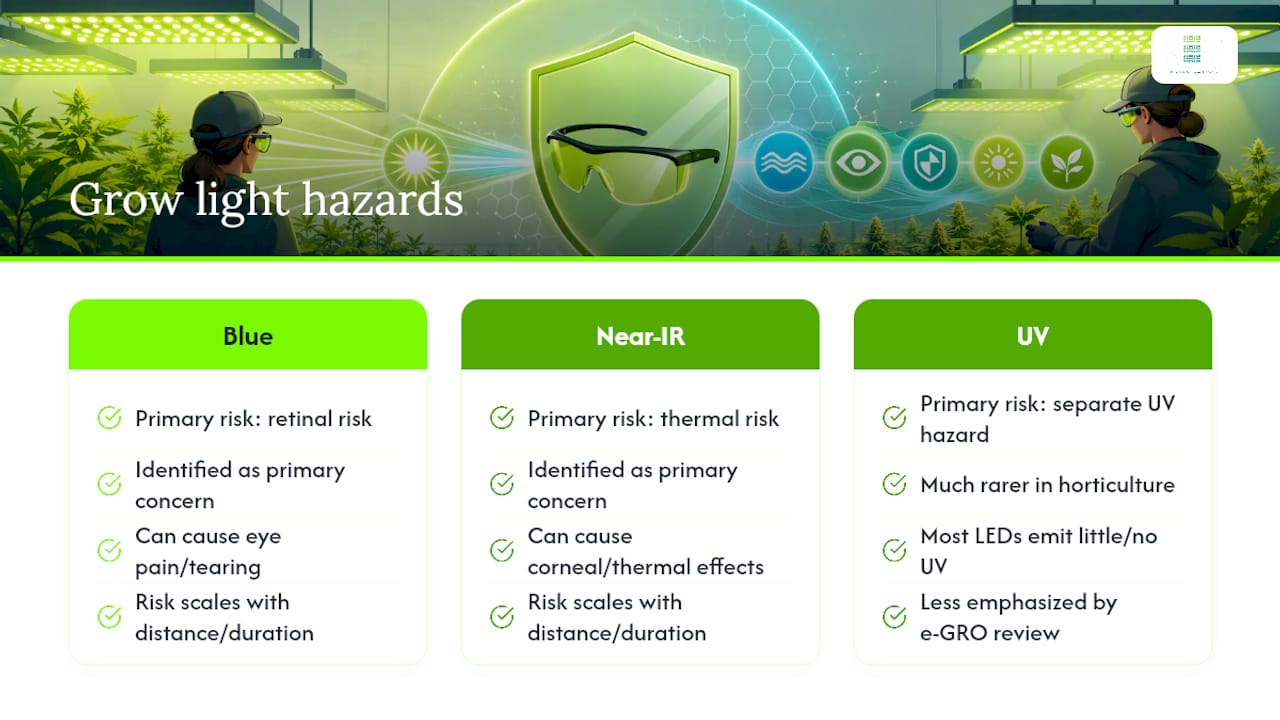
Two hazard types drive nearly every horticultural lighting safety conversation: blue light, which carries retinal risk, and near-infrared, which carries thermal risk. UV is a separate, much rarer concern in this category, since most supplemental horticultural LEDs emit little to no UV.
Exposure math that matters: risk scales with intensity, distance, and duration together. Standing three feet from a fixture for a five-second glance carries a very different hazard profile than leaning in for a ten-minute close inspection at six inches. The e-GRO photobiology review identifies blue light and near-infrared as the primary wavelengths of concern in modern horticultural setups, which is exactly why distance and duration deserve as much attention as the fixture spec sheet.
If you experience eye pain, gritty sensation, excessive tearing, or light sensitivity after working under a fixture, stop immediately and rest your eyes in a dim room. Those symptoms can point to photokeratitis, a corneal inflammation from intense light exposure that usually resolves but warrants medical attention if it persists. Check your fixture’s manufacturer documentation for its risk group before assuming any of this applies to your setup.
Picking eyewear by trial and error wastes money and, worse, gives you false confidence. Work through these steps in order.
Pro Tip: Bring a leaf sample or a color reference card into the store lighting (or check under your own fixture before buying) if you can. If a lens makes healthy green foliage look muddy or gray, it’s going to make nutrient deficiencies nearly impossible to catch early.
Standard sunglasses don’t belong on this list. They rarely correct the color cast from horticultural lighting and typically offer no meaningful infrared filtering, which makes them a poor substitute for purpose-built grow-room lenses.
The best pair of protective glasses does nothing for you sitting in a drawer. Comfort determines compliance more than any spec sheet, so fit matters as much as lens quality.
Rotating tasks so you’re not staring into a canopy under full intensity for hours at a stretch also reduces general eye fatigue, glasses or no glasses.
Some LED grow light manufacturers build their lighting systems around proprietary technology that improves under-canopy light distribution, and that same attention to light behavior shapes how we think about eye safety in the grow room. Standards like IEC 62471 and ANSI/CAN/UL 8800 translate directly into decisions you can make at the fixture and at the checkout counter.
A risk-group label on a horticultural LED fixture, RG0 through RG3, is a required safety disclosure based on standardized testing. It tells you the manufacturer’s tested exposure limits. It does not automatically mean an LED fixture is more dangerous than an HPS system you’ve used for years without a label at all.
Read the label as a guide to conservative behavior: shorter glance times, more distance, or eyewear for close work, rather than as a verdict on the technology itself. Growers with existing eye conditions, or anyone with symptoms that don’t resolve after a day or two, should talk to an eye-care professional rather than self-diagnose based on a fixture’s spec sheet.
Here’s the uncomfortable truth about protective eyewear: the glasses with the best transmittance chart don’t help you if they sit in a drawer because they fog up or pinch your temples after twenty minutes. I’ve seen growers buy solid, well-rated eyewear and stop using it within a week for exactly that reason. Comfort and coverage are not secondary features. They’re the difference between protection you actually get and protection you own.
— Scott
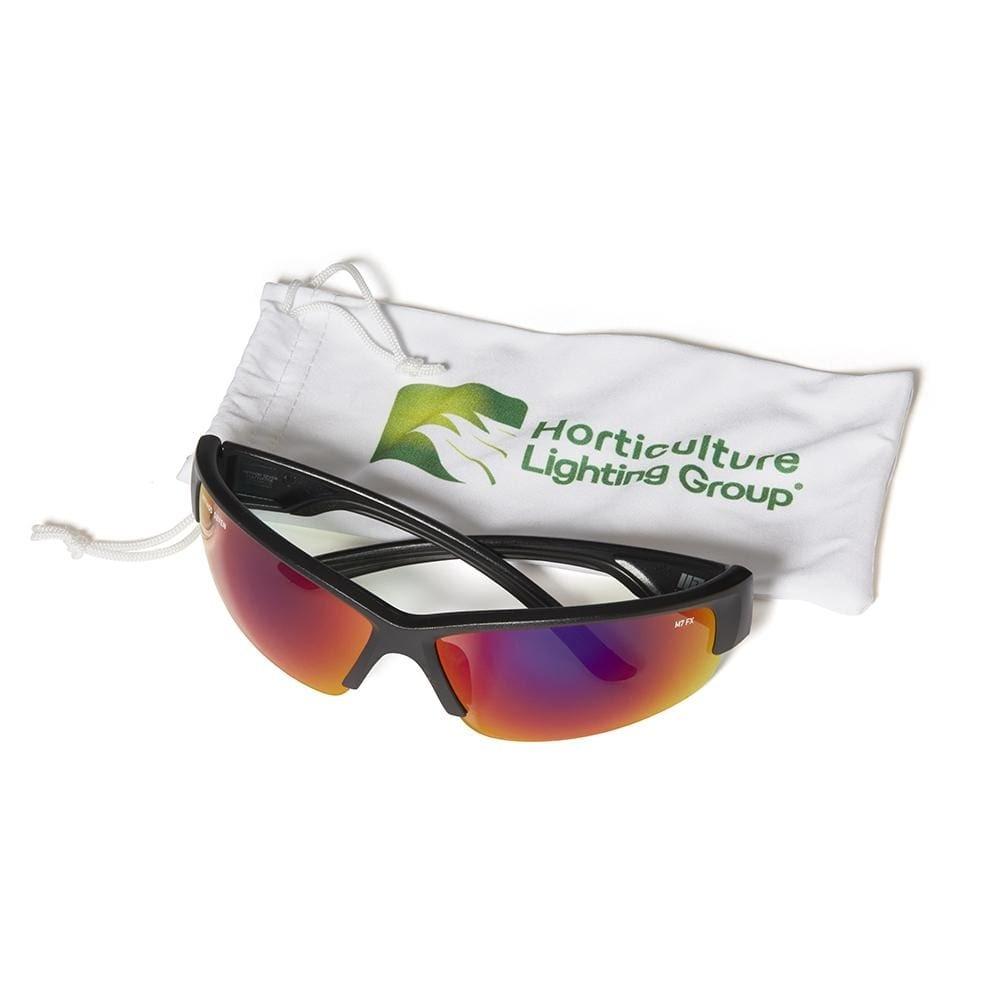
Once you know your fixture type and the task at hand, matching eyewear gets simple. The HLG Cultivator FX Glasses offer full-spectrum grow room protection with FX lenses that block UV and infrared inside an impact-resistant frame, built for growers who spend real time under high-intensity fixtures. If you want something more field-friendly for daily maintenance rounds, the Black Dog LED Grow Glasses prioritize comfortable, all-day wear without sacrificing coverage.
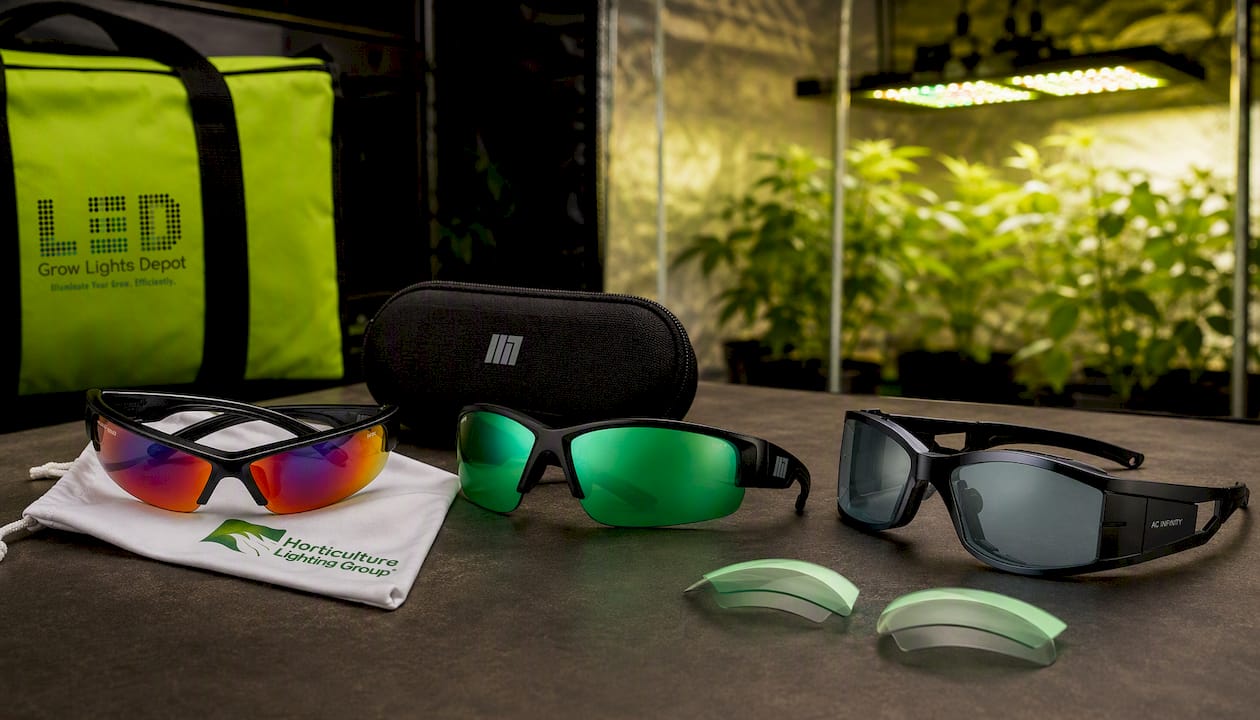
Growers running mixed fixture types, HPS in flower, LED in veg, get the most flexibility from the AC Infinity Grow Room Glasses I, which ship with three color-corrective lenses so you’re not buying three separate pairs. Whichever option you’re considering, check its spectral transmittance data and try it on for fit before you commit; a lens that doesn’t match your fixture’s spectrum or doesn’t sit comfortably won’t get worn. Browse the full grow light collection alongside top lighting and under-canopy grow lights to match eyewear to whatever fixture you’re running, and get expert advice on pairing the two before you check out.
Most grow lights are safe for casual, brief exposure, but repeated close or prolonged viewing under high-intensity fixtures carries real risk. The main concerns are blue light and near-infrared, and manufacturers assign risk groups under IEC 62471 and ANSI/CAN/UL 8800 to communicate safe exposure limits.
LED grow lights are not inherently more dangerous than other horticultural lighting, but their high output of blue wavelengths does warrant caution during close inspection work. Blue light exposure from bright LED sources has been linked to potential retinal effects has been linked to potential retinal stress, which is why grow-room glasses with blue-light filtering matter more under LEDs than under many older lighting types.
Grow lights aren’t broadly harmful with normal, sensible use, but sustained close exposure without eye protection can lead to fatigue, discomfort, or acute injuries like photokeratitis. Following manufacturer risk-group labeling and wearing appropriate eyewear for close or extended work, such as the HLG Cultivator FX Glasses, keeps that risk low.
Most modern supplemental horticultural LEDs emit very little UV, making it a less common hazard than blue light or infrared in this category. UV remains a distinct exposure class with its own health effects, so it’s still worth checking your specific fixture’s spectral output rather than assuming it applies uniformly across all grow lights.
0 of 3 items selected

Leave a comment