
Free Shipping in the USA on nearly all items!
Limited phone hours during the Holidays! Call us: 888-611-9305
Free Shipping in the USA on nearly ALL items! Limited phone hours during the Holidays!

Far-red light reliably accelerates flowering in long-day and many photoperiod-sensitive crops when delivered as end-of-day or night-break light at species-appropriate red:far-red ratios. It does this by shifting phytochrome toward its inactive form and triggering the flowering signals that respond to darkness. Timing, ratio, and total light intensity all determine whether you get faster blooms or just taller, weaker stems, so the right first move is a small cultivar-specific trial that tracks days to visible bud and internode length before you commit a whole room to the treatment.
TL;DR:
- Timing and ratio are critical; using low-intensity end-of-day pulses or carefully timed night-breaks based on species-specific data can accelerate flowering by up to 12 days in some crops.
- Applying far-red light during propagation stages may reduce germination rates, and high doses can cause undesirable stem elongation or pigment shifts, so each protocol must be tested on a small scale first.
- Long-day crops like petunia respond well to far-red acceleration when treatment occurs after Pfr levels naturally decline, while short-day crops may see delayed flowering or suppression if the treatment overlaps with their dark period.
- The effective R:FR ratio varies by species, with ratios near 3.1 to 5.3 promoting flowering in certain crops like lentil and lisianthus, but these thresholds are not transferable between different cultivars or species without testing.
- Accurate measurement of far-red flux and consistent fixture placement are essential; growers should log treatments carefully and avoid relying on generic ratios or uncalibrated meters to ensure predictable responses.
“Far-red flowering” isn’t standard botanical terminology. The recognized science here is photoperiodic flowering control via phytochrome photoequilibrium, and understanding that mechanism is what separates a grower who gets predictable results from one who’s guessing. Far-red light sits at the 700 to 750 nanometer edge of the spectrum, just past what your eyes register as red and just before infrared. Plants use it as a signal, not just an energy source, and that distinction drives everything else in this article.
Phytochrome is the pigment doing the work. It exists in two interconvertible states: Pr, which absorbs red light, and Pfr, which absorbs far-red light. Red light pushes the molecule toward Pfr. Far-red light pushes it back toward Pr. This isn’t a one-way switch. It’s a dynamic balance that shifts constantly based on what wavelengths are hitting the leaf, and the ratio between the two forms at any given moment is called the photostationary state.
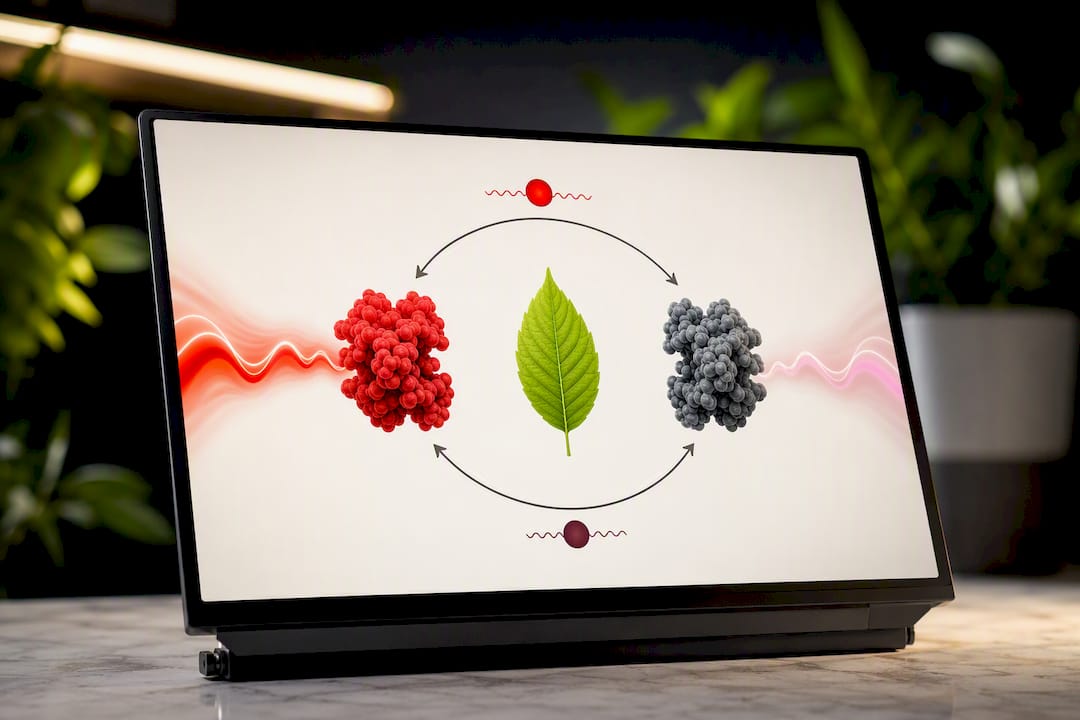
Here’s where it gets useful for flowering control. Pfr is the active form, and in darkness it slowly reverts to Pr over several hours. Long-day plants use falling Pfr levels during the night to sense that days are lengthening, which then permits flowering-promoter genes like FT (Flowering Locus T) to activate. Short-day plants use the opposite logic. High Pfr during a long, uninterrupted night suppresses their flowering signal, and they need that suppression to lift before they’ll bloom.
Add far-red light at the right moment, and you can manipulate that Pfr decay artificially:
The circadian clock adds another layer. Flowering integrator genes don’t respond to light alone. They respond to light interpreted through a roughly 24-hour internal clock that gates when phytochrome signals actually matter. A rice study using 50 μmol m⁻² s⁻¹ of supplemental far-red found flowering advanced by up to 12 days compared with a red-blue-green control, and the researchers traced this to upregulated circadian rhythm pathway genes working alongside classic photoperiodic flowering genes. That’s a mechanistic link, not just a correlation. The far-red wasn’t simply adding light. It was resetting the timing of the plant’s internal calendar.
Statistic to remember: that 12-day acceleration in rice came from a relatively modest far-red photon flux, which tells you the flowering pathway is sensitive to comparatively small doses when the timing is right.
There’s a second mechanism worth knowing, separate from flowering timing entirely: the Emerson enhancement effect. Photosystem II absorbs primarily red and blue light, while Photosystem I pulls more efficiently from far-red. When both photosystems fire together, the electron transport chain runs faster than either running alone would predict, which is why far-red can boost whole-canopy photosynthesis even though it does almost nothing for photosynthesis when applied by itself. Full-spectrum lighting that includes a far-red fraction is exploiting this synergy, not just adding wasted photons at the spectrum’s edge.
A lettuce canopy study captured the practical payoff of this dual mechanism. Supplemental far-red increased leaf length, leaf width, and canopy light interception enough that whole-plant photosynthesis and yield increased, even though leaf-level photosynthetic capacity actually declined. The plant traded photosynthetic efficiency per leaf for more total leaf area intercepting light. That’s a morphological win dressed up as a physiological one, and it’s the reason far-red sometimes improves yield in ways a simple leaf-gas-exchange measurement would miss entirely.
Two delivery methods dominate the practical literature: end-of-day (EOD) far-red and night-break far-red. They’re not interchangeable, and picking the wrong one for your crop category wastes the treatment.
End-of-day far-red means a short far-red pulse delivered immediately after your main light period ends, before the room goes fully dark. It works by dropping Pfr fast, effectively telling a long-day plant that night started sooner than it did. This is the lower-risk, easier-to-implement option for most indoor setups because it’s brief and doesn’t require you to interrupt sleep-phase darkness.
Night-break far-red means a longer far-red exposure delivered partway through the dark period, sometimes lasting up to four hours. A day-extension study in long-day ornamentals found that an 8-hour day-extension using combined red and far-red light often outperformed a shorter 4-hour night-break for promoting flowering, though results varied enough by species that duration alone doesn’t guarantee an outcome. The same research noted that far-red timed after dusk tended to beat far-red applied before dawn for several crops, which points to a sensitivity window tied to when phytochrome reversion is furthest along.
Here’s how to translate that into a working protocol:
Fixture placement matters here too. Far-red sources mounted for even canopy coverage, rather than concentrated at one edge of the room, avoid creating a gradient where plants near the source get a much stronger signal than plants at the far wall. This is especially relevant for proximity-style under-canopy lighting, where the goal is uniform light distribution rather than a single hot spot.
Pro Tip: Log your far-red treatments the same way you’d log a nutrient change: date, duration, flux, and R:FR ratio, then photograph internode spacing weekly. Growers who skip the logging step almost always end up repeating a failed trial without realizing it’s the second time.
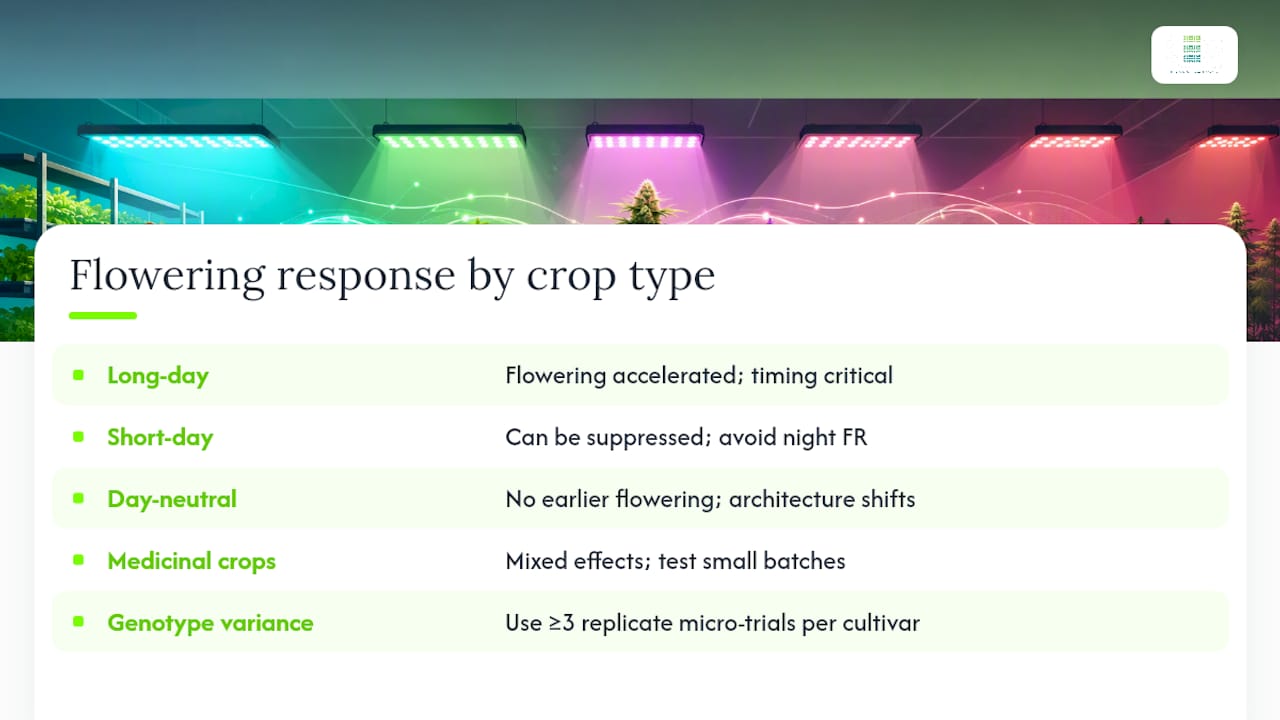
Photoperiod category predicts outcome more reliably than almost any other single variable, but genotype still has the final word within each category.
Long-day crops generally respond well to far-red flowering acceleration. Petunia and snapdragon are commonly cited examples where reduced night-time Pfr, whether through EOD pulses or night-breaks, pushes flowering-promoter pathways to activate sooner. Timing is what separates a useful treatment from a wasted one here: applying far-red too early in the dark period, before Pfr has started its natural decline, produces a weaker response than applying it once decay is already underway.
Short-day crops run on the opposite logic, and this is where far-red missteps cause the most damage. A night-break that re-elevates Pfr during what the plant reads as its critical dark period can suppress or delay flowering entirely. If you’re growing anything in the short-day category, far-red at night should be avoided outright or handled only with tightly controlled, low-intensity trials that you’re prepared to abandon if bud formation stalls.
Day-neutral crops don’t shift flowering timing much with far-red at all. What changes instead is architecture: stem length, leaf angle, and internode spacing respond to the shade-avoidance pathway that far-red activates through PIF proteins, independent of any flowering-timing effect. If you’re growing a day-neutral crop for far-red’s supposed bloom-acceleration benefit, you’re likely to get taller plants and no earlier flowers.
Medicinal crops, cannabis chief among them, don’t fit neatly into any of the above. Recent controlled work on far-red in medicinal cannabis reports mixed effects on biomass and cannabinoid concentration depending on treatment timing and intensity. Some protocols increase biomass without harming cannabinoid content, others show measurable shifts in cannabinoid profile, and the variation across studies is wide enough that no single recipe is safe to assume. This is the strongest case in the entire article for conservative, small-batch testing before scaling anything.
Genotype variance compounds all of this. A recommended practice across the flowering-response literature is running at least three replicate micro-trials per cultivar before adopting a far-red protocol at farm scale, because two cultivars of the same species can respond to an identical treatment in noticeably different ways.
Far-red flowering acceleration doesn’t come free, and three risks show up often enough to deserve a permanent spot on your checklist.
Stem elongation is the most visible tradeoff. Far-red activates the shade-avoidance response through PIF protein stabilization, and the plant’s default reaction to that signal is to stretch. Internode length increases, and depending on the crop, you can end up with weaker stems that lodge under their own weight or a canopy dense enough at the top to shade out lower bud sites. A crop that flowers three days earlier but falls over before harvest hasn’t actually won anything.
Pigment and antioxidant levels can shift under high far-red exposure, which matters for any crop where visual color or nutritional compound density factors into grading or market value. The mechanism ties back to the same shade-avoidance signaling that drives elongation: a plant behaving as though it’s competing for light under a canopy tends to deprioritize pigment production relative to a plant grown under a more balanced spectrum.
Germination is a separate concern entirely, and one easy to overlook. Evidence in multiple species shows that red and far-red light exposure during the germination window can reduce germination rates, since the same phytochrome system that regulates flowering also gates seed dormancy release. The practical rule: keep far-red treatments off the table during propagation and early seedling stages, and reserve them for the vegetative-to-flower transition once plants are established.
For medicinal crops, treat any cannabinoid or terpene claim tied to far-red with the same skepticism you’d apply to an unverified yield claim. The current research is genuinely mixed, not just underreported, so the only responsible move if you’re growing for a chemical profile target is to run the treatment on a limited batch and send samples for analytical testing before touching your main canopy.
Running far-red treatments without a structured trial is how growers end up with anecdotes instead of data. This four-step protocol turns the science above into something you can actually execute in a single flowering cycle.
What you measure through that window should include time-to-visible-bud, internode length, projected canopy size, and your realized DLI across the treatment period. Medicinal growers should add a chemical sampling step, pulling a small tissue or flower sample at a consistent point in flowering across both treatment and control groups to reduce phenological noise in the comparison.
Two starting recipes cover most situations. For long-day ornamental or vegetable crops, a conservative EOD far-red pulse at low intensity for the first pilot cycle gives you a readable signal without much elongation risk. For medicinal crops, start with a micro-pulse protocol at the lowest end of tested far-red flux, and don’t scale past your pilot batch until lab testing confirms your chemical profile held steady or improved.
Pro Tip: Run your control and treatment groups under the same fixture whenever the setup allows it, splitting the room with a physical light barrier rather than using two different fixture models. Two different fixtures introduce spectral variables beyond far-red alone, which muddies the comparison you’re trying to make.
On the hardware side, protocol choice should drive fixture choice, not the other way around. EOD pulses pair naturally with compact supplemental strips positioned close to the canopy. Combined PAR-plus-far-red flowering recipes are better served by a full-spectrum fixture built to deliver both bands from a single source. Gentle night-break applications, where you want low intensity spread evenly rather than a concentrated burst, tend to favor T5-style strip lighting over a high-output panel.
The biggest misconception in this space is treating far-red as a bloom accelerator you bolt onto any crop and expect uniform results. It isn’t. It’s a signal, and signals only produce the outcome you want when the receiving system, the crop’s photoperiod category and its specific genotype, is wired to respond the way you’re assuming.
Conventional advice tends to fixate on a single number, usually an R:FR ratio pulled from one study, and treat it as portable across species. The lentil data showing a 10 to 11 day acceleration at R:FR 3.1 and the Lisianthus threshold near 5.3 are both real, both useful, and both completely non-transferable to a cultivar neither study touched. That’s not a flaw in the research. It’s a limit on how far any single data point should be stretched.
What actually deserves priority is the boring part: baseline measurement, a real control group, and a willingness to accept a null result on your first trial. Growers chasing speed skip straight to scaling a treatment that showed promise in someone else’s greenhouse, and then wonder why their internodes stretched three inches with no earlier bud set to show for it. Start small, measure honestly, and let your own canopy tell you what the literature can only suggest.
— Scott
Once you’ve settled on a protocol, the fixture you pick determines how consistently you can execute it. Under-canopy proximity systems solve the specific problem most far-red trials run into on cheaper setups: uneven light distribution that leaves plants near the fixture overtreated and plants at the room’s edges barely touched.

For end-of-day pulses, the Secondary Supplemental Lighting PROXIMITY Cube system delivers under-canopy far-red augmentation designed around even distribution rather than a single hot spot. For combined PAR-plus-far-red flowering recipes in a single fixture, the ThinkGrow LED Model-I covers smaller rooms and tents, while the ThinkGrow LED Model-I Plus scales that same spectrum to larger footprints once your pilot data supports moving beyond a single tent. High-PPFD flowering rooms running dense canopies pair well with the Grower’s Choice ROI-E720 or the Grower’s Choice ROI-FF 650W for 4x4 flowering spaces. For gentle night-break work, the Active Grow Integrated Strip T5 delivers low-intensity, evenly spread light suited to longer exposure windows, and the compact Sunblaster Micro LED Garden fits propagation-adjacent spaces where you want a small, controlled far-red source kept well away from actual seedlings. Reach out to a lighting specialist for help matching a fixture to your specific canopy size and protocol.
The rice study on far-red and circadian flowering genes, the Lisianthus R:FR threshold research, and the lentil ratio experiments remain the clearest peer-reviewed sources on species-specific thresholds. The lettuce canopy and yield study explains the Emerson-effect mechanics behind far-red’s yield benefits, and the long-day ornamental timing trials cover EOD versus night-break scheduling in depth. For implementation guidance matched to fixture selection, LedGrowLightsDepot’s flowering spectrum LED recipes guide and full-spectrum lighting explainer walk through spectrum choices in more practical terms.
This article is general information, not a substitute for advice from a qualified doctor. Consult a qualified healthcare professional about your own circumstances before acting on anything here.
0 of 3 items selected


Leave a comment