
Free Shipping in the USA on nearly all items!
Limited phone hours during the Holidays! Call us: 888-611-9305
Free Shipping in the USA on nearly ALL items! Limited phone hours during the Holidays!

Most lettuce performs best at a daily light integral between 12 and 17 mol·m⁻²·d⁻¹, with 14 to 15 mol·m⁻²·d⁻¹ working as a reliable benchmark for indoor and greenhouse production. Cultivar matters: butterhead types tolerate the lower end while romaine and crisphead varieties respond well closer to 17. Push past roughly 20 to 22 mol·m⁻²·d⁻¹ and tipburn or premature bolting risk climbs fast. Reaching that number with low PPFD over a long photoperiod, rather than high intensity for fewer hours, usually costs less to run.
TL;DR:
- Lettuce’s optimal daily light integral ranges from 12 to 17 mol·m⁻²·d⁻¹, with 14 to 15 mol·m⁻²·d⁻¹ commonly used as a benchmark for indoor and greenhouse production.
- Cultivar type influences light needs: butterhead requires 10 to 17 mol·m⁻²·d⁻¹, while romaine can tolerate up to 18 mol·m⁻²·d⁻¹, and red-leaf varieties depend more on blue light to develop pigmentation.
- Raising DLI above 20 to 22 mol·m⁻²·d⁻¹ sharply increases tipburn and bolting risks, with CO₂ enrichment only slightly extending safe light levels.
- DLI calculation involves multiplying PPFD and photoperiod in hours, then by 0.0036; matching this to the plant’s growth stage improves yield and reduces stress.
- Adjusting light spectrum and photoperiod according to growth stage and target cultivar enhances quality and biomass, while moderate blue light boosts pigmentation without yield loss.
Lettuce is not one crop with one number. Loose-leaf and butterhead types build tender, less pigmented rosettes and top out at lower light demand than crisphead or tall romaine, which pack more leaf layers and use more total photons to fill out.
Quick reference ranges, based on extension guidance and grower calculators:
For most commercial operations chasing consistent head weight and shelf appearance, 14 to 15 mol·m⁻²·d⁻¹ is the balanced benchmark extension research supports. During the rapid growth phase, that number can climb toward 17 mol·m⁻²·d⁻¹ without penalty, and stage-wise trials found that raising DLI to roughly 17.2 to 17.3 mol·m⁻²·d⁻¹ during rapid growth maximized photon yield compared with holding a flat target the whole cycle.
Anything below 10 mol·m⁻²·d⁻¹ tends to produce stunted, pale heads that never fill out properly. On the other end, the same Michigan State extension work flags 20 to 22 mol·m⁻²·d⁻¹ as the point where tipburn and bolting risk rises sharply for many cultivars. Elevated CO₂ enrichment (often 800 to 1,200 ppm in sealed rooms) can push that ceiling slightly higher by helping plants use extra photons for carbon fixation instead of just heat and stress, but it doesn’t eliminate the risk. Treat CO₂ as a modifier, not a license to run lights at full blast.
DLI is simply the total light a plant receives across one day, measured in moles of photons per square meter. The formula converts instantaneous light intensity (PPFD, in µmol·m⁻²·s⁻¹) into that daily total:
DLI = PPFD × photoperiod (hours) × 3,600 seconds ÷ 1,000,000
A shortcut that gets you close enough for practical use: PPFD × hours × 0.0036 ≈ DLI.
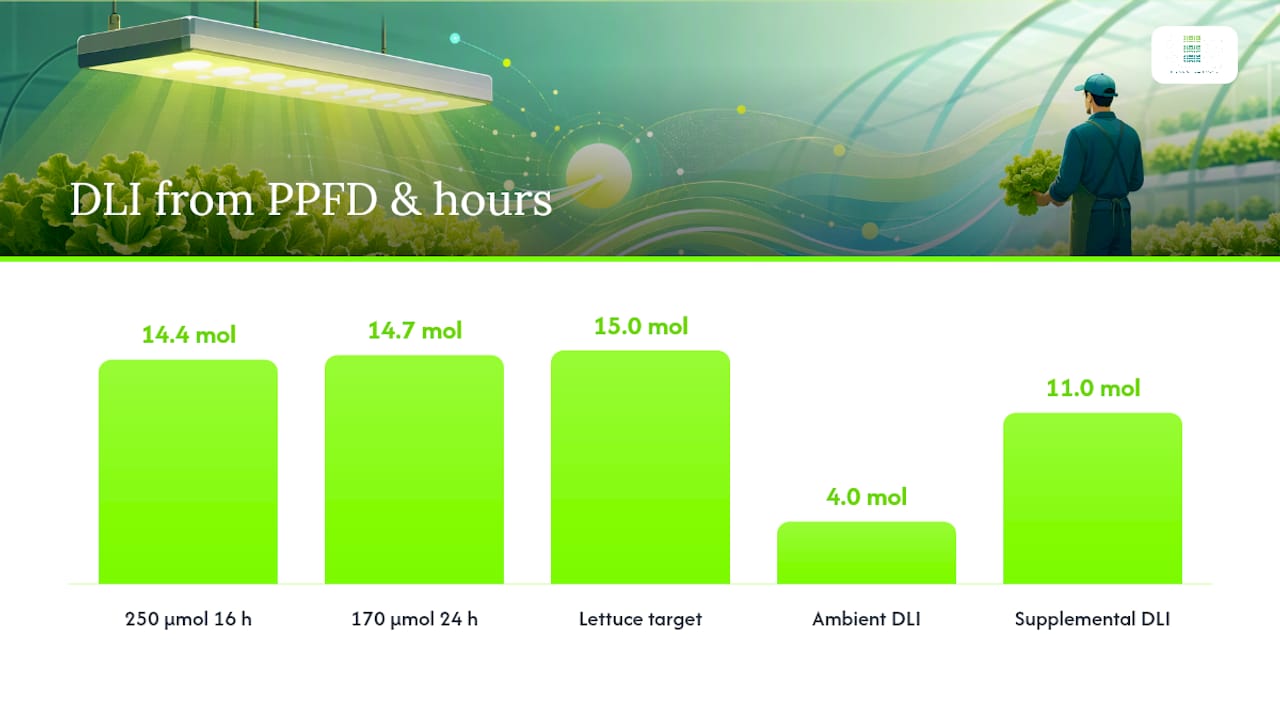
Two examples show how different combinations land near the same target:
Both hit roughly the same DLI, but they draw power very differently, a tradeoff worth digging into once you have your baseline number.
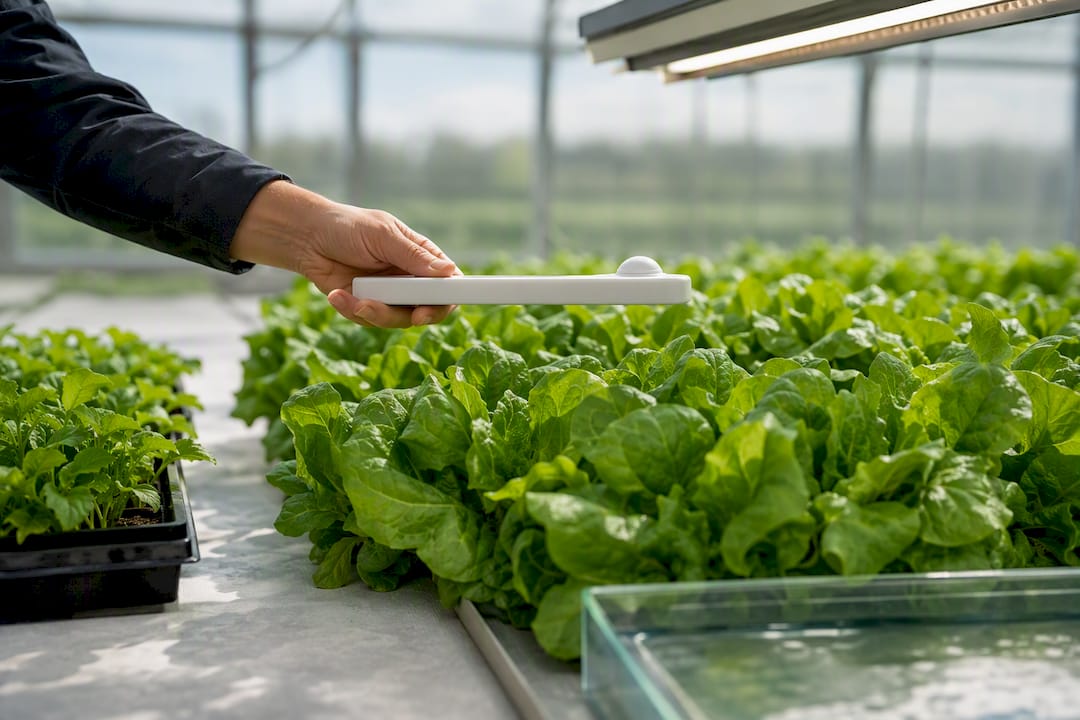
If you’re growing in a greenhouse with natural light, measure ambient DLI with a quantum sensor logging throughout the day, then add supplemental lighting only to close the gap. Michigan State’s extension guidance gives a practical example: ambient DLI of 4 plus artificial DLI of 11 gets you to a 15 mol·m⁻²·d⁻¹ target without wasting energy topping up light you already have.
Pro Tip: Mount your sensor at canopy height, not at the fixture. Light intensity drops fast with distance, and a reading taken six inches from the bulb will badly overstate what your lettuce actually receives. For a deeper walkthrough of these conversions, LedGrowLightsDepot’s guide on PPFD to DLI conversion for leafy greens covers additional scenarios worth checking against your own setup.
Yes, and treating DLI as a single fixed number for the entire crop cycle leaves yield on the table. Lettuce doesn’t need the same light load as a tiny seedling that it needs three weeks later when it’s packing on mass fast.
A practical stage schedule looks something like this:
The stage-wise optimization research testing 11.5, 14.4, and 18.0 mol·m⁻²·d⁻¹ at different points in the cycle found that ramping from roughly 14.4 in slower stages to about 17.3 during rapid growth maximized photon yield without cutting into photosynthetic efficiency. Jumping straight to a high DLI on day one doesn’t help. Young plants with limited leaf area simply can’t absorb the extra photons, so that light gets wasted as heat.
Watch leaf area expansion and dry mass gains as your monitoring markers rather than relying on a fixed calendar. If leaf area is stalling while DLI climbs, you’ve likely overshot the plant’s current capacity to use that light.
Spectrum shapes how lettuce looks and grows, even when total DLI stays constant. The blue photon fraction in your light recipe is the biggest lever here.
Higher blue fractions in broad-spectrum LEDs increase red pigmentation and produce more compact, tighter heads, but that often comes at a cost: biomass tends to run lower than under white spectra with less blue content, even at identical total PPFD and DLI. If you’re growing red-leaf cultivars for market appeal, that pigmentation boost usually justifies the modest yield tradeoff.
Practical spectral guidance by lettuce color:
Supplementing far-red light can stretch internode length and leaf size in some setups, useful if you’re chasing larger heads, but it also pushes plants toward a more elongated, less compact form. If compactness matters more than raw size, skip the far-red boost and lean on blue instead.
Holding DLI constant, how you deliver it matters almost as much as the number itself. Continuous low-PPFD lighting across 24 hours can improve energy use efficiency while maintaining yield and quality compared with running high-intensity fixtures for a shorter photoperiod.
Separate research on PPFD and photoperiod combinations backs this up: at a DLI near 15.6 mol·m⁻²·d⁻¹, lower PPFD stretched over a longer photoperiod produced greater fresh and dry mass than higher PPFD compressed into fewer hours. Lower instantaneous light intensity appears to reduce photoinhibition stress on leaves, letting plants use those photons more productively.
Operational factors that should drive your choice:
Pro Tip: If your utility charges demand fees based on peak draw, running lower PPFD over more hours often beats blasting high intensity for a short burst, even when total energy use looks similar on paper. Extended or continuous photoperiods make the most sense when demand charges or fixture heat load are limiting factors; shorter high-PPFD windows suit facilities with flat energy rates and strong cooling capacity.
Lighting-related disorders in lettuce usually trace back to one of three things: too much instantaneous intensity, too much cumulative DLI, or environmental conditions amplifying light stress that would otherwise be manageable.
Temperature and humidity interact with light more than most growers assume. The same DLI that’s perfectly safe at 68°F and moderate humidity can trigger tipburn at 75°F with dry air, because faster transpiration outpaces calcium delivery to new leaf tissue.
The DLI numbers in extension guides and peer-reviewed trials are a starting point, not a finish line. Scott, who covers grow lighting strategy, has seen enough support tickets and grower questions to know the gap between a recommended range and a working schedule is where most people get stuck.
There are guides on DLI for indoor grows and core lighting metrics like PAR, PPF, PPFD, and DLI because growers need conversion math and stage charts they can act on the same day, not just a target number floating in isolation. The right fixture and the right controller matter less than knowing what number you’re actually chasing and why it changes across a crop cycle.
— Scott
Hitting a specific DLI target consistently depends on two things: a fixture that delivers even, broad-spectrum light across your canopy, and a controller that can automate the photoperiod and intensity adjustments this guide walks through.
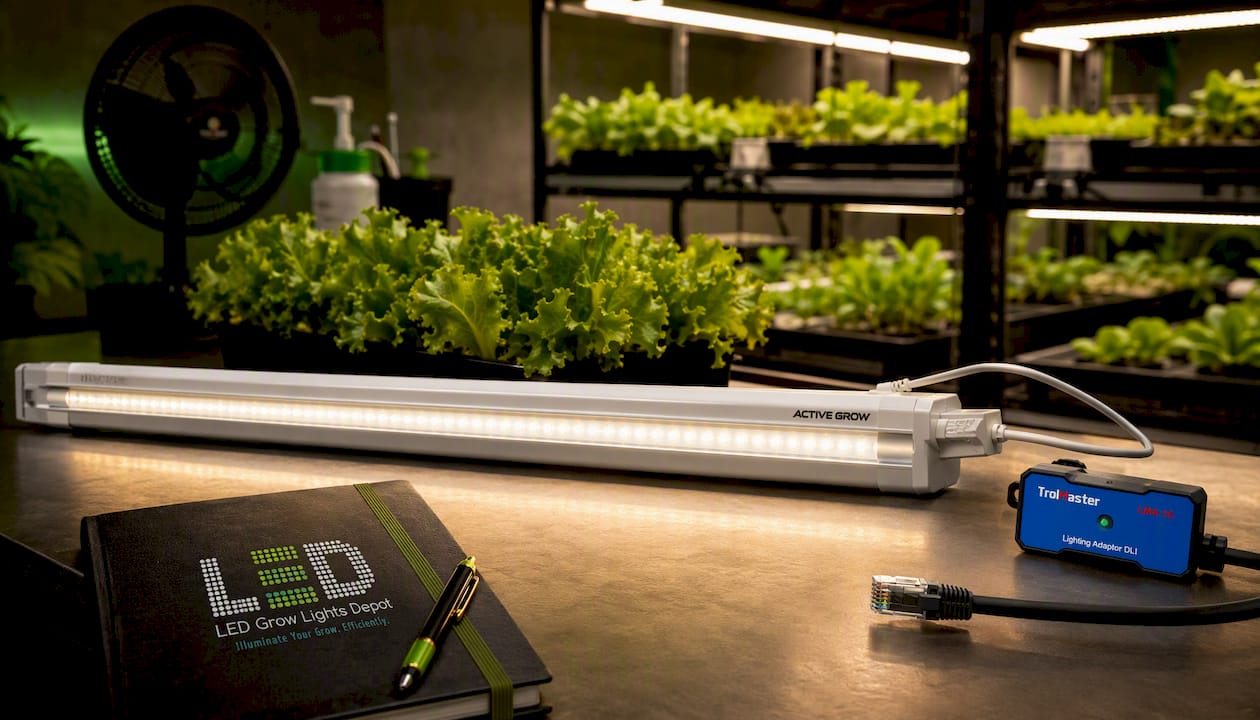
The Active Grow Integrated Strip T5 4FT LED Grow Light (54W Eqv.) in Sun White Spectrum delivers the kind of broad, even white spectrum that suits most green and butterhead lettuce targets in the 14 to 17 mol·m⁻²·d⁻¹ range, without the sharp shadowing that under-lights leggy, uneven growth. Pairing it with the TrolMaster Hydro-X Lighting Control Adapter DLI (LMA-15) lets you automate photoperiod and intensity adjustments by stage instead of resetting timers by hand every time your plants move from seedling to rapid growth. Neither product replaces the math in this guide. They just make it easier to execute once you’ve picked your numbers. Browse the full lighting lineup at LedGrowLightsDepot to find the fixture and controller combination that fits your grow space.
0 of 3 items selected

Leave a comment