
Free Shipping in the USA on nearly all items!
Limited phone hours during the Holidays! Call us: 888-611-9305
Free Shipping in the USA on nearly ALL items! Limited phone hours during the Holidays!

Grow lights are artificial light sources designed to replace or supplement sunlight for indoor plants, and the three main types of beginner-friendly grow lights are LED, compact fluorescent (CFL/T5), and high-intensity discharge (HID) lamps. Each type works differently, costs differently, and suits different growing situations. LEDs are the most popular starting point for novice indoor gardeners because they consume the least electricity, produce minimal heat, and require almost no technical setup. This article breaks down every type so you can match the right light to your plants, your space, and your budget.
The three main grow light types beginners encounter are LED, fluorescent (T5/T8/CFL), and HID (metal halide and high-pressure sodium). Each category represents a different technology, a different price point, and a different level of complexity. LEDs consume around 100W for a standard beginner panel, fluorescents sit in the mid-range, and HIDs consume the most power while generating the most heat. Knowing this hierarchy upfront saves you from buying the wrong fixture for a small apartment grow shelf.
The right choice depends on three factors: the size of your growing area, the growth stage of your plants, and how much you want to spend on electricity each month. A beginner growing herbs on a windowsill shelf needs a completely different solution than someone setting up a 4x4 tent for tomatoes. The sections below walk through each type in detail.
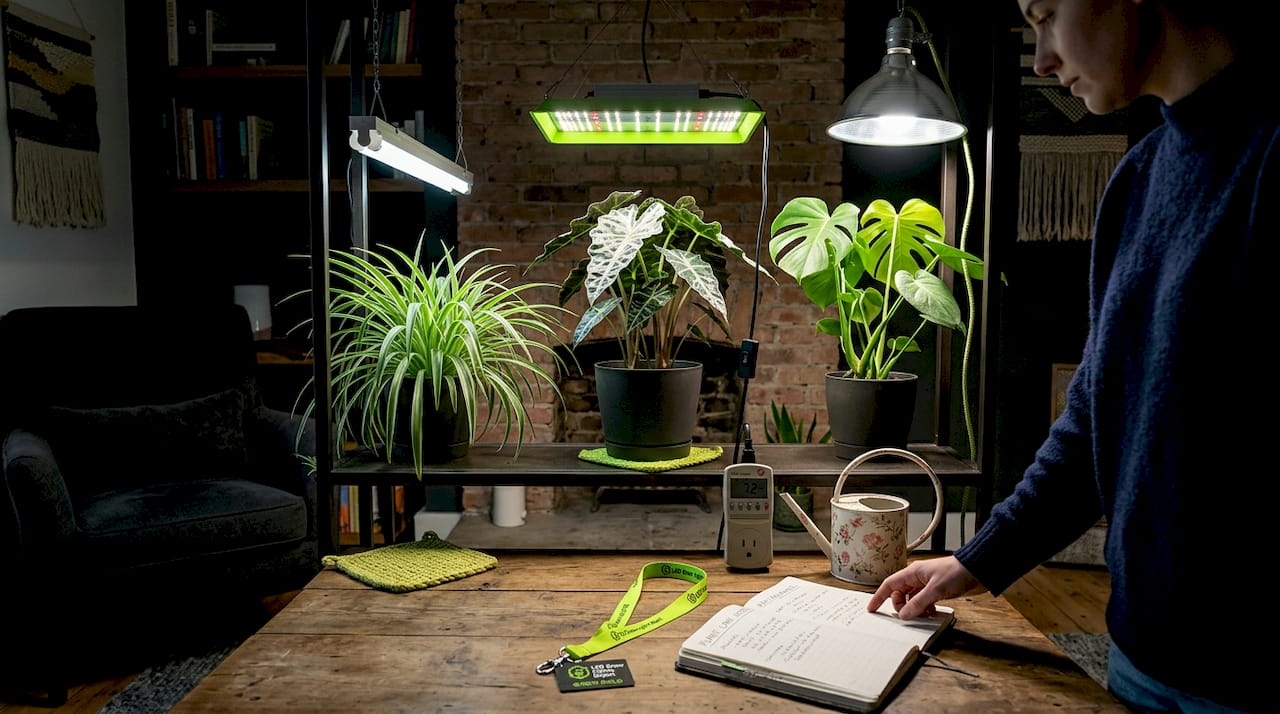
LED grow lights use semiconductor diodes to convert electricity directly into light, which is why LEDs consume the least electricity and produce far less heat than competing technologies. That low heat output is the single biggest advantage for beginners. You can hang an LED panel over a seedling tray on your kitchen counter without worrying about scorching leaves or overheating a small room.
Key benefits that make LEDs the top pick for novice growers:
Popular beginner models include the Spider Farmer SF1000 and the Mars Hydro TS 3000, both of which include dimmable full-spectrum output and are sized for small to medium grow spaces. Many beginner kits include dimmable full-spectrum LEDs for flexible lighting, which means you can dial down intensity for delicate seedlings and ramp it up for flowering plants.
Pro Tip: Set your LED panel to 50% power for the first two weeks with new seedlings. Seedlings need lights at a Kelvin rating near 6000K for healthy leafy growth, and most full-spectrum LEDs hit that range by default.
Fluorescent grow lights work by passing electricity through mercury vapor inside a glass tube, which excites a phosphor coating to produce visible light. CFL bulbs screw into standard lamp sockets, while T5 fixtures are long, flat panels that hang above plant trays. Both are inexpensive to buy and widely available at hardware stores, making them a common first purchase for beginners on a tight budget.
The critical limitation is coverage. Fluorescent lights must be placed close to plants to be effective, typically within 2 to 4 inches for CFLs and 4 to 6 inches for T5 panels. Move them farther away and the light intensity drops sharply, leading to leggy, stretched seedlings that lean toward the fixture. This physical proximity requirement limits fluorescents to small seedling trays, propagation setups, and low-light houseplants.
What fluorescents do well:
Where they fall short is scaling. Once your plants grow taller than a few inches, keeping fluorescents close enough to be effective becomes difficult. You end up repositioning fixtures constantly, and the limited coverage area means you can only grow a few plants at a time. For a small herb garden or a seedling propagation station, fluorescents are a solid, affordable choice. For anything larger, you will outgrow them quickly.
HID stands for high-intensity discharge, and this category covers two distinct lamp types: metal halide (MH) and high-pressure sodium (HPS). Metal halide produces a blue-white light that favors vegetative growth, while HPS outputs a warm orange-red spectrum that drives flowering and fruiting. Serious indoor growers often use both in sequence, switching from MH during the vegetative stage to HPS when plants begin to flower.
HID lights produce the highest light intensity of any grow light category, which is why commercial greenhouses and large home grow tents have relied on them for decades. A 600W HPS lamp can cover a 4x4 foot area with intense, penetrating light that LEDs at the same wattage cannot always match in raw canopy penetration.
The trade-offs are significant for beginners:
HID lights make sense for advanced beginners who are growing in a dedicated tent or room and want maximum yield from a larger canopy. For anyone starting with a shelf, a closet, or a small grow box, the heat and complexity make HIDs a poor first choice. HID lights require ventilation that most small indoor spaces simply cannot accommodate without significant modification.
Choosing between LED, fluorescent, and HID comes down to matching the technology to your actual growing conditions. The table below summarizes the key differences across the factors that matter most to beginners.
| Factor | LED | Fluorescent (CFL/T5) | HID (MH/HPS) |
|---|---|---|---|
| Energy consumption | Lowest (~100W typical) | Moderate | Highest (400W to 1000W) |
| Heat output | Low | Low to moderate | Very high |
| Light spectrum | Full spectrum available | Blue-heavy, limited red | Blue (MH) or red (HPS) |
| Coverage area | Medium to large | Small only | Large |
| Lifespan | 50,000+ hours | 10,000 to 20,000 hours | 10,000 to 24,000 hours |
| Setup complexity | Plug and play | Plug and play | Ballast and ventilation required |
| Upfront cost | Medium to high | Low | Medium to high |
| Best for | All stages, all sizes | Seedlings, small spaces | Large canopies, advanced growers |
Energy consumption ranks from highest to lowest as HID, then fluorescent, then LED. That ranking directly affects your monthly electricity bill and the amount of heat management your space requires. A beginner running a 1000W HPS in a small bedroom will spend more on cooling than on the light itself.
Pro Tip: If you are unsure which type fits your setup, start with a full-spectrum LED panel sized for your grow area. You can always add a second fixture later, but you cannot undo the heat damage or the electricity bill from starting too large with HID.
The correct grow light choice depends on application, scale, and plant stage rather than any single technology being universally best. Work through these four questions before you buy anything.
How large is your growing area? Measure your space in square feet. A 2x2 foot shelf needs roughly 100 to 150 watts of LED coverage. A 4x4 tent needs 400 to 600 watts. Fluorescents only cover a narrow strip directly below the fixture, so they work for trays but not tents.
What growth stage are your plants in? Seedlings and clones need blue-spectrum light around 5000K to 6000K. Flowering plants need red-spectrum light in the 2700K to 3000K range. Full-spectrum LEDs cover both stages without any changes to your setup.
What is your monthly electricity budget? Running a 600W HPS for 18 hours a day adds up to a meaningful electricity cost over a growing season. LEDs at equivalent output use roughly half that power, which matters if you are growing year-round.
How much setup effort are you willing to invest? If you want to plug in a light and start growing the same day, LEDs and fluorescents are your options. HIDs require ballast installation, reflector mounting, and ventilation planning before you can use them safely.
Incorrect fixture distance leads to leggy or slow-growing seedlings, so placement matters as much as the light type you choose. LEDs allow more flexibility in hanging height, while fluorescents must stay close to be effective. Set a timer for 16 to 18 hours of light per day for seedlings and 12 hours for flowering plants, regardless of which fixture type you use.
The most effective grow light for beginners is a full-spectrum LED, sized to your grow area, because it combines low heat, low energy use, and zero setup complexity.
| Point | Details |
|---|---|
| LED is the best starting point | Low heat, low energy use, and plug-and-play setup make LEDs ideal for novice growers. |
| Fluorescents suit small seedling setups | CFL and T5 lights work well close to seedlings but cannot scale to larger plants or spaces. |
| HID delivers power at a cost | Metal halide and HPS lights produce intense output but require ventilation and ballast setup. |
| Spectrum matters by growth stage | Use 5000K to 6000K for seedlings and vegetative growth; use warmer spectrums for flowering. |
| Match the light to your space | Measure your grow area and calculate wattage needs before purchasing any fixture. |
Most beginners overthink the technology and underthink the placement. I have seen growers spend weeks researching HID setups for a 2x2 foot closet shelf, then abandon the whole project because the heat made the space unusable. The light type matters far less than getting the fixture at the right height and running it on a consistent schedule.
My honest recommendation is to start with a single full-spectrum LED panel sized for your actual space, not the space you might have someday. The Spider Farmer SF1000 covers a 2x2 foot vegetative area and costs less than a decent HID ballast alone. You can grow herbs, leafy greens, and even small fruiting plants through a full cycle without ever touching the settings.
The one mistake I see repeatedly is buying fluorescents because they are cheap, then hanging them too high because the fixture looks awkward close to the plants. Fluorescent grow light strength and coverage diminish significantly at distance, and the result is always the same: pale, stretched plants that never recover their structure. If you go the fluorescent route, commit to keeping the fixture within 4 inches of your canopy and accept that you will need to raise it every few days as plants grow.
HIDs are not beginner lights. They are production lights that happen to be available to beginners. If your goal is to grow a few tomato plants or a tray of basil, an HID setup will cost you more in electricity, cooling, and frustration than the harvest is worth. Save HIDs for when you have a dedicated grow room, a proper exhaust system, and a reason to push for maximum yield.
Start small, get comfortable with light scheduling, and upgrade when your plants outgrow your current setup. That path works every time.
— Scott
Ledgrowlightsdepot carries a wide selection of LED grow lights for beginners and experienced growers alike, with expert-reviewed products from trusted brands including Mars Hydro and Spider Farmer. Whether you are setting up a small herb shelf or a full grow tent, the catalog includes options at every budget and coverage size. The Mars Hydro TSL 2000 is a strong full-spectrum choice for growers ready to move beyond a starter panel, while the HLG 100 suits compact spaces with high efficiency. Every product ships with setup guidance, and the team behind Ledgrowlightsdepot holds a 4.8 out of 5 customer satisfaction rating across more than 5,800 reviews.
LED grow lights are the easiest option for beginners because they require no ballast, produce minimal heat, and plug directly into a standard outlet. Full-spectrum models support every plant growth stage without any bulb changes.
LED panels typically hang 18 to 24 inches above seedlings, while CFL and T5 fluorescents need to stay within 2 to 4 inches to deliver effective light intensity. Incorrect distance causes leggy, slow-growing plants.
Full-spectrum grow lights are the most practical choice because they provide the blue and red wavelengths plants need at every stage, from germination through flowering, without requiring separate fixtures for each phase.
HID lights are not well-suited for small indoor spaces because they generate significant heat and require ventilation equipment that most compact setups cannot accommodate. LEDs deliver comparable results with far less complexity for spaces under 16 square feet.
Seedlings and vegetative plants typically need 16 to 18 hours of light per day, while flowering plants perform best on a 12-hour cycle. Using a basic outlet timer removes the guesswork and keeps your schedule consistent.
0 of 3 items selected

Leave a comment