
Free Shipping in the USA on nearly all items!
Limited phone hours during the Holidays! Call us: 888-611-9305
Free Shipping in the USA on nearly ALL items! Limited phone hours during the Holidays!

Interlighting for plants is the practice of positioning LED grow lights directly within a plant canopy to deliver photons to shaded middle and lower leaves that overhead lighting cannot reach. Standard toplighting saturates the upper canopy while the inner and lower leaves stay light-starved, limiting the photosynthetic output of the entire plant. Research from Philips GreenPower trials and peer-reviewed greenhouse studies confirms that interlighting places LED fixtures between canopy layers to target exactly those deficient zones. For indoor gardeners growing tomatoes, cucumbers, cannabis, or any dense vining crop, this technique changes what is physically possible with supplemental lighting.
Upper leaves on a dense plant absorb light aggressively. By the time sunlight or a top-mounted LED fixture penetrates two or three leaf layers, the photon flux drops sharply. This effect, called light extinction, is especially severe in high-wire crops like indeterminate tomatoes and cucumbers where the canopy can reach several meters tall.
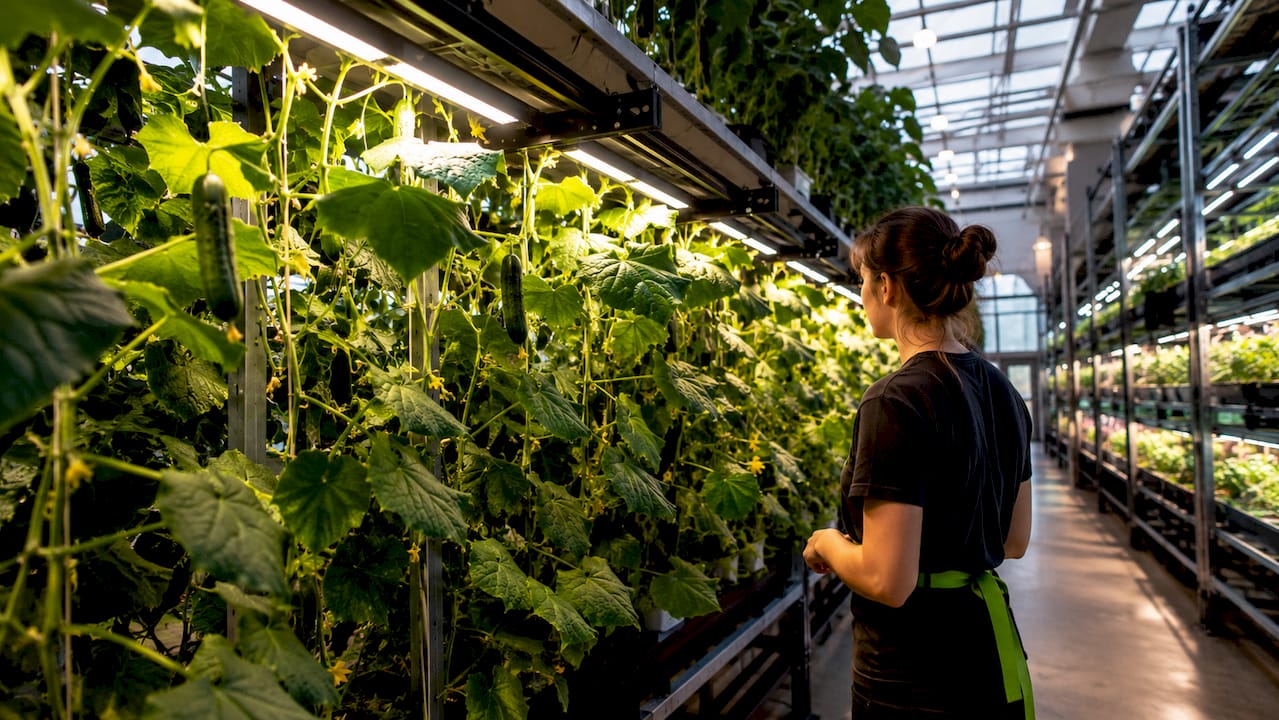
Interlighting solves this by placing LED bars or strip fixtures at mid-canopy height, between plant rows, or at multiple vertical positions within the foliage. The lights deliver photons directly to leaves that are still capable of increasing photosynthesis but are receiving far less light than they need. Upper leaves saturate quickly; adding more light from above past that saturation point is wasted energy. Redirecting that same energy into the canopy interior is where the efficiency gain comes from.
LED technology makes this practical in a way that older HPS or fluorescent fixtures never could. LEDs run cool enough to sit inches from foliage without burning leaves, and their slim form factor fits between plant rows without blocking airflow. The result is more uniform light distribution across the entire plant, improved biomass, and balanced vegetative and fruit development.
Pro Tip: If you notice yellowing or stunted growth on lower leaves while the top of your plant looks healthy, light deficiency in the lower canopy is the most likely cause. That is the exact problem interlighting is designed to fix.
The evidence for interlighting benefits is not theoretical. Controlled greenhouse trials across tomatoes, cucumbers, and cannabis show consistent, measurable gains in yield, fruit quality, and crop uniformity.
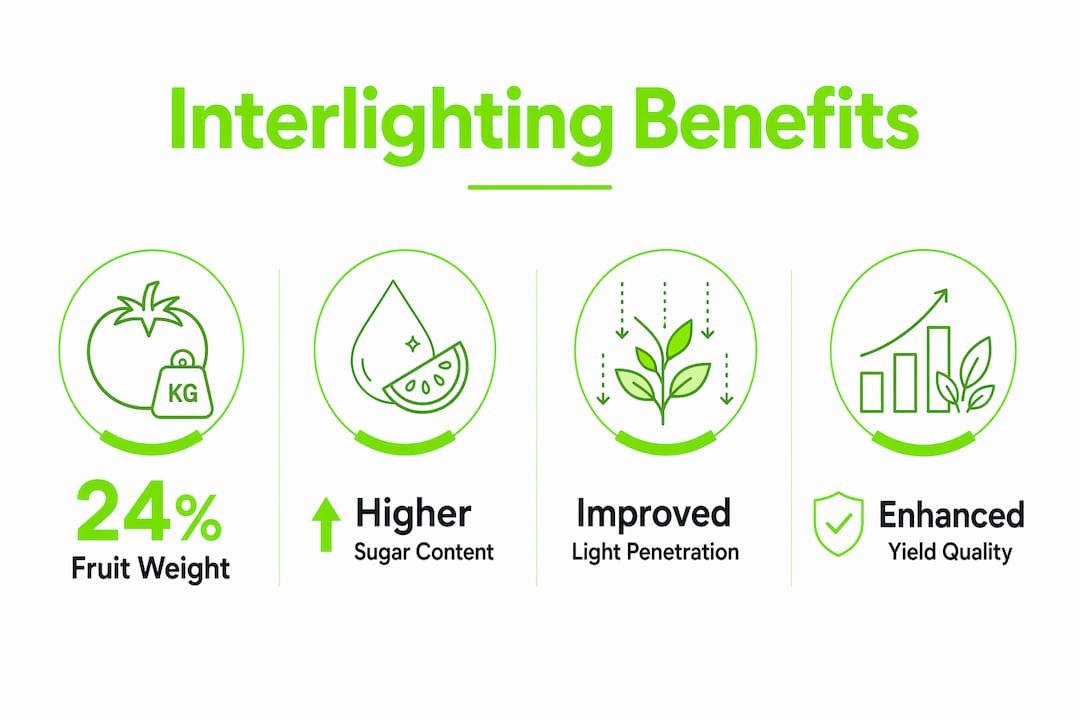
In tomato trials, inter-canopy LEDs increased fruit weight by 22.62% to 24.02% during early overwinter periods and by 48.2% to 72.88% in later growth stages depending on the spectral strategy used. Those are not marginal improvements. A 72% increase in fruit weight from a lighting adjustment represents a fundamental shift in what a given growing space can produce.
Cucumber and tomato yields combined showed 20% to 24% yield increases at higher light intensities, with interlighting partially replacing toplighting at better energy efficiency. This matters for indoor growers managing electricity costs. Cannabis research adds another dimension: interlighting increased yields by roughly 30%, cannabinoid content by 24%, and terpene production by 12.5% while standardizing quality across the crop. Standardization is often overlooked, but for any grower selling or sharing produce, consistent quality across every plant is as valuable as total yield.
“Interlighting is beneficial not only in winter but also in late spring and rainy seasons to reduce variability and stabilize production cycles.” — Hortidaily, Japanese cucumber production research
Fruit quality improvements extend beyond weight. Tomatoes grown with interlighting show higher sugar content, improved lycopene levels, and better vitamin C concentrations. These changes happen because the lower and middle leaves, now receiving adequate light, contribute meaningfully to the plant’s overall photosynthetic output and carbohydrate production.
| Crop | Yield improvement | Quality benefit |
|---|---|---|
| Tomato (early overwinter) | 22–24% fruit weight increase | Higher sugar and lycopene content |
| Tomato (late season) | 48–73% fruit weight increase | Improved vitamin C levels |
| Cucumber | 20–24% yield increase | More uniform fruit development |
| Cannabis | ~30% yield increase | 24% higher cannabinoids, 12.5% more terpenes |
The distinction between interlighting techniques and standard toplighting goes beyond fixture placement. Each method serves a different part of the plant and requires a different approach to spectrum, intensity, and timing.
Toplighting covers the entire canopy from above. It works well for seedlings, low-growing plants, and crops with open canopy structures. The limitation is that it cannot overcome the physics of light extinction in dense foliage.
Intercanopy lighting places fixtures at mid-canopy height, typically between plant rows at a height that targets the middle third of the plant. This is the most common form of interlighting and the starting point for most growers.
Intracanopy lighting goes further, positioning fixtures at multiple vertical levels within the canopy itself. This approach suits very tall high-wire crops and delivers the most uniform light distribution but requires more planning and hardware.
Subcanopy lighting targets the lowest leaves and the root zone area. Research on cannabis specifically found that subcanopy supplemental light enhances and standardizes yields by activating leaves that would otherwise contribute nothing to the plant’s photosynthetic budget.
Spectrum choice within each technique also matters significantly. Stage-specific red and blue mixes outperform uniform whole-canopy settings. A red-dominant spectrum early in the growth cycle supports vegetative development and fruit set. Shifting toward more blue later in the cycle improves fruit density and secondary metabolite production. Understanding LED grow light spectrums is the foundation for getting spectral strategy right.
| Technique | Best for | Spectrum focus |
|---|---|---|
| Toplighting | Low-growing or open canopy crops | Full spectrum or red-heavy |
| Intercanopy | Mid-height dense crops, tomatoes, cucumbers | Red/blue mix, stage-adjusted |
| Intracanopy | High-wire crops over 1.5 meters | Multi-level, stage-specific |
| Subcanopy | Cannabis, root-zone activation | Blue-dominant for quality |
Setting up an interlighting system does not require a commercial greenhouse. Home growers can apply the same principles at smaller scale with the right fixtures and a clear plan.
Choose the right fixture type. Linear LED bars are the standard choice for interlighting because their slim profile fits between plant rows without blocking light or airflow. The Thrive Agritech Infinity XE Linear LED Light Bar is a purpose-built example of this fixture category. Full-spectrum panels like the IONBOARD S22 work well for smaller setups where a single fixture covers both mid-canopy and lower zones.
Position fixtures at the right height. Place interlighting bars at roughly one-third to two-thirds of the total plant height. For a tomato plant at 150 cm, that means fixtures at 50 to 100 cm from the base. Adjust based on where you observe the most leaf shading.
Set intensity and photoperiod carefully. A practical starting point is around 50 to 55 µmol/m²/s from interlighting fixtures, combined with toplighting at roughly 200 µmol/m²/s. One Japanese cucumber trial used approximately 212 µmol/m²/s toplighting plus 55 µmol/m²/s interlighting to maintain a daily light integral of 30 to 35 mol/m²/d year-round. Photoperiods up to 18 hours are used in commercial settings, but most home growers see strong results at 16 hours.
Integrate with existing light sources. Interlighting works alongside natural light and toplighting, not instead of them. On bright days, reduce interlighting intensity to avoid over-saturating the mid-canopy. On cloudy days or in winter, increase it to compensate.
Monitor and adjust by growth stage. Switch spectral ratios as the plant moves from vegetative to fruiting stages. The LED grow lights blog at Ledgrowlightsdepot covers stage-specific lighting strategies in practical detail.
Pro Tip: Start with one interlighting bar per two plant rows and observe leaf color and growth rate in the mid-canopy over two weeks before adding more fixtures. Gradual scaling prevents over-investment and gives you real data from your specific growing environment.
Interlighting delivers measurable yield and quality gains by targeting the shaded canopy zones that toplighting physically cannot reach, making it the most efficient use of supplemental light energy in dense indoor crops.
| Point | Details |
|---|---|
| Core definition | Interlighting places LED fixtures within the canopy to light shaded middle and lower leaves. |
| Yield impact | Trials show 20% to 73% fruit weight increases depending on crop and spectral strategy. |
| Spectrum strategy | Stage-specific red and blue mixes outperform uniform settings across the full growth cycle. |
| Fixture choice | Linear LED bars are the standard tool; slim profile and low heat make them safe for close placement. |
| Setup starting point | Begin at 50 µmol/m²/s interlighting intensity and 16-hour photoperiods, then adjust by observation. |
Most growers spend years optimizing their toplighting setup, chasing the perfect fixture wattage and hanging height, without ever questioning whether overhead light can physically reach the leaves that need it most. I made that mistake for longer than I care to admit.
The shift for me came when I started looking at where plant growth was actually happening versus where I was directing light. The upper canopy was getting everything. The middle and lower leaves were getting almost nothing. Adding a second overhead fixture made the top leaves even more saturated and did almost nothing for yield. Dropping linear bars into the canopy at mid-height changed the results immediately.
What I find most underappreciated about interlighting is the quality argument, not just the yield argument. The cannabinoid and terpene data from cannabis research, and the sugar and lycopene improvements in tomatoes, point to something deeper: plants that photosynthesize more efficiently across their entire structure produce better chemistry, not just more weight. That is a meaningful distinction for any grower who cares about what they are actually growing, not just how much of it.
My honest advice is to start small. One or two linear bars in your existing setup will tell you more than any research paper. The results in your specific environment, with your specific plants, are the only data that matter for your next decision. Do not wait for a perfect system before you start experimenting.
— Scott
Getting interlighting right starts with fixtures built for the job. Ledgrowlightsdepot carries a full range of LED grow lights suited for intercanopy applications, from slim linear bars that fit between plant rows to full-spectrum panels for smaller setups. The ThinkGrow LED Model I and the NextLight 150h are two fixtures that home growers and commercial cultivators consistently rely on for supplemental and interlighting use. With over 5,800 verified reviews and a 4.8 out of 5 satisfaction rating, Ledgrowlightsdepot gives you access to professional-grade equipment and the expert guidance to use it well. Browse the full LED grow lights selection to find the right fit for your canopy.
Interlighting is the practice of placing LED grow lights inside a plant canopy rather than above it, so that shaded middle and lower leaves receive direct light. This increases the plant’s total photosynthetic output and improves both yield and quality.
Toplighting delivers light from above and saturates upper leaves while lower leaves stay shaded. Interlighting targets the mid and lower canopy directly, improving light use efficiency across the whole plant rather than concentrating it at the top.
Dense, tall, or vining crops benefit most, including indeterminate tomatoes, cucumbers, and cannabis. These plants develop thick canopies where light extinction is severe and lower leaves receive a fraction of the photons they need.
A starting point of around 50 to 55 µmol/m²/s from interlighting fixtures, combined with toplighting at roughly 200 µmol/m²/s, maintains a productive daily light integral. Adjust based on your crop’s growth stage and the natural light available in your space.
Home growers can apply interlighting effectively with one or two linear LED bars positioned at mid-canopy height. The same principles that drive 20% to 73% yield increases in commercial trials apply at any scale, as long as fixture placement and light intensity are managed correctly.
0 of 3 items selected


Leave a comment