
Free Shipping in the USA on nearly all items!
Limited phone hours during the Holidays! Call us: 888-611-9305
Free Shipping in the USA on nearly ALL items! Limited phone hours during the Holidays!

LED efficiency measures how effectively a grow light converts electricity into usable photons for plant photosynthesis, making it the single most important specification home growers should evaluate before buying any fixture. The standard industry term for this is photon efficacy, expressed in micromoles per joule (µmol/J). Understanding why LED efficiency matters in home grows goes beyond saving money on your electric bill. It determines how much light your plants actually receive, how much heat your tent accumulates, and whether your setup delivers the yields you expect. Brands like Horticulture Lighting Group and NextLight have built their reputations on pushing photon efficacy higher, and the difference between a 1.8 µmol/J fixture and a 2.7 µmol/J fixture is not marginal. It reshapes your entire grow.
Photon efficacy, measured in µmol/J, tells you how many usable light photons a fixture produces for every joule of electricity consumed. This is the number that actually predicts performance, not the wattage printed on the box. A 600W fixture rated at 1.6 µmol/J delivers far less usable light than a 400W fixture rated at 2.7 µmol/J, while drawing more power and generating more heat.
Wattage alone does not predict growth. Poor canopy coverage and uneven distribution can persist even with high-wattage fixtures, leaving some plants light-starved while others receive excess intensity. This is why published PPFD maps matter as much as efficacy ratings.
PPFD (Photosynthetic Photon Flux Density) measures the density of usable light hitting your canopy at a specific point, expressed in µmol/m²/s. PPFD and efficacy measure different things: PPFD tells you how much light lands on your plants, while efficacy tells you how efficiently electricity was converted to produce that light. You need both numbers to evaluate a fixture properly.
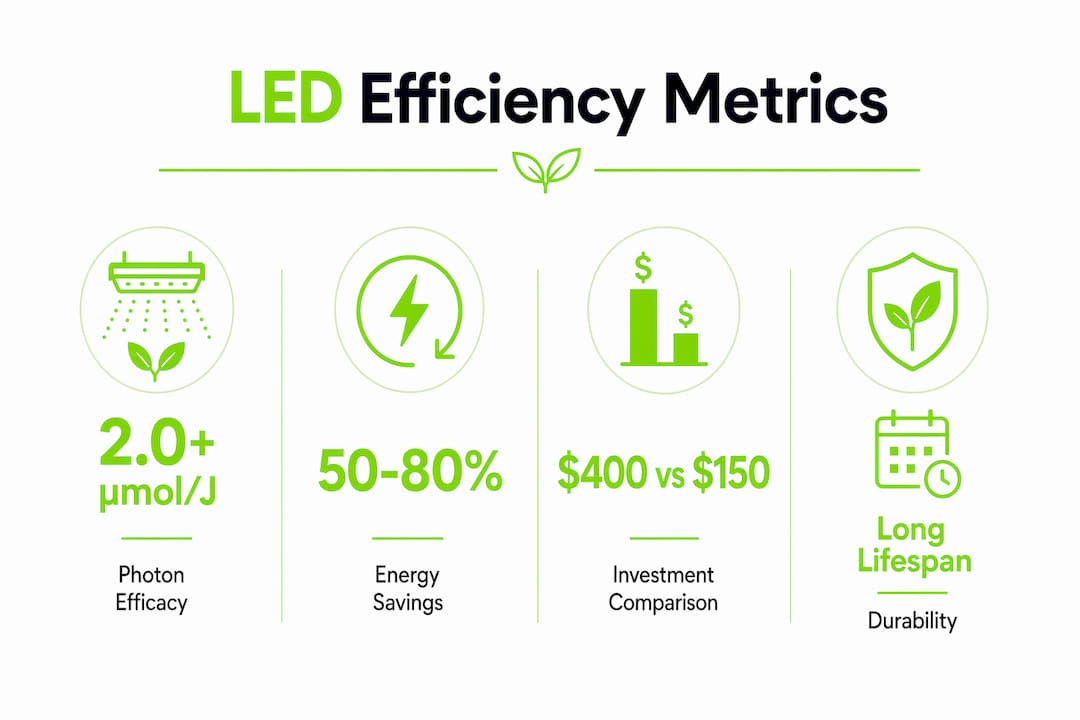
Practical benchmarks give you a clear filter. Efficiency ratings should exceed 2.0 µmol/J for solid performance, with premium LEDs reaching 2.7 to 3.0+ µmol/J at the top of the market. For wattage per square foot, herbs and leafy greens need 20 to 30 watts, while flowering plants demand 30 to 50 watts per square foot.
Pro Tip: When a manufacturer lists “equivalent wattage” rather than actual draw wattage, that number is marketing. Always find the actual power consumption in watts and divide it into the listed µmol/s output to calculate real efficacy.
The financial case for high-efficiency LEDs is direct and measurable. Premium LEDs consume 50 to 80% less electricity than HPS or fluorescent systems while matching or exceeding their harvests. For a home grower running a 4x4 tent, that translates to $100 to $150 in annual electricity savings compared to legacy lighting. That figure compounds over time.
Here is how the financial benefits stack up across a typical home grow:
The math is straightforward. A grower who spends $400 on a high-efficacy LED instead of $150 on a budget HPS fixture recovers that $250 difference in under two years through electricity savings alone, before accounting for cooling and bulb replacement costs.
Efficient LEDs improve plant outcomes through two mechanisms working together: better light quality and lower heat output. Less heat allows lights to hang closer to the canopy, increasing light intensity and improving penetration into the lower canopy where buds develop. This is a structural advantage that inefficient fixtures simply cannot replicate without burning plants.
The light quality benefits are equally significant:
One critical point most growers miss: upgrading to a more efficient, higher-intensity LED requires recalibrating your environment. Higher light intensity increases transpiration rates, which means your vapor pressure deficit (VPD) targets need to shift upward. Ignoring this after an upgrade leads to leaf crisping and stalled growth despite having excellent light available.
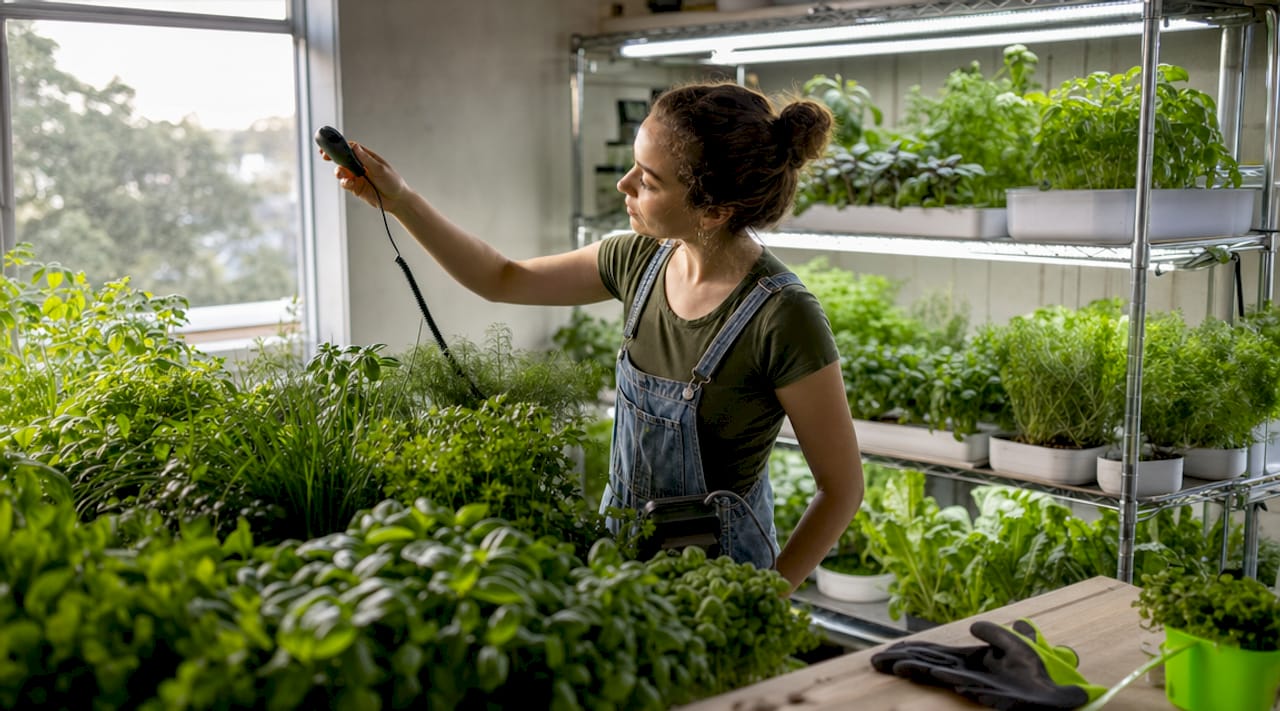
Pro Tip: After installing a new high-efficacy LED, raise your humidity by 5 to 10% and monitor leaf temperature with an infrared thermometer for the first week. Plants signal VPD stress before you see it in growth metrics.
You can explore how spectrum choices affect growth in detail to match your fixture’s output to each growth stage.
Selecting the right fixture starts with verifying the numbers manufacturers publish, not the marketing claims. Use this comparison to understand what to look for across fixture categories:
| Specification | What to look for | Red flag |
|---|---|---|
| Photon efficacy (µmol/J) | 2.0+ for solid performance; 2.7+ for top tier | No efficacy rating listed |
| Actual draw wattage | Matches your space needs (20 to 50W/sq ft) | Only “equivalent wattage” listed |
| PPFD map | Published by manufacturer for your target height | No PPFD data available |
| Spectrum | Full spectrum with red/blue emphasis; adjustable preferred | Single-band or unlisted spectrum |
| Lifespan | 50,000+ hours rated | Under 30,000 hours or unspecified |
Beyond the spec sheet, the setup decisions you make after buying a fixture determine how much of its efficiency potential you actually capture:
For growers starting seeds, the lighting requirements differ significantly from mature plants. The seed germination lighting guide from Ledgrowlightsdepot covers the specific intensity and spectrum needs for early-stage growing.
LED efficiency (photon efficacy in µmol/J) is the defining metric for home grow success because it determines usable light output, heat generation, operating cost, and plant yield quality simultaneously.
| Point | Details |
|---|---|
| Photon efficacy is the key metric | Look for 2.0+ µmol/J minimum; top fixtures reach 2.7 to 3.0+ µmol/J. |
| Energy savings are substantial | Efficient LEDs cut electricity use by 50 to 80%, saving $100 to $150 annually in a 4x4 tent. |
| Lower heat improves plant outcomes | Less heat allows closer placement, better canopy penetration, and reduced leaf stress. |
| Long lifespan reduces total cost | Quality LEDs last over 50,000 hours, eliminating frequent bulb replacement expenses. |
| VPD recalibration is required | Upgrading to efficient LEDs increases transpiration; humidity targets must be adjusted accordingly. |
The most common mistake I see home growers make is buying the highest-wattage fixture they can afford and calling it done. Wattage is a power draw number. It tells you what your electric meter will register, not what your plants will receive. I have watched growers run 1,000W HPS setups and pull mediocre harvests while a neighbor with a 400W high-efficacy LED in the same tent size consistently outperforms them.
The shift in thinking that changes everything is treating your grow light as an energy conversion device, not a light source. You are paying for photons in the PAR range. Everything else, heat, infrared radiation, wasted blue or green output, is money leaving your pocket without benefiting your plants. Once you start evaluating fixtures through that lens, the µmol/J number stops being a technical detail and becomes the only number that matters.
I also want to push back on the idea that efficient LEDs are a “set it and forget it” upgrade. The growers who get the most out of high-efficacy fixtures are the ones who treat the upgrade as a system change, not a bulb swap. They adjust their VPD, reconsider their nutrient schedule, and often discover their plants can handle more intensity than they previously thought. The fixture unlocks potential that your environment then has to support.
The trend toward sensor-driven lighting control is the next frontier for home growers. Fixtures that adjust output based on real-time temperature, humidity, and DLI (daily light integral) readings are already available at the commercial level. As those systems reach home grower price points, efficiency will compound further. Getting comfortable with efficacy metrics now puts you ahead of that curve.
— Scott
Ledgrowlightsdepot carries a curated selection of high-efficacy LED grow lights verified for real-world performance, not just spec-sheet claims. The NextLight 150h is a standout option for home growers running 2x4 to 4x4 spaces, delivering top-tier photon efficacy with a low heat profile that keeps your tent environment stable. For growers who want to compare options across wattage ranges and canopy sizes, the full LED grow lights catalog includes detailed PPFD maps and efficacy ratings for every fixture. With a 4.8 out of 5 rating from over 5,800 verified customers, Ledgrowlightsdepot backs every product with expert support and warranty coverage so you can invest with confidence.
µmol/J (micromoles per joule) measures photon efficacy: how many usable light photons a fixture produces per joule of electricity consumed. Higher numbers mean more light for your plants per dollar of electricity spent.
A high-efficacy LED grow light can cut electricity consumption by 50 to 80% compared to HPS or fluorescent systems. For a standard 4x4 home grow tent, that typically translates to $100 to $150 in annual savings.
No. Wattage measures power draw, not light quality or plant-usable output. A lower-wattage fixture with a high µmol/J efficacy rating will outperform a high-wattage fixture with poor efficacy in both yield and energy cost.
Efficient LEDs deliver higher light intensity, which increases plant transpiration rates. Without raising humidity to match the new VPD target, plants experience stress that limits growth even when light levels are optimal.
Quality LED grow lights are rated for over 50,000 hours of operation. That lifespan significantly reduces replacement frequency and long-term maintenance costs compared to HPS or fluorescent alternatives.
0 of 3 items selected

Leave a comment