
Free Shipping in the USA on nearly all items!
Limited phone hours during the Holidays! Call us: 888-611-9305
Free Shipping in the USA on nearly ALL items! Limited phone hours during the Holidays!

Canopy light distribution is defined as the evenness and quality of light spread across a plant’s entire canopy, determining how effectively photons drive photosynthesis at every growth layer. Most growers focus on raw wattage or LED chip efficiency, but uneven distribution creates simultaneous energy waste at the top and light starvation at the bottom. Plants absorb up to 90% of red and blue light at the canopy top, leaving lower leaves severely underpowered. Understanding why canopy light distribution matters is the difference between a crop that performs and one that merely survives. LED Grow Lights Depot has built its entire product philosophy around solving this exact problem.
Uneven light distribution creates two problems at once. Canopy tops receive excessive Photosynthetic Photon Flux Density (PPFD), triggering photoinhibition, a state where plants are overwhelmed by light and actually shut down photosynthetic activity. Meanwhile, lower leaves receive too little light to sustain meaningful growth.
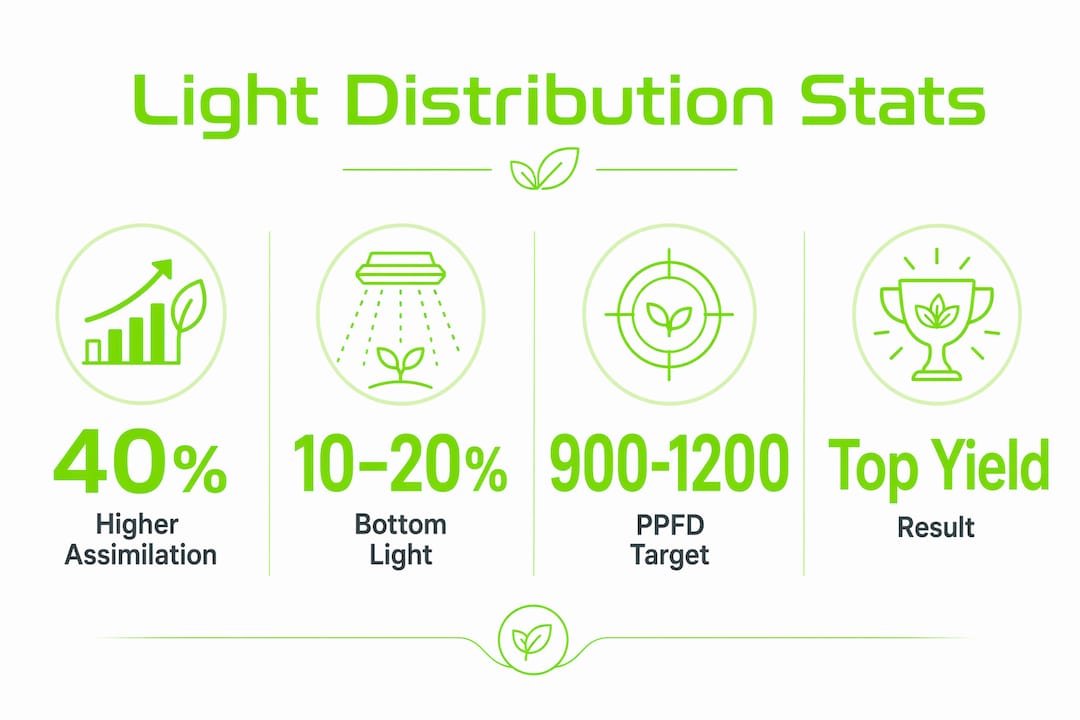
The bottom third of tall plants receives only 10–20% of top light intensity under standard overhead setups. That gap means the majority of your plant’s leaf area contributes almost nothing to yield. Leaf nitrogen allocation follows light availability, so chronically shaded leaves become metabolically inactive and eventually die off.

Uniform PPFD across the canopy allows every leaf layer to contribute to photosynthesis. This matters most during the flowering phase, when dense canopy growth creates the most severe self-shading. A grower who addresses distribution rather than just intensity will consistently outperform one who simply adds more power.
The consequences of poor light distribution show up in three measurable ways: reduced total yield, uneven bud development, and wasted electricity.
“Failing to optimize canopy light distribution wastes energy through photoinhibition in high-PPFD zones and suppresses photosynthesis in low-light areas, reducing potential yield. Plants absorb up to 90% of red and blue light at the canopy top, while the lower third often receives only 10–20% of that intensity.”
The practical implication is clear. A fixture that delivers high average PPFD but poor uniformity will underperform a lower-wattage fixture with a well-designed optical footprint. Average numbers hide the damage done by peaks and troughs.
Diffuse light reaches leaves from multiple angles rather than a single overhead point. This physical difference has a dramatic effect on photosynthetic output.
Research shows the photosynthetic assimilation rate (Amax) is 40% higher under diffuse light compared to direct light. That is not a marginal gain. It means a well-designed diffuse lighting setup can outperform a high-intensity direct setup even at lower total power input.
The acclimation rate under diffuse light is also more than twice that under direct light, measured at 1.8 μmol m⁻² s⁻¹ per mol photon m⁻² d⁻¹ versus 0.8 under direct light. Faster acclimation means plants adjust their leaf physiology more quickly to changing light conditions, which matters during transitions between vegetative and flowering phases.
Multi-angle light also reduces self-shading in dense canopies. When light arrives from multiple directions, interior leaves that would otherwise sit in shadow receive usable photons. The shift to large-area emission lighting, using wider emitting surfaces and overlapping footprints, is the most effective way to replicate diffuse light conditions indoors.
Statistic: Amax under diffuse radiation is 40% higher than under direct light, and acclimation rates are more than double. This means diffuse lighting is not just gentler. It is biologically more productive.
Pro Tip: If your grow space uses a single overhead fixture per zone, try adding a supplemental side-mounted bar light at mid-canopy height. Even modest side lighting significantly reduces the shadow zones that overhead-only setups create.
Most lighting errors fall into two categories: choosing the wrong fixture and installing the right fixture incorrectly.
Pro Tip: Before purchasing a new fixture, request the photometric data file (IES file) from the manufacturer. Plot the footprint against your bed dimensions. If the footprint does not match your bed shape, the fixture will waste photons regardless of its rated efficiency.
Practical optimization starts with measurement, not guesswork. A PPFD meter and a systematic grow room light mapping process reveal exactly where your canopy receives too much or too little light before you invest in new equipment.
| Growth stage | Target PPFD range (μmol m⁻² s⁻¹) | Key distribution priority |
|---|---|---|
| Seedling | 100–300 | Uniform, low-intensity coverage across all seedlings |
| Vegetative | 400–600 | Even spread to support balanced branching |
| Early flower | 600–900 | Consistent top-to-bottom penetration |
| Peak flower | 900–1,200 | Maximum uniformity to prevent uneven bud development |
Once you know your current PPFD map, apply these steps in order:
For growers working in confined spaces, the guide on micro grow tent lighting covers fixture selection for irregular geometries where distribution errors are most costly.
Canopy light distribution determines yield more than raw light intensity, because uneven PPFD wastes energy at the top while starving growth at the bottom.
| Point | Details |
|---|---|
| Distribution beats intensity | A fixture with a flat PPFD footprint outperforms a higher-wattage fixture with hotspots. |
| Diffuse light is more productive | Amax is 40% higher under diffuse light, making multi-angle setups biologically superior. |
| Chip efficiency is not enough | Optical footprint design must be addressed at the module stage, not fixed by adding more fixtures. |
| Under-canopy lighting fills the gap | Supplemental lower-canopy fixtures target the 10–20% light zone that overhead setups cannot reach. |
| Measure before you change | PPFD mapping reveals distribution problems that wattage specs and manufacturer claims never show. |
Most growers I talk to obsess over PPFD averages. They want to know the peak number at canopy center, and they use that figure to compare fixtures. That single-point measurement is almost meaningless without a uniformity ratio to go with it.
The growers who consistently hit top yields are not the ones running the highest wattage. They are the ones who treat their grow room as an optical system. They think about beam angles, footprint overlap, and canopy layer access the same way an engineer thinks about load distribution. The light has to reach every productive leaf, not just the ones at the top.
The research on diffuse light acclimation changed how I think about fixture placement entirely. A 40% higher Amax under diffuse conditions means that a well-placed multi-bar array at moderate intensity can outperform a single high-power fixture at maximum output. That is a counterintuitive result that most product spec sheets will never tell you.
The other shift I have seen in 2026 is growers moving away from the idea that more power solves distribution problems. The inverse square law does not care how efficient your chips are. If you are relying on a single overhead point source, you are fighting physics. The solution is geometry, not wattage.
— Scott
Growers who take distribution seriously need fixtures designed with optical footprint quality as a first-order specification, not an afterthought.

LED Grow Lights Depot carries fixtures engineered for exactly this purpose. The NextLight 150h delivers precision optics designed to produce a flat, uniform PPFD footprint across rectangular growing beds, reducing hotspots without sacrificing total output. For growers building multi-angle setups, the ION 720W combines high output with an optical design built for canopy penetration. Ledgrowlightsdepot has earned a 4.8 out of 5 rating from more than 5,800 growers by focusing on results, not just specifications. Browse the full range at LED Grow Lights Depot to find the right fixture for your canopy layout.
Canopy light distribution refers to how evenly PPFD (Photosynthetic Photon Flux Density) is spread across all layers of a plant’s canopy. Uniform distribution ensures every leaf zone contributes to photosynthesis rather than just the top layer.
The lower third of tall plants typically receives only 10–20% of the light intensity that the canopy top receives. This light deficit limits carbon fixation in lower zones, producing smaller, less developed buds.
Adding more fixtures of the same type raises total intensity but does not correct uneven distribution. The inverse square law limits overhead-only lighting, and the fix requires better optical design or multi-angle placement, not more power.
Peak flowering typically requires 900–1,200 μmol m⁻² s⁻¹ measured at canopy level. Uniformity across that range matters as much as the peak number, since uneven PPFD produces uneven bud development.
Diffuse light reaches leaves from multiple angles, reducing self-shading and raising the photosynthetic assimilation rate. Research shows Amax is 40% higher under diffuse light than under direct light, making multi-angle lighting setups more productive per photon delivered.
{"one"=>"Select 2 or 3 items to compare", "other"=>"{{ count }} of 3 items selected"}


Leave a comment