
Free Shipping in the USA on nearly all items!
Limited phone hours during the Holidays! Call us: 888-611-9305
Free Shipping in the USA on nearly ALL items! Limited phone hours during the Holidays!

Full-spectrum LED grow lights are the single best lighting choice for growing herbs indoors in an urban apartment. They deliver the exact wavelengths plants need for photosynthesis, run cool enough to place close to your herbs, and look good in a living space. This urban indoor herb garden lighting guide covers everything you need: why LEDs beat other options, how to position and time your lights, what to spend, and how to match lighting to specific herbs. Get this right, and your basil, rosemary, and mint will grow dense, aromatic, and productive year-round.
Full-spectrum LED grow lights outperform fluorescent and HID options for one clear reason: they deliver the right light at the right cost without heating up your space. Modern full-spectrum white LEDs in the 3500K–5000K color temperature range provide both the blue wavelengths herbs need for leafy growth and the red wavelengths that drive flavor development. They do this while keeping the light looking natural in your home, not the harsh purple or pink glow that older grow lights produce.
Energy efficiency is a real advantage here. LEDs draw significantly less power than HID or fluorescent setups for the same light output. That matters when your herb garden runs 14–16 hours a day. Low heat output is the other major win: you can position LEDs 6–12 inches above your herb canopy without scorching leaves, which is impossible with HID lights.
Pro Tip: If you want to understand the full science behind why spectrum matters, the Ledgrowlightsdepot guide on full-spectrum grow light benefits breaks it down clearly without the jargon.
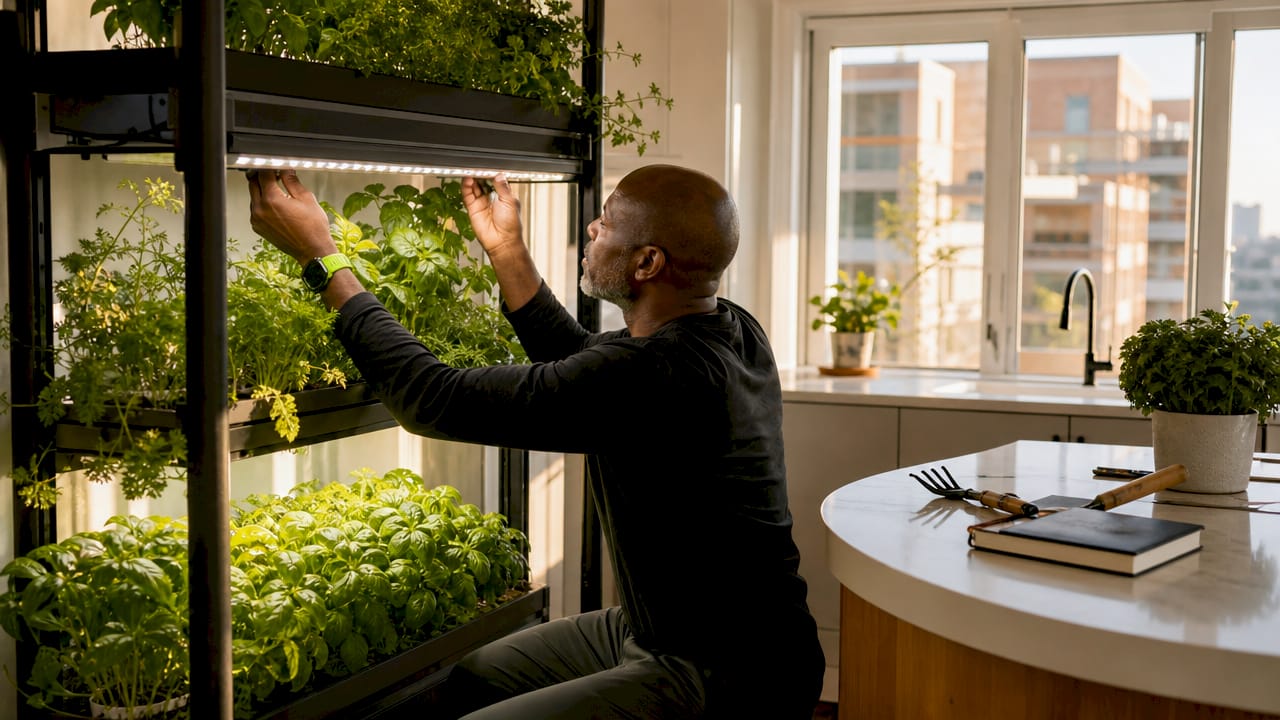
Light placement is the most underestimated variable in any indoor herb lighting setup. Distance from the light to the canopy matters as much as the wattage of the bulb itself. A powerful light mounted too high delivers weak, diffuse photons. A modest LED placed correctly at 6–12 inches above your herbs delivers dense, productive growth.
Here is a simple positioning process to follow:
Most herbs need 12–16 hours of light daily with 8–10 hours of darkness. That dark period is not wasted time. It drives the metabolic processes that produce the essential oils responsible for herb flavor and aroma.
Pro Tip: Buy a simple outlet timer for $10–$15 and set it once. Consistent light cycles matter more than any other single variable in herb productivity.
DLI stands for Daily Light Integral. It measures the total amount of usable light your plants receive in a full day, expressed in mol/m²/day. Most growers ignore it and wonder why their herbs look weak. DLI is the number that actually predicts growth quality.
Culinary herbs fall into three DLI categories: low-intensity herbs need 10–18 mol/m²/day, medium-intensity herbs need 14–22 mol/m²/day, and high-intensity herbs like basil and rosemary need 18–25 mol/m²/day. A standard window in a city apartment rarely delivers more than 5–8 mol/m²/day, even on a sunny day. That gap explains why windowsill herbs so often look pale and spindly.
You do not need to calculate DLI manually. Position your LED at the correct height, run it for 14–16 hours, and you will hit the target range for most culinary herbs. The math works out when placement and timing are both correct.
Automated timers maintaining 14–16 hours on and 8–10 hours off produce measurably better herb flavor and growth density than inconsistent manual switching. Consistency is the key word. Herbs that experience irregular light cycles grow slower and produce fewer aromatic oils.
A basic plug-in mechanical timer handles this perfectly. Smart plugs work too and let you adjust schedules from your phone. Set your lights to come on in the morning and go off in the evening to match a natural rhythm. Avoid running lights through the night. Herbs need that dark period to complete their growth cycle properly.
Increasing light intensity can reduce the hours needed, but this trade-off requires careful management. Pushing intensity too high without reducing hours causes light burn. For most apartment growers, the 14–16 hour standard at 6–12 inches is the safest and most productive approach.
Indoor herb garden grow light setups range from $25 clip-on LEDs to $80+ small panel systems. The right choice depends on how many pots you are growing and how much shelf space you have. Here is how the options break down:
| Setup type | Best for | Approximate cost | Coverage |
|---|---|---|---|
| Clip-on LED | 1–3 pots | $25–$40 | Single pot or small cluster |
| T5 LED tube | Shelf rows | $40–$70 | 2–4 ft shelf length |
| Small LED panel | Multi-pot setup | $60–$100+ | 2–4 sq ft canopy |
Simple setups with quality full-spectrum LEDs and proper placement consistently outperform expensive but poorly positioned grow panels. Spend your money on placement accuracy before you spend it on wattage.
Not every herb has the same light appetite. Matching your lighting setup to the specific herbs you grow prevents both underperformance and light stress.
High-light herbs (14–16 hours daily):
Moderate-light herbs (12–14 hours daily):
No true shade-loving indoor culinary herb exists. Every aromatic herb needs at least 6 hours of strong artificial light to produce flavor. Underestimating light is the most common mistake apartment growers make.
For small spaces, vertical shelving with LED strip lights on each shelf level is the most space-efficient approach. Rotate your pots a quarter turn each week so every side of the plant receives even light exposure. This prevents the one-sided lean that makes herbs look scraggly and grow unevenly.
Pro Tip: If you are growing both basil and mint on the same shelf, position the basil closer to the light source and the mint slightly further away. Both get what they need without you buying a second fixture.
The grow light market offers a lot of options, and most of the marketing focuses on wattage. Wattage is not the metric that matters most. PPFD (Photosynthetic Photon Flux Density) measures how many usable light particles actually reach your plant canopy per second. That number, combined with your light duration, determines your DLI.
Most indoor growers choose lights based on visible brightness rather than PPFD or DLI values. Visible brightness does not equal plant-usable light. A light that looks bright to your eyes may deliver poor PPFD at canopy level. Look for lights that publish their PPFD values at specific distances. That transparency signals a quality product.
For a practical starting point, check out the beginner guide to LED, CFL, and HID grow lights from Ledgrowlightsdepot. It cuts through the spec sheet confusion and tells you what actually matters for herb-scale growing.
Proper lighting for urban indoor herb gardens requires full-spectrum LEDs positioned 6–12 inches above the canopy, running 14–16 hours daily with consistent dark periods to drive flavor and yield.
| Point | Details |
|---|---|
| Use full-spectrum LEDs | 3500K–5000K white LEDs deliver the right wavelengths without disrupting home aesthetics. |
| Position lights correctly | Keep LEDs 6–12 inches above the canopy and adjust by 4 inches if plants bleach or stretch. |
| Run 14–16 hours daily | Consistent light cycles with 8–10 hours of darkness maximize herb flavor and density. |
| Match light to herb type | Basil and rosemary need 14–16 hours; mint and chives perform well at 12–14 hours. |
| Use a timer | Automated timers maintain consistent cycles better than manual switching every time. |
The biggest mistake I made early on was buying a light based on its wattage rating and mounting it too high because I was worried about burning my plants. The result was pale, leggy basil that tasted like nothing. Moving the light down to 8 inches above the canopy changed everything within two weeks.
The second lesson took longer to learn: timers are not optional. I ran my lights manually for the first month, turning them on when I woke up and off when I remembered. My herbs grew, but they never thrived. The moment I plugged in a basic timer and locked in a 15-hour cycle, the difference in leaf density and aroma was obvious within 10 days.
Full-spectrum white LEDs also changed how my apartment felt. The old purple grow light I started with made my kitchen look like a nightclub. Switching to a 4000K white LED panel meant the herb shelf looked like a design feature, not a science experiment. That matters when you live in a small space.
The one thing most guides skip: flavor is the real payoff. Herbs grown under properly timed, correctly positioned full-spectrum LEDs taste noticeably more intense than herbs grown in poor light. If you have ever bought a pot of supermarket basil and been disappointed by its blandness, inadequate light is almost certainly the reason.
— Scott
Getting the lighting right is the fastest way to go from struggling herbs to a productive, flavorful indoor garden. Ledgrowlightsdepot carries a full range of LED grow lights built specifically for home growers who want real results in small spaces.
The NextLight 150h is a strong choice for apartment herb setups: full-spectrum output, low heat, and a natural white light that looks good in any room. For shelf-based herb rows, the Toggled 2 ft. LED grow fixture delivers even, high-output coverage across multiple pots. Browse the full LED grow lights selection at Ledgrowlightsdepot to find the right fit for your space and herb lineup.
Most culinary herbs need 12–16 hours of light daily with 8–10 hours of darkness. High-light herbs like basil and rosemary perform best at the 14–16 hour end of that range.
Position LED grow lights 6–12 inches above the plant canopy. If leaves appear pale, raise the light by 4 inches. If stems stretch toward the light, lower it by 4 inches.
Full-spectrum white LEDs in the 3500K–5000K range provide the blue and red wavelengths herbs need while maintaining a natural look in your home.
A south-facing window can support some herb growth, but most city apartments receive far less than the 12–25 mol/m²/day DLI that culinary herbs need. A grow light fills that gap reliably year-round.
No. A quality clip-on LED starting around $25 handles 1–3 pots effectively. Proper placement and consistent timing matter more than spending more on a higher-wattage fixture.
0 of 3 items selected

Leave a comment