
Free Shipping in the USA on nearly all items!
Limited phone hours during the Holidays! Call us: 888-611-9305
Free Shipping in the USA on nearly ALL items! Limited phone hours during the Holidays!

Wholesale LED grow light procurement is the process of sourcing bulk high-performance horticultural lighting to reduce per-unit costs, standardize fixture specifications across grow rooms, and maximize crop yield at scale. Commercial cultivators and large-scale home growers who skip this process pay retail prices for fixtures that may not meet DLC Horticultural V4.0 standards, miss utility rebates worth thousands of dollars, and end up with mismatched PPFD coverage across their canopy. This guide covers supplier selection, technical specifications, lighting layout, rebate compliance, and order management so you can buy smarter and grow more.
The single most important factor in bulk LED grow lights procurement is factory-direct sourcing. Distributors add margin without adding value. Going direct to manufacturers or authorized wholesale channels gives you volume pricing, customization options, and direct access to technical support when something goes wrong.
When evaluating led grow light suppliers, prioritize these criteria:
Pro Tip: Request a photometric test report (IES file) for every fixture you are considering. Load it into AGi32 or Dialux to model actual PPFD distribution before placing a bulk order. This step alone prevents the most common and expensive procurement mistake: buying fixtures that look good on spec sheets but produce hot spots and dead zones in your actual grow space.
Buying bulk LED grow lights without understanding the core metrics is how commercial operations end up with expensive fixtures that underperform. The industry has moved past wattage comparisons. The metrics that actually predict crop performance are PPFD, efficacy in µmol/J, and spectral quality.
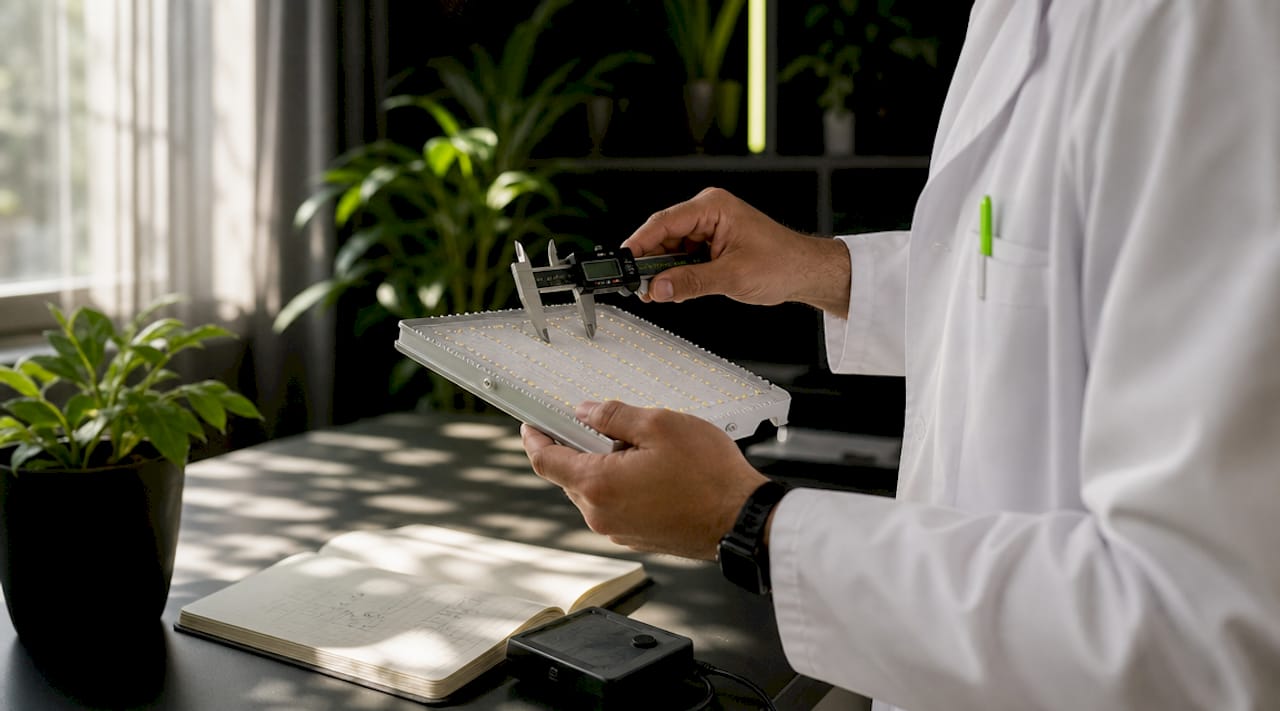
PPFD targets by crop and growth stage define how much photosynthetically active radiation reaches your canopy. Crop-specific PPFD targets range from 250 to 350 µmol/m²/s for leafy greens up to 1,000 µmol/m²/s for flowering cannabis. That is a fourfold difference, which means a fixture sized for lettuce will starve a cannabis flower room. Match fixtures to your specific crop and stage before you order a single unit.
Efficacy is the measure of photon output per watt of electricity consumed. Higher µmol/J means lower operating costs over the fixture’s lifespan. For commercial operations running lights 16 to 18 hours per day, a 10% improvement in efficacy translates directly to measurable reductions in monthly energy bills.
Diode and driver quality determine both efficacy and longevity. Samsung LM301H EVO diodes paired with Mean Well drivers represent the current standard for horticultural lighting efficiency and long-term reliability. The EVO flip-chip design improves heat dissipation over previous generations, which extends diode life and maintains lumen output over time. Avoid fixtures that do not disclose their diode source.
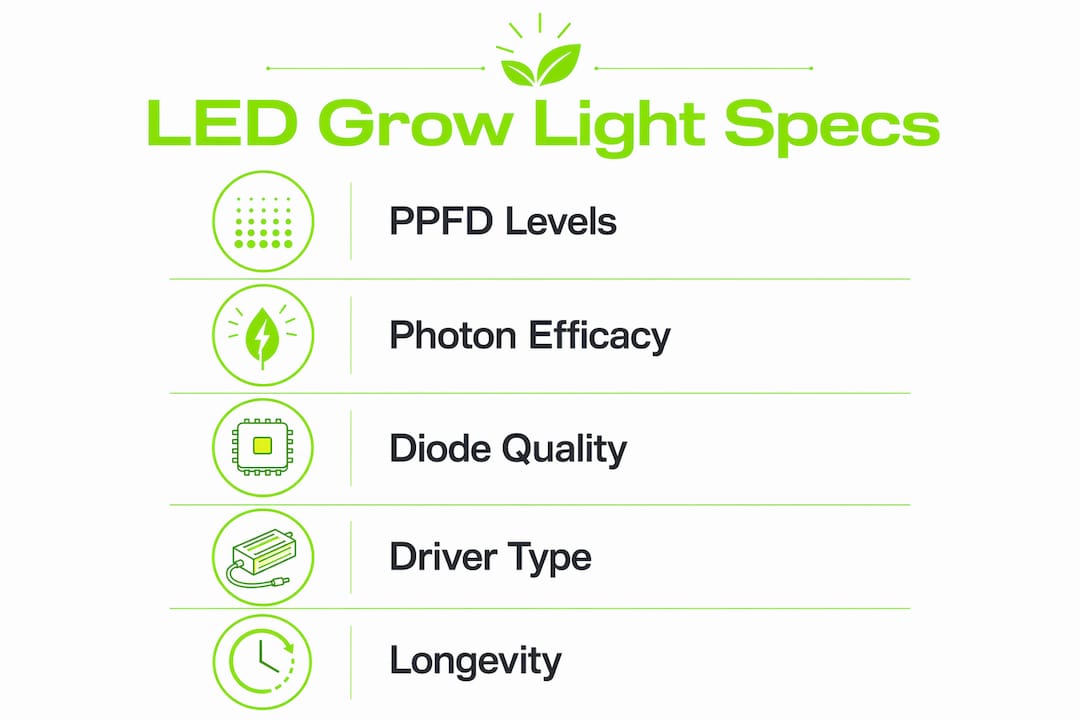
The table below summarizes the key specifications to request from any supplier during the procurement process.
| Specification | What to look for | Why it matters |
|---|---|---|
| PPFD at canopy | Match to crop stage target | Determines actual plant photon uptake |
| Efficacy (µmol/J) | 2.5+ for commercial grade | Drives energy cost over fixture lifespan |
| Diode source | Samsung LM301H EVO or equivalent | Predicts longevity and heat performance |
| Driver brand | Mean Well or equivalent | Reliability under continuous commercial use |
| IP rating | IP65 minimum for wet environments | Protects against humidity and spray |
| Dimming capability | 0-10V or PWM | Required for DLC compliance and energy codes |
Pro Tip: Prioritize PPFD maps and µmol/J efficacy over marketed wattage equivalents or lumen ratings. Lumens measure light visible to the human eye, not the photons plants absorb. A fixture advertising 1,000 lumen-equivalent output can still deliver poor canopy coverage if its spectral output is mismatched to the photosynthetic action spectrum.
Effective lighting layout planning starts with your Daily Light Integral target, not your fixture count. DLI is the total photon dose a plant receives over a 24-hour period, expressed in mol/m²/day. Cannabis in flower requires a DLI of 40 to 65 mol/m²/day. Lettuce and herbs perform well at 12 to 17 mol/m²/day. Tomatoes in production need 20 to 30 mol/m²/day. These numbers set your PPFD target once you fix your photoperiod.
Follow this process to calculate fixture quantity for a commercial space:
Fixture type selection also affects layout efficiency. Bar lights deliver superior airflow and uniformity compared to quantum boards in larger commercial setups. Heat rises and disperses more effectively between bar segments, which reduces the thermal load on your HVAC system. Quantum boards work well in smaller spaces where mounting height is limited, but at commercial scale, bar-style fixtures give you better canopy coverage and easier maintenance access.
For driver placement in large spaces, mount drivers outside the grow room where possible. This keeps heat out of the canopy zone, extends driver life, and simplifies electrical maintenance. Fixtures with remote driver capability are worth the premium at commercial scale. You can review compact LED grow light types to understand how form factor affects both layout and thermal management.
Utility rebates can offset 20 to 40% of fixture costs on large commercial installations, but only if your procurement process is built around compliance from the start. The DLC Horticultural V4.0 standard is the current threshold for rebate eligibility, and the 2025 to 2026 transition period is delisting a significant number of legacy fixtures. DLC Horticultural V4.0 listing is now the non-negotiable baseline for any commercial operation expecting rebate returns.
The most common procurement mistake in this area is verifying DLC status once during the design phase and never checking again. Utilities require the exact model ID from the DLC Qualified Products List at the time of rebate submission. If a fixture gets delisted between your purchase order and your rebate application, you lose the incentive entirely. That risk is real and growing as V4.0 enforcement tightens.
Key steps to protect your rebate eligibility:
Procurement teams that manage DLC qualification as a milestone checkpoint rather than a one-time verification consistently avoid the rebate shortfalls that catch other operations off guard.
Executing a large-scale wholesale purchase requires more than finding the right fixture. The order management process determines whether you receive the right product, on time, at the agreed price, with warranty coverage intact.
Volume pricing tiers can significantly reduce per-unit costs as order quantities increase. This means your negotiating leverage grows with your order size. Always request a tiered pricing schedule before committing to a quantity, and ask whether splitting a large order across two delivery windows still qualifies for the volume discount.
Practical steps for managing bulk procurement effectively:
Successful wholesale LED grow light procurement requires matching PPFD targets to your specific crop, verifying DLC qualification at every stage, and treating supplier relationships as long-term partnerships rather than one-time transactions.
| Point | Details |
|---|---|
| PPFD drives fixture selection | Match PPFD targets to crop and growth stage before calculating fixture quantity. |
| Diode and driver quality predict longevity | Samsung LM301H EVO diodes with Mean Well drivers set the current commercial standard. |
| DLC compliance protects rebate value | Verify exact QPL model IDs at purchase, delivery, and rebate submission stages. |
| Volume pricing requires negotiation | Request tiered pricing schedules and confirm bulk discounts apply to phased deliveries. |
| Bar lights outperform boards at scale | Bar-style fixtures deliver better uniformity and thermal management in commercial spaces. |
I have reviewed enough commercial grow buildouts to identify the single most consistent mistake: growers prioritize fixture price per watt over fixture performance per dollar of crop produced. Those are completely different calculations, and conflating them is expensive.
A fixture that costs 20% less per unit but delivers uneven PPFD coverage forces you to run higher intensity to compensate for dead zones. That increases energy costs, accelerates plant stress, and reduces yield quality. The math never works in favor of the cheaper fixture once you account for operating costs over a three to five year depreciation cycle.
The second pattern I see repeatedly is treating rebate compliance as an afterthought. Procurement teams finalize fixture selections, place orders, and then ask whether the models qualify for rebates. By that point, substitutions are expensive and delays are unavoidable. Building DLC verification into the specification phase costs nothing and protects significant capital.
My practical advice: start every procurement cycle with your PPFD targets and your utility’s rebate requirements. Let those two constraints drive your fixture shortlist. Then evaluate suppliers on customization capability, warranty terms, and logistics reliability. Price negotiation comes last, not first. Growers who follow this sequence consistently outperform those who lead with cost.
The emerging trend worth watching is integrated environmental controls. Fixtures with onboard sensors and smart dimming capabilities are becoming cost-competitive with standard commercial units. For operations planning a second or third buildout, specifying these now avoids a costly retrofit later. You can explore LED grow light spectrum guides to understand how spectral control ties into both yield optimization and energy management.
— Scott
Ledgrowlightsdepot carries a curated selection of commercial-grade fixtures built for growers who need proven performance at scale, not catalog filler.
The NextLight 150h is a standout option for commercial cultivators running high-PPFD environments. It delivers the diode quality, dimming capability, and build reliability that large-scale operations require, with the technical documentation you need for DLC rebate applications. Ledgrowlightsdepot’s team provides consultation on fixture layout, PPFD modeling, and bulk pricing for operations of any size. With a 4.8 out of 5 rating across more than 5,800 verified reviews, the product range and support structure are built for growers who cannot afford to get lighting wrong. Browse the full commercial product catalog to find fixtures matched to your crop, canopy size, and budget.
Minimum order quantities vary by supplier, but most wholesale channels start at 10 to 20 units. Suppliers like LEDxBRIGHT offer factory-direct pricing with volume discounts and respond to bulk inquiries within 24 hours.
Search the exact fixture model ID on the DLC Qualified Products List at designlights.org. Confirm the specific configuration matches your order, since DLC listings are model-specific and can be delisted during the 2025 to 2026 V4.0 transition period.
Flowering cannabis requires PPFD levels up to 1,000 µmol/m²/s at the canopy. Seedling and vegetative stages operate effectively at 300 to 600 µmol/m²/s, so fixtures with 0-10V dimming allow a single unit to serve multiple growth stages.
Bar lights outperform quantum boards in commercial settings because they allow better heat dissipation and deliver more uniform PPFD across wide canopy areas. Quantum boards are better suited to smaller spaces with limited mounting height.
Bulk pricing tiers can reduce per-unit costs meaningfully as order quantities increase. For example, moving from single-unit retail pricing to a 20-plus unit order can cut per-fixture cost by a significant margin, making the negotiation of tiered pricing schedules a standard step in any commercial procurement process.
0 of 3 items selected

Leave a comment