
Free Shipping in the USA on nearly all items!
Limited phone hours during the Holidays! Call us: 888-611-9305
Free Shipping in the USA on nearly ALL items! Limited phone hours during the Holidays!

Compact LED grow lights are defined as energy-efficient, small-footprint lighting fixtures that deliver targeted light spectrums to indoor plants within limited growing spaces. The industry term for this category spans several distinct form factors, including bar-style, panel, COB (chip-on-board), and strip lights, each engineered for different coverage needs and growth stages. Brands like Spider Farmer, Mars Hydro, and HLG have made these fixtures accessible to home growers and serious cultivators alike. This article breaks down every major type, explains how each performs in real growing conditions, and tells you exactly which format fits your setup.
LED grow lights vary significantly in form factor, and understanding those differences is the first step toward choosing the right fixture for your space. The four primary types are bar-style, panel-style, COB, and strip lights. Each has a distinct light distribution pattern, heat profile, and installation requirement.
Beyond form factor, spectrum type defines how a fixture performs across growth stages. Dual-band lights emit only red and blue wavelengths, which plants use most directly for photosynthesis. Full-spectrum LEDs replicate a broader solar range and support all growth stages with better environmental control and less heat than traditional grow lights. White-spectrum LEDs blend all visible wavelengths and are increasingly preferred by growers who want a single fixture from seed to harvest.
Pro Tip: If you are choosing between dual-band and full-spectrum for a single-fixture setup, full-spectrum wins every time. Dual-band fixtures force you to swap lights between growth stages, which disrupts your schedule and adds cost.
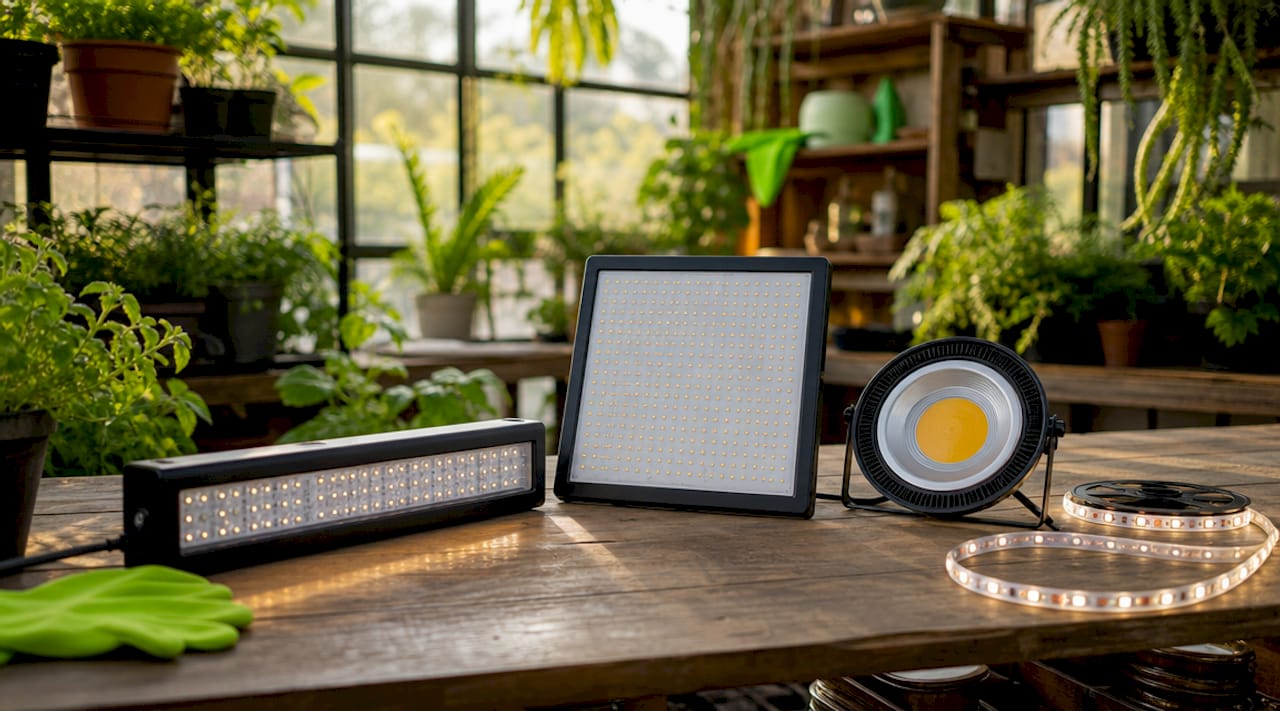
The form factor you choose directly shapes coverage area, light penetration, and heat management inside your grow space. These are not abstract specifications. They translate into real differences in plant health and yield.
| LED Type | Coverage Strength | Heat Output | Best Growth Stage |
|---|---|---|---|
| Bar-style | Wide, even canopy coverage | Low to moderate | Veg and flower |
| Panel | Defined square footprint | Moderate | All stages |
| COB | Deep canopy penetration | Moderate to high | Flower and fruiting |
| Strip light | Shallow, close-range coverage | Very low | Seedlings and clones |
Bar-style fixtures like the Spider Farmer SE7000 excel in grow tents because their distributed light bars minimize the intensity gradient between the center and edges of the canopy. Panel fixtures work well when your grow area matches the manufacturer’s stated coverage zone precisely. COB lights are the strongest performers for flowering plants that need photons pushed deep into dense foliage, but they require more careful distance management.
LED grow lights consume roughly half the power of comparable compact fluorescents for similar light output. A setup drawing 100W from an LED replaces a 200W compact fluorescent setup. That difference compounds over a full grow cycle, cutting electricity costs significantly for home growers running lights 16 to 18 hours per day.
Full-spectrum LEDs support all growth stages with better environmental control and less heat than HID or fluorescent alternatives. This matters most in small enclosed spaces where heat buildup directly stresses plants and forces growers to add ventilation equipment they may not have room for.
Pro Tip: Run your hand at canopy height after the light has been on for 30 minutes. If it feels uncomfortably warm on your skin, your plants are experiencing the same stress. Raise the fixture two inches and recheck.
No single LED type is universally best. The right choice depends on your space constraints, the plants you are growing, and the growth stage you are targeting most often.
LED grow lights produce more than twice the light per watt compared to fluorescents and can be positioned at greater distances from plants without losing effective intensity. This gives compact LED fixtures a meaningful advantage in low-ceiling spaces where fluorescent tubes would need to sit uncomfortably close to the canopy.
Getting the fixture type right is only half the job. How you use it determines whether your plants thrive or struggle.
Pro Tip: Keep a simple grow journal noting fixture height, daily light hours, and any visible plant stress. Two weeks of notes will tell you more about your specific setup than any manufacturer guide.
Choosing the right compact LED grow light type requires matching form factor, spectrum, and output to your specific space and growth stage rather than chasing a single “best” fixture.
| Point | Details |
|---|---|
| Form factor defines coverage | Bar-style lights cover wide canopies evenly; COBs penetrate deep into dense foliage. |
| Spectrum drives stage performance | Use blue-dominant or full-spectrum LEDs for seedlings; shift to red-rich output for flowering. |
| LED efficiency cuts operating costs | LEDs consume roughly half the power of comparable compact fluorescents for the same output. |
| Distance control prevents damage | Start fixtures higher than the minimum and lower gradually while monitoring for leaf bleaching. |
| Match fixture to space size | Manufacturer coverage ratings are optimistic; size down by 20 to 25 percent for consistent results. |
Scott here. My honest position is that most growers overthink fixture type and underthink fixture placement. I have tested bar-style lights from Spider Farmer, COB arrays from Citizen, and slim panel fixtures from Mars Hydro across setups ranging from a single 1x1 foot propagation box to a 4x8 foot tent. The pattern I keep seeing is that a correctly positioned mid-range fixture outperforms an expensive one hung at the wrong height.
The shift I recommend most often is moving away from dual-band purple lights toward white full-spectrum fixtures. The older red-blue combination works, but it makes it nearly impossible to spot early signs of nutrient deficiency, pest damage, or overwatering because everything looks purple under that light. White full-spectrum LEDs let you see your plants as they actually are, which makes you a faster, better diagnostician.
Bar-style fixtures have become my default recommendation for anyone growing in a tent under four feet wide. The even distribution simply removes a variable that panel lights introduce. For anything smaller than a 2x2 foot space, a quality LED strip light or a compact COB like the NextLight 150h gives you more control than a full panel that may overpower the space.
The one thing I would tell every new grower: buy a PAR meter or use a smartphone app like Photone before you finalize your hanging height. Manufacturer charts are starting points, not answers.
— Scott
Ledgrowlightsdepot carries a broad selection of compact LED grow lights spanning every form factor covered in this article, from LED strip lights for propagation shelves to high-output bar fixtures for flowering tents. Their proprietary proximity systems improve under-canopy light distribution and have delivered over 20% yield increases for home growers and commercial cultivators. With a 4.8 out of 5 customer satisfaction rating across more than 5,800 reviews, the team at Ledgrowlightsdepot backs every product with expert guidance tailored to your specific space and crop. Explore the full LED grow lights blog for setup guides, spectrum breakdowns, and model comparisons before you buy.
The four primary types are bar-style, panel, COB (chip-on-board), and strip lights. Each differs in coverage area, light penetration depth, and heat output, making them suited to different plant stages and space sizes.
LED strip lights or low-wattage panel fixtures with a blue-dominant spectrum between 5000 and 6500K work best for seedlings. Kansas State University Extension identifies this color temperature range as optimal for seed starting and early growth.
Start at the manufacturer’s maximum recommended height and lower gradually while watching for leaf bleaching or curl. Dynamic distance adjustment based on plant response is more reliable than any fixed-height rule.
Full-spectrum LEDs support all growth stages without fixture swaps and let you monitor plant health accurately under natural-looking light. For single-fixture setups, the added cost pays back in convenience and consistency across the full grow cycle.
LEDs consume roughly half the power of comparable compact fluorescents for the same light output and last two to four times longer. They also produce more light per watt and can be positioned farther from the canopy without losing effective intensity.
0 of 3 items selected

Leave a comment