
Free Shipping in the USA on nearly all items!
Limited phone hours during the Holidays! Call us: 888-611-9305
Free Shipping in the USA on nearly ALL items! Limited phone hours during the Holidays!

Green light is defined as the wavelength band between roughly 500–560 nm within Photosynthetically Active Radiation (PAR), and its role in canopy photosynthesis is to penetrate deeper into leaf tissue and sub-canopy layers than red or blue light can reach. This deeper penetration drives whole-plant photosynthesis in ways that top-canopy illumination alone cannot replicate. Research shows that incorporating green light can improve whole-canopy biomass by up to 15% compared to red-blue-only spectra. That number reflects a fundamental shift in how horticulturists should think about spectral design. McCree’s action spectrum, the foundational model for plant light use, underestimated green light’s contribution at the whole-canopy level because it measured single leaves, not layered foliage. Ledgrowlightsdepot builds full-spectrum LED systems specifically to address this gap, delivering balanced green wavelengths alongside red and blue for growers who want results at every layer of the plant.
Red and blue wavelengths absorb strongly at the leaf surface, which is why chlorophyll appears green to the human eye. Green light reflects and transmits through upper leaf layers rather than absorbing immediately. That behavior, often called the “green gap,” is exactly what makes green light so useful deeper in the canopy.
Upper canopy leaves intercept most red and blue photons before they reach lower foliage. Green photons scatter internally within leaf tissue and pass through to leaves below. This scattering effect means that shaded leaves in the lower canopy receive a meaningful dose of usable light that red and blue wavelengths simply cannot deliver at the same depth.
The practical result is improved CO2 assimilation across the whole plant. Studies on basil found that green wavelengths near 500 nm produced the highest CO2 assimilation rates, with optimal white-light compositions including 25% shorter wavelengths in the 430–527 nm range. That finding matters because basil is a dense, leafy crop where lower-canopy photosynthesis directly affects total yield.
Bell peppers show a similar pattern. Supplementing 12% green light in a red-blue greenhouse spectrum increased average fruit weight compared to red-blue-only lighting. The fruit weight gain traces directly back to improved photosynthetic output from leaves that would otherwise sit in spectral shadow.
Pro Tip: If your grow space uses a dense, multi-layer canopy, green light penetration matters more than in a single-tier setup. Prioritize full-spectrum fixtures over red-blue-only panels when your plant count per square foot is high.
Green light works best as part of a balanced spectrum, not as an isolated addition. The research points to roughly 12% green light supplementation within a red-dominant spectrum as a reliable starting point for fruiting crops. Going higher than that introduces a different problem.
Excessive green light triggers shade-avoidance signaling, causing stem elongation and loose plant architecture. Plants interpret high green light ratios as a signal that competitors are shading them, so they stretch upward rather than building dense, productive tissue. For indoor growers, that means taller plants with weaker stems and lower bud density.
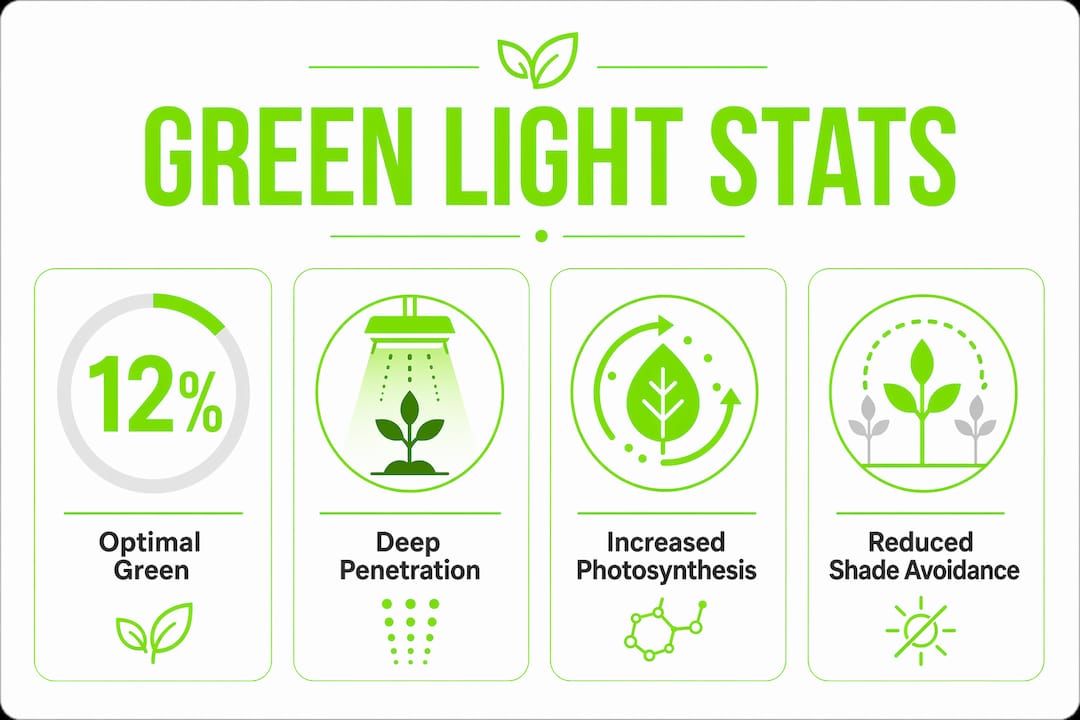
The right balance depends on three factors: plant species, growth stage, and canopy density. Seedlings and young plants in sparse canopies see less benefit from green supplementation because there are fewer lower-canopy leaves to illuminate. Dense, mature plantings gain the most, since green light impact is most noticeable in thick, layered foliage where red and blue light cannot penetrate effectively.
Full-spectrum LED systems that incorporate green wavelengths also carry a practical monitoring advantage. Green light restores natural daylight appearance under grow lights, making it easier to spot pest damage, nutrient deficiencies, and color changes that a pure red-blue environment masks completely.
Here is a practical breakdown of spectral ratios and their effects:
| Green light ratio | Effect on photosynthesis | Effect on morphology | Best use case |
|---|---|---|---|
| 0% (red-blue only) | Good at canopy top, poor below | Compact but lower-canopy deficient | Single-tier, sparse setups |
| 10–15% | Improved whole-canopy CO2 assimilation | Compact growth maintained | Dense canopies, fruiting crops |
| 20–25% | High in basil-type crops at 500 nm | Risk of mild stem elongation | Leafy greens, controlled environments |
| Above 30% | Diminishing returns | Shade-avoidance elongation likely | Not recommended for most crops |
Key principles for integrating green light into your setup:
Pro Tip: Watch internode spacing during the first two weeks after changing your spectrum. Stretching internodes are the earliest visible sign that green light is triggering shade-avoidance responses.
The most persistent myth is that green light is wasted because plants reflect it. Plants do reflect more green than red or blue at the leaf surface. That surface reflection does not mean the wavelength is useless. It means the photons travel further into the canopy before being absorbed.
A second misconception is that red and blue light are always superior for photosynthesis. That claim holds at low light intensities and for single leaves. At the whole-canopy level under high irradiance, the picture changes. Green light can outperform red and blue in photosynthetic efficiency under high light intensity conditions. The reason is that upper canopy leaves become light-saturated under intense red and blue illumination, while green photons bypass those saturated leaves and drive photosynthesis in lower, unsaturated tissue.
Green light also carries photomorphogenic weight that growers rarely account for. Green light modulates plant architecture through shade-avoidance signaling, influencing stem elongation, leaf expansion, and branching patterns. This is not a side effect. It is a direct regulatory mechanism that affects the physical structure of your crop.
Green light was historically underestimated because McCree’s action spectrum measured isolated leaves under low light. Whole-canopy measurements under realistic irradiance tell a fundamentally different story: green wavelengths drive photosynthesis in the layers that red and blue light cannot reach, and their morphogenic signals shape the plant architecture that determines final yield.
The practical takeaway for indoor gardeners is straightforward. Dismissing green light based on chlorophyll absorption curves misses most of what green wavelengths actually do inside a real, layered plant canopy.
Effective green light implementation starts with fixture selection. A full-spectrum LED that includes green wavelengths in its native output is more reliable than adding a separate green supplemental light to an existing red-blue setup. Isolated green additions are harder to ratio correctly and can push the spectrum out of balance.
Fixture height and angle affect how green light distributes through the canopy. Mounting lights closer to the canopy top increases intensity at the upper leaves but reduces the scattering effect that sends green photons downward. A moderate mounting height, combined with under-canopy lighting strategies, delivers green wavelengths both from above and from within the lower canopy simultaneously.
Follow these steps to deploy green light effectively in your grow room:
Full-spectrum lighting for indoor gardens also reduces the thermal stress that high-intensity red and blue arrays can cause. Green light generates less leaf heating than red or blue wavelengths, which matters in high-output grow rooms where thermal management directly affects plant health.
Ledgrowlightsdepot’s proximity systems are designed specifically to address under-canopy light deficits, and their customer base of home growers and commercial cultivators consistently reports yield improvements that trace back to better light distribution across the full plant, not just the top layer.
Pro Tip: Use a PAR meter to map light levels at three canopy depths: top, mid, and bottom. If your bottom-canopy readings are below 100 µmol/m²/s, green light supplementation combined with under-canopy fixtures will produce the most measurable gains.
Green light’s role in canopy photosynthesis is defined by its ability to penetrate deeper leaf layers than red or blue light, driving whole-plant biomass gains that surface-level spectral strategies cannot achieve.
| Point | Details |
|---|---|
| Green light penetrates deeper | Red and blue absorb at the leaf surface; green scatters through to lower canopy layers. |
| Biomass gains are measurable | Whole-canopy biomass improves by up to 15% with green light inclusion in the spectrum. |
| 12% supplementation is a reliable baseline | Bell pepper trials show fruit weight gains at 12% green in a red-blue spectrum. |
| Excess green causes stretching | Green ratios above the optimal range trigger shade-avoidance stem elongation. |
| Dense canopies benefit most | Sparse or young plantings see minimal green light gains; mature, layered canopies see the largest impact. |
I spent years running red-blue-heavy spectra because the chlorophyll absorption charts made it look like the obvious choice. The charts are not wrong. They just describe a single leaf in isolation, which is not what any of us are actually growing.
The shift for me came when I started mapping PAR at three canopy depths instead of just measuring at the top. The bottom-canopy numbers under red-blue-only fixtures were consistently low, sometimes below 80 µmol/m²/s in dense plantings. Switching to full-spectrum fixtures with documented green output brought those lower readings up without sacrificing top-canopy intensity. The plants responded with more uniform branching and noticeably heavier lower buds.
The morphogenic piece still catches growers off guard. Green light does not just feed photosynthesis. It talks to the plant about its environment. Getting that signal wrong in either direction, too little or too much, shows up in plant architecture before it shows up in yield numbers. Watch the internodes. They tell you what the spectrum is doing before the harvest data does.
The honest truth is that green light research is still catching up to what growers are observing in real rooms. The 2026 findings on high-irradiance conditions are particularly interesting because they suggest the conventional wisdom about red and blue dominance breaks down exactly when you are pushing your lights hardest. That is worth paying attention to as LED output continues to increase.
— Scott
Ledgrowlightsdepot carries full-spectrum LED fixtures built to deliver balanced green wavelengths alongside red and blue, addressing the under-canopy light deficit that limits yield in dense grow rooms.
The Grower’s Choice ROI-E420 is a strong fit for growers who want documented full-spectrum output with green wavelengths calibrated for canopy penetration. For growers who want precise control over light delivery timing and intensity, the TrolMaster lighting control adapter integrates with LED fixtures to fine-tune DLI delivery across growth stages. Ledgrowlightsdepot holds a 4.8 out of 5 rating from more than 5,800 reviews, and their team can help you match the right fixture to your canopy depth and plant density.
Green light drives photosynthesis in lower canopy leaves that red and blue light cannot reach, and research shows it can improve whole-canopy biomass by up to 15%.
Around 12% green light in a red-dominant spectrum is a well-supported starting point for fruiting crops like bell peppers, based on greenhouse trial data showing improved fruit weight at that ratio.
Yes. Excessive green light triggers shade-avoidance responses, causing stem elongation and loose plant architecture. Monitor internode spacing and reduce green ratios if stretching appears.
Green light scatters through upper leaf layers rather than absorbing immediately, allowing it to penetrate to shaded lower leaves where red and blue photons are largely depleted.
Full-spectrum lighting that includes green wavelengths outperforms red-blue-only systems in dense, mature canopies because it activates lower-canopy leaves that would otherwise contribute little to total photosynthesis.
0 of 3 items selected


Leave a comment