
Free Shipping in the USA on nearly all items!
Limited phone hours during the Holidays! Call us: 888-611-9305
Free Shipping in the USA on nearly ALL items! Limited phone hours during the Holidays!

Infrared light does far more than warm your grow room. At the right wavelengths and intensities, it acts as a biological signal that controls when plants flower, how tall they grow, and how well they fight off viruses. Near-infrared (NIR) light, particularly in the 810–850 nm range, delays flowering in short-day plants like Cannabis and soybean, triggers stem elongation, and activates immune pathways that reduce viral load without any chemical intervention. Understanding the role of infrared light in plant growth lets you make deliberate choices about your lighting setup rather than leaving these effects to chance.
Key effects at a glance:
Photon flux from 850 nm NIR LEDs applied across a 12-hour dark period delayed flowering in soybean by 3 days and in Cannabis by 12 days as flux increased up to 83 and 116 μmol m⁻²s⁻¹, respectively. The mechanism is phytochrome activation: NIR photons convert the inactive Pr form to the active Pfr form, which suppresses floral initiation in short-day species. This is the same pathway red light exploits during a night-break treatment.
NIR promotes stem elongation by converting Pfr back to Pr, releasing the brake on transcription factors that drive cell elongation. At one meter from an NIR floodlight, soybean stems grew 33% longer. The catch: wavelength and intensity both matter. Blue and NIR at low intensity elongate stems, but at high intensity they can inhibit elongation. Getting the dose wrong flips the effect.
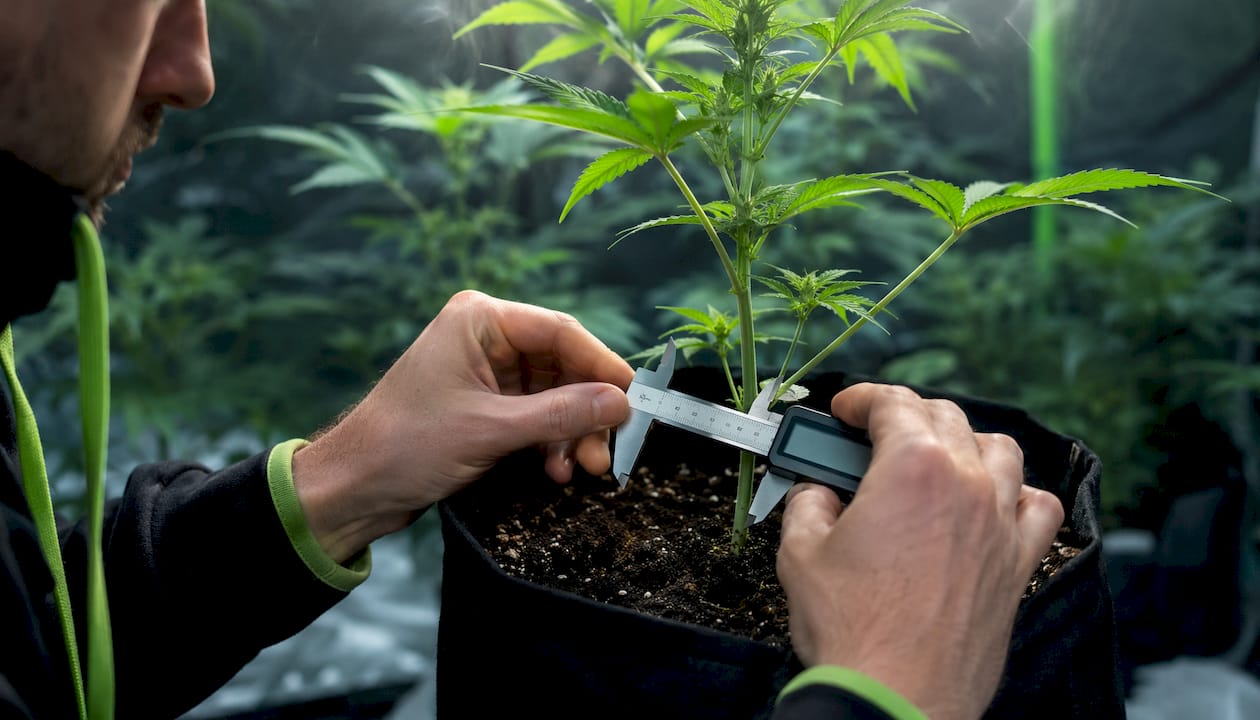
In Ashwagandha (Withania somnifera), combined IR and UV-B treatment increased shoot length by 154.9% under IR alone and 176.4% under IR plus UV-B. Fresh root weight improved by 146% with IR treatment. These are not marginal gains. For growers cultivating high-value medicinal crops, pairing IR with UV-B supplementation is worth serious consideration.
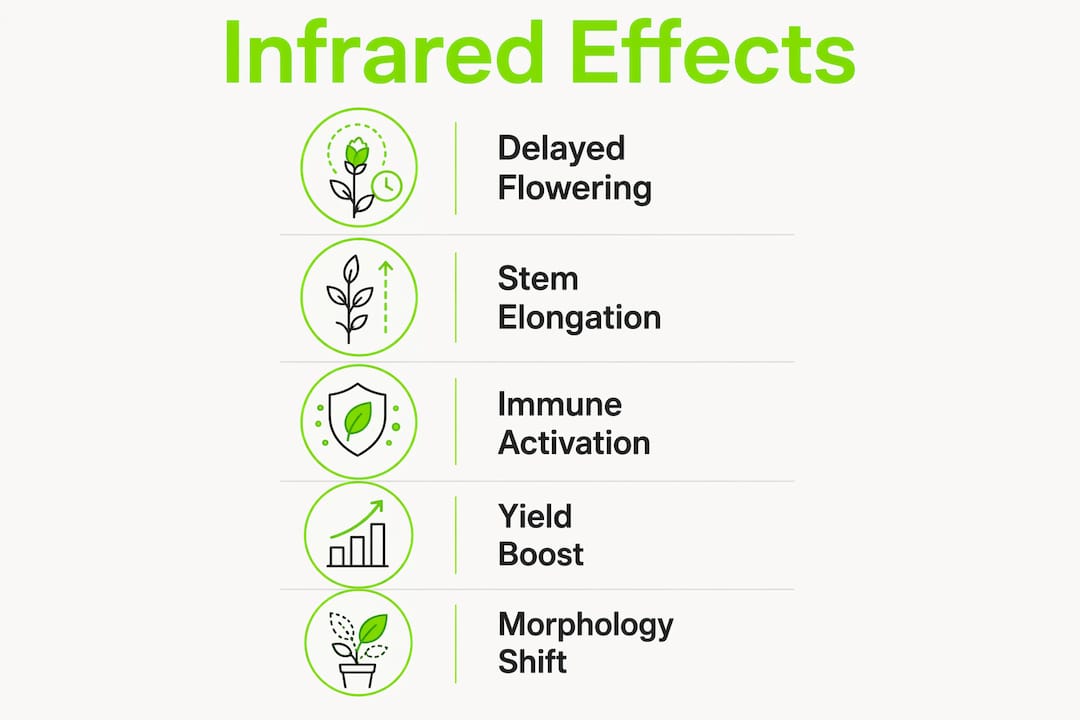
This is the finding most growers have not heard about. NIR light at approximately 810 nm triggers PIF4, a transcription factor that upregulates RNA silencing genes RDR6 and AGO1. The result is a measurable reduction in viral genomic DNA accumulation. Researchers describe this as infrared phototherapy for crops: a chemical-free way to prime plant defenses against begomoviruses and potentially other pathogens.
A foundational study on growth chamber illumination found a strong correlation between a lamp’s infrared emission and its photomorphogenetic efficacy across flowering, stem elongation, chlorophyll synthesis, and production yield. Plants under fluorescent lighting, which is deficient in far-red and infrared, grew shorter and more darkly pigmented than those under incandescent or natural light. That finding from 1974 still explains why so many indoor setups underperform.
A decreased red-to-far-red ratio triggers shade avoidance responses: stem elongation, leaf expansion, and altered flowering timing. In Cannabis, far-red light also improved biomass accumulation in certain genotypes by improving the balance of excitation between photosystems I and II. The photosynthetic efficiency gain is real, but it is genotype-specific.
| Treatment | Effect on shoot length | Effect on root fresh weight |
|---|---|---|
| IR alone | +154.9% | +146% |
| IR + UV-B | +176.4% | +176.4% |
| UV-B alone | +176.4% | Declined vs. control |
| Control | Baseline | Baseline |
Data from Ashwagandha study; source: doi.org/10.21275/v5i2.nov161683
When the red-to-far-red ratio drops, phytochromes shift toward the inactive Pr form. That shift releases PHYTOCHROME INTERACTING FACTORS (PIFs) from the nucleus into the cytoplasm, where they activate auxin biosynthesis and cell elongation genes. The plant reads a low ratio as competition from neighboring plants and responds by growing taller and reducing lateral branching. In a controlled indoor setup, you can deliberately lower that ratio to stretch plants during the vegetative phase, or keep it high to maintain compact structure.
Short-day plants are the most sensitive. Extended NIR exposure during the dark period acts like a night-break, pushing back the flowering trigger. For Cannabis growers running a 12-hour dark cycle, even low-level NIR from equipment in the room can add days to the flowering timeline. Conversely, far-red applied at end-of-day in a shortened photoperiod can accelerate flowering in long-day species without disrupting short-day crops.
A 4-hour far-red dose combined with a 12-hour photoperiod reduced flower biomass yield in Cannabis across all tested genotypes. The plant redirected energy toward vegetative growth at the expense of reproductive output. End-of-day treatments in a shortened photoperiod avoided this problem. Timing, not just wavelength, determines whether far-red helps or hurts.
Pro Tip: Check every piece of equipment in your grow room for NIR output. Security cameras with 850 nm night-vision LEDs can function as unintentional night-break lights for photoperiod-sensitive crops like Cannabis. Cover or redirect any camera LEDs that face your canopy during the dark period.
For immune priming, target approximately 810 nm. For flowering management and stem elongation, 850 nm NIR is the most studied wavelength. Avoid running high-intensity NIR continuously during dark periods if you are growing short-day plants. For UV-B supplemental lighting combined with IR, short daily exposure windows produce the strongest growth responses without stressing the plant.
Plants are largely water, and infrared above 1,200 nm heats plant tissue directly. In greenhouses or warm grow tents, reflecting excess NIR prevents overheating that halts photosynthesis and slows development. Specialized reflective coatings can block heat-generating wavelengths while preserving the signaling wavelengths your plants actually use. In a sealed tent, adequate airflow and temperature monitoring matter more than in open greenhouse settings.
Research on Cannabis shows that end-of-day far-red application in a 10-hour photoperiod produced no detrimental effect on flowering, while a 4-hour dose during a 12-hour photoperiod demolished yield. Short, timed pulses at the end of the light cycle give you the morphological and photosynthetic benefits without the flowering disruption.
Beyond security cameras, heat lamps, incandescent bulbs used for supplemental warmth, and even some monitoring equipment emit NIR. A simple IR detector card (available at most photography supply stores) can reveal hidden sources. Eliminate or shield any that face the canopy during dark periods.
Pro Tip: When selecting an LED grow light with IR output, look for fixtures that let you adjust the IR channel independently. Full-spectrum lights with a fixed IR ratio give you less control than programmable systems, especially when you need to shift between vegetative and flowering phases. The LED grow light buyer’s guide from Ledgrowlightsdepot covers what to look for in spectral customization.
Light is not just fuel. It is a signaling system that plants use to read their environment and adjust development accordingly. Photoreceptors like phytochromes detect the ratio of red to far-red light and translate that ratio into decisions about height, branching, flowering time, and immune readiness. Standard fluorescent lighting, deficient in far-red and infrared, produces plants that are shorter and more darkly pigmented than their naturally grown counterparts. That is not a minor cosmetic difference. It reflects altered gene expression driven by spectral imbalance.
Adding infrared to a red-and-blue LED setup changes what the plant “thinks” about its environment. A higher far-red component signals open canopy and abundant light, encouraging efficient photosynthesis and normal morphology. A spectrum heavy in red with no far-red signals dense competition, producing compact but sometimes stressed plants. For growers who want to steer vegetative versus generative growth, adjusting the LED grow light spectrum is one of the most direct levers available.
Ledgrowlightsdepot has built its product line around the principle that spectral precision, not raw wattage, drives yield. Their California Lightworks SolarSystem series offers programmable spectral output, including adjustable IR channels, so growers can dial in the exact red-to-far-red ratio their crops need at each growth stage. The SolarSystem 1100 covers larger canopies with full-cycle spectra, while the SolarSystem 550 suits mid-size home setups where IR control still matters.
With a 4.8 out of 5 rating from more than 5,800 customer reviews, Ledgrowlightsdepot’s results speak to what happens when spectral science meets practical hardware. Their proprietary proximity systems improve under-canopy light distribution, addressing the penetration problem that standard overhead fixtures leave unsolved.

Infrared light shapes plant development through molecular signaling, not just heat, and growers who control it deliberately outperform those who ignore it.
| Point | Details |
|---|---|
| NIR delays flowering in sensitive crops | 850 nm NIR delayed Cannabis flowering by 12 days and soybean by 3 days at high photon flux. |
| Stem elongation is dose-dependent | Soybean stems grew 33% longer under NIR at one meter; intensity determines whether elongation increases or reverses. |
| IR primes antiviral immunity | NIR at ~810 nm activates PIF4, which upregulates RDR6 and AGO1 to reduce viral load without chemicals. |
| Timing matters as much as wavelength | A 4-hour far-red dose with a 12-hour photoperiod reduced Cannabis flower yield; end-of-day dosing avoids this. |
| Hidden IR sources disrupt photoperiod | Security cameras with 850 nm LEDs can act as night-break lights; audit and shield all NIR-emitting equipment. |
{"one"=>"Select 2 or 3 items to compare", "other"=>"{{ count }} of 3 items selected"}


Leave a comment