
Free Shipping in the USA on nearly all items!
Limited phone hours during the Holidays! Call us: 888-611-9305
Free Shipping in the USA on nearly ALL items! Limited phone hours during the Holidays!

Plug-in grow lights suit tents, small rooms and any setup you may want to rearrange. Hardwired grow lights suit permanent rooms with a high total load, where a licensed electrician builds the circuit once and the fixtures stay put. The right choice depends on your total wattage, your voltage and how long the room will stay as it is. Most of the search results for this phrase cover EV chargers. This guide covers grow lights.
We build grow room setups around the full system: fixtures, cords, timers, controllers and the circuit behind them. This guide gives you the decision rules, the numbers to check and the mistakes to avoid.
A plug-in fixture has a power cord ending in a plug. You push the plug into a receptacle (the wall outlet) or into a splitter cord, and you can pull it out at any time. In the US, the plug shape tells you the voltage and amperage it is built for. A NEMA 5-15 plug is the standard 120V, 15-amp household plug. A NEMA 6-15 plug is a 240V, 15-amp plug that will not fit a 120V outlet.
A hardwired fixture has no plug. Its wires go into a junction box and connect to the branch circuit, which is the run of wiring from the breaker panel. Many commercial LED fixtures and drivers are installed this way, and it is how a room gets a fixed, permanent power layout.
Both are normal. The difference is what sits between the breaker and the light: a receptacle and a plug, or nothing but a wire connection.
| Factor | Plug-in | Hardwired |
|---|---|---|
| Connection | Cord and plug into a receptacle or splitter cord | Fixture wires joined to the circuit in a junction box |
| Moving or swapping a fixture | Unplug and replug | Electrician work to disconnect and reconnect |
| Typical use | Tents, home rooms, rentals, test rooms | Permanent and commercial rooms |
| Installation | Often an existing outlet, or a new receptacle | Always planned wiring, usually permit-related |
| Receptacle wear points | Plug and receptacle | None |
| Layout changes | Easy | Costly |
A common assumption is that hardwiring lets you pull more power. It does not by itself. What limits you is the circuit: the breaker size, the wire gauge and the voltage.
Watts equal volts times amps. A 120V, 15-amp circuit carries a maximum of 1,800 watts on paper. A 240V, 15-amp circuit carries 3,600 watts on paper. Lights that run for 12 hours or more are a continuous load, and electrical practice keeps continuous loads well below the breaker rating. Our guide to calculating grow room circuit load in amps and watts walks through the math with worked numbers.
A worked example: you plan eight fixtures at 640 watts each, which is 5,120 watts. On 120V that is about 43 amps, which means several separate circuits. On 240V it is about 21 amps, which fits two 240V circuits with room to spare. Hardwiring does not change the arithmetic. Moving to 240V does, and 240V fixtures can be either plug-in (with the correct plug) or hardwired.

This is why we recommend settling voltage and total load first, then choosing the connection.
Plug-in works well when the receptacle, the cord and the circuit all match. Problems come from mismatches.
A single receptacle on its own circuit must match the circuit’s ampere rating, and a receptacle on a shared circuit has its own limits under the National Electrical Code, according to Electrical Contractor magazine’s article on Article 210. Do not swap in a higher-rated plug or a bigger breaker to “make it fit.” The plug shape exists to stop that.
An extension cord or consumer power strip is a temporary fix. The Naval Postgraduate School safety office notes that the National Electrical Code and OSHA do not permit extension cords as permanent wiring, and that longer or chained cords add resistance and heat. A grow light runs for many hours every day for months, so it is permanent use. Use cords rated for the load and sized to the run, and keep runs short.
Wire gauge matters here. Thicker wire has less resistance and carries more current safely. See our guide to wire gauge for grow lights for what size each load needs.
Grow rooms are warm, wet places. Plugs, receptacles and cord ends should sit off the floor, away from drips and runoff, and out of the spray zone. Keep power connections above the level where water can pool. A hardwired connection has no plug to loosen or corrode, which is one reason permanent rooms favor it. Plug-in setups handle humidity well when connections are kept dry and accessible.
Cost and permits. Hardwiring needs conduit or cable, junction boxes, correct breakers and often a permit and inspection. Rules differ by city and county, and local codes adopt the National Electrical Code on their own schedule. Ask your local building department which edition and which permits apply before you start.
Rearranging. Once the room is wired, moving a fixture means moving a junction box or rewiring. If you are still testing layouts, canopy heights or a new strain, this slows you down.
Remote drivers. Some fixtures separate the driver (the power supply) from the light head, and the driver can be mounted away from the heat of the canopy. The distance between them matters, and it is a voltage drop question, not a maximum feet question. Our article on remote LED driver mounting and voltage drop explains how to calculate it.
Do-it-yourself risk. Wiring into a panel or junction box is work for a licensed electrician. Shut off the breaker, verify the circuit is dead and have the work inspected where the local code calls for it. This is not a place to learn on the job.
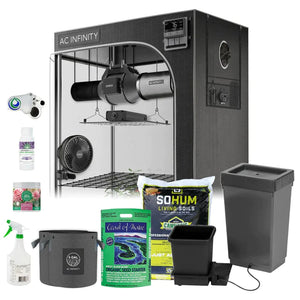
A single tent or closet grow is the clearest plug-in case. A few fixtures on one dedicated 120V circuit, a timer and a small environmental controller are all plug-in devices. You can reposition, replace and expand without calling anyone. Our tents and kits are built around this kind of setup, so you can plan the lighting, environment and power together.
If you are running several fixtures and tripping breakers, go to 240V before you add more circuits. Many 240V fixtures plug in with a NEMA 6-15 plug, so you keep flexibility and cut the amperage in half. For fixtures that use a splitter cord, the ThinkGrow Model One 7’ splitter power cord with a NEMA 6-15 plug (TDC-240) is the 240V option, and the NEMA 5-15 version (TDC-120) is the 120V option for the same system.
If your rooms and cycles are stable, decide per room. A dedicated flower room with fixed rows of fixtures benefits from a tidy, fixed layout. A veg room or clone area where you adjust often benefits from plug-in. Mixing both in one facility is common.
Large rooms with dozens of fixtures usually run 240V or higher, on circuits designed by an electrician, with a panel schedule that matches the room. Hardwiring suits that fixed layout. Total load, breaker count and voltage drop are the real design issues, and the fixture connection follows from them. We also offer bulk order and financing options for commercial purchases, so a lighting plan and a purchase plan can be set together.

Plug-in fixtures have an advantage with automation. A smart timer or control plug sits between the receptacle and the fixture, so you can schedule light cycles without touching the wiring. The Mars Hydro iTime 2-in-1 smart timer offers dual outlets with app control and custom scheduling. The AC Infinity UIS control plug is built for outlet-powered equipment. Hardwired fixtures need a contactor or controller wired in by an electrician, which suits larger rooms but is a bigger job.
The connection type is one decision in a larger setup. Fixtures, cords, timers, tents and environmental controls need to agree on voltage and load. Our catalog covers LED grow lights, grow tents and kits, environmental controls and more, including top lighting and under canopy grow lights. Under-canopy systems use our proprietary proximity design to improve light distribution below the top layer, which we have seen increase yields by over 20%. Most US orders ship free, and our expert advice team can help you match fixtures to your circuit.

A customer satisfaction rating of 4.8 out of 5 from more than 5,800 reviews reflects how many growers have used that help to plan their rooms.
Most power problems in grow rooms come from planning, not from the plug or the wire. Growers buy lights first and count amps later. We reverse that order. Total load, voltage and circuit count come first. Then the connection type is easy to pick.
For most home growers, plug-in is the practical choice. It lets you adjust canopy height, add an under-canopy light and expand without rewiring. When we help a grower with a new room, we ask for the wattage of each fixture and the voltage available before we recommend anything.
Where a room is permanent and large, hardwired circuits designed by an electrician make sense, and the fixtures we sell fit into those plans. Our job is to make sure the lighting, the controls and the power all agree.
Scott
Neither is better in every room. Hardwired suits permanent, high-load rooms, and plug-in suits tents and rooms you adjust. Both are safe when the circuit, cords and listings match the load and the work is done correctly.
We recommend a licensed electrician for any connection into a circuit or junction box. Local codes often require permits and inspection for new wiring. Plug-in fixtures need no wiring work if the receptacle already matches.
No. For the same fixture wattage, the energy used is the same. What changes is the current: at 240V the same load draws about half the amps, so you can run more fixtures per circuit and use thinner wire runs with less voltage drop.
It is not a good practice for long-term use. Extension cords are meant for temporary use, and chained cords add resistance and heat. Use fixtures and splitter cords rated for the load, or add a properly sized circuit.
0 of 3 items selected


Leave a comment