
Free Shipping in the USA on nearly all items!
Limited phone hours during the Holidays! Call us: 888-611-9305
Free Shipping in the USA on nearly ALL items! Limited phone hours during the Holidays!

LED bar fixtures are defined as directional, high-intensity linear lighting units engineered for deep canopy penetration, while LED panel lights deliver broad, uniform, diffused illumination across wide growing areas. Understanding how LED bar fixtures differ from panels is the single most important decision you will make when setting up a grow room. The wrong choice costs you yield, not just money. Ledgrowlightsdepot’s product line spans both fixture types, and growers with a 4.8 out of 5 satisfaction rating across more than 5,800 reviews consistently report that matching the fixture to the canopy makes the biggest difference.
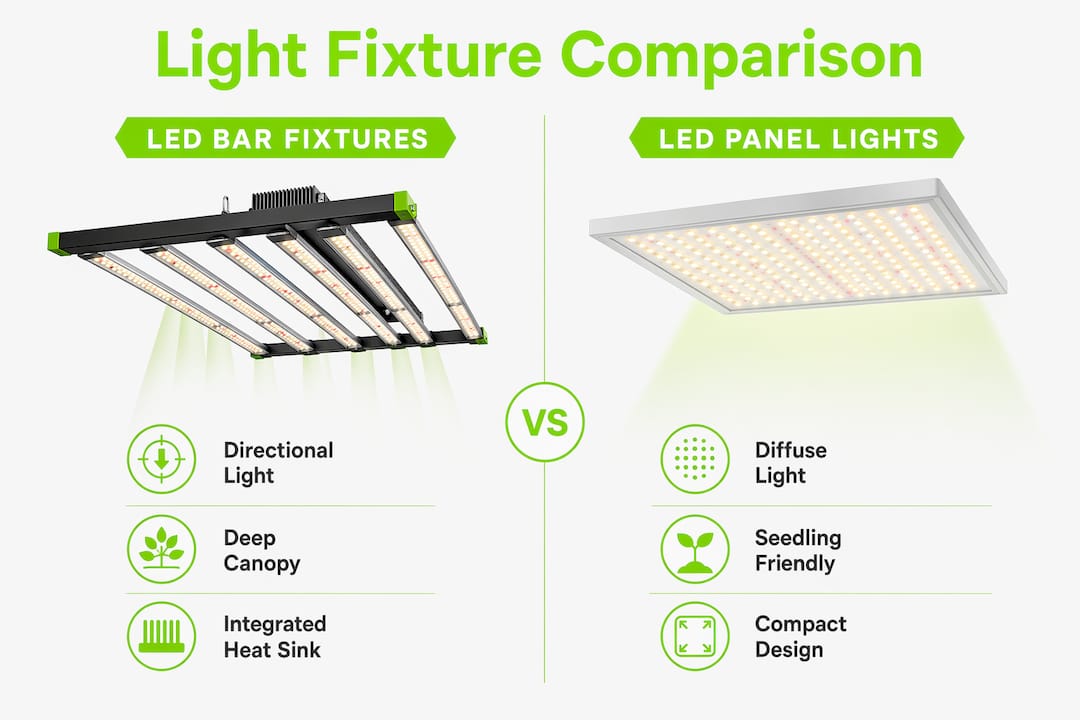
LED bars produce directional, linear light that drives photons deep into a plant canopy, while panels spread light isotropically across the entire surface area below them. That distinction matters more than wattage or lumen count when you are growing dense, multi-tier crops like cannabis, tomatoes, or vertical lettuce racks.
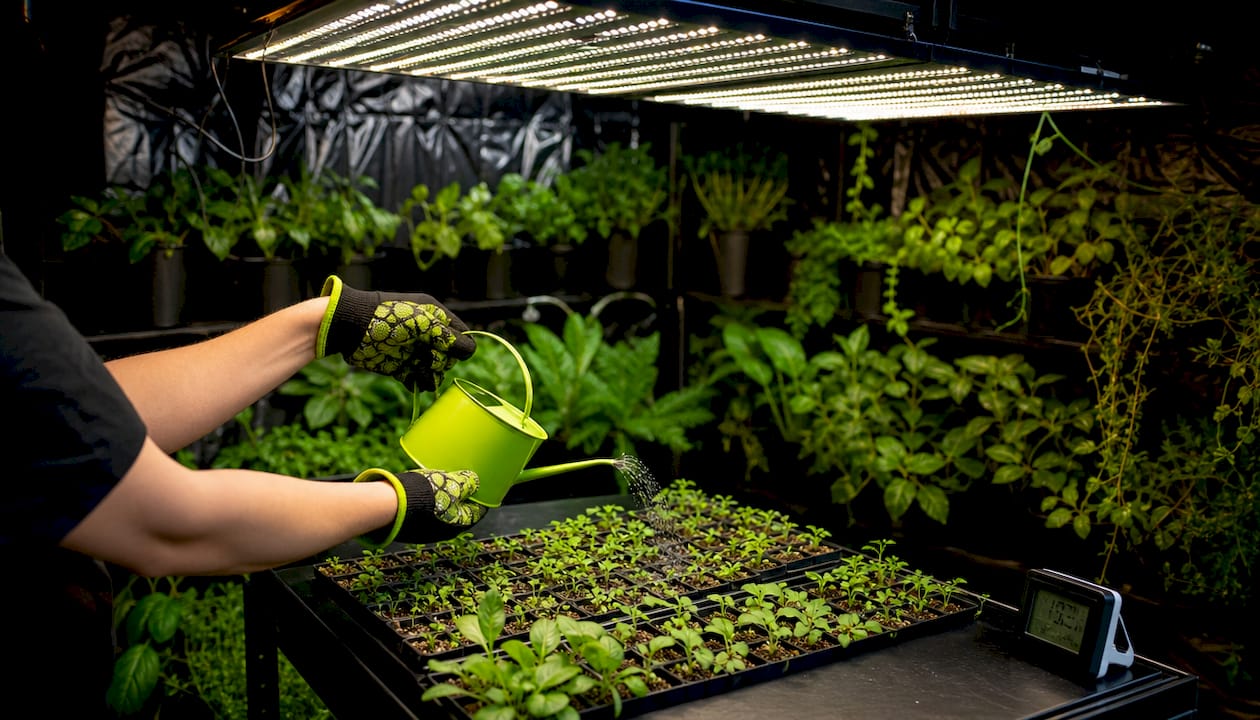
Panels create what lighting engineers call ambient, shadow-free illumination. That quality works well for seedling trays and leafy greens where every leaf sits close to the light source and uniform coverage prevents hot spots. A single 2x4 panel over a propagation bench gives you even germination across every cell.
Bars work differently. Directional linear light enables better photosynthetic efficiency deep in plant canopies because the beam angle concentrates photons rather than scattering them. A bar positioned above a tomato plant pushes usable light past the top leaves and into the fruiting zone below. Panels at the same wattage cannot replicate that penetration even when hung at the same height.
Pro Tip: If your canopy is taller than 18 inches, a bar fixture will almost always outperform a panel at the same wattage because of its directional beam angle.
The table below summarizes the core light distribution differences between the two fixture types.
| Feature | LED Bar Fixture | LED Panel Light |
|---|---|---|
| Light pattern | Directional, linear | Diffuse, isotropic |
| Canopy penetration | Deep | Surface level |
| Coverage footprint | Narrow, targeted | Wide, uniform |
| Best plant type | Tall, dense canopies | Seedlings, leafy greens |
| Glare level | Higher | Low, shadow-free |
Thermal design is where bars and panels separate most sharply. LED bars use integrated aluminum housings that act as continuous heat sinks along the entire length of the fixture. That construction keeps junction temperatures low, which directly preserves light output over time.
Panels are thinner by design. Their compact frames leave less surface area for heat to escape, which causes the LEDs inside to run hotter during long photoperiods. Hotter LEDs degrade faster, and that degradation shows up as reduced Photosynthetic Photon Flux (PPF) output before the fixture ever burns out completely.
The lifespan gap is significant. Integrated LED bar fixtures last up to 100,000 hours, while standard panel lights average 30,000–50,000 hours. For a commercial grower running 18-hour photoperiods, that gap translates to years of additional service life before replacement.
Here is what that means practically for your grow operation:
Pro Tip: Check the fixture’s rated L70 value, which is the point at which light output drops to 70% of original. A higher L70 hour rating means more consistent yields over the fixture’s life.
You can read more about why LED lifespan matters when buying in volume for a commercial operation.
Installation complexity separates casual home growers from commercial cultivators faster than almost any other factor. LED panels fit standard 2x2 and 2x4 ceiling grids and connect with a single plug, making them the fastest fixture to deploy in a new grow room. You drop them in, plug them in, and you are growing.
Bars require more planning. They are rigid, factory-built units that mount to rails, cables, or fixed brackets above the canopy. That rigidity is a feature, not a flaw. It means the fixture holds its position precisely over the canopy even in high-humidity environments where cheaper mounting hardware corrodes and shifts.
For home growers, the scalability question usually comes down to tent size. A 4x4 tent works well with two or three bar fixtures on a single rail system. Expanding to a 5x5 means adding one more bar, not rewiring the entire space. Panels in the same scenario require you to recalculate coverage overlap and often add a second driver circuit.
Commercial cultivators face a different set of priorities:
The bar lights vs. quantum boards comparison on the Ledgrowlightsdepot blog covers mounting and scalability in more detail for growers choosing between bar-style formats.
Panels carry a lower sticker price in almost every product category. Their simpler construction, thinner profile, and standardized form factor make them cheaper to manufacture and ship. That upfront savings is real, and for a home grower setting up a small propagation space, it matters.
The math changes over a full crop cycle. A single LED bar fixture can cover broad spaces, potentially reducing total installation and wiring cost compared to deploying multiple panels across the same footprint. In a large commercial grow, fewer fixtures mean fewer drivers, fewer mounting points, and less labor during installation.
Energy efficiency follows the same pattern. Because bars maintain lower operating temperatures, their LEDs convert a higher percentage of electricity into usable photons rather than waste heat. That efficiency advantage compounds over thousands of operating hours. You can review long-term LED grow lighting costs to see how fixture efficiency affects your electricity bill across a full year of cultivation.
| Cost Factor | LED Bar Fixture | LED Panel Light |
|---|---|---|
| Upfront unit price | Higher | Lower |
| Installation labor | Moderate | Low |
| Replacement frequency | Low (longer lifespan) | Higher (shorter lifespan) |
| Energy efficiency | Higher over time | Moderate |
| Utility rebate eligibility | Frequent (DLC 5.1) | Less consistent |
Industry experts note that integrated LED bars offer excellent thermal efficiency, but their non-modular design means replacing the entire unit if internal components fail. Panels, by contrast, often allow component-level swaps. That modularity can reduce repair costs in the short term, even if the panel’s overall lifespan is shorter. For a workshop or commercial environment, this trade-off is worth reviewing in a workshop lighting guide that covers both fixture types across demanding use cases.
LED bar fixtures outperform panels for deep canopy penetration and long-term efficiency, while panels remain the faster, lower-cost option for uniform surface coverage in smaller or simpler grow spaces.
| Point | Details |
|---|---|
| Light distribution | Bars deliver directional light for canopy depth; panels spread light evenly across the surface. |
| Lifespan advantage | Bars last up to 100,000 hours versus 30,000–50,000 hours for standard panels. |
| Installation speed | Panels install faster in grid ceilings; bars offer more flexibility for custom room layouts. |
| Total cost of ownership | Bars cost more upfront but save money through fewer replacements and better energy efficiency. |
| Best use case | Use bars for tall, dense crops and commercial grows; use panels for seedlings and leafy greens. |
Most growers who regret their fixture choice made the same mistake: they compared lumen output and stopped there. Relying on lumen output alone is misleading when choosing between bars and panels for horticulture. Lumens measure brightness to the human eye, not photosynthetic efficiency at canopy depth.
The growers I respect most think about their canopy architecture first. A sea-of-green setup with a flat, even canopy genuinely benefits from panel-style coverage. A screen-of-green or a tall photoperiod plant with multiple bud sites needs bars. Getting that match right is worth more than any spec sheet comparison.
My honest concern with integrated bars is the replacement cost risk. Integrated LED bars require replacing the entire unit if a core component fails, unlike modular panels where you can swap a driver or a board. For a home grower with two fixtures, that risk is manageable. For a commercial operation running 200 bars, it is a budget line item that needs planning from day one.
The combination approach works better than most growers expect. Bars over the main canopy for penetration, panels over propagation and clone areas for uniform coverage. That split lets you match the fixture to the task rather than forcing one technology to do everything. The LED vs. HPS benefits comparison is worth reading alongside this decision, because the fixture type choice and the light source choice interact in ways that affect your total room design.
— Scott
Choosing between bars and panels is easier when you can compare real products side by side with expert input behind you.
Ledgrowlightsdepot carries a full range of high-performance bar-style fixtures, including the Grower’s Choice ROI-E420, built for growers who need reliable deep canopy penetration without sacrificing energy efficiency. The team at Ledgrowlightsdepot has helped more than 5,800 growers find the right fixture for their specific space, canopy type, and budget. Whether you are setting up a 4x4 home tent or scaling a commercial facility, the right fixture recommendation starts with a conversation about your plants, not just your ceiling height. Reach out to the Ledgrowlightsdepot team for a tailored lighting plan built around your grow.
LED bars produce directional, high-intensity linear light for deep canopy penetration, while LED panels deliver broad, diffused, uniform illumination suited for surface-level coverage. The core difference is light distribution, not wattage.
LED bar fixtures last up to 100,000 hours due to their integrated aluminum heat sinks, while standard LED panels average 30,000–50,000 hours. Better thermal management is the primary reason for that gap.
Panels work well for seedlings, clones, and leafy greens in small spaces because of their even coverage and easy installation. Bars are the better choice for taller plants or any canopy deeper than 18 inches.
Bars carry a higher upfront price, but their longer lifespan and better energy efficiency lower the total cost of ownership over time. In large commercial grows, bars can also reduce installation costs by covering more area per fixture.
Yes, and many experienced growers do exactly that. Bars work over the main flowering canopy for penetration, while panels cover propagation and clone areas where uniform surface light matters most.
0 of 3 items selected

Leave a comment