
Free Shipping in the USA on nearly all items!
Limited phone hours during the Holidays! Call us: 888-611-9305
Free Shipping in the USA on nearly ALL items! Limited phone hours during the Holidays!

Shelf gardening with LED strips is defined as the practice of mounting low-profile, full-spectrum light sources directly onto or beneath shelving units to deliver consistent photosynthetically active radiation to indoor plants. This method solves the core problem of uneven light distribution that plagues traditional clamp lamps and overhead fixtures in compact spaces. Properly installed full-spectrum LED grow strips outperform traditional clamp lamps by 2.3x higher leaf mass and 37% faster regrowth in urban herb gardens. That gap exists because LED strips deliver light across the entire canopy rather than from a single point source. Understanding how shelf gardening uses LED strips, including the right spectrum, placement, and scheduling, is what separates a thriving herb wall from a shelf full of leggy, pale plants.
LED strips work in shelf gardening by running along the underside of each shelf tier, pointing downward at the plants below. This geometry creates a near-uniform light field across the canopy, unlike a clamp lamp that floods the center and starves the edges. The standard measure of that light field is photosynthetic photon flux density (PPFD), which counts the number of photons hitting a square meter per second. Focusing on PPFD or Daily Light Integral (DLI) is more effective than wattage for matching lighting to plant needs. Wattage tells you how much electricity a strip draws; PPFD tells you whether your basil is actually getting enough light to grow.
Full-spectrum LED strips cover the 400–700 nanometer wavelength range that plants use for photosynthesis, including the blue wavelengths that drive compact leafy growth and the red wavelengths that push flowering. RGB strips and white-only strips fall short because they miss portions of that range. For indoor herb gardens, full-spectrum output is the baseline requirement, not an upgrade.
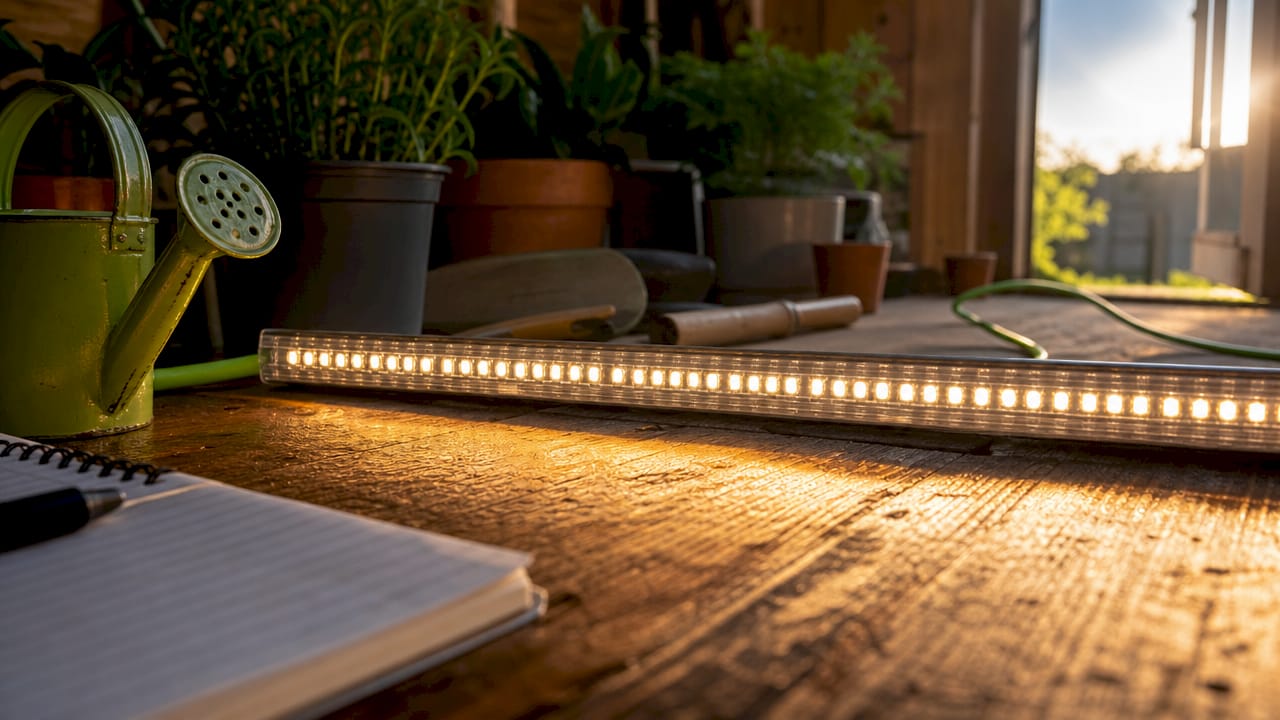
The right LED strip for a shelf garden has four non-negotiable characteristics: full-spectrum output, an appropriate PPFD range, a UL-listed driver, and a reliable mounting system.
Pro Tip: Avoid daisy-chaining more than three 2-meter strips on one driver. Voltage drop beyond that limit causes uneven light intensity across the shelf, producing patchy growth even when the strips look fully lit.
Installation determines whether your LED strips perform at their rated output or waste half their potential. Follow these steps for a setup that delivers consistent results.
Pro Tip: Raise the strip height by 2–3 cm every two weeks as seedlings mature into full plants. Keeping the canopy at a consistent distance from the strip maintains stable PPFD as plant height increases.
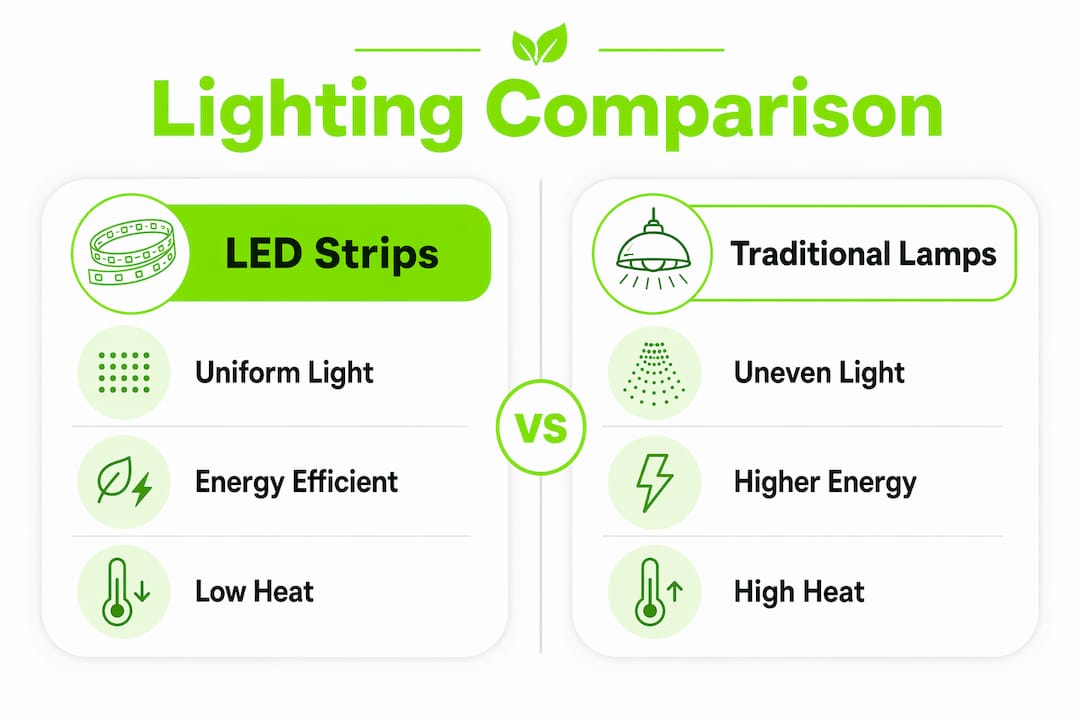
LED strips and traditional grow lights solve the same problem differently. The table below compares the two approaches across the factors that matter most for shelf gardening.
| Feature | LED strips | Traditional clamp lamps |
|---|---|---|
| Light uniformity | ±12% variance across canopy | Steep center-to-edge falloff |
| Surface temperature | 32–36°C | 52–78°C |
| Safe mounting distance | 12–25 cm above canopy | 30+ cm required |
| Heat risk to plants | Low | Moderate to high |
| Fit in confined spaces | Flat profile fits any shelf | Bulky clamp hardware limits placement |
| Leaf mass growth rate | 2.3x higher than clamp lamps | Baseline |
The ±12% light variance figure is the key number here. It means every plant on the shelf receives nearly the same PPFD, regardless of whether it sits at the center or the edge. Clamp lamps cannot replicate that uniformity because they emit from a single point. For urban growers with limited shelf depth, that uniformity difference directly translates into consistent harvests rather than a mix of thriving center plants and stunted edge plants.
Energy consumption also favors LED strips. Because strips run cooler and convert more electricity into usable light, they draw less power for equivalent PPFD output. For a home grower running lights 14–16 hours a day, that difference shows up on the monthly electricity bill.
Light scheduling is where most home growers leave yield on the table. Getting the photoperiod right is as important as getting the spectrum right.
Most LED strip problems in shelf gardens fall into three categories: electrical issues, mechanical failures, and plant stress responses.
Pro Tip: Set a calendar reminder every 90 days to inspect all mechanical mounts, check driver connections, and wipe dust from the strip surface. Dust accumulation on LEDs reduces light output more than most growers expect.
Monitoring plant responses is the most reliable early warning system. Leggy stems reaching toward one side of the shelf mean the light is off-center. Uniform, compact growth with dark green leaves means the setup is working. For a full walkthrough on building a shelf garden from scratch, the 2026 urban shelf setup guide from Ledgrowlightsdepot covers each step in detail.
LED strips deliver consistent, full-spectrum light across every plant on a shelf, making them the most effective lighting method for compact indoor gardens.
| Point | Details |
|---|---|
| Measure PPFD, not watts | Match your strip’s PPFD output to your crop’s needs, not its wattage rating. |
| Mount with hardware, not adhesive | Mechanical clips prevent strip failure in humid shelf environments. |
| Limit daisy-chain length | Keep chains to three 2-meter strips per driver to avoid voltage drop and uneven growth. |
| Use reflective surfaces | Matte-white walls or Mylar add 10–25% more usable light at no extra energy cost. |
| Schedule 14–16 hours of light | Consistent photoperiods with a timer produce more reliable harvests than manual switching. |
Most growers who struggle with shelf gardens are not making lighting mistakes. They are making measurement mistakes. They buy a strip, mount it, and assume the plants will respond. When growth is slow or uneven, they add more strips, which often makes things worse by creating hot spots or overloading a single driver.
The growers who get consistent results start with a DLI calculation before they buy anything. They know their target PPFD for the crop, they know how many hours they plan to run the lights, and they choose a strip that hits those numbers. That approach takes 20 minutes of planning and saves months of troubleshooting.
The second mistake I see constantly is skipping reflective surfaces. Growers spend money on better strips when a $15 roll of Mylar taped to the back wall would give them more usable light than upgrading to a more expensive strip. The physics are simple: every photon that hits a dark wall is a wasted photon. Bounce it back onto the canopy instead.
The third thing worth saying plainly: LED strips are not a complete growing system. Temperature, humidity, airflow, and watering frequency all interact with light quality. A perfectly lit shelf in a room that runs at 85°F will still produce stressed plants. Light is the most controllable variable in shelf gardening, which is why it gets the most attention. But it works best when the other variables are also managed. Ledgrowlightsdepot’s product range, including environmental sensors and control systems, exists precisely because growers who get the lighting right eventually want to bring the same precision to every other variable.
— Scott
Ledgrowlightsdepot carries full-spectrum LED grow lights and environmental control systems built for exactly the kind of precision shelf gardening covered here. Their products are rated 4.8 out of 5 across more than 5,800 customer reviews, and their proprietary proximity systems deliver over 20% yield increases compared to standard setups.
For growers who want to take light management further, the TrolMaster Hydro-X environmental control system with full-spectrum quantum sensor pairs directly with LED strip setups to monitor and log real-time PPFD at canopy level. That data removes the guesswork from photoperiod adjustments and strip height decisions. Browse the full selection at Ledgrowlightsdepot to find the right lighting and control combination for your shelf garden.
Full-spectrum LED strips covering 400–700 nanometers are required for productive shelf gardening. This range includes the blue and red wavelengths plants use most for vegetative growth and flowering.
Mount LED strips 12–25 cm above the plant canopy. Full-spectrum strips run at 32–36°C, which is cool enough for close placement without leaf burn risk.
Run LED strips 14–16 hours per day with 8–10 hours of darkness. Use a programmable timer to keep the schedule consistent, since manual switching introduces gaps that slow plant development.
Uneven growth usually means voltage drop from a daisy-chain that is too long, or strips that do not extend 1–2 inches beyond the plant width on each side. Both issues reduce PPFD at the canopy edges.
Wattage alone does not determine plant performance. Use PPFD and DLI as your primary selection criteria, since they measure the actual light dose your plants receive rather than the electricity the strip consumes.
0 of 3 items selected

Leave a comment