
Free Shipping in the USA on nearly all items!
Limited phone hours during the Holidays! Call us: 888-611-9305
Free Shipping in the USA on nearly ALL items! Limited phone hours during the Holidays!

Full spectrum grow lights are defined as LED fixtures that emit a balanced range of wavelengths across the entire visible light spectrum, closely mimicking natural sunlight for indoor plants. Unlike older red-blue-only setups, these lights deliver green, far-red, and UV-A wavelengths that plants actively use through multiple photoreceptor systems. The result is faster growth, better yields, and healthier plants across every stage of development. If you’re researching the benefits of full spectrum grow lights to upgrade your indoor garden, the science behind them is more compelling than most product pages let on.
Full spectrum lighting accelerates plant growth because plants use multiple photoreceptors tuned to different wavelengths, not just red and blue. Blue light drives compact foliage and root development. Red light regulates flowering. Green light penetrates deeper into the canopy and contributes to photosynthesis at a level comparable to red and blue. Far-red light speeds up cell elongation and triggers developmental transitions that red-blue lights alone cannot replicate.
Scientific studies on tomatoes and lettuce confirm this. Research published in Scientific Reports found that supplementary lighting with varied spectra significantly accelerated fruit ripening and improved overall plant development compared to standard red-blue light. Far-red inclusion in lettuce trials increased leaf area and nutritional pigment production, delivering gains in both quantity and quality.
Pro Tip: If your plants are growing slowly under a red-blue LED, the missing piece is often far-red or green wavelengths. Check your fixture’s spectral output chart before assuming you need more wattage.
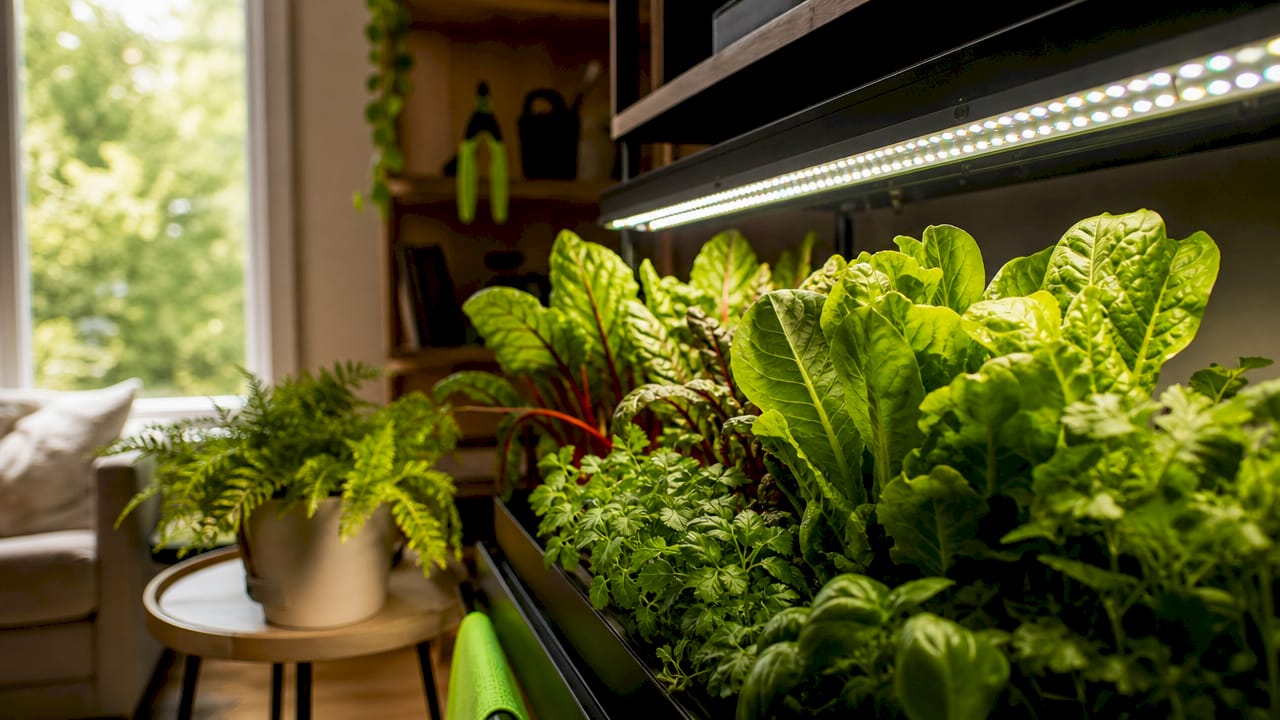
The advantages of full spectrum lights go well beyond raw growth speed. They directly affect the nutritional value, flavor, and potency of what you grow. A study on facility-grown tomatoes found that spectral composition beyond red-blue increased large fruit numbers by 25.79% and yield per plant by 6.94%. Those are not marginal gains. They reflect how much photosynthetic potential is left on the table when growers rely on narrow-spectrum fixtures.
Cannabis growers see some of the most dramatic results. Research in Scientific Reports showed that combining red supplementation during vegetative growth with UV-A during flowering increased CBG and CBD yields by 91.8% and 44.1% respectively compared to control groups. That finding reframes how hobbyists should think about spectrum. It is not just about keeping plants alive. It is about unlocking the plant’s full biochemical output.
| Crop | Spectrum addition | Measured benefit |
|---|---|---|
| Tomato | Red supplementation beyond RB | 25.79% more large fruit, 6.94% yield increase per plant |
| Cannabis (hemp) | Red + UV-A at targeted stages | 91.8% CBG increase, 44.1% CBD increase |
| Lettuce | Far-red inclusion | Increased leaf area and nutritional pigment production |
| Petunia | Elevated far-red | Accelerated flowering without reducing flower bud quality |
Leafy greens also benefit significantly. Far-red light in lettuce trials improved both biomass and the concentration of chlorophyll and carotenoids. Those pigments are not just cosmetic. They represent the antioxidant content that makes homegrown greens nutritionally superior to store-bought produce.
Plant health under full spectrum lighting is visible. Leaves are darker green, stems are thicker, and growth patterns are more compact. The reason is blue light. Blue wavelengths activate phototropins and cryptochromes, the receptors that regulate how a plant allocates energy between upward stretch and lateral leaf development. Without adequate blue light, plants go leggy, reaching toward the light source instead of building dense, productive structure.
Non-full-spectrum fixtures that spike only in red create exactly this problem. Plants grow tall and thin, with weak stems and pale coloration. Full spectrum lighting corrects this by delivering the blue content that keeps internodal spacing tight. The Soltech Aspect Gen 2 is a well-known example of a fixture designed around this principle, producing white light that supports both plant health and home aesthetics without the purple glow of traditional grow lights.
Far-red and green wavelengths also influence plant architecture in ways that matter to hobbyists. Far-red radiation advanced flowering in petunia trials while maintaining market-quality traits, showing that spectrum management can control timing without sacrificing plant structure. For growers who want to stagger harvests or manage bloom cycles in a small space, this is a practical tool.
Pro Tip: If you notice your plants developing pale leaves or excessive stretch, increase the blue light ratio during vegetative growth. Many full spectrum fixtures allow spectrum adjustment. Use it.
Full spectrum LEDs produce white light with high energy efficiency and minimal heat output, making them the most practical choice for home indoor gardens. Traditional HID and HPS lights generate significant heat that requires active cooling, raises electricity bills, and creates fire risk in small spaces. Full spectrum LEDs run cooler, draw less power for equivalent photon output, and last significantly longer.
Energy efficiency matters more than most hobbyists realize when they first set up a grow space. A fixture running 12 to 18 hours per day adds up fast on your electricity bill. Understanding why LED efficiency matters for home grows is the difference between a hobby that pays for itself and one that quietly drains your budget. The best full spectrum grow lights are rated by their efficacy in micromoles per joule (µmol/J), not just wattage. A higher µmol/J rating means more usable light per watt of electricity consumed.
Heat management also affects plant health directly. Excessive heat from older fixtures causes tip burn in lettuce, accelerates soil drying, and stresses plants during critical growth phases. Full spectrum LEDs eliminate most of these problems at the source.
Choosing the right full spectrum fixture requires looking past the marketing label. Many lights are sold as “full spectrum” but deliver only a modest improvement over red-blue designs. The key is to check the spectral output chart and confirm that the fixture includes meaningful output across blue, green, red, far-red, and ideally UV-A bands. A fixture that spikes in red and blue with a token green contribution is not delivering the full spectrum grow light benefits described in the research.
Controlling light dose and spectrum together is what drives plant growth outcomes. PPFD (photosynthetic photon flux density) measures how many photons hit your plant canopy per second. DLI (daily light integral) measures the total photon dose over a full day. Both numbers matter more than wattage alone. A 200-watt fixture with poor spectral distribution will underperform a 100-watt fixture with optimized spectrum and high efficacy.
| Factor | What to look for | Why it matters |
|---|---|---|
| Spectral output | Blue, green, red, far-red, UV-A coverage | Ensures all photoreceptors are activated |
| PPFD rating | Matched to your plant type and growth stage | Prevents under or over-lighting |
| Efficacy (µmol/J) | 2.0 µmol/J or higher for quality fixtures | Reduces electricity cost per gram of yield |
| Heat output | Passive or low-noise active cooling | Protects plants and simplifies home setup |
| Coverage area | Manufacturer-specified at target PPFD | Avoids edge-of-canopy light deficiency |
Stage-specific spectrum management produces the largest quality improvements. Using UV-A during flowering and higher blue ratios during vegetative growth outperforms a fixed full spectrum setting applied uniformly across the entire grow cycle. If your fixture allows spectrum adjustment, build a simple light recipe for each growth phase rather than leaving it on a single setting throughout.
Pro Tip: Use a PAR meter or a free PPFD calculator app to verify that your canopy is receiving the right light dose at each growth stage. Guessing based on fixture height alone leads to inconsistent results.
For hobbyists exploring compact LED grow light options, matching fixture size to your grow space is as important as spectrum quality. Oversized fixtures in small tents create heat and intensity problems that no spectrum can fix.
Full spectrum grow lights outperform narrow-spectrum alternatives because they activate the complete range of plant photoreceptors, delivering faster growth, higher yields, and measurably better crop quality across vegetables, herbs, and specialty crops.
| Point | Details |
|---|---|
| Spectrum breadth drives results | Blue, green, red, far-red, and UV-A each serve distinct plant functions that red-blue alone cannot cover. |
| Yield gains are documented | Tomato trials show 25.79% more large fruit; cannabis trials show up to 91.8% cannabinoid yield increase with targeted spectrum. |
| Plant health is visible | Balanced spectrum prevents stretch, improves coloration, and builds stronger root and stem structure. |
| Dose and spectrum work together | PPFD and DLI must be matched to growth stage. Wattage alone does not predict fixture performance. |
| Stage-specific lighting wins | Adjusting spectrum by growth phase outperforms a fixed full spectrum setting applied uniformly all cycle. |
Most hobbyists buy a “full spectrum” fixture, hang it at the recommended height, and assume the work is done. The label does a lot of heavy lifting that the actual spectral output sometimes cannot support. I’ve seen growers spend months troubleshooting slow growth, pale leaves, or poor flowering, only to discover their “full spectrum” light had almost no far-red output and a UV-A contribution too small to measure.
The uncomfortable truth is that the term “full spectrum” has no regulated definition in the grow light industry. Any manufacturer can print it on a box. What separates a genuinely useful fixture from a marketing exercise is the spectral distribution chart. If a brand won’t publish one, that tells you something.
What I find most interesting is how the research keeps confirming that timing matters as much as spectrum. The cannabis data showing stage-specific UV-A and red supplementation producing nearly double the cannabinoid yield is not an outlier. It reflects a broader principle: plants are not passive recipients of light. They respond differently to the same wavelengths depending on where they are in their development cycle.
For hobbyists, this means the best investment is not always the most expensive fixture. It is the fixture that gives you control. A light with adjustable spectrum ratios and a published PPFD map at multiple heights will serve you better than a fixed-output unit with a higher price tag and a vague “full spectrum” claim.
My honest recommendation is to treat your grow light like a tool with settings, not a switch you flip once. Learn your plants’ stage-specific needs, match your spectrum and dose to those needs, and you will see results that most hobbyists never achieve.
— Scott
Ledgrowlightsdepot carries a curated selection of full spectrum LED fixtures built for exactly the kind of results the research describes. The NextLight 150h is a standout option for home growers who want high efficacy, balanced spectral output, and a fixture designed to perform across all growth stages without generating excessive heat. For growers who need flexible coverage, the Toggled 2 ft. LED grow fixture delivers ultra-high output in a compact form.
With a 4.8 out of 5 rating from more than 5,800 verified customers, Ledgrowlightsdepot backs every product with real grower experience and expert guidance. Browse the full grow light selection to find the right fixture for your space, your plants, and your goals.
Full spectrum grow lights activate multiple plant photoreceptors that red-blue lights miss, including those responsive to green, far-red, and UV-A wavelengths. This produces faster growth, better yields, and healthier plant structure across all growth stages.
Yes. Research confirms benefits across tomatoes, lettuce, cannabis, and flowering plants like petunia. The specific wavelength ratios and light dose should be adjusted to match each plant species and growth phase for best results.
PPFD measures the number of photons hitting your canopy per second and determines whether your plants are receiving enough light to photosynthesize effectively. Spectrum quality and PPFD must both be matched to your plant type and growth stage. Wattage alone is not a reliable guide.
Quality full spectrum LEDs deliver the wavelength range and intensity needed to support full plant development indoors without natural sunlight. Fixtures with documented PPFD output and broad spectral coverage, including far-red and UV-A, come closest to replicating outdoor growing conditions.
Request or look up the fixture’s spectral distribution chart. A genuine full spectrum light shows meaningful output across blue (400 to 500 nm), green (500 to 600 nm), red (600 to 700 nm), and far-red (700 to 800 nm) bands. Fixtures that only spike in red and blue with minimal coverage elsewhere do not deliver the full spectrum grow light benefits supported by current research.
0 of 3 items selected


Leave a comment