
Free Shipping in the USA on nearly all items!
Limited phone hours during the Holidays! Call us: 888-611-9305
Free Shipping in the USA on nearly ALL items! Limited phone hours during the Holidays!

Commercial LED system scaling is defined as the process of expanding modular lighting infrastructure across a cultivation facility while maintaining uniform light output, energy efficiency, and control integration at every stage of growth. Understanding how commercial LED systems scale is the difference between a facility that grows with you and one that creates expensive bottlenecks. Commercial LED retrofits achieve energy savings between 50% and 75% compared to legacy lighting, which means every square foot you add to your operation carries a compounding financial advantage. The DesignLights Consortium (DLC) qualification standard and Section 179D federal tax deductions make scaling even more financially attractive for commercial cultivators in 2026.
Modular fixture design is the foundation of any scalable commercial LED system. A modular approach lets you add, reconfigure, or replace individual units without rewiring an entire facility or disrupting active grow zones. Modular high-bay LED systems scale from 10,000 to 120,000 lumens using interchangeable units suited for ceiling heights from 5 to over 25 meters. That range covers everything from a small propagation room to a full-scale warehouse canopy.
Integrated controls are what separate a scalable system from a collection of individual fixtures. Occupancy sensors, daylight harvesting, and zonal dimming work together to reduce energy draw and adapt output to plant stage requirements. Controls integration early in design prevents incompatibility and maximizes savings through features like daylight harvesting and zonal dimming. The two dominant dimming protocols are 0-10V for single-zone control and DALI for multi-zone environments where different rooms or benches need independent schedules.
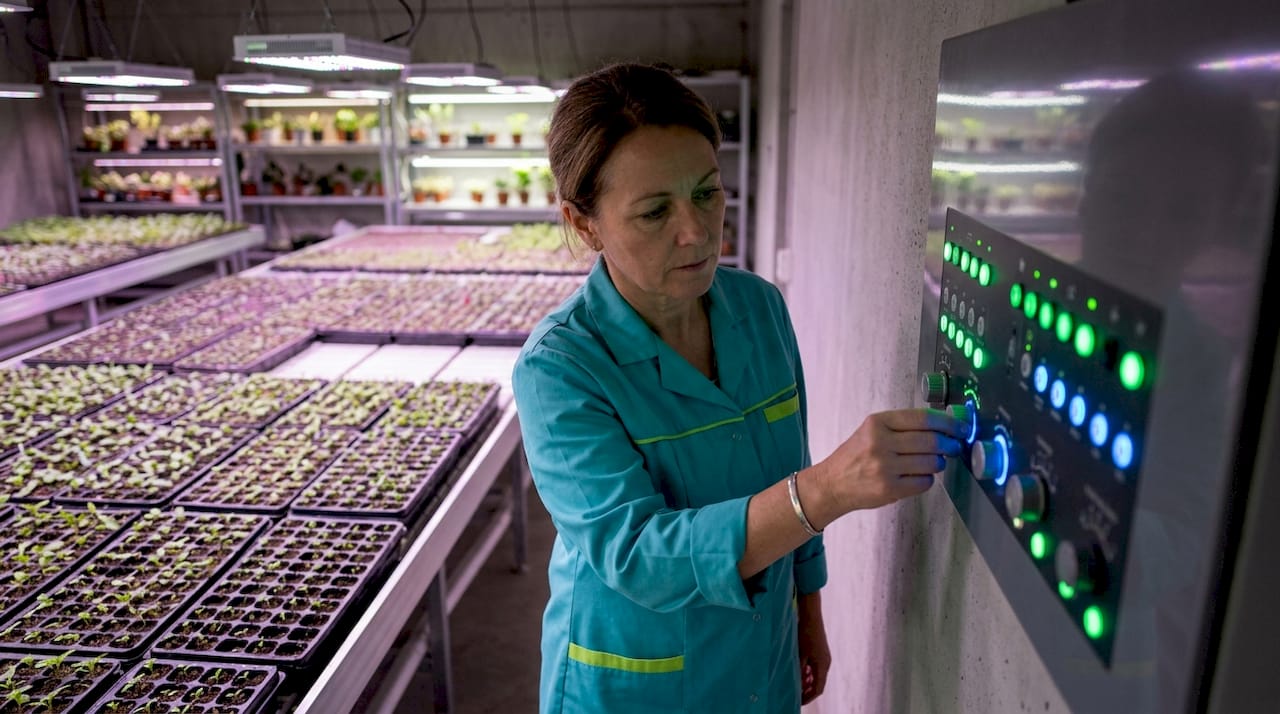
Uniform binning is a detail most growers overlook until they see the results. Binning refers to how LED chips are sorted by color temperature and brightness during manufacturing. Mismatched bins across a large installation create a patchwork of warm and cool zones that disrupts plant development and makes canopy readings unreliable. Consistent binning standards during manufacturing avoid mismatched color temperatures and brightness, preventing that patchwork appearance across large projects.
Key design elements to specify before purchasing fixtures for a scalable system:
Pro Tip: Request a photometric layout from your vendor before committing to a fixture count. A proper layout shows PPFD distribution across your canopy and identifies dark spots before installation, not after.
A phased rollout is the most reliable method for scaling commercial LED systems without disrupting active crops. The logic is straightforward: test one zone, verify the results, then expand. Testing a single zone before full-scale LED deployment ensures actual energy savings and occupant comfort before you commit capital to the rest of the facility. This approach also gives your team time to learn the control interface and identify any wiring or driver issues in a low-stakes environment.
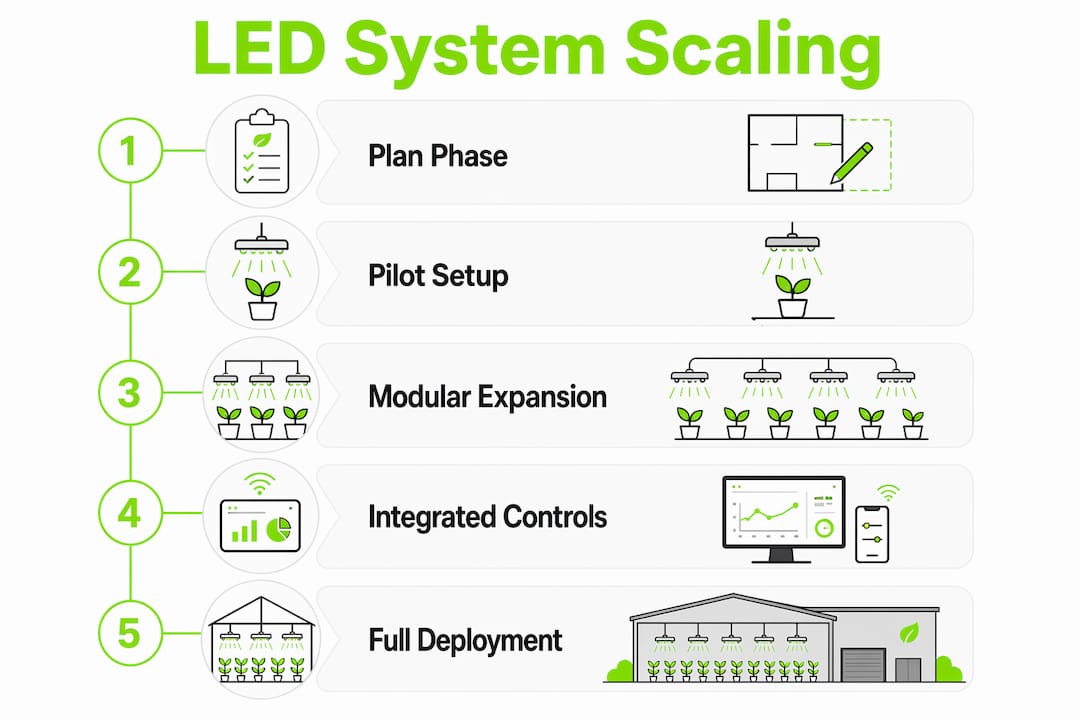
The financial case for phased expansion is strong. Most commercial LED projects reach payback in 2 to 4 years due to reduced wattage, maintenance costs, and utility rebates. A warehouse replacing 100 fixtures saves 45,500 kWh annually. That number scales linearly as you add zones, which means your ROI calculation becomes more predictable with each phase.
A practical step-by-step approach for growers expanding their LED footprint:
Pro Tip: Build a simple spreadsheet tracking kWh consumed per zone before and after each installation phase. This data becomes your rebate documentation and your internal justification for the next capital request.
For growers managing large-scale LED greenhouse upgrades, the phased approach also reduces the risk of cash flow strain by spreading capital expenditure across multiple budget cycles.
Voltage drop is the most common technical failure in large LED installations. When current travels long distances through undersized wire, resistance causes a voltage reduction at the far end of the run. The result is a visible brightness fade that creates uneven canopy coverage. Using 24V systems and multi-point power injection prevents voltage drop and maintains uniform brightness across long linear runs. Multi-point injection means connecting power at multiple points along a run rather than feeding from one end only.
Driver sizing is the second most common failure point. Undersized drivers cause flicker, overheating, and early failures, which is why a 20% safety margin in driver sizing is the standard recommendation. A driver running at 100% of its rated load has no thermal headroom. At 80% load, it runs cooler, lasts longer, and handles brief load spikes without failing.
| Technical challenge | Root cause | Solution |
|---|---|---|
| Brightness fade in long runs | Voltage drop from resistance | 24V systems with multi-point power injection |
| Flicker and overheating | Undersized or overloaded drivers | Size drivers to 80% of rated load maximum |
| Control incompatibility | Protocol mismatch between fixtures and controllers | Specify 0-10V or DALI at design phase, not after |
| Color temperature mismatch | Inconsistent LED binning across batches | Require bin code documentation from vendor |
| Inspection failures | Missing UL certification on fixtures or drivers | Specify UL-listed components in every purchase order |
Control protocol incompatibility is a problem that almost always traces back to a single mistake: specifying fixtures before specifying controls. Specifying lighting controls after fixtures instead of integrating them in the initial design causes compatibility issues and higher labor costs. The fix is simple. Define your control protocol in the design document before you request fixture quotes.
Vendor selection determines whether your second and third expansion phases go as smoothly as your first. The most important factor is not price. It is the vendor’s ability to supply identical fixtures across multiple orders separated by months or years. Successful scaling requires vendors with stable batch production to maintain optical consistency and allow expansion without visual or performance mismatches. A vendor who cannot guarantee batch consistency will create a patchwork facility that is expensive to correct.
Evaluate vendors against these criteria before signing a supply agreement:
The long-term cost of LED grow lighting is heavily influenced by vendor reliability. A fixture that costs 10% less but requires replacement at year three costs far more than a premium fixture that runs for ten years with consistent output. Growers who treat vendor selection as a procurement decision rather than a partnership decision consistently underestimate this risk.
Ledgrowlightsdepot maintains a 4.8 out of 5 customer satisfaction rating from more than 5,800 reviews, which reflects the kind of consistent product quality and support that large-scale growers need when expanding across multiple phases.
Commercial LED systems scale most reliably when modular design, integrated controls, and vendor batch consistency are built into the plan from the start, not added later.
| Point | Details |
|---|---|
| Modular design enables growth | Fixtures ranging from 10,000 to 120,000 lumens let you expand zones without replacing infrastructure. |
| Phase before you scale | Test one zone for a full crop cycle before committing capital to facility-wide installation. |
| Integrate controls early | Specify 0-10V or DALI dimming protocols before selecting fixtures to avoid costly retrofits. |
| Prevent voltage drop | Use 24V systems with multi-point power injection to maintain uniform brightness across long runs. |
| Vendor consistency is non-negotiable | Require bin code documentation and repeat-order guarantees before signing any supply agreement. |
The most expensive mistake I see commercial growers make is treating controls as an afterthought. They select fixtures, negotiate pricing, place the order, and then ask which dimming protocol the fixtures support. At that point, the answer determines whether your control system works or whether you spend two weeks and significant labor costs rewiring. Specifying controls first takes fifteen minutes. Fixing the problem after installation takes weeks.
The second pattern I notice is the temptation to skip the pilot phase when capital is available. A grower with budget for a full facility upgrade will often push to install everything at once to get it done. The problem is that a full-facility installation with an unverified design locks in any mistakes at full scale. One zone with a driver sizing error is a minor fix. Forty zones with the same error is a project.
Vendor relationships matter more than most growers realize until they try to expand. The growers who scale smoothly are the ones who treated their first order as the beginning of a supply partnership, not a one-time transaction. They asked for batch documentation upfront, confirmed repeat-order capacity, and built a relationship with a technical contact at the vendor. When phase two arrives, those growers place an order and move on. Everyone else spends weeks verifying that the new batch matches the old one.
Consistent lighting is also the single biggest controllable variable in yield uniformity. When your canopy receives the same PPFD at every point, your plants develop at the same rate, your harvest windows tighten, and your grading improves. Ledgrowlightsdepot’s proprietary proximity systems are specifically designed to address under-canopy light distribution, which is where most standard setups lose yield without realizing it.
— Scott
Commercial growers expanding their LED footprint need fixtures that deliver consistent output across every phase of growth, from propagation through peak flowering.
The Grower’s Choice ROI-E420 is built for exactly this kind of phased, modular expansion. It delivers high-output performance in a form factor that tiles cleanly across large canopies without creating hot spots or dark zones. For larger rooms, the ROI-E720 and ROI-E900 provide the output density that full-scale commercial operations require. Ledgrowlightsdepot’s team offers expert guidance on fixture layout, control integration, and phased rollout planning for growers ready to expand with confidence.
Commercial LED systems scale through modular fixture design that allows growers to add units zone by zone while maintaining consistent light output. Integrated controls like DALI or 0-10V dimming tie each zone into a unified management system as the facility grows.
Commercial LED retrofits achieve energy savings between 50% and 75% compared to legacy lighting systems. Most projects reach full payback within 2 to 4 years when utility rebates and reduced maintenance costs are factored in.
Voltage drop in long linear runs is the most common technical failure, causing visible brightness fade across the canopy. Using 24V systems with multi-point power injection eliminates this problem before it affects crop uniformity.
A vendor who cannot supply identical fixtures across multiple orders separated by months will create color temperature and brightness mismatches at scale. Requiring bin code documentation and confirmed repeat-order capacity before signing a supply agreement prevents this outcome.
The Section 179D federal tax deduction offers up to $5.81 per square foot for qualifying energy-efficient lighting projects. Utility rebate programs add further financial return, and most require pre-approval before installation begins.
0 of 3 items selected


Leave a comment